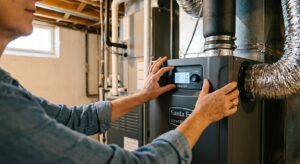
You set the thermostat to 72 degrees, the downstairs feels great, and then you walk upstairs and it feels like a different climate zone. Sound familiar? This is one of the most common comfort complaints homeowners bring to HVAC technicians every summer, and the frustrating part is that most people never get a satisfying answer. They are told to just run the AC harder, or worse, to buy a second system.
The real explanation involves physics, not equipment failure. Heat rises, attics can reach 140 to 160 degrees Fahrenheit on a hot summer day, and most homes have duct systems that were never designed to deliver enough airflow to the second floor. Add in sun-baked roofs, poor attic insulation, and air leaks around recessed lights and top-plate penetrations, and your second floor is fighting a battle your AC simply cannot win on its own.
This post breaks down exactly why your upstairs is hotter, which causes matter most for your specific home, and what you can do about it ranging from free adjustments you can make today to targeted upgrades with payback periods under three years. Most homeowners can close the temperature gap by 3 to 5 degrees with a combination of these approaches.
What You’ll Need
Click on an item below to shop for the recommended items for this recipe on Amazon.
As an Amazon Associate, we earn from qualifying purchases.
How to Do It
- Locate the supply air registers on your second floor and make sure none are blocked by furniture, curtains, or rugs. Even partial blockage reduces airflow significantly.
- Find the manual damper levers inside accessible first-floor supply registers (usually a small tab or dial near the register grille) and partially close 2 to 3 of the largest first-floor registers to redirect more airflow upstairs. Do this in 25% increments and check comfort after 24 hours.
- Set your thermostat fan to ON instead of AUTO during the hottest afternoon hours (2 to 6 PM). Continuous fan circulation moves air between floors and reduces hot spots, though it does increase fan energy use slightly.
- Close blinds and curtains on south and west-facing second-floor windows between noon and 5 PM. Interior shading is less effective than exterior shading, but it still reduces solar heat gain through glass by 20 to 30%.
- Check that your attic access hatch has weatherstripping around the perimeter and at least R-30 insulation on top of the door or panel. An uninsulated attic hatch is equivalent to leaving a small window open to a 150-degree space.
- On a cool morning, enter the attic with proper safety gear (N95 mask, safety glasses, long sleeves, work gloves). Walk the perimeter and look for gaps around recessed light cans, plumbing and electrical penetrations, and top plates where interior walls meet the attic floor. These are your biggest heat and air leak points.
- Use a can of fire-rated spray foam (for gaps up to 3 inches) or fire-rated acoustical sealant (for gaps near recessed lights) to seal every penetration you can find. A typical attic has 50 to 100 penetrations. Sealing them reduces both heat gain and the stack effect that pulls conditioned air into the attic. This step alone can improve second-floor temps by 1 to 2 degrees.
- Measure your existing insulation depth with a ruler. If you have less than 10 to 12 inches of fiberglass batts or less than 13 inches of blown cellulose, you are below R-38. Rent a blower machine from a home improvement store for free when you buy 10 or more bags of blown insulation, and top up to R-49 (about 16 to 18 inches of blown cellulose) for the best results in most climate zones.
- Install a radiant barrier on the underside of your roof rafters if you have an open attic (staple-up foil product, roughly $0.15 to $0.25 per square foot). This reflects up to 97% of radiant heat before it can heat the attic air, and it works especially well in humid climates where extra insulation alone does not drop attic temps enough.
- After completing insulation work, replace or add a programmable or smart thermostat if you do not have one. Program a 4-degree setback during the hottest afternoon hours (when family is away) and a pre-cool cycle that starts 30 minutes before everyone returns home. This uses the improved insulation to hold temperature longer and reduces peak demand on the AC.
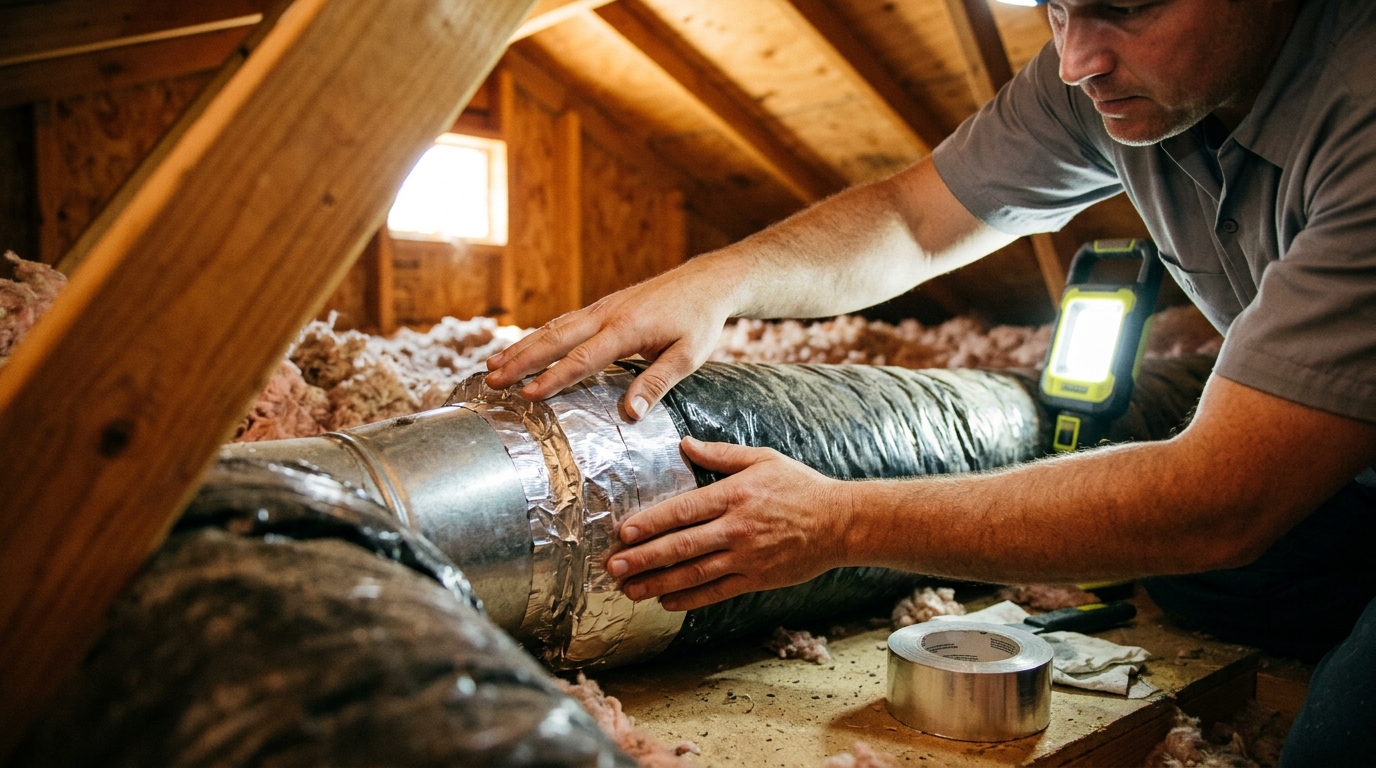
- Schedule a duct leakage test (blower door or duct pressurization test) with a certified HVAC technician or energy auditor. This test costs $150 to $300 and tells you exactly how leaky your duct system is and where the losses are concentrated. Homes over 15 to 20 years old routinely show 25 to 35% duct leakage.
- Ask the contractor about Aeroseal duct sealing, a process where a sealant mist is pumped through the duct system and seals leaks from the inside. Average cost is $1,500 to $2,500 for a whole house, but it can reduce duct leakage from 30% down to under 5% and commonly cuts cooling bills by $200 to $400 per year, giving a payback of 4 to 8 years.
- Request a Manual D airflow analysis of your duct system. This calculation determines whether your ducts are sized correctly to deliver enough cubic feet per minute of air to each second-floor room. If they are undersized, the contractor can add or enlarge supply runs or install a zoning damper system.
- Consider a whole-house zoning system if your budget allows. A two-zone system with a second thermostat for the upstairs costs $1,500 to $3,500 installed, but it allows the HVAC to deliver more cooling capacity to the upper floor independently during peak afternoon hours, virtually eliminating the floor-to-floor temperature gap.
Why It Works: The Benefits
Addressing attic insulation, duct balancing, and air sealing together can reduce the temperature difference between floors from a typical 5 to 8 degrees down to 1 to 3 degrees, making the whole house genuinely comfortable.
Reducing attic heat gain and fixing duct leaks together can cut summer cooling costs by 15 to 30% according to ENERGY STAR data, saving the average homeowner $150 to $400 per cooling season.
When the second floor stops acting as a heat sponge, your AC does not have to run as long or as hard to maintain setpoint. Shorter runtimes reduce wear on the compressor, potentially extending system life by several years.
Sleep researchers recommend bedroom temperatures between 65 and 68 degrees for optimal sleep. Reducing second-floor temps by even 4 degrees can move a stuffy bedroom from uncomfortable to sleep-friendly without running the system at extreme settings.
A 20% reduction in cooling energy for a typical 2,000 square foot home prevents roughly 500 to 800 pounds of CO2 emissions per summer, equivalent to planting about 10 trees annually.
💰 Savings Impact by Action
Upgrading attic insulation from R-19 to R-49 reduces ceiling heat transfer by up to 60%, cutting second-floor cooling load by 15 to 25%.
Sealing duct leaks from a typical 25% loss rate down to under 5% recovers 20% of conditioned air that was previously wasted into the attic.
Sealing attic floor penetrations reduces stack-effect air loss and prevents conditioned air from being pulled into the attic, saving up to 15% on cooling costs.
Installing a foil radiant barrier on attic rafters reflects up to 97% of radiant heat, reducing attic air temperature by 20 to 30 degrees and cutting cooling costs by 5 to 10% in sunny climates.
Redirecting airflow to underserved second-floor rooms by adjusting dampers improves distribution efficiency and can reduce runtime by 8% without any equipment changes.
🏠 Key Concepts Explained
The Science Behind It
The second floor temperature problem is fundamentally a battle between heat transfer mechanisms and your HVAC system’s ability to remove that heat. Heat moves in three ways: conduction (through solid materials like insulation and drywall), convection (through moving air), and radiation (through space, like the sun warming the earth). Your attic experiences all three simultaneously. The roof surface absorbs solar radiation, conducts heat into the structural framing and sheathing, and then radiates that heat downward into the attic air space and through your ceiling assembly into the living space below.
What makes the second floor uniquely vulnerable is the thermal mass difference between floors. The first floor is largely surrounded by conditioned space or a crawlspace that moderates temperature. The second floor ceiling is separated from a 150-degree environment by only a few inches of insulation and drywall. According to building science research, every R-value point of insulation reduces heat flow by approximately 5 to 7%, which is why jumping from R-19 to R-49 in the attic can reduce heat transfer through the ceiling assembly by 60% or more, dramatically cutting the heat load your second-floor rooms must overcome.
The duct problem compounds this because the laws of thermodynamics work against you here too. When 55-degree supply air from your evaporator coil travels through an uninsulated or under-insulated duct running through a 140-degree attic space, that air absorbs heat along the way. A duct with R-6 insulation (code minimum in many areas) running through a 140-degree attic space will raise the air temperature inside by 5 to 15 degrees before it even exits the register. This means instead of delivering 55-degree air, you may be delivering 65 to 70-degree air to the very rooms that need cooling the most, creating a self-reinforcing comfort problem that no thermostat setting can fully correct.
Frequently Asked Questions
▼ Why is my second floor still hot even though I just had a new AC installed?
A new air conditioner addresses equipment capacity but does not fix the underlying causes of second-floor heat gain, which are usually attic insulation, duct leakage, and airflow imbalance. In fact, a new high-efficiency system sometimes feels worse upstairs because it runs in shorter cycles and delivers less total airflow to the upper floor. Ask your HVAC contractor to do a Manual J load calculation and a duct leakage test before assuming the equipment is the problem.
▼ Would an attic fan fix the temperature difference between floors?
A powered attic ventilator can reduce attic air temperature by 20 to 30 degrees, which helps, but it is not a substitute for proper insulation and air sealing. If your attic insulation is below R-38, the attic fan reduces the heat source but the heat still conducts through the inadequate insulation layer. Fix insulation first, then consider an attic fan as a supplementary measure. Solar-powered attic fans are a popular option at $150 to $300 installed since they run for free.
▼ Can I just add a window AC unit to the hottest bedroom?
A window unit in the hottest room is an effective and inexpensive short-term fix, costing $150 to $350 for a unit sized for a bedroom. The tradeoff is that it adds to your total energy use rather than reducing it, and it does not address the underlying cause. If you are renting or cannot make structural changes, a window unit plus a ceiling fan is a practical combination that can make a stuffy upstairs bedroom genuinely comfortable for a low upfront cost.
▼ How do I know if my ducts are the problem versus my attic insulation?
Hold your hand in front of a second-floor supply register while the AC is running. The air should feel noticeably cool, around 55 to 60 degrees. If it feels only mildly cool or lukewarm (above 65 degrees), your ducts are picking up heat from the attic, pointing to a duct insulation or leakage problem. If the air feels properly cold but the room still heats up quickly after the system cycles off, radiant heat gain through the ceiling is the bigger issue, and insulation should be your priority.
▼ My house is a single story. Why does this post matter to me?
Even in single-story homes, rooms under the attic (like a master bedroom at the back of the house) experience the same physics as a second floor. The same fixes apply: attic air sealing, insulation upgrades, duct sealing, and register balancing. The advantage in a single-story home is that attic access is often easier and the duct runs are shorter, which can make DIY repairs more straightforward and less expensive.
Quick Tips
- Plant deciduous trees or install exterior awnings on south and west elevations to block summer sun before it ever hits the roof or windows. Mature trees can reduce cooling loads by up to 25% on sun-exposed walls.
- If you have a whole-house fan (not an attic fan), run it in the early morning hours (5 to 8 AM) to flush hot air from the upper floor and pull in cool outdoor air before the day heats up.
- Use ceiling fans in second-floor bedrooms set to spin counterclockwise (standard summer direction) at medium speed. Ceiling fans do not cool air but the wind chill effect allows you to raise the thermostat setpoint by 4 degrees without reducing comfort, saving roughly 8% on cooling costs.
- Check your attic ventilation ratio. You need approximately 1 square foot of net free ventilation area for every 150 square feet of attic floor space (or 1 to 300 with a vapor barrier). Inadequate ventilation traps hot air in the attic and raises the baseline temperature your insulation must overcome.
Variations for Your Situation
- Apartment or Condo: If you are on the top floor of a building and the attic or roof space is not your responsibility, focus on what you can control. Add thermal curtains to south and west windows ($30 to $80 per panel), place a portable evaporative cooler or portable AC unit in the hottest room, and use a ceiling fan to improve circulation. Ask your property manager or HOA about the attic insulation status, since many building owners will add insulation when presented with data showing it reduces HVAC wear and utility costs for common areas.
- Tight Budget (under $100): Start with the free damper adjustments and thermostat fan settings described in the quick fix approach. Then spend $20 to $30 on weatherstripping and foam tape to seal your attic hatch, and $40 to $60 on a programmable thermostat if you do not have one. These three steps together can deliver 2 to 4 degrees of improvement for under $100 total. Defer the insulation and duct work until you can budget $300 to $600 for materials.
- Older Home (pre-1980): Homes built before 1980 present two additional challenges. First, attic insulation is almost certainly below modern code, often R-11 or less, and may contain asbestos if it is vermiculite material. Have it tested before disturbing anything ($25 to $50 for a mail-in test kit). Second, duct systems in older homes are often made of flex duct that has degraded or disconnected at joints over decades, with leakage rates of 35 to 50%. An energy audit by a BPI-certified auditor ($300 to $500 but sometimes free through your utility company) will prioritize which fixes deliver the most impact for your specific home before you spend money on materials.