If your central air conditioner runs almost constantly during summer, your energy bills climb every July regardless of what you set the thermostat to, and some rooms never quite cool down, your house itself is likely the problem. Older homes, particularly those built before 1980, were constructed under different energy codes, with thinner insulation standards, single-pane windows, and virtually no attention to air sealing. The result is a structure that fights your cooling system every hour of the day.
The good news is that the inefficiency is not random. It comes from a handful of well-understood building science problems, each with proven fixes that deliver real, measurable savings. You do not need to gut your home or replace your HVAC system to see dramatic results. In most cases, the highest-impact improvements are things a motivated homeowner can tackle over a single weekend, with a payback period measured in months rather than years.
This post walks through exactly why older homes struggle to stay cool, which fixes deliver the biggest return, and how to prioritize your budget for maximum impact. Whether you have $0 or $2,000 to spend, there is a meaningful improvement you can make today.
What You’ll Need
Click on an item below to shop for the recommended items for this recipe on Amazon.
As an Amazon Associate, we earn from qualifying purchases.
How to Do It
- Set your thermostat to 78 degrees Fahrenheit when home and 85 degrees when away or sleeping. The DOE estimates this single change saves up to 10% on cooling costs compared to holding a constant 72 degrees all day.
- Walk through every room and feel along the base of exterior walls, around electrical outlets on exterior walls, and at the top and bottom of interior door frames for air movement. Mark leaky spots with painter’s tape so you can address them systematically.
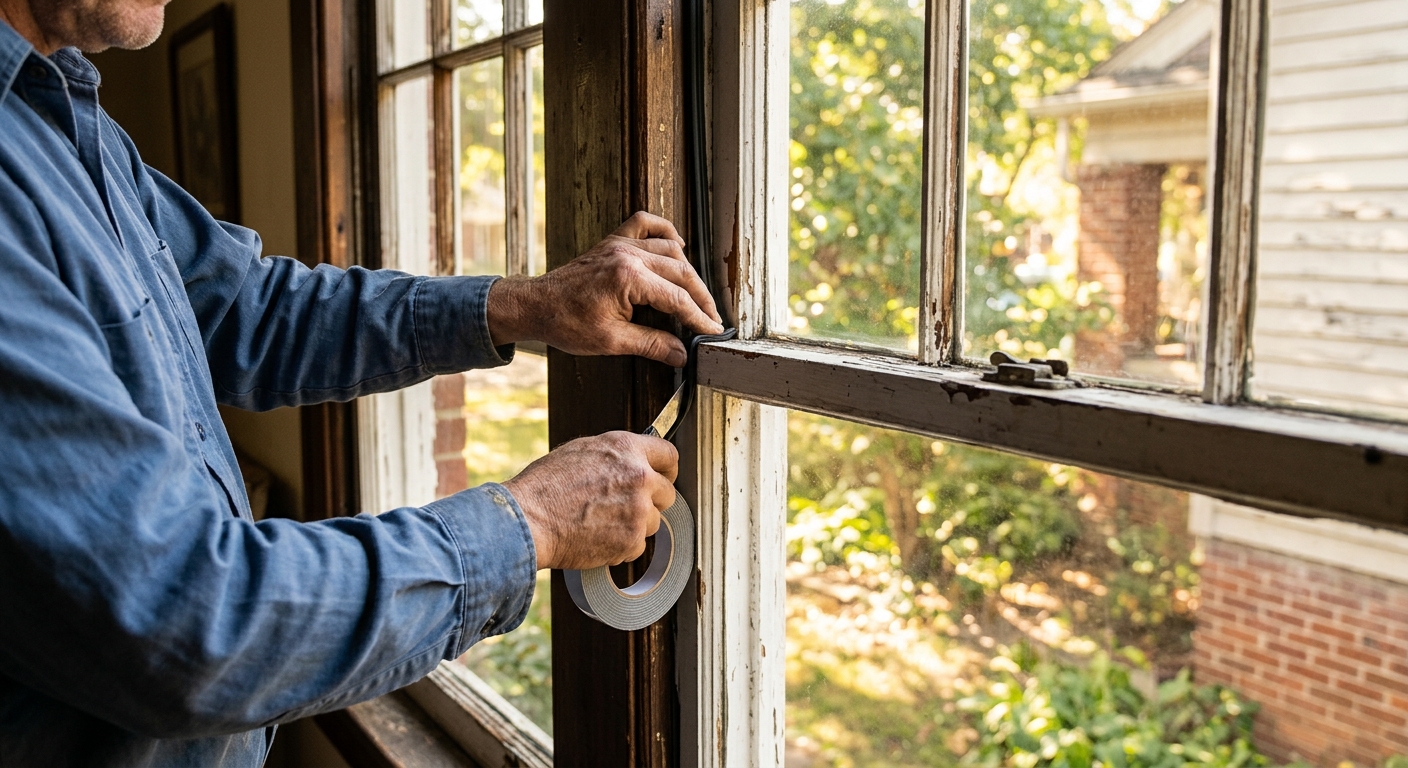
- Press adhesive foam weatherstripping into the gaps around every exterior door. A door with a 1/8-inch gap around its perimeter leaks as much air as a 2.4-square-inch hole. This typically costs $8 to $15 per door and takes 20 minutes.
- Close blinds and curtains on south and west-facing windows between 11 AM and 5 PM. Interior window coverings with a reflective backing can block 30 to 45% of solar heat gain with zero cost if you already own them.
- Switch ceiling fans to counterclockwise rotation at high speed. The wind-chill effect allows you to raise the thermostat setpoint by 4 degrees without reducing comfort, directly cutting compressor runtime.
- Check and replace your AC air filter if it has not been changed in more than 60 days. A clogged filter reduces airflow by 15 to 25%, making the system work harder and increasing electricity consumption.
- Purchase one to two cans of low-expansion spray foam and a caulk gun with paintable latex caulk. Go into the attic early in the morning before it heats up and seal every penetration where wires, pipes, or light fixtures pass through the top plates of interior walls. These bypasses are the single largest source of air leakage in most pre-1980 homes.
- Seal the attic hatch or pull-down stairs with weatherstripping and add a rigid foam insulation cover on top. Pull-down stair assemblies are notoriously leaky and uninsulated, often equivalent to leaving a window open.
- Use a caulk gun to seal along the interior base of exterior walls where the drywall meets the floor, behind baseboard trim where accessible. Also seal around all electrical outlets and switch plates on exterior walls using outlet gaskets, available for about $0.50 each.
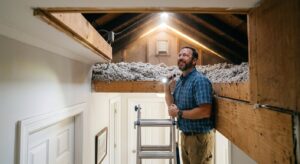
- If your attic insulation is less than 10 inches deep (roughly R-30 or less), rent a blower from a home improvement store and add blown-in fiberglass or cellulose insulation to bring it to 14 to 16 inches (R-38 to R-49). Many stores provide the blower for free when you purchase 10 or more bags of insulation.
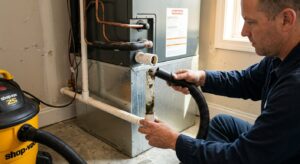
- Inspect accessible ductwork in the attic or crawlspace for disconnected joints or visible gaps. Seal any gaps with UL 181-rated foil tape (not standard duct tape, which fails within a year or two in heat) and wrap bare metal ducts with R-6 duct insulation wrap.
- After completing the sealing work, run your AC for two hours and walk through each room checking for previously warm spots. Compare your next utility bill against the same month in the prior year to quantify actual savings.
- Hire a certified BPI (Building Performance Institute) or RESNET energy auditor to perform a blower door test and thermographic scan. The test pressurizes your home to 50 Pascals and measures total air leakage, generating a specific list of problem areas rather than guesswork. Audits typically cost $200 to $500 and identify savings opportunities that far exceed that cost.
- Review the audit report and prioritize the recommendations by payback period. Air sealing almost always comes first with a payback under two years, followed by insulation, then window upgrades, and finally equipment replacement.
- Hire an insulation contractor to dense-pack wall cavities if your walls are uninsulated. Pre-1980 wood-frame walls are often completely empty. Dense-pack cellulose brings wall insulation to R-13 to R-15 and can reduce wall heat gain by 40 to 60%. Cost runs $1 to $2 per square foot of wall area.
- If your AC is older than 15 years and has a SEER rating below 13, get quotes for replacement. A new 18 SEER unit replacing an old 8 SEER system reduces cooling electricity use by 55%, and qualifies for a federal tax credit of up to $600 plus utility rebates.
- Ask the contractor to test duct leakage using a duct blaster test. If more than 15% of conditioned air is leaking into unconditioned spaces, professional duct sealing with Aeroseal or mastic compounds is worth the $700 to $1,500 cost and typically pays back in 2 to 3 years.
Why It Works: The Benefits
Combining air sealing and attic insulation upgrades typically cuts cooling energy use by 25 to 40%, translating to $50 to $150 per month in savings during peak cooling season depending on climate and home size.
Reducing envelope leakage and improving insulation eliminates the hot spots and dead zones that plague older homes. Rooms that previously ran 5 to 8 degrees warmer than the thermostat setting often come within 2 degrees after sealing and insulation work.
Every cubic foot of outdoor air that infiltrates brings humidity with it. Cutting air leakage by 30% can reduce indoor relative humidity by 5 to 10 percentage points, which makes 76 degrees feel like 72 degrees and reduces mold risk.
When the thermal envelope is tighter, the air conditioner runs fewer hours per day to maintain setpoint. Reducing daily runtime by 2 to 3 hours extends compressor and fan motor life significantly, often delaying a costly replacement by 3 to 5 years.
The federal Inflation Reduction Act provides a 30% tax credit (up to $1,200 per year) for qualifying insulation and air sealing projects in existing homes. Many utilities layer additional rebates of $100 to $500 on top of that, improving payback periods substantially.
💰 Savings Impact by Action
Sealing top-plate bypasses and penetrations in an older attic reduces total home air leakage by up to 20%, directly lowering the heat and humidity the AC must overcome.
Upgrading attic insulation from R-11 to R-38 cuts ceiling heat gain by 17 to 25%, reducing how hard the AC must work during peak afternoon hours.
Professional duct sealing in homes with leaky attic ductwork recovers 20 to 30% of cooling energy that was previously lost to unconditioned space.
Setting the thermostat to 78 degrees when home and 85 degrees when away saves approximately 10% annually compared to holding a constant 72 degrees.
Replacing a pre-2000 unit rated at 8 to 10 SEER with a modern 18 SEER system cuts cooling electricity consumption by 40 to 55% for the same amount of cooling delivered.
🏠 Key Concepts Explained
The Science Behind It
Heat always moves from warm to cool, never the other way around, and it does so through three mechanisms simultaneously: conduction (direct contact through solid materials), convection (movement of air carrying heat), and radiation (infrared energy traveling through space). An older home’s inefficiency is really a story about all three mechanisms operating largely unchecked. Thin attic insulation means heat conducts straight through the ceiling. Leaky walls and penetrations mean hot outdoor air convects freely into conditioned space. Single-pane windows and unshaded roofs absorb and re-radiate solar energy directly into the home.
The stack effect amplifies every other problem. Because warm air is less dense than cool air, it naturally rises and escapes through gaps at the top of a house, which draws replacement air in through gaps at the bottom. In a leaky older home, this creates a continuous chimney effect even on calm days. On a 95-degree day with a 75-degree interior, the pressure difference is enough to drive significant air exchange every hour. Air sealing disrupts this cycle by eliminating the entry and exit points the stack effect depends on.
Duct losses deserve special attention because they are invisible and frequently overlooked. When ducts carrying 55-degree supply air run through an attic at 130 degrees, the temperature difference of 75 degrees drives heat through the duct walls continuously. Even insulated ducts lose meaningful cooling capacity under those conditions. Every dollar spent cooling air that is then partially reheated before it reaches the living space is wasted. Bringing ducts into conditioned space, or at minimum sealing and insulating them to R-8, addresses this loss directly and is one of the fastest-payback professional upgrades available for older homes.
Frequently Asked Questions
▼ Why is my AC running all day even after I sealed and added insulation?
If runtime has not improved, the system may be undersized for the actual heat load, the refrigerant charge may be low (reducing cooling capacity by 20 to 30%), or there are still significant duct leaks losing conditioned air to the attic. Schedule an HVAC technician to check refrigerant charge and static pressure, and ask specifically about a duct leakage test.
▼ One room is always much hotter than the rest of the house. What causes that?
This almost always points to one or more of three causes: a disconnected or kinked supply duct starving that room of airflow, inadequate insulation on the exterior wall or ceiling of that specific room, or a west-facing window without shading. Inspect the duct serving that room first since it is the most common cause and easiest to fix.
▼ My house is from the 1940s. Is it even worth investing in efficiency upgrades or should I just replace the AC?
Envelope improvements almost always deliver better return than equipment replacement in older homes because a new AC installed in a leaky house still fights the same heat load. Seal and insulate first, then reassess whether the existing equipment can maintain comfort. Many 1940s homes have excellent bones and respond very well to air sealing investments.
▼ How do I know if my existing attic insulation is doing anything?
Stand in your attic on a hot afternoon and hold your hand six inches above the insulation surface. If you feel significant heat radiating upward, the insulation is either too thin or has settled and compressed over time. Less than 10 inches of depth in any area is a strong signal to add more. R-38 (about 12 to 14 inches of blown cellulose) is the current minimum DOE recommendation for most US climate zones.
▼ Can I do these upgrades myself if I have a flat or low-slope roof?
Flat and low-slope roofs typically do not have accessible attic space, which means insulation and air sealing must be addressed from the exterior (adding continuous rigid foam under a new roof membrane) or from the interior (spray foam applied to the underside of the roof deck). Both approaches require professional contractors and are best addressed during a planned roof replacement to control cost.
Quick Tips
- Thermal imaging smartphone attachments (around $150 to $250) let you scan walls, ceilings, and outlets to see heat infiltration in real time, making air leaks visible before you spend money on materials.
- Planting deciduous trees on the south and west sides of your home provides natural shade in summer while allowing winter sun through bare branches. Mature trees reduce cooling loads by up to 25% according to DOE research, though the payback timeline is measured in years.
- If you have a programmable or smart thermostat, use the pre-cooling feature to bring the house to 74 degrees before the peak heat of the day (usually 2 to 6 PM), then let it drift up to 78 degrees during peak hours. This shifts energy use to cheaper off-peak rates in time-of-use billing areas.
- Check that bathroom and kitchen exhaust fans vent to the exterior and not into the attic. Exhausting humid air into an attic is a moisture problem and also pulls conditioned air out of the home as replacement air infiltrates through cracks.
Variations for Your Situation
- Apartment or Renter: Renters in older buildings cannot modify insulation or ductwork, but can still make meaningful improvements. Focus on door and window weatherstripping (ask permission first, as most landlords welcome it), reflective window film on south and west windows ($20 to $50 per window), and programmable plug-in thermostat controllers for window AC units. Portable evaporative coolers work well in dry climates and add no cooling load to the building electrical system. Document before-and-after utility bills to negotiate future rent adjustments based on demonstrated efficiency improvements.
- Tight Budget (Under $50): Prioritize in this order: replace the AC filter ($8 to $15), install foam outlet gaskets on exterior wall outlets ($6 for a 12-pack), apply adhesive weatherstripping to exterior door gaps ($10 to $15 per door), and close south and west window coverings during peak sun hours at zero cost. Together these steps cost under $40 and can reduce cooling bills by 8 to 15% with no tools required and no landlord permission needed.
- Older Home Pre-1960 with No Ductwork: Homes of this era often rely on window AC units or have had a ductless mini-split retrofit. The efficiency strategy shifts significantly. Focus heavily on air sealing the attic plane and basement or crawlspace rim joists, where the biggest leakage occurs in older balloon-frame construction. Consider a ductless mini-split system if window units are your primary cooling, as modern mini-splits at 20 to 25 SEER use 40 to 60% less electricity than a window unit from the same era.