If your home feels drafty in winter, stuffy in summer, or your energy bills never seem to come down no matter what you do, air leaks are likely the culprit. The average American home loses 25 to 40% of its heating and cooling energy through gaps, cracks, and penetrations in the building envelope. That is not a rounding error. For a household spending $2,000 per year on energy, that is $500 to $800 walking out through your walls, attic hatch, and electrical outlets every single year.
The good news is that air sealing is one of the highest-return improvements you can make to a home, and most of the worst leaks are accessible with basic tools and a few tubes of caulk or cans of spray foam. Unlike replacing windows or upgrading your HVAC system, sealing air leaks costs very little and starts paying back immediately on your next bill. The Department of Energy estimates that thorough air sealing can reduce energy costs by 10 to 20% annually, with payback periods of one to three years on the materials alone.
In this guide, we walk you through exactly how to find the leaks in your home using two proven detection methods, then tackle them with a clear priority list so you spend your afternoon on the fixes that deliver the biggest savings first. Whether you are doing a quick sweep with zero tools or gearing up for a full DIY sealing session, there is a practical approach here for every homeowner.
What You’ll Need
Click on an item below to shop for the recommended items for this recipe on Amazon.
As an Amazon Associate, we earn from qualifying purchases.
How to Do It
- On a cold or windy day, hold the back of your hand near window frames, door frames, electrical outlets on exterior walls, and the base of exterior walls. Any detectable cool air movement identifies a priority leak location.
- Check every exterior door for daylight visible around the frame and a firm seal when closed. Replace worn door weatherstripping on any door where you can feel airflow or see light. Self-adhesive foam or V-strip weatherstripping costs $5 to $15 per door and installs in under 20 minutes.
- Install foam gaskets behind all electrical outlet and switch plate covers on exterior walls. These $3 to $5 packs of pre-cut foam inserts are the fastest air sealing upgrade available and take about 30 seconds per outlet.
- Check your attic hatch or pull-down stairs. These are notoriously leaky and in the worst possible location for stack effect losses. Press your hand around the frame. If you feel warmth in winter or cool air in summer, add adhesive foam weatherstripping around the perimeter of the hatch frame.
- Look for any visible gaps where pipes or wires enter through exterior walls under sinks, behind appliances, or in utility rooms. Stuff larger gaps with fire-rated foam backer rod and seal with caulk, or use expanding spray foam on gaps smaller than 3 inches.
- Start in the attic. Move aside insulation to expose the top plates of interior walls and look for gaps around every pipe, wire, duct, and electrical box penetrating the ceiling drywall below. Use canned expanding foam for gaps under 3 inches and fire-rated caulk or sheet metal plus foam for larger openings. This single zone often accounts for 30 to 40% of a home’s total air leakage.
- Seal around all duct penetrations in the attic floor using mastic sealant or foil-faced tape rated for HVAC use, not standard duct tape. Leaky duct connections at the air handler and main trunks can waste 20 to 30% of conditioned airflow before it ever reaches your living space.
- Move to the basement or crawlspace. Seal all rim joist cavities (the framing where your floor meets the foundation wall) with cut-to-fit rigid foam board glued and foamed in place. Rim joists are among the leakiest spots in most homes and are quick to address with 2-inch rigid foam and spray foam around the edges.
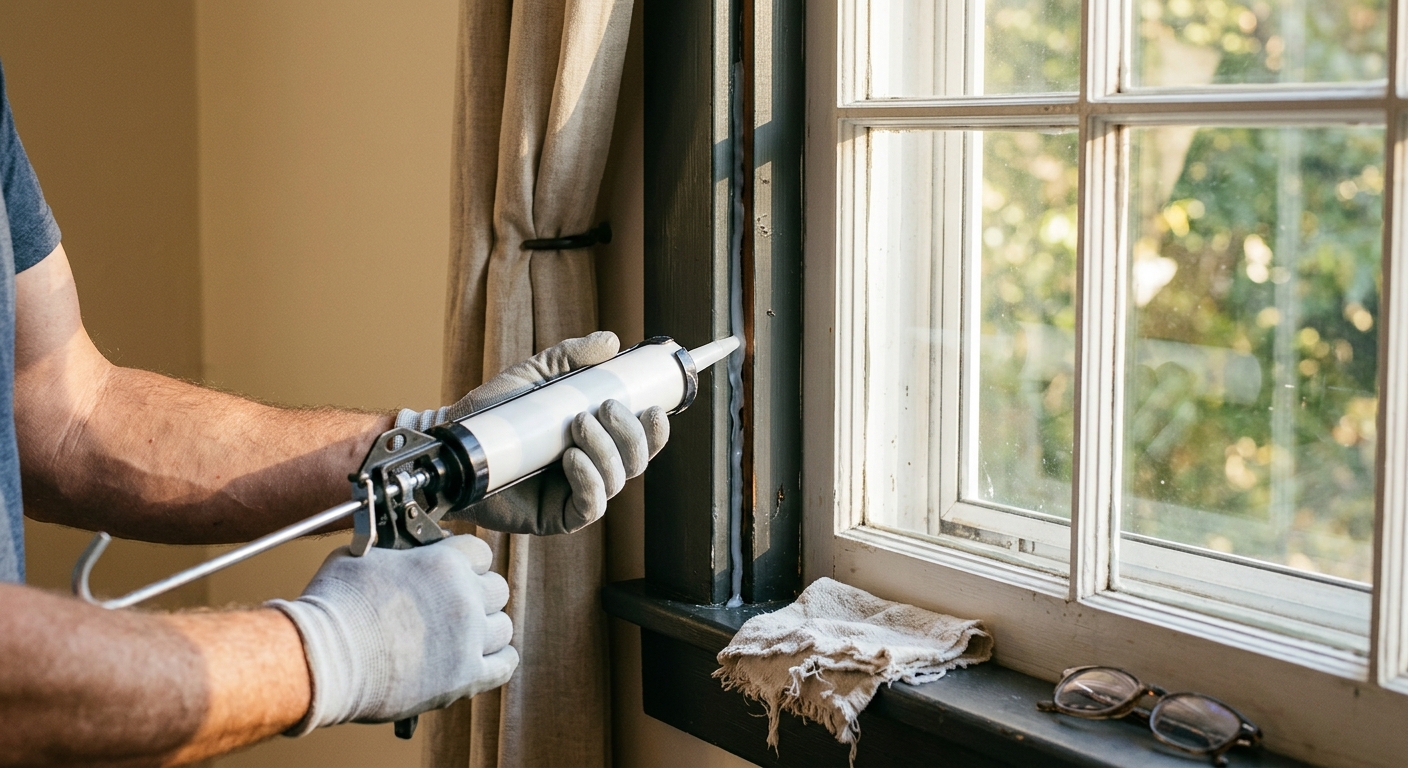
- Caulk all window and door frames from inside where the frame meets drywall and from outside where frame meets siding. Use paintable latex caulk indoors and a siliconized exterior caulk outdoors rated for your climate.
- Seal around all plumbing penetrations under every sink and behind every toilet and washing machine. Use fire-rated expanding foam for pipes passing through interior walls to other floors as well.
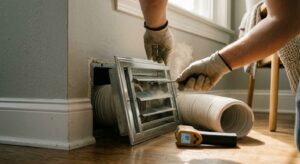
- After completing all sealing work, do a final hand-check on a windy day or use a stick of incense to test for residual airflow in all the locations you addressed plus any you may have missed. Smoke moving horizontally indicates air movement. Mark any remaining gaps and seal within the same session.
- Schedule a home energy audit with a BPI-certified energy auditor or your utility company. Many utilities offer subsidized or free audits. The auditor installs a calibrated fan in an exterior door (the blower door) to depressurize your home and measure total leakage in CFM50 (cubic feet per minute at 50 pascals of pressure).
- During the depressurization test, use the auditor’s thermal camera or smoke pencil to locate every significant leak in real time. This process identifies leaks that are impossible to find by visual inspection alone, including leaks inside wall cavities and behind finished surfaces.
- Review the auditor’s prioritized report and ask specifically about payback period for each recommended measure. Focus your investment on measures with payback periods under 5 years, which typically include attic air sealing, rim joists, and duct sealing.
- If proceeding with professional sealing, the contractor will use a combination of two-part spray foam, fire-rated caulk, and rigid foam board to seal all identified locations while the blower door runs continuously, confirming improvement in real time.
- Request a post-sealing blower door test to document the final ACH number and confirmed leakage reduction. This number is required for some utility rebates and is good documentation if you sell the home. Typical professionally sealed homes achieve 20 to 40% reduction in measured air leakage.
Why It Works: The Benefits
The DOE and ENERGY STAR estimate that air sealing combined with insulation improvements saves the average homeowner 10 to 20% annually on heating and cooling. On a $2,000 energy bill, that is $200 to $400 back in your pocket every year from a one-time afternoon of work.
Eliminating drafts and cold infiltration air reduces the temperature swings between rooms and floors that make certain areas uncomfortable regardless of thermostat setting. Homeowners who air seal consistently report that rooms that were always too cold or too hot stabilize within days.
When conditioned air stays inside longer, your heating and cooling system runs fewer cycles to maintain set temperature. Shorter runtimes reduce wear on the compressor and heat exchanger, potentially extending HVAC lifespan by several years and reducing maintenance costs.
Uncontrolled air infiltration brings in outdoor pollutants, pollen, dust, and humidity through dirty, unfiltered gaps in your building envelope. Sealing leaks means the air entering your home is more likely to come through your HVAC filter rather than through cracks in your foundation or attic.
Sealing air leaks reduces the risk of humid air condensing inside wall cavities and attic spaces, where it can cause mold growth and wood rot over time. This protective benefit can save thousands in structural repairs compared to the $20 to $100 cost of caulk and foam.
💰 Savings Impact by Action
Sealing penetrations at the attic floor eliminates stack-effect-driven leakage that typically accounts for 30 to 40% of a home’s total air loss, translating to up to 15% in annual energy savings.
Insulating and air sealing rim joists with rigid foam reduces basement-level infiltration and can cut heating costs in that zone by up to 8% annually.
Sealing leaky duct connections with mastic or foil tape can recover 20 to 30% of conditioned airflow that is currently lost before it reaches living areas.
Replacing weatherstripping and caulking window and door frames reduces visible drafts and contributes 5% or more in savings, particularly in older homes with original frames.
Installing foam gaskets behind outlet and switch plates on exterior walls is a small but immediate fix that reduces infiltration through one of the most overlooked penetration types in residential construction.
🏠 Key Concepts Explained
The Science Behind It
Air leakage is driven by pressure differences between the inside and outside of your home. Two forces create those pressure differences constantly: the stack effect and wind. The stack effect works like a chimney year-round. Warm air is less dense and rises, so in winter your home’s warm interior air pushes outward through every gap near the ceiling and at the top of walls, while cold outdoor air is simultaneously pulled in through gaps at the bottom. In summer the direction can partially reverse depending on outdoor conditions, but the effect persists. This pressure-driven engine means air is moving through your gaps 24 hours a day, every day, regardless of whether you can feel a draft.
What makes this more than just a comfort problem is the thermodynamics of infiltration. Every cubic foot of cold outside air that enters your home in winter must be heated from outdoor temperature to your set point. If it is 20 degrees Fahrenheit outside and you keep your home at 70 degrees, your heating system has to add 50 degrees of heat energy to every cubic foot of infiltration air. In a leaky home exchanging air once per hour, that represents an enormous and continuous heat load on your HVAC system. The same logic applies in reverse during summer cooling. Air sealing directly reduces the volume of air your system must condition, which translates proportionally into energy savings.
There is also a compounding effect worth understanding. Insulation is rated for its resistance to conductive heat transfer, but that rating assumes still air. When air moves through or adjacent to insulation, it bypasses the insulation entirely via convection, and the effective R-value of your insulation drops substantially. A well-sealed attic with R-38 insulation performs dramatically better than a leaky attic with R-49 insulation. This is why energy scientists consistently say air sealing first, then insulate. The seal is what allows insulation to perform at its rated value rather than a fraction of it.
Frequently Asked Questions
▼ I sealed a bunch of gaps but my energy bill is barely different. What did I miss?
The most impactful leaks are almost always in the attic and basement, not near windows and doors where most homeowners focus. If you did not address the attic floor penetrations and rim joists, you likely missed 60 to 70% of your home’s total leakage. Go back to those two zones first. If you have done both and still see minimal savings, consider scheduling a blower door test to identify leaks behind finished surfaces that are not visible.
▼ Can renters seal air leaks without landlord permission?
Most renter-safe sealing options require no permanent modification. Outlet foam gaskets, door draft stoppers, and removable weatherstripping on windows are all reversible and typically do not require permission. Avoid spray foam or permanent caulk on any surface you do not own. If you find significant leaks, document them with photos and request repairs from your landlord in writing since drafts and air leaks can indicate habitability issues depending on your state’s tenant code.
▼ How long before I actually see savings on my bill?
You should see the first measurable difference on your bill within 30 to 60 days if you seal during the heating or cooling season. Because utility bills vary month to month, compare your bill to the same month the prior year rather than the prior month for a more accurate read. Most homeowners who complete attic and basement sealing report clearly visible bill reductions by the second billing cycle.
▼ My home is older than 40 years. Is it worth sealing or does it need something bigger?
Older homes typically have 2 to 4 times the air leakage of newer construction, which actually means air sealing delivers proportionally larger savings since you are starting from a higher baseline. The approach is the same but expect to use more materials and find more gaps than a newer home. One important caveat: older atmospherically-vented combustion appliances need adequate combustion air supply. Consult an HVAC tech before doing aggressive sealing in a home with a pre-1990 furnace or water heater.
▼ Is spray foam safe to use indoors? I have heard it off-gasses.
Canned one-component spray foam (like Great Stuff) is safe for indoor use once cured, which takes 8 to 24 hours depending on humidity. During application and curing, ventilate the space well and avoid prolonged inhalation. Wear gloves since cured foam is nearly impossible to remove from skin. Two-component professional spray foam applied by contractors has a longer off-gassing period and requires occupants to vacate for at least 24 to 72 hours, but this is not typically used in DIY sealing.
Quick Tips
- Work from top to bottom in your home. Attic and upper floor penetrations drive the most stack-effect leakage and deliver the highest return per hour of sealing work.
- Do your detection walk-through on a day when wind speed is at least 10 mph or when the temperature difference between inside and outside is at least 15 degrees. Pressure differences are too small to feel otherwise.
- Use the right product for the right gap. Caulk is for narrow cracks under a quarter inch. Backer rod plus caulk handles gaps up to an inch. Spray foam handles gaps from one inch up to about 3 inches. Anything larger needs rigid foam board, metal flashing, or framing before you foam and caulk over it.
- Photograph every gap before you seal it and label the photo with location. This documentation helps if you ever want to get a rebate, sell the home, or if a contractor needs to understand what work was already done.
Variations for Your Situation
- Apartment or Rental: Renters cannot modify shared walls or HVAC systems but can still address window gaps with rope caulk (a removable, non-damaging product sold in hardware stores for $4 to $8), add foam outlet gaskets, use door draft stoppers, and place thermal curtains over windows. These combined measures can reduce drafts noticeably and cost under $50 total with zero permanent changes.
- Tight Budget Under $50: Prioritize outlet foam gaskets ($3 to $5 per pack), one tube of exterior caulk for the worst window and door frame gaps ($6 to $8), and self-adhesive door weatherstripping for the leakiest exterior door ($8 to $15). These three purchases address the most common and accessible leaks and can be completed in under two hours. Skip spray foam and attic work until you have the budget to do it properly and safely.
- Older Home Pre-1980: Expect higher baseline leakage and prioritize getting a utility-sponsored energy audit first since many utilities offer them free or subsidized for older homes. Focus on rim joists as a first DIY project since pre-1980 homes almost universally have completely open rim joists that are among the fastest wins available. Budget for two to three times more caulk and foam than a newer home, and have your heating system inspected before significant air sealing to confirm it does not rely on infiltration air for combustion.