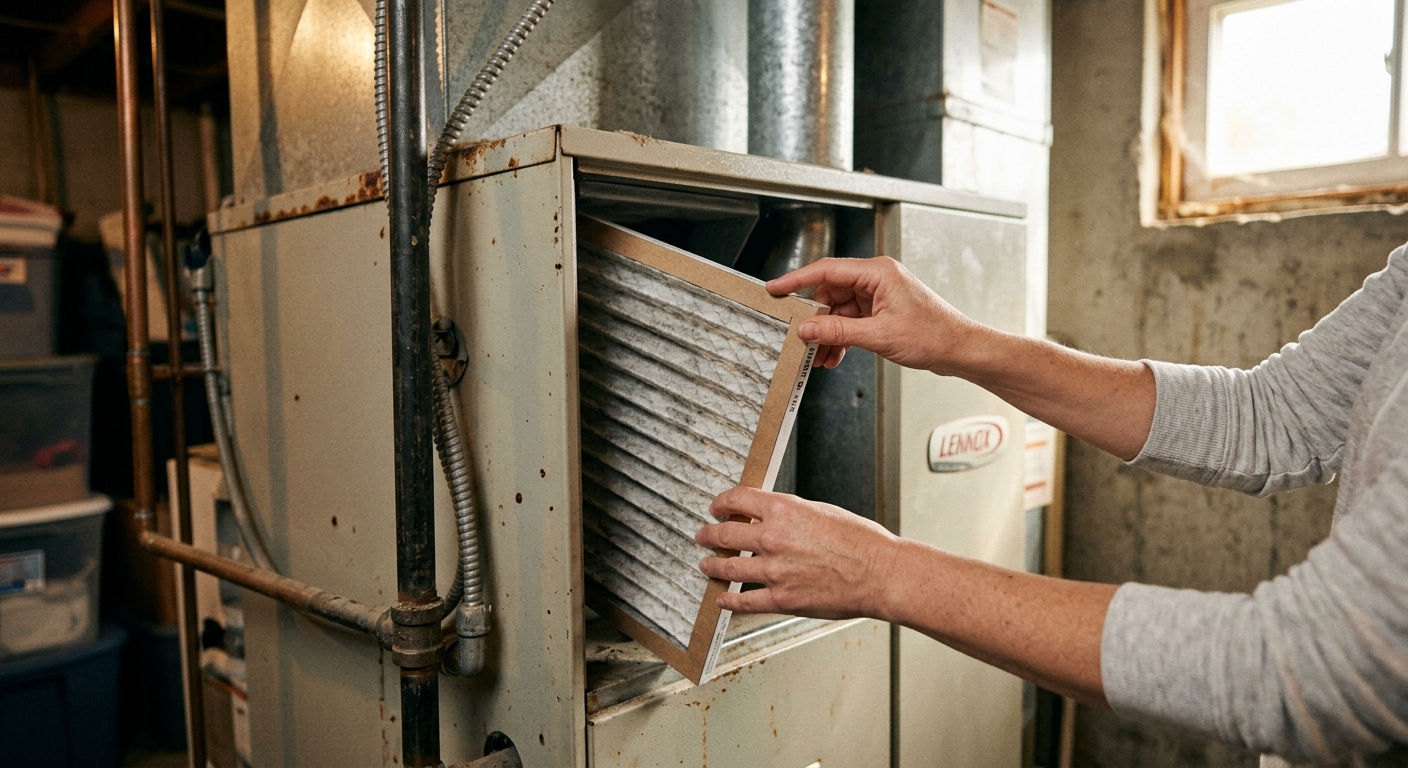
Your furnace filter has one job: keep dust, debris, and airborne particles from clogging your HVAC system’s blower, heat exchanger, and evaporator coil. When it gets clogged, airflow drops, your system works harder, runs longer, and wears out faster. The Department of Energy estimates that a dirty filter alone can increase heating and cooling energy use by 5 to 15%, and restricted airflow is a leading cause of blower motor burnout, a repair that typically costs $400 to $1,500 depending on the system.
The frustrating part is that this is almost entirely preventable. A replacement filter costs $5 to $30, takes five minutes to swap out, and can extend your system’s lifespan by years. Most homeowners either forget to check their filter, buy the wrong type, or install it backwards without realizing it. All three mistakes are surprisingly common, and all three carry real consequences for your comfort and your wallet.
This guide walks you through a proper furnace filter inspection, how to choose the right replacement, how to install it correctly, and how to set up a reminder system so you never let it slip again. Whether you are a first-time homeowner or have been maintaining your own HVAC system for years, there is something here that will save you money.
What You’ll Need
Click on an item below to shop for the recommended items for this recipe on Amazon.
As an Amazon Associate, we earn from qualifying purchases.
How to Do It
- Turn off your thermostat or set it to OFF before opening the filter compartment. This prevents the blower from pulling unfiltered air through the system while the filter is out.
- Locate the filter slot, which is typically at the return air duct where it enters the furnace, or inside the air handler cabinet. Common locations are in a wall or ceiling return grate, or directly on the furnace itself.
- Slide out the existing filter and hold it up to a light source. A lightly used filter looks gray with visible dust. A filter that needs replacing will be visibly dark gray or brown, and light will barely pass through it. If you cannot see light through the filter, replace it immediately.
- Check the filter frame for a printed airflow arrow. Install the new filter with that arrow pointing toward the furnace or air handler, not toward the return duct. Installing a filter backwards is a very common mistake that reduces its effectiveness and can damage the system.
- Write the installation date on the filter frame with a marker so you know exactly when it was changed. Set a recurring phone reminder for 30 days out to do a visual check, even if the filter does not need replacing yet.
- Restore power and set your thermostat back to your normal schedule. Listen for the first few minutes of operation to confirm the blower sounds smooth and normal without any new rattling or whistling.
- Before buying filters, look up your furnace model number (found on a sticker inside the cabinet door or on the side of the unit) and check the manufacturer’s recommended MERV rating range. Most residential furnaces work best with MERV 8 to 11. Going higher without confirming compatibility with your system can restrict airflow and cause the problems you are trying to prevent.
- Measure your existing filter carefully. Filter sizes printed on the frame are nominal and often differ by up to half an inch from true dimensions. Write down the exact measured size before purchasing replacements.
- Buy a 6-pack or annual supply of the correct filter in one purchase. Buying in bulk typically saves 20 to 30% per filter compared to single purchases, and having filters on hand eliminates the most common reason people delay changes: not having a replacement ready.
- Inspect the return air duct and filter housing for visible gaps, disconnected sections, or missing seals around the filter slot. Gaps here allow unfiltered air to bypass the filter entirely and go straight to the blower. Seal any gaps with HVAC foil tape, which costs about $8 at a hardware store.
- Store your filter supply near the furnace in a labeled bag or on a nearby shelf. Tape a simple maintenance log card to the inside of the furnace access panel door listing the filter size, MERV rating, and a column to record each change date.
- Set up a recurring calendar reminder every 30 days to do a 60-second visual check. Filters in homes with pets or recent renovation work may need monthly replacement. Homes with no pets and low dust may stretch to every 60 to 90 days. Visual inspection tells you the truth regardless of the calendar.
- Schedule a furnace tune-up with a licensed HVAC technician before heating season, typically September or October. Many utility companies offer rebates of $25 to $50 for documented preventive maintenance visits, which can offset most of the cost.
- Ask the technician to measure system static pressure with a manometer and confirm your current filter type is appropriate for your specific blower and ductwork. This rules out a filter that is too restrictive for your system even when clean.
- Have the technician inspect and clean the blower wheel, check the heat exchanger for cracks, measure combustion efficiency, and verify that the flue and venting are clear. These checks catch problems that filter maintenance alone cannot prevent.
- Request a written summary of any findings, recommended filter specs, and the measured airflow or static pressure readings. Keep this in your home maintenance file as a baseline for future comparison.
- Ask about a maintenance agreement if your system is more than 10 years old. Annual agreements typically cost $150 to $200 and include priority service, discounted parts, and two filter changes per year, which often makes them cost-neutral while ensuring the work actually gets done.
Why It Works: The Benefits
Maintaining a clean filter keeps airflow at design levels, which the DOE links to a 5 to 15% reduction in heating and cooling energy use. On a $1,800 annual HVAC energy bill, that is $90 to $270 back in your pocket each year.
Blower motor failures, frozen evaporator coils, and cracked heat exchangers are among the most common HVAC repairs, and restricted airflow contributes to all three. Blower motor replacements average $400 to $1,500, while a cracked heat exchanger can mean a full furnace replacement costing $2,500 to $6,000.
A functioning filter captures dust, pollen, mold spores, and pet dander before they recirculate through your home. Homes with properly maintained filters show measurably lower airborne particulate counts, which matters especially for anyone with asthma or allergies.
The average gas furnace lasts 15 to 20 years with proper maintenance. Chronic airflow restriction from dirty filters shortens that lifespan by creating repeated thermal stress and blower strain. Regular filter changes are one of the highest-return maintenance tasks available.
A restricted filter reduces the volume of conditioned air reaching your rooms, which can cause cold spots, uneven heating, and rooms that never quite reach the set temperature. Restoring proper airflow often fixes comfort complaints that homeowners mistakenly attribute to an undersized furnace.
💰 Savings Impact by Action
Replacing a clogged filter restores design airflow and reduces HVAC energy consumption by 5 to 15% according to DOE data.
Preventing evaporator coil fouling maintains full heat transfer capacity, which can otherwise drop by up to 20% on a heavily soiled coil.
Regular filter maintenance reduces the likelihood of blower motor and heat exchanger failures, which account for roughly 30% of all residential HVAC repair calls.
Consistent filter changes reduce cumulative thermal and mechanical stress, potentially extending furnace lifespan by 25% or more compared to chronic neglect.
🏠 Key Concepts Explained
The Science Behind It
Your HVAC system moves air by creating a pressure difference: the blower pulls air in through the return side and pushes it out through the supply ducts. The filter sits on the return side and is designed with a known flow resistance so the blower can do its job without working too hard. When a filter loads up with particles, its flow resistance increases, and the blower has to work against higher static pressure to pull the same volume of air through. This is called elevated static pressure, and it forces the blower motor to draw more electrical current, increasing energy consumption and generating excess heat in the motor windings.
The heat exchanger problem is less obvious but potentially more serious. In a gas furnace, combustion gases heat the metal walls of the heat exchanger, and the airflow from the blower picks up that heat and carries it into your home. When airflow drops due to filter restriction, the heat exchanger walls get hotter than they were designed for because less cool air is passing over them. Repeated thermal cycling above design temperatures causes metal fatigue over time, and eventually, microscopic cracks can form. A cracked heat exchanger allows combustion byproducts, including carbon monoxide, to enter the air stream. This is rare with newer systems but is a documented failure mode in older furnaces with long histories of poor filter maintenance.
On the cooling side, a dirty filter causes a different but equally damaging problem. The evaporator coil, which is the cold coil inside your air handler that removes heat from your home’s air, requires a minimum airflow to stay above freezing. When the filter reduces airflow below that threshold, the coil surface temperature drops below 32 degrees Fahrenheit and moisture in the air freezes on the coil. A frozen coil cannot absorb heat at all, so the system runs continuously without cooling your home, and when it thaws, the resulting water can overflow the condensate pan and cause water damage. The fix is almost always a clean filter, but the flooding and the service call are easily avoided by staying on top of filter maintenance.
Frequently Asked Questions
▼ I just changed my filter but my furnace is still short cycling or shutting off early. What is wrong?
A fresh filter fixes airflow restriction going forward, but if the system was running with a dirty filter for a long time, the heat exchanger may have overheated and triggered a high-limit safety switch that needs to reset, or the blower motor itself may have sustained damage. Check that the new filter is installed in the correct direction with the arrow pointing toward the furnace. If the problem persists after one full heating cycle, call an HVAC technician to check the high-limit switch and blower motor.
▼ How do I know what MERV rating to buy? The store has dozens of options.
Look up your furnace model number on the manufacturer’s website or call their support line and ask for the recommended filter MERV range. Most residential gas furnaces and heat pumps are designed for MERV 8 to 11. If you cannot find specific guidance, MERV 8 is a safe default for most systems and still captures the majority of common household particles. Avoid anything above MERV 12 unless your system was specifically designed for it.
▼ My filter is only two weeks old and it already looks dirty. Is something wrong with my system?
Fast filter loading usually points to one of a few causes: a recent renovation that stirred up drywall dust or debris, a gap in the ductwork or filter housing that is pulling in unconditioned air from a dirty space like an attic or crawlspace, or an unusually dusty environment like a home with multiple pets or near a construction site. Inspect the filter housing for gaps and seal them with HVAC foil tape. If loading stays unusually rapid after sealing, have a technician check for duct leaks on the return side.
▼ Can I wash and reuse a disposable filter to save money?
No. Disposable pleated filters are made from materials that lose their structural integrity and filtration efficiency when wet. Washing a disposable filter collapses the pleats, reduces surface area, and can introduce moisture that encourages mold growth inside the air handler. Reusable electrostatic filters do exist and are designed to be washed, but they must be completely dry before reinstallation and typically cost $25 to $60 upfront. Do not wash a standard disposable filter.
▼ My house has multiple HVAC systems. Do they all need separate filter checks?
Yes. Each air handler or furnace has its own filter, and they can load at different rates depending on where they are located and what zones they serve. A basement unit may stay cleaner longer than a main-floor unit that serves a kitchen and living area with higher traffic. Check each filter independently on the same monthly schedule and track them separately.
Quick Tips
- Set a recurring reminder in your phone for the first of every month to do a 60-second visual filter check. You do not have to replace it every month, just look at it.
- If you have a dog or cat, assume you need to check your filter every 30 days and replace it every 45 to 60 days. Pet dander loads filters dramatically faster than household dust alone.
- Buy your filters in multipacks from a wholesale retailer or online. A 6-pack of MERV 8 filters typically costs $18 to $24, compared to $8 to $12 per filter bought individually at a hardware store.
- If you have multiple return air vents with their own filters, label each one with its location using a permanent marker on the frame so you can track them independently and never accidentally reuse an old one.
Variations for Your Situation
- Apartment or Rental: Renters are typically responsible for filter changes in their own unit, and most leases explicitly require it. Check your lease to confirm, but in most cases you can and should replace the filter without asking permission. Standard 1-inch disposable filters cost $5 to $15 and are a renter-safe maintenance task. Document each change with a dated photo sent to yourself in case there is ever a dispute about HVAC care. If your unit has a wall-mounted return grate with a filter behind it, the same rules apply.
- Tight Budget Under $25: The single highest-return action is a basic MERV 8 filter at $5 to $8, which is all most systems need. Skip the expensive high-MERV or smart filters for now. Buy a 4-pack from a warehouse store for $12 to $18 and set a phone reminder to check every 30 days. The free step is taping over any visible gaps in the filter housing with foil tape you may already have, which prevents unfiltered bypass air and costs nothing if the tape is on hand.
- Older Home Pre-1980: Homes of this age often have oversized return ducts, non-standard filter sizes, and original furnaces with blowers that run at lower static pressure than modern units. Measure your filter slot carefully since nominal sizes are often inaccurate in older systems. Use a MERV 8 filter rather than anything higher to avoid restricting airflow in a blower that was never designed for high-efficiency filters. If your furnace is original to the home and more than 25 years old, the annual professional tune-up approach in this guide is especially important since older heat exchangers carry a higher risk of cracking under thermal stress.