Your fireplace looks cozy and inviting, but when it’s not in use, it may be acting like an open window in the middle of your living room wall. A worn or poorly fitting fireplace damper allows warm conditioned air to escape straight up the chimney while cold outside air drafts down into your home. According to the U.S. Department of Energy, a fireplace with a standard throat damper can account for as much as 14% of a home’s total heat loss in winter, even when the damper appears to be fully closed.
The good news is that this is one of the most fixable energy problems in any home, and the solutions range from a $20 inflatable draft stopper you can install in five minutes to a top-mounted damper cap that costs around $150 and seals the flue at the very top, where heat loss begins. Whether your damper is warped, rusted, missing entirely, or just a poor design, there’s an approach that fits your budget and skill level.
This guide walks you through how to diagnose a leaky damper, understand why it matters to your heating bills, and choose the right fix for your situation, with real cost and payback numbers at every step.
What You’ll Need
Click on an item below to shop for the recommended items for this recipe on Amazon.
As an Amazon Associate, we earn from qualifying purchases.
How to Do It
- Hold a lit candle or incense stick near the closed damper on a cold windy day. Flickering flame confirms air infiltration and tells you how bad the leak is before you start.
- Measure the width and depth of your fireplace throat opening just above the firebox. Most standard fireplaces use a 12-inch by 12-inch or 9-inch by 12-inch balloon, but measure first to confirm.
- Purchase the correct size chimney balloon from a hardware store or online. Brands like ChimneySaver and Battic Door are widely available and reusable for 10 or more years with care.
- Insert the partially inflated balloon into the throat of the damper, above the damper plate but below the smoke shelf. Center it so it contacts all four sides of the flue.
- Inflate the balloon using the small hand pump included until it fits snugly against the flue walls with no visible gaps on any side.
- Attach the reminder tag to the damper handle or a nearby visible location so anyone in the household knows the balloon is in place before lighting a fire.
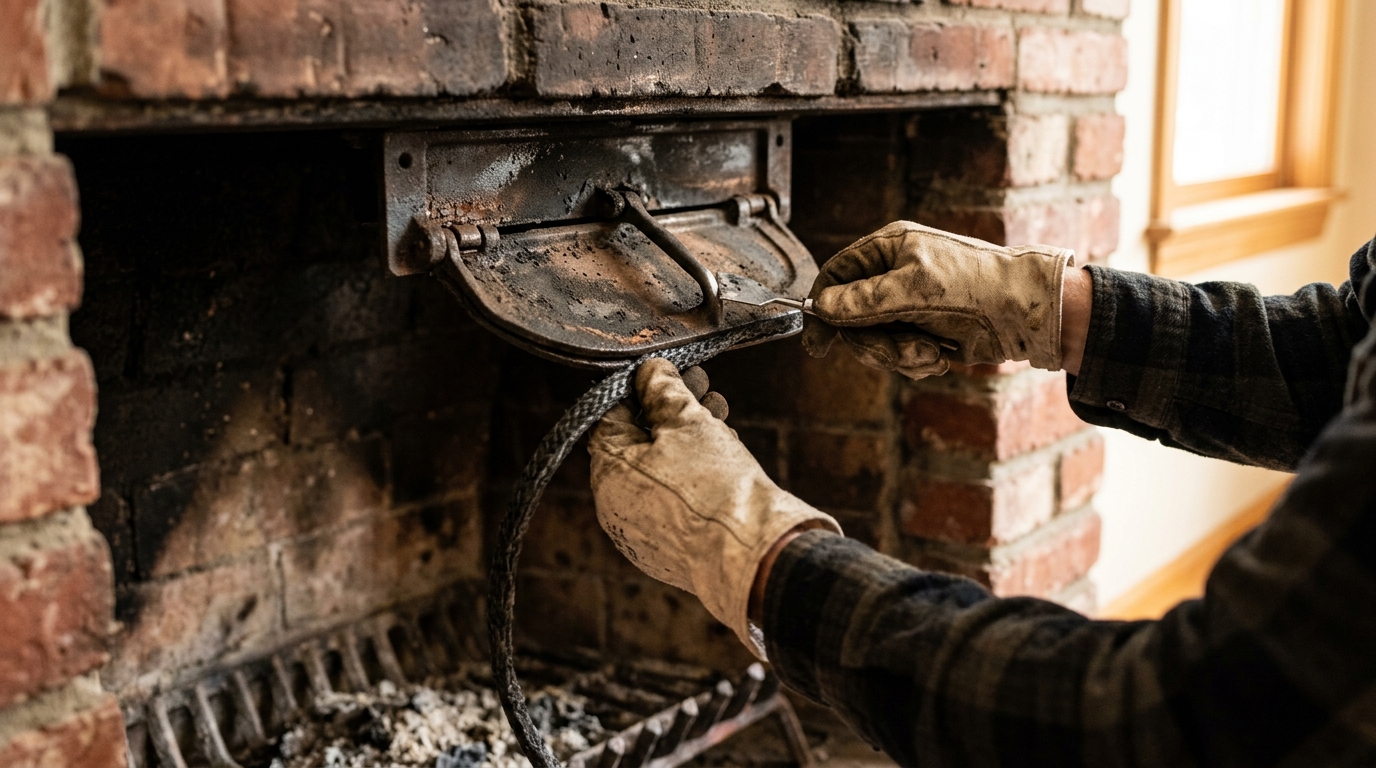
- Inspect your existing throat damper from inside the firebox using a flashlight. If the plate is warped, the hinge is broken, or you can see daylight past the closed plate, a top-mounted damper is the right upgrade.
- Measure the outside dimensions of your chimney flue opening at the top, which is usually a clay tile liner. Common sizes are 8 by 8, 8 by 13, or 13 by 13 inches. Take width and length measurements.
- Purchase a top-mounted damper cap sized to your flue, such as the Lyemance or Lock-Top brand, which use a silicone rubber gasket to create an airtight seal when the stainless steel cable is pulled tight from the firebox.
- Set up a stable ladder to reach the chimney crown. Work on a dry day with no wind. Wear rubber-soled shoes and use a roof harness if your roof pitch is 6-in-12 or steeper.
- Set the damper cap over the flue tile opening and secure it according to the manufacturer’s instructions, usually by tightening a compression bracket that grips the inside of the tile liner.
- Run the stainless steel control cable down through the flue, through the open throat damper, and secure it to the fireplace wall or damper handle using the included clamp. Test the open and close action from inside before descending.
- From inside, close the throat damper as well, creating a double-seal system. Repeat the candle test to confirm drafts are eliminated.
- Schedule an inspection with a Chimney Safety Institute of America certified chimney sweep. They will assess damper condition, flue liner integrity, and draft performance as a package.
- Request a written quote that separates the cost of the damper hardware from the labor, so you can compare against doing the top-mounted damper yourself.
- If the throat damper frame is cracked or the firebox masonry is damaged, have the sweep repair those issues at the same time. Attempting to seal around damaged masonry is ineffective and potentially unsafe.
- Ask the professional to install a top-mounted damper as part of the service. Many sweeps include this as a standard upsell that adds $50 to $100 to the visit cost for parts and 30 minutes of labor.
- After the visit, request documentation of any flue liner condition or safety items observed. This is useful for homeowner’s insurance and future reference if you sell the home.
Why It Works: The Benefits
Sealing a leaky fireplace damper properly can reduce heating energy use by 10 to 30% for homes where the fireplace is the primary draft source. For a household spending $1,500 per year on heating, that translates to $150 to $450 in annual savings.
Stopping the cold air cascade from the flue eliminates the uncomfortable drafts and cold floors near the fireplace that make rooms feel 3 to 5 degrees colder than your thermostat reading, so you can turn the heat down and still feel comfortable.
When your furnace or heat pump is not fighting a continuous cold air source, it cycles less frequently. Shorter runtime reduces wear on motors, heat exchangers, and compressors, extending equipment life and reducing maintenance costs over time.
A leaky damper can allow outdoor pollutants, pollen, chimney odors, and even small animals or insects to enter your home. Sealing the flue properly eliminates this infiltration pathway completely.
An inflatable draft stopper costs $20 to $40 and pays for itself in as little as two to three weeks during a cold winter. A top-mounted damper cap at $130 to $200 installed typically pays back within one heating season in cold climates.
💰 Savings Impact by Action
An inflatable damper seal eliminates up to 14% of whole-home heat loss attributable to an open or leaky fireplace flue.
Top-mounted damper caps reduce fireplace-related air infiltration by up to 90% compared to a standard corroded throat damper in the closed position.
Sealing the ash pit cleanout door with weatherstripping eliminates a secondary infiltration pathway that adds roughly 5% to fireplace-related heat loss.
Combining a top-mounted cap with a closed throat damper creates a dual air barrier that reduces fireplace heat loss by 95% compared to a standard uncorrected damper.
🏠 Key Concepts Explained
The Science Behind It
The fireplace chimney is essentially a vertical air column connecting your living space to the outside. In winter, the temperature difference between your warm interior and the cold outdoor air creates a pressure differential that drives airflow continuously upward through any unsealed opening. This is called the stack effect, and it does not require a fire or even wind to operate. It runs 24 hours a day whenever outdoor temperatures drop significantly below indoor temperatures. A standard throat damper with even minor warping or a failed sealing surface can leave a gap equivalent to a 4-inch diameter hole wide open to the sky.
Traditional cast iron throat dampers were never designed as air-sealing devices. They were built to control draft during a fire and to prevent rain and debris from falling into the firebox. The metal-on-metal contact between the plate and seat corrodes and warps through thousands of heat cycles, and the fit degrades over years of use. Independent testing by the Florida Solar Energy Center found that a typical closed throat damper still allows between 20 and 100 cubic feet per minute of air exchange depending on wind conditions, which is equivalent to leaving a window cracked open all winter.
Top-mounted damper caps work on a fundamentally different principle. By closing the flue at the very top of the chimney with a silicone rubber gasket, they prevent cold air from entering the flue column at all. This keeps the entire masonry chimney mass warmer, reduces downdraft pressure, and eliminates the convective loop that throat dampers can never fully stop. Silicone gaskets maintain their seal over a temperature range of negative 60 to 500 degrees Fahrenheit, so they perform reliably even in extreme climates and survive the brief high-heat events that occur when the damper is opened for a fire.
Frequently Asked Questions
▼ How do I know if my fireplace damper is the source of my cold drafts?
Hold a lit stick of incense or a candle near the damper handle with the damper fully closed on a cold windy day. If the smoke is pulled upward or pushed down toward you, you have an air leak at the damper. You can also feel for cold air with your hand held a few inches below the closed damper plate. If you feel cold air movement, the damper is not sealing.
▼ My damper is closed but I still feel cold air coming from the fireplace. What else could it be?
Cold air can also enter through the ash pit cleanout door at the base of the firebox, through gaps around a gas log igniter, or past the damper frame itself if the masonry has cracked. Check the ash pit door first since it is often forgotten and left unlatched. Seal it with weatherstripping or a foam rope gasket rated for moderate heat if it does not close flush.
▼ Can I use an inflatable chimney balloon if I have a gas fireplace?
No. Gas fireplace inserts and gas log sets require combustion air and venting at all times. Blocking the flue with any device on a gas appliance creates a carbon monoxide hazard. For a gas fireplace, consult the manufacturer’s manual or a licensed gas technician for the correct venting and sealing approach specific to your unit.
▼ How long will a top-mounted damper cap last?
Stainless steel top-mounted damper caps typically last 15 to 25 years. The silicone gasket is the component that wears first and can be replaced separately on most models for around $20 to $30. Inspect the gasket every 5 years or any time you notice drafts returning after a long period of good performance.
▼ I rent my home. Can I still fix a drafty fireplace?
The inflatable chimney balloon is completely removable and leaves no marks, so it is the ideal renter solution. Purchase the correct size for your flue, install it when the fireplace is not in use, and remove it when you move out. Notify your landlord about the draft issue in writing so they are aware, which may prompt them to arrange a more permanent fix at their expense.
Quick Tips
- Do the candle test first before buying anything. Hold a lit candle near the closed damper on a cold day. The direction the flame bends tells you immediately whether you have downdraft, updraft, or no movement at all.
- If your damper handle is stiff or the plate only moves partway, lubricate the hinge pivot with high-temperature anti-seize compound, not standard WD-40, which burns off and gums up the mechanism.
- In very cold climates, combining a top-mounted damper cap with a closed throat damper creates a double-seal air barrier that can reduce fireplace-related heat loss by over 90% compared to a standard open-position throat damper.
- If you have a gas fireplace insert, the damper situation is different. Gas appliances require a specific amount of combustion air, and some must be vented with the damper clipped open permanently. Check your appliance manual before sealing anything.
Variations for Your Situation
- Apartment/Rental: Use an inflatable chimney balloon in the $20 to $40 range. These are fully reversible and leave no permanent marks. Confirm with your landlord before making any modifications, and always keep the reminder tag attached to the damper handle. If the draft is severe, you can also place a magnetic fireplace cover over the firebox opening on the interior side as an additional layer at no cost to install.
- Tight Budget (under $50): Start with the candle test to confirm the damper is the source. If the damper plate moves freely, try tightening or adjusting the closure mechanism before spending anything. If a balloon is the solution, a $25 inflatable damper balloon delivers the majority of the energy benefit of a $200 top-mounted cap and pays for itself within a few weeks. This is the highest ROI fix available in the entire home efficiency toolkit.
- Older Home (pre-1980): Homes from this era often have large masonry fireboxes with oversized flues and throat dampers that have gone through decades of heat cycles. Warping and corrosion are almost certain. Budget for a top-mounted damper replacement rather than trying to repair the throat damper, since the original hardware is likely beyond the point where adjustment or lubrication will restore a usable seal. Also check the firebox for cracked mortar joints before sealing, as older masonry is more likely to need repointing.