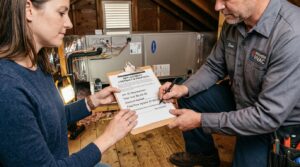
If you have ever closed the vents in a guest room or unused basement to redirect cool air elsewhere, you are not alone. It feels intuitive: block the airflow to rooms you are not using, and your AC focuses its energy where you need it most. The problem is that central HVAC systems simply do not work that way, and this one habit could be quietly adding $15 to $30 per month to your energy bill while shortening the life of your equipment.
Your air conditioner and its duct system are designed as a balanced system. Your blower fan moves a fixed volume of air, and your ducts are sized to handle a specific amount of resistance. When you close a vent, you do not reduce the air your system moves, you just increase the pressure it has to push against. That excess pressure forces air through every crack and gap in your ductwork, and in a typical home, those leaks are already losing 20 to 30% of conditioned air into attics and crawlspaces before it ever reaches a room.
In this post, you will learn exactly why closed vents hurt your system, what to do instead to improve comfort in specific rooms, and two practical approaches you can take this weekend to balance your home’s airflow and lower your cooling bills. No HVAC license required for either one.
What You’ll Need
Click on an item below to shop for the recommended items for this recipe on Amazon.
As an Amazon Associate, we earn from qualifying purchases.
How to Do It
- Open every supply vent in your home fully. This immediately lowers static pressure and reduces the strain on your blower motor.
- Walk through each room and feel the airflow from each supply vent with your hand. Rooms that feel weak may indicate a partially blocked vent, furniture blocking the register, or a damper issue inside the duct.
- Check that furniture, rugs, and curtains are not obstructing any supply or return vents. Even partial blockage adds resistance to the system.
- For rooms that genuinely feel too cold, use the vent louvers to reduce airflow by no more than 25 to 30% rather than closing them fully. This keeps static pressure within a safe range.
- Set your thermostat fan to AUTO rather than ON so the blower only runs when cooling is actually occurring, preventing the circulation of warm, humid air during the off cycle.
- Access your main duct trunk lines in the basement, attic, or crawlspace and look for gaps at joints, takeoffs, and any point where sections connect. Use a flashlight and run your hand along seams while the system is running to feel escaping air.
- Apply UL 181-rated mastic sealant or foil-backed duct tape (not standard cloth duct tape, which fails quickly) to every visible gap and joint. Mastic is more durable and preferred by HVAC professionals for long-term sealing.
- Wrap any uninsulated duct runs in unconditioned spaces with R-6 or R-8 duct wrap insulation, securing it with foil tape at the seams. Ducts in a 130-degree attic lose tremendous cooling capacity even without leaks.
- Install simple in-duct damper handles on branch lines serving rooms you want to control. These adjustable metal dampers let you fine-tune airflow without closing off the duct entirely, keeping static pressure balanced.
- After sealing, replace your air filter with a clean one rated MERV 8 to 11. A clogged filter is a major source of excess static pressure and accounts for up to 15% efficiency loss on its own.
- Run the system for 30 minutes after completing work, then check each room with a thermometer. Rooms should reach within 2 to 3 degrees of your thermostat setpoint within one to two hours on a hot day.
- Contact a licensed HVAC contractor to perform a Manual J load calculation and assess whether your existing duct system can support bypass dampers for a zoned setup.
- Request quotes for a smart zoning control board paired with motorized dampers. A two-zone system for a 2,000-square-foot home typically costs $1,500 to $2,500 installed and can reduce cooling costs by 15 to 25% annually.
- For a room addition, home office, or garage conversion that does not have existing ductwork, get quotes for a single-zone ductless mini-split. Units sized at 9,000 to 12,000 BTU cover 350 to 550 square feet and cost $1,500 to $3,000 installed.
- Check ENERGY STAR and your utility company websites for available rebates before committing. Federal tax credits under the Inflation Reduction Act cover 30% of mini-split costs up to $600 through 2032.
- After installation, confirm your contractor verifies refrigerant charge and airflow on the existing central system, since a properly installed zone system should reduce total demand and may allow your central AC to be downsized at its next replacement.
Why It Works: The Benefits
Restoring proper airflow and sealing duct leaks together can reduce cooling energy use by 10 to 20%, translating to $15 to $40 per month for a typical home running central AC in a warm climate.
Eliminating the chronic high-static-pressure stress on your blower motor and reducing short cycling can add years to your system’s lifespan, deferring a $3,000 to $7,000 replacement.
Proper airflow lets your evaporator coil run full cycles instead of freezing up, removing 20 to 50% more moisture from the air and making a 75-degree home feel as comfortable as a 72-degree one with poor humidity control.
Balanced airflow eliminates hot and cold spots caused by pressure imbalances, so you are not cranking the thermostat lower just to make one room comfortable.
Reducing duct leakage means less attic dust, insulation fibers, and outdoor pollutants get pulled into your living space through pressure-driven infiltration.
💰 Savings Impact by Action
Reopening closed vents reduces excess static pressure and can restore 10% of lost cooling efficiency immediately with no cost.
Sealing accessible duct leaks with mastic reduces conditioned air loss from 25 to 30% down to under 10%, cutting cooling energy use by up to 20%.
Replacing a clogged air filter restores proper CFM through the coil and eliminates up to 15% efficiency loss caused by restricted airflow.
Wrapping uninsulated ducts in a 130-degree attic with R-6 duct wrap reduces heat gain into the supply air by 10 to 15%, meaning your AC delivers cooler air by the time it reaches the room.
A properly installed two-zone damper system reduces cooling runtime for unoccupied areas and can cut total cooling costs by 15 to 25% annually.
🏠 Key Concepts Explained
The Science Behind It
Your central AC system is a closed-loop air mover. The blower fan pushes a fixed volume of air, measured in cubic feet per minute (CFM), through supply ducts and pulls the same volume back through return ducts. The system is designed and balanced for a specific total external static pressure, typically between 0.1 and 0.5 inches of water column for residential systems. Every closed vent, clogged filter, or undersized return raises that number. When static pressure exceeds design specs, airflow drops, the evaporator coil gets too cold, and efficiency collapses.
The evaporator coil operates at around 40 to 55 degrees Fahrenheit under normal airflow. That cold surface absorbs heat from the air passing over it and also condenses moisture, which is your dehumidification. When airflow drops because of high static pressure, the coil temperature falls below 32 degrees, and moisture freezes onto it instead of draining away. The ice acts as insulation, blocking further heat transfer. Your AC continues running but stops cooling, and when the ice eventually melts, it can overflow the condensate drain and cause water damage.
Duct leakage compounds every one of these problems. The DOE estimates that in a typical home, 25 to 40% of the energy used for heating and cooling is lost due to leaky ducts. When static pressure rises from closed vents, the pressure differential between the inside of the duct and the surrounding attic or crawlspace increases, forcing even more conditioned air through those gaps. Sealing ducts with mastic reduces leakage to under 5% of system airflow, restoring the balance the system was designed to maintain and allowing the blower to run at lower speed and lower electricity consumption.
Frequently Asked Questions
▼ I opened all my vents but one room is still much warmer than the rest. What is wrong?
The most common causes are a disconnected or crushed duct section, a closed in-duct damper, or insufficient insulation on that branch run. Go into your attic or crawlspace with a flashlight and trace the duct from the main trunk to that room. Look for any section that is kinked, disconnected, or has a closed butterfly damper. A disconnected flex duct section in the attic is one of the most frequent findings and is a straightforward DIY repair with foil tape and a duct clamp.
▼ My energy bill went up this summer but I did not change anything. Could my habit of closing vents have caused this?
Yes, especially if you closed multiple vents in a home with an older PSC blower motor. Higher static pressure increases motor electricity consumption, and it can push the system into short-cycling mode where it runs more frequent but incomplete cycles. Start by opening all vents and replacing the air filter, then watch your next billing cycle. If the bill does not drop, schedule a duct leakage test with an HVAC contractor to see what percentage of conditioned air you are losing before it reaches the rooms.
▼ Can renters do any of this without landlord permission?
Renters can safely open all vents, reposition furniture away from grilles, and replace the air filter without any permission, and those steps alone can meaningfully improve comfort and reduce energy use. For portable improvements, a window air conditioner or portable AC unit for a specific room avoids duct system issues entirely. Get landlord approval before applying any sealants or making physical modifications to the HVAC system.
▼ My house has two stories and the upstairs is always 5 to 8 degrees hotter. Is this a vent problem?
This is a very common multi-story problem, and closed vents are rarely the only culprit. The stack effect naturally drives warm air upward, and upper-floor ducts often run through hotter attic spaces, losing cooling capacity before the air arrives. Check that attic insulation is at least R-38 (R-49 is better in hot climates) and that all attic duct runs are insulated and sealed. You can also partially restrict a few lower-floor supply vents by 20 to 25% to redirect more airflow upstairs during the cooling season, then open them fully in winter.
▼ How do I know if my ducts are leaking without hiring someone?
The simplest DIY test is to run your system on a hot day, then feel along accessible duct joints in your attic, basement, or crawlspace for air movement. You can also hold a lit incense stick near joints and watch for smoke disturbance. Professionally, a duct blaster test gives you a precise leakage percentage and costs $150 to $300, but many utility companies offer this test free or subsidized through home energy audit programs. A leakage rate above 10% of system airflow is worth sealing.
Quick Tips
- Replace your air filter every 60 to 90 days during peak cooling season. A dirty MERV 11 filter at 90 days can restrict airflow as much as two or three closed vents combined.
- If one room is always too hot, check whether its supply duct has an in-line damper that was partially closed during original installation. Look for a small wing-nut or slotted screw on the round duct near the main trunk.
- Use a $15 indoor thermometer hygrometer in problem rooms to track both temperature and humidity. A room sitting above 55% relative humidity with the AC running is a sign of a coil or airflow problem, not just a thermostat issue.
- Ceiling fans do not lower air temperature, but they let you raise the thermostat by 4 degrees without a loss in comfort, saving roughly 8% on cooling costs per degree. Use them only in occupied rooms and turn them off when you leave.
Variations for Your Situation
- Apartment or Rental: Renters typically cannot modify ductwork, but opening all vents fully and keeping the air filter clean (check monthly and replace every 60 days) delivers most of the airflow benefit at zero cost. For a room that is consistently too warm, a 6,000 to 8,000 BTU window air conditioner ($150 to $300) bypasses the central system entirely and lets you cool only occupied spaces, which is actually the most energy-efficient approach when used strategically.
- Tight Budget (Under $50): Focus on the no-cost steps first: open all vents, move furniture blocking grilles, and set the fan to AUTO. A new MERV 8 air filter costs $8 to $15 and restores proper airflow immediately. A roll of UL 181 foil tape ($12 to $18) lets you seal the most accessible duct joints in your basement or crawlspace in under an hour. These three steps together can recover 10 to 15% of cooling efficiency with no professional help.
- Older Home (Pre-1980): Homes built before 1980 often have undersized return air systems with a single central return grille, duct leakage rates of 30 to 40%, and original duct materials like fibrous ductboard that degrade over time. Sealing and rebalancing helps, but a professional duct leakage test is strongly recommended first to establish a baseline. Also prioritize attic air sealing and insulation before duct work, as thermal bypasses in older attics often account for more heat gain than duct losses alone.