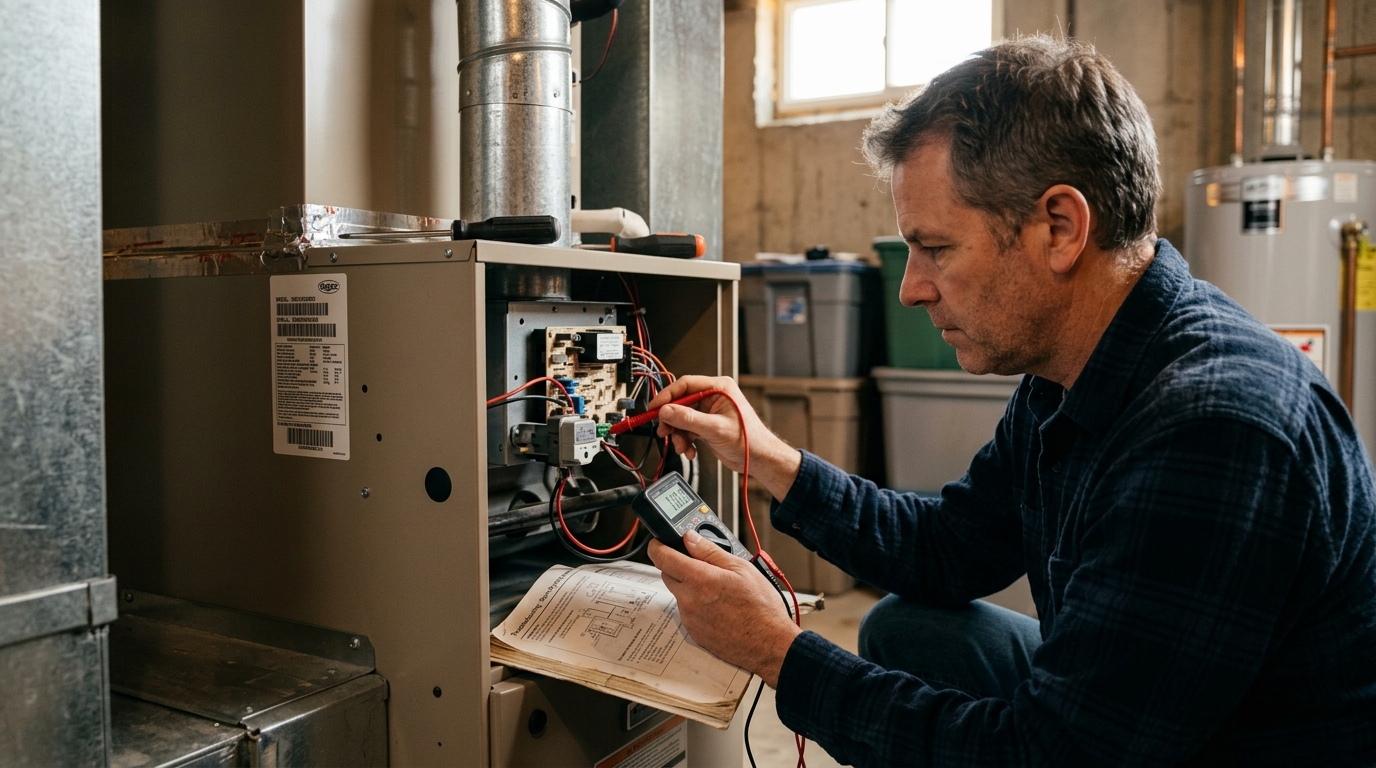
If your furnace is firing up, running for a minute or two, then shutting off before your home reaches temperature, you have a short cycling problem. It is one of the most common furnace complaints during heating season, and it is also one of the most misunderstood. Many homeowners assume the fix requires an HVAC technician right away, when in fact the most frequent causes are things you can find and often fix yourself in less than an hour.
Short cycling puts your furnace under serious stress. Every startup cycle draws a surge of electricity and heat, and a furnace that cycles 10 to 12 times per hour instead of the normal 3 to 5 will wear out its heat exchanger, inducer motor, and igniter far faster than one running normally. Beyond component wear, short cycling inflates your gas and electric bills because the system never reaches efficient steady-state operation. Homeowners with a short cycling furnace commonly see heating bills 15 to 30% higher than they should be.
This guide walks you through a structured self-diagnosis you can complete before scheduling a service call. You will learn the four most common causes of short cycling, how to test each one yourself, and which situations genuinely require a licensed HVAC technician. Whether your furnace is 5 years old or 25, these steps apply to virtually every forced-air gas furnace on the market.
What You’ll Need
Click on an item below to shop for the recommended items for this recipe on Amazon.
As an Amazon Associate, we earn from qualifying purchases.
How to Do It
- Check and replace the air filter first. Pull the filter and hold it up to a light source. If you cannot see light through it, replace it with a MERV 8 filter. A clogged filter is responsible for roughly 40% of short cycling cases. After replacing, run the furnace for 10 minutes and observe whether the cycle length improves.
- Inspect all supply and return vents throughout the home. Open any that are closed or blocked by furniture. Furnaces need all registers open to maintain proper static pressure. Closing more than 20% of registers can restrict airflow enough to trigger the high-limit switch.
- Walk outside and visually inspect the flue vent termination. High-efficiency furnaces have one or two white PVC pipes exiting through the side wall, typically 12 to 24 inches above grade. Look for bird nests, ice blockage, or debris. Clear any obstruction and make sure the pipes terminate at least 12 inches from the ground.
- Turn the thermostat fan setting from AUTO to ON and let the blower run for 5 minutes before firing the furnace. If the furnace then runs a full cycle, the heat exchanger was likely retaining heat from a previous over-limit trip. This also helps you confirm whether the root cause is airflow or something else.
- Check your thermostat location. If it is within 3 feet of a supply register, in direct sun, or on an exterior wall, it may be reading falsely high. A simple test is to tape a thermometer next to the thermostat for one full cycle and compare readings. A difference of more than 3 degrees signals a placement problem.
- Turn off the furnace at the power switch on the unit and set the thermostat to OFF. Wait 5 minutes for the heat exchanger to cool. For added safety, turn off the 120V breaker feeding the furnace.
- Remove the furnace access panel. On most units this is a snap-off or screw-on panel on the lower or front face of the furnace. Locate the flame sensor, which is a single metal rod 2 to 4 inches long mounted near the burner assembly with one wire connected to it.
- Remove the single mounting screw holding the flame sensor bracket. Gently pull the sensor straight out. Do not touch the metal rod portion with bare hands, as skin oils accelerate re-fouling.
- Lightly buff the metal rod with a fine steel wool pad or an emery cloth. You are removing the thin white or gray oxidation layer. This should take less than 30 seconds. Do not sand aggressively or use sandpaper coarser than 220 grit, which can remove the rod coating.
- Reinstall the sensor, reconnect the wire, replace the access panel, and restore power. Initiate a heat call from the thermostat and watch through the sight glass if present. The furnace should fire and sustain a flame. A properly functioning flame sensor will keep the burner running; if the furnace still shuts off within 30 seconds, proceed to professional diagnosis.
- If flame sensor cleaning does not resolve the short cycling, document the furnace error code if your model has a flashing LED indicator on the control board. Count the flashes and look up the code in the manual or on the door label. This code will save your technician 15 to 30 minutes of diagnostic time and may reduce your service bill.
- Before calling, note the furnace brand, model number (on the label inside the front panel), and age. Take a photo of any error code light flashing pattern on the control board. This information reduces diagnostic time.
- Describe the symptom precisely when booking: how long the furnace runs before shutting off, whether it retries immediately or waits, and any sounds such as clicking, rumbling, or high-pitched noise. Technicians diagnose faster with a precise symptom description.
- Ask the technician specifically to check the pressure switch hoses, inducer motor operation, and heat exchanger integrity. These are the three remaining causes after DIY checks, and skipping any one of them risks a misdiagnosis.
- Request a written estimate before authorizing any part replacement. A pressure switch typically costs $40 to $80 in parts. A control board runs $150 to $400. If the technician recommends a heat exchanger replacement on a furnace older than 15 years, get a second opinion because replacement often costs more than a new unit.
Why It Works: The Benefits
HVAC service call rates typically run $100 to $200 just to show up and diagnose, before any parts or labor. Identifying a dirty filter or fouled flame sensor yourself eliminates that cost entirely.
A short cycling furnace never reaches thermal equilibrium, burning more fuel per degree of heat delivered. Resolving the root cause returns the system to normal 3 to 5 cycles per hour and can cut gas usage by 15 to 30% depending on how severe the cycling was.
Each furnace startup stresses the heat exchanger, igniter, and inducer motor. A furnace cycling 10 times per hour accumulates startup wear roughly three times faster than normal, shortening a typical 20-year lifespan considerably. Fixing short cycling now can add 5 or more years of reliable operation.
Short cycling means the blower rarely runs long enough to distribute heat evenly. Rooms farthest from the furnace stay cold while the area near the thermostat satisfies the call, creating 5 to 10 degree temperature swings across the home.
Persistent overheating is one of the leading causes of heat exchanger cracks, which can allow carbon monoxide to enter living spaces. Self-diagnosis that identifies overheating early can prompt action before a crack develops, a safety benefit that goes well beyond energy savings.
💰 Savings Impact by Action
Replacing a heavily clogged filter restores proper airflow and eliminates overheating-driven short cycling, recovering up to 15% of wasted heating fuel.
A clean flame sensor allows full burn cycles to complete, reducing the number of ignition attempts per hour by up to 60% and cutting ignition-related electricity waste by roughly 12%.
Opening all supply and return registers reduces duct static pressure, improves airflow volume, and lowers blower motor energy draw by approximately 8%.
Removing a partial flue obstruction on a high-efficiency furnace restores proper combustion and prevents pressure switch trips that force the system to restart from cold, saving up to 10% on gas use.
Correcting a thermostat that reads 5 degrees high due to poor placement prevents premature cycle termination and recovers approximately 7% of heating capacity per cycle.
🏠 Key Concepts Explained
The Science Behind It
A gas furnace operates on a straightforward thermodynamic principle: burn fuel to heat a metal heat exchanger, then blow household air across that exchanger to transfer the heat into your living space. The entire system is designed around a precise airflow rate measured in cubic feet per minute. When that airflow drops because of a clogged filter or closed registers, the heat exchanger temperature climbs rapidly. The high-limit switch, typically calibrated to trip between 180 and 200 degrees Fahrenheit, is a bimetallic safety device that opens the burner circuit before the exchanger can crack. The furnace shuts off, the blower continues running to cool the exchanger, and once it drops below the reset threshold, the burner fires again. This overheating loop is what most homeowners experience as short cycling.
The flame sensor works on a principle called flame rectification. When a gas flame is present, it conducts a small alternating current between the sensor rod and the burner ground, converting it to a measurable DC microamp signal, typically 2 to 10 microamps. The furnace control board monitors this signal. If it drops below roughly 1 microamp, the board assumes no flame is present and shuts off the gas valve as a safety measure. Oxidation on the sensor rod increases its electrical resistance, reducing the microamp reading until it falls below the threshold even with a healthy flame burning. Lightly abrading the rod removes the oxidation layer and restores conductivity, returning the sensor to normal operation without any new parts.
Oversized furnaces present a fundamentally different physics problem. A furnace rated at 100,000 BTU per hour in a home that only needs 60,000 BTU per hour on the coldest day will satisfy the thermostat setpoint in 3 to 4 minutes rather than the ideal 10 to 15. This is too short a cycle for the heat exchanger to fully stabilize, for humidity to be managed, and for heat to distribute evenly via ductwork. The result is a home with cold spots, excessive dryness in winter, and a furnace that accumulates startup cycles at two to three times the intended rate. Proper HVAC sizing using Manual J load calculations is the only permanent solution to this condition, which is why having an oversized furnace replaced with a properly sized modulating or two-stage unit often pays for itself within 5 to 7 years in combined fuel savings and avoided repairs.
Frequently Asked Questions
▼ My furnace short cycles but the filter is clean and the vents are all open. What is next?
Move to the flame sensor. A furnace that fires and shuts off within 5 to 30 seconds almost always has a fouled flame sensor rather than an airflow problem. Follow the DIY flame sensor cleaning steps in this guide. If cleaning does not resolve it, check whether your control board has an error code flashing light and look up the code before calling a technician.
▼ How do I know if my furnace is oversized versus just malfunctioning?
Time the run cycle from burner ignition to the point the thermostat is satisfied. If the furnace consistently shuts off in under 5 minutes and the home actually reaches the set temperature, oversizing is likely. A malfunctioning furnace will shut off before the home reaches temperature. You can confirm sizing suspicions by having a contractor run a Manual J calculation for your home, which typically costs $100 to $200 but is often included in quotes for new equipment.
▼ My high-efficiency furnace short cycles only on very cold days. Is that normal?
No, this is a sign the system is working harder than it can handle on design-day conditions. The two most common causes are a partially blocked flue pipe, which is more restrictive under high firing rates, and a condensate drain that begins backing up when the furnace runs longer. Check the exterior PVC vent terminations for partial ice blockage and confirm the condensate drain line is clear and sloped properly.
▼ Can a bad thermostat cause short cycling?
Yes, though it is less common than airflow or flame sensor issues. A thermostat located near a heat source, in direct sunlight, or on a poorly insulated exterior wall can read 5 to 10 degrees warmer than the actual room temperature, satisfying the call for heat too early. Test by taping an independent digital thermometer beside the thermostat for several cycles. If the thermometer reads consistently lower than the thermostat setpoint at shutdown, relocating or replacing the thermostat is the fix.
▼ Will short cycling damage my furnace if I wait a week to fix it?
It depends on severity. A furnace cycling every 2 to 3 minutes is accumulating startup stress roughly five times faster than normal, and each cycle stresses the igniter, which has a finite lifespan of roughly 2,000 to 5,000 cycles. At extreme short cycling rates you can shorten igniter life from years to weeks. Resolve the issue as quickly as practical, and in the meantime, manually setting the thermostat 2 to 3 degrees lower than normal can reduce cycling frequency while you work on a diagnosis.
Quick Tips
- Replace furnace filters every 60 to 90 days during heating season, not the 90 to 180 days printed on the package, which assumes light use.
- Set your thermostat fan to ON for 5 minutes after the furnace shuts off. This purges residual heat from the heat exchanger and ducts, improving efficiency by 3 to 5% and reducing the chance of a high-limit trip on the next cycle.
- Keep at least 80% of your supply and return registers fully open regardless of how rooms are used. Closing registers increases duct static pressure, reduces airflow, and stresses both the blower motor and heat exchanger.
- Install a carbon monoxide detector within 10 feet of your furnace if you do not already have one. A short cycling furnace that is overheating is at elevated risk for heat exchanger stress, and a CO detector is your last line of defense if a crack develops.
Variations for Your Situation
- Apartment or Condo: Renters typically cannot access the furnace cabinet or replace components. Start by replacing the furnace filter if your lease allows it, which costs $8 to $20 and is the renter’s most common legitimate fix. Document the short cycling with a video, note the error code light pattern if visible through the cabinet, and submit a written maintenance request to your landlord or property manager. Most leases require the landlord to maintain HVAC in working order, and documentation protects you.
- Tight Budget (under $25): Focus exclusively on the zero-cost and near-zero-cost steps first. Replace the filter ($8 to $15), open all closed registers, and clear any exterior vent obstruction. These three steps alone resolve short cycling in the majority of cases. Flame sensor cleaning costs nothing if you already own a screwdriver and costs under $5 if you need to buy steel wool. Defer the professional call unless you smell gas or see a CO alarm trigger.
- Older Home (pre-1990 Furnace): Furnaces from this era often have a standing pilot rather than an electronic igniter, and their limit switches may have drifted out of calibration after decades of cycling. A pilot that burns weakly can mimic short cycling by allowing the thermocouple to drop out. Check that the pilot flame fully engages the thermocouple tip. Also be aware that a furnace more than 25 years old with a short cycling problem may have a compromised heat exchanger, and a professional inspection for cracks is strongly recommended before investing in repairs costing more than $150.