If you are still running incandescent bulbs anywhere in your home, you are essentially paying to generate heat instead of light. About 90% of the energy an incandescent bulb consumes is released as heat, with only 10% actually producing visible light. That inefficiency shows up directly on your electricity bill every single month, and over a full year it adds up to a surprisingly large number.
LED bulbs have improved dramatically over the past decade. They now produce warmer, more natural light than early LED models, they dim smoothly, and they last 15,000 to 25,000 hours on average compared to roughly 1,000 hours for a standard incandescent. The upfront cost has also dropped to the point where a quality A19 LED bulb costs $2 to $5 at any hardware store. For most households, the full payback period on every bulb is under six months, making this one of the fastest returns available in home efficiency.
This post breaks down exactly how much you can save by switching, walks through two practical approaches depending on your budget and situation, and answers the most common questions homeowners have about making the switch. Whether you want to do it all in one afternoon or replace bulbs gradually as they burn out, there is a strategy here that works for you.
What You’ll Need
Click on an item below to shop for the recommended items for this recipe on Amazon.
As an Amazon Associate, we earn from qualifying purchases.
How to Do It
- Walk through every room and count your current bulbs by type (A19, BR30, candelabra, etc.) and wattage so you know exactly what to buy.
- Purchase LED equivalents in multipacks from a hardware store or online. For a 60W incandescent, buy a 9W or 10W LED rated for 800 lumens. For recessed cans, use BR30 or PAR30 LED floods.
- Choose 2700K color temperature for living rooms and bedrooms for a warm, familiar feel. Use 3000K or 4000K in kitchens, bathrooms, and home offices for crisper, brighter light.
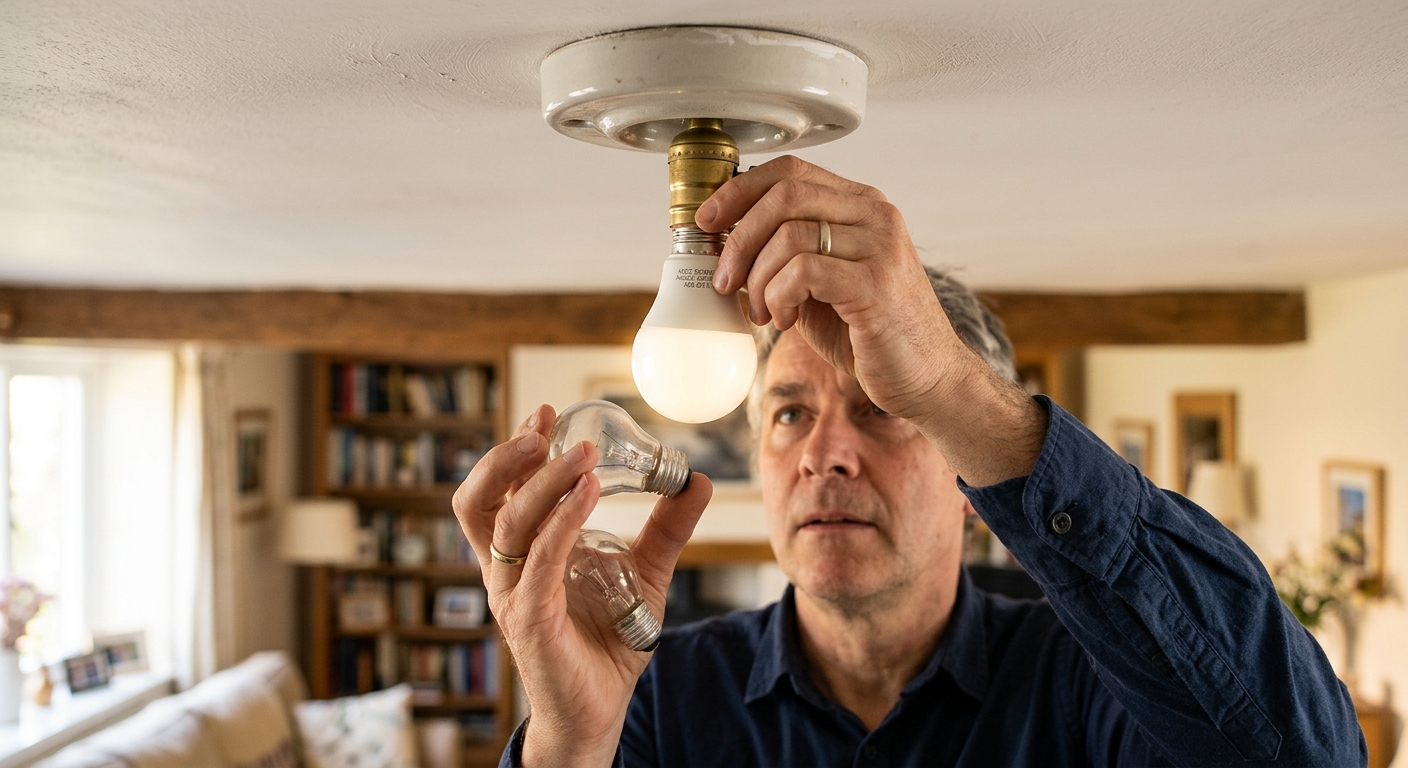
- Turn off each fixture, allow hot bulbs to cool for 2 minutes, then swap the old bulb for the LED. No tools needed for standard screw-base fixtures.
- If you have dimmer switches, verify the new LEDs are labeled as dimmable. Test the dimmer range after installing to check for flicker. If flickering occurs, note the dimmer model for a potential upgrade.
- Dispose of any CFL bulbs at a hardware store recycling drop-off since they contain mercury. Incandescents can go in the regular trash.
- Identify your three highest-use rooms or fixtures, typically the kitchen, living room, and primary bathroom, and start there. High-use locations deliver payback in 3 to 4 months versus 6 to 9 months for rarely used fixtures.
- Check each dimmer switch for an LED compatibility label or look up the model number online. Older Lutron or Leviton dimmers designed for incandescents often cause LED flickering or buzzing.
- Purchase LED-compatible dimmer switches rated for low wattage loads, typically 150W to 600W LED range. Brands like Lutron Caseta or Leviton Decora are reliable choices at $15 to $25 per switch.
- Turn off the circuit breaker for the room you are working in, confirm power is off with a non-contact voltage tester, then remove the old dimmer. Take a photo of the wiring before disconnecting anything.
- Wire the new dimmer following the manufacturer’s diagram, which is typically line, load, and neutral if required. Restore power and test the full dimmer range with the new LED bulb installed.
- Continue room by room over the following days or weeks, replacing remaining incandescents with LEDs as your schedule allows and tracking which rooms are complete.
Why It Works: The Benefits
Replacing 20 incandescent 60W bulbs with 9W LEDs saves roughly 1,020 kWh per year at 5 hours of daily use. At the national average of $0.16 per kWh, that is about $163 in annual savings from lighting alone.
Because LEDs generate far less heat than incandescents, your air conditioner does not have to work as hard to offset the heat those bulbs add. Homes with many light fixtures can see a measurable 2 to 5% reduction in summer cooling load.
At 3 hours of daily use, a 25,000-hour LED lasts over 22 years. That eliminates dozens of replacement purchases and the hassle of climbing ladders to swap out burned-out bulbs in ceiling fixtures.
Modern LEDs are available in 2700K warm white, 3000K soft white, and 4000K daylight color temperatures, so you can match the light quality to each room. CRI ratings of 90 or above make kitchens and bathrooms look noticeably better.
A $4 LED bulb replacing a 60W incandescent that runs 5 hours a day pays for itself in electricity savings in roughly 3 to 4 months. No other home upgrade delivers a full return that quickly.
💰 Savings Impact by Action
Replacing incandescent bulbs with LEDs cuts lighting energy consumption by up to 75% for the same light output.
LEDs use 30 to 40% less electricity than CFL bulbs, with better instant-on performance and no mercury disposal concerns.
Eliminating incandescent heat output in a typical home reduces summer air conditioning load by 2 to 5%.
For the average household, lighting accounts for 10 to 15% of total electricity use, so a full LED swap delivers meaningful whole-bill savings.
🏠 Key Concepts Explained
The Science Behind It
The core reason LEDs are so efficient comes down to how they generate light. Traditional incandescent bulbs work by heating a tungsten filament to roughly 2,700 degrees Celsius until it glows. That process is inherently wasteful because generating that much heat requires enormous energy input relative to the light output. LED chips, by contrast, use electroluminescence, which is a process where electrons pass through a semiconductor material and release photons directly. Far less energy is lost as heat in that conversion, which is why an LED can produce the same 800 lumens as a 60W incandescent using only 8 to 10 watts.
The ripple effect on your home’s energy system matters too. Every watt of heat that an incandescent bulb dumps into your living space during summer has to be removed by your air conditioner. Air conditioners operate at a coefficient of performance of roughly 2.5 to 3.5, meaning they use about 1 watt of electricity to move 2.5 to 3.5 watts of heat out of the house. So a single 60W incandescent bulb generating 54W of waste heat forces your AC to consume an additional 15 to 22 watts just to compensate. Multiply that across 20 or 30 fixtures running during a hot afternoon and the secondary cooling impact becomes significant, often adding 5 to 10% to summer electricity bills beyond the direct lighting cost.
LED lifespan is also rooted in physics. Because the semiconductor junction operates at much lower temperatures than a glowing filament, it degrades far more slowly. Most quality LEDs are rated to reach 70% of their original brightness (L70 rating) at 25,000 hours of use. At 3 hours of daily use, that is over 22 years of service from a single bulb. Cheaper bulbs with poor thermal management run their junctions hotter, which accelerates degradation and causes early failure, which is why ENERGY STAR certification and reputable brands matter more than the lowest sticker price.
Frequently Asked Questions
▼ My LED bulbs are flickering on my dimmer switch. How do I fix it?
Flickering almost always means the dimmer switch is not compatible with LED bulbs. Older incandescent dimmers cut power in a way that LEDs cannot handle smoothly at low wattages. Replace the dimmer with an LED-rated model such as the Lutron Skylark or Leviton Decora Smart, which cost $15 to $25, and make sure the LEDs themselves are labeled as dimmable.
▼ My LED bulb burned out way before the rated lifespan. What went wrong?
Early LED failure is usually caused by one of three things: an enclosed fixture that traps heat around the bulb (check that the LED is rated for enclosed use), voltage fluctuations from a poorly matched dimmer, or simply a low-quality bulb without proper thermal management. Replace with an ENERGY STAR certified bulb from a brand like Philips, GE, or Cree, and verify the fixture type matches the bulb’s rating.
▼ How long before I actually see a difference on my electricity bill?
You should see a measurable drop on the first full monthly bill after completing the swap, assuming you replaced most or all of your high-use fixtures. For a home replacing 20 incandescent bulbs, expect a savings of $10 to $18 per month depending on local electricity rates and daily usage hours. The savings are real and consistent every month from that point forward.
▼ Do LEDs work in outdoor fixtures and extreme cold?
Yes, LEDs perform better in cold temperatures than CFLs, which struggled to reach full brightness below freezing. Look for bulbs rated for outdoor or damp locations for any exposed or porch fixtures. Cold weather actually improves LED efficiency slightly, so garage and exterior lights are excellent candidates for replacement.
▼ I have a mix of older CFL and incandescent bulbs. Which should I replace first?
Replace incandescent bulbs immediately since the savings gap between incandescent and LED is 75%, delivering payback in months. CFLs are worth replacing too since LEDs use about 30 to 40% less energy than CFLs, but the payback period is longer at 12 to 24 months. Start with high-use incandescents, then replace CFLs as they reach end of life or when you want to improve light quality.
Quick Tips
- Buy LEDs with an ENERGY STAR label. Certified bulbs must meet minimum efficiency, lifespan, and color quality standards, which filters out the cheap imports that fail early.
- Match color temperature to room function. Use 2700K in bedrooms and living rooms for warm, relaxing light, and 3500K to 4000K in kitchens and bathrooms for crisp, task-friendly brightness.
- Check the lumens number on the package, not the wattage. An 800-lumen LED is equivalent to a 60W incandescent regardless of whether it draws 8 watts or 10 watts.
- For recessed can lights, use PAR or BR-series LED flood bulbs designed for that fixture type. A-19 bulbs in a can fixture often produce a hot spot directly below without filling the room well.
- If you rent, LED bulbs belong to you. When you move, you can take them with you and reinstall the original bulbs, making this a genuinely renter-friendly upgrade with no landlord approval needed.
Variations for Your Situation
- Apartment/Rental: LED bulbs are one of the best upgrades for renters because they belong to you, not the apartment. Swap the existing bulbs when you move in, store the originals in a bag, and reinstall them when you leave. You take your LEDs to every new home. At $2 to $5 per bulb and payback in 3 to 6 months, this is a zero-permission upgrade that saves real money immediately.
- Tight Budget (under $50): Focus your first purchase on the five to seven fixtures you use most, typically kitchen overhead lights, bathroom vanity, and the main living room lamp. A six-pack of A19 LEDs costs $10 to $15 at most hardware stores. Replacing just those high-use bulbs captures 60 to 70% of your total potential lighting savings and pays back in under four months, before you spend another dollar.
- Older Home (pre-1980): Homes built before 1980 often have a mix of older wiring, non-grounded outlets, and early-generation dimmer switches that were never designed for LED loads. Skip dimmer upgrades yourself if you are unsure about the wiring, and call a licensed electrician for any switch work. Standard screw-base bulb swaps require no electrical work and are safe in any home. Also check for knob-and-tube wiring in the attic before assuming enclosed fixtures are safe for any bulb type.