If your floors feel cold in winter and your heating bill climbs every November, there is a good chance your rim joists are quietly draining your home’s warmth. The rim joist is the band of framing lumber that sits on top of your foundation wall and closes off the ends of your floor joists. It is exposed directly to outdoor temperatures, often uninsulated, and riddled with small gaps that let cold air pour into your home’s lower level. The Department of Energy estimates that air sealing and insulating rim joists can reduce heating and cooling costs by 10 to 20% in many homes.
The frustrating part is that rim joists are almost never addressed during new construction or basic home upgrades. They sit in the basement or crawl space, out of sight and out of mind, while homeowners spend money on window replacements and programmable thermostats that deliver far smaller returns. A single weekend afternoon with $50 to $150 in materials can fix a problem that has been costing you money for years.
This guide walks you through everything you need to know: what rim joists are and why they leak, how to seal and insulate them yourself with rigid foam or spray foam, and when it makes sense to call a professional. Whether you have a finished basement or an unfinished crawl space, there is an approach here that will work for your home.
What You’ll Need
Click on an item below to shop for the recommended items for this recipe on Amazon.
As an Amazon Associate, we earn from qualifying purchases.
How to Do It
- Put on safety glasses and nitrile gloves before starting. Spray foam is sticky and difficult to remove from skin.
- Walk the perimeter of your basement or crawl space and locate the rim joist: it is the vertical band of lumber sitting on top of the concrete or block foundation wall, just below the subfloor.
- Look for visible daylight, spider webs indicating airflow, or gaps where the sill plate meets the foundation and where the rim joist meets the subfloor above.
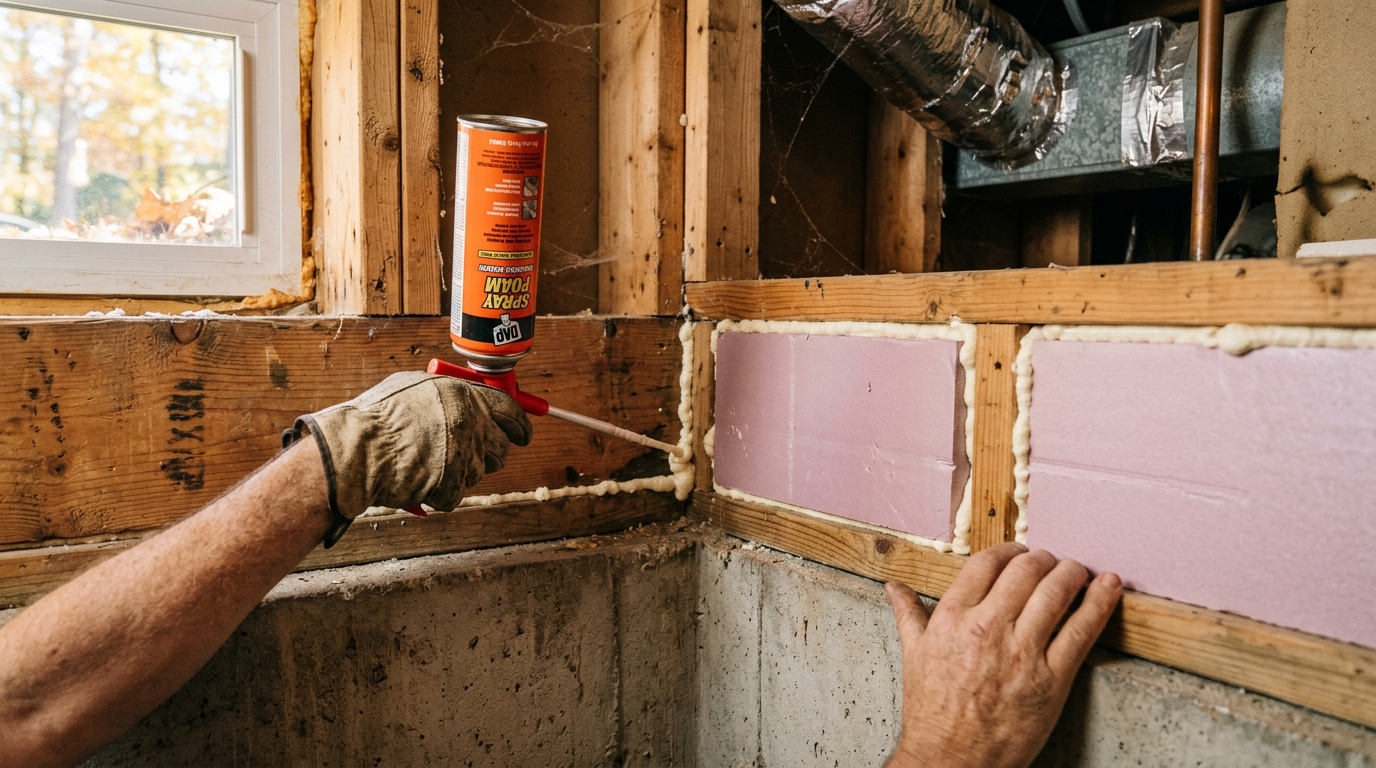
- Using a can of low-expansion spray foam (choose low-expansion to avoid warping wood), seal all gaps along the top of the foundation wall, along the edges of the rim joist boards, and around any pipes or wires penetrating the area.
- Allow foam to cure for at least one hour, then trim any excess with a utility knife so the surface is flush with the framing.
- Check your work on a cold day by holding your hand near the treated area. You should feel no cold airflow if sealing was complete.
- Purchase 2-inch foil-faced polyisocyanurate (polyiso) rigid foam board from a home center. One 4×8 sheet covers roughly 32 square feet of rim joist and costs $25 to $35.
- Measure each rim joist bay (the rectangular opening between floor joists) individually. Bays vary slightly in width, so measure each one rather than cutting identical pieces.
- Cut foam pieces using a utility knife and straight edge or a circular saw with a fine-tooth blade. Cut each piece about 1/4 inch smaller than the bay opening on all sides to allow room for spray foam to seal the edges.
- Press each foam piece snugly into its bay, foil side facing into the basement (toward you). The foam should sit flush with or slightly recessed from the face of the floor joists.
- Run a bead of low-expansion spray foam around the entire perimeter of each foam plug, sealing it to the framing on all four sides. This is the air sealing step and must be thorough.
- Allow foam to cure for one hour. On a cold day, feel around each plug for drafts. Re-apply spray foam to any spots where you still feel air movement.
- Get at least two quotes from insulation contractors who specialize in spray foam. Ask specifically for closed-cell foam at the rim joists and confirm they will also seal the sill plate to foundation junction.
- Before the crew arrives, clear all stored items from the basement perimeter so contractors have unobstructed access to the rim joist zone.
- Ensure the contractor applies a minimum of 2 inches of closed-cell foam, which delivers approximately R-13 to R-14 and qualifies as a Class II vapor retarder at that thickness.
- Ask the contractor to also address the sill plate (the horizontal lumber resting on the foundation) and any penetrations for pipes, wires, and HVAC ducts in the same zone.
- After the job is complete, confirm the foam is smooth and fully adhered with no voids. Closed-cell foam should appear hard and uniform with no soft or spongy spots.
- Check whether your state or utility offers rebates for professional air sealing. Many utilities offer $100 to $300 rebates that can significantly offset the project cost.
Why It Works: The Benefits
DOE data shows that sealing and insulating rim joists can reduce heating and cooling costs by 10 to 20% annually, often saving $150 to $400 per year in colder climates depending on home size and fuel type.
Eliminating cold air infiltration at the rim joist removes the primary source of drafty floors above the basement, making the first floor noticeably more comfortable without touching the thermostat.
Air sealing the rim joist prevents warm moist indoor air from reaching the cold wood surface, dramatically reducing condensation risk and the mold or rot that follows in chronically cold, damp rim joist bays.
Materials for a full rim joist treatment typically run $50 to $200 for an average home, with most homeowners recouping the cost within one to two heating seasons through reduced energy bills.
Sealing rim joists blocks a key pathway for outdoor dust, radon, insects, and noise to enter the living area. Homes with higher radon risk particularly benefit from thorough air sealing at the foundation level.
💰 Savings Impact by Action
Spray foam sealing rim joist gaps without added insulation reduces infiltration-driven heat loss by up to 10% in homes with previously unsealed rim joists.
Cut-and-cobble rigid foam with spray foam edges achieves R-13 and can reduce whole-home heating and cooling costs by up to 20% according to DOE air sealing data.
Professional closed-cell spray foam at 2 inches delivers R-13 plus vapor control, with savings comparable to DIY rigid foam but with superior adhesion and longevity.
Pairing rim joist sealing with attic air sealing addresses the two largest infiltration zones in most homes, combining for up to 35% reduction in heating energy use.
🏠 Key Concepts Explained
The Science Behind It
Rim joists lose heat through two distinct mechanisms that work together to rob your home of warmth. The first is conduction: wood transfers heat roughly 400 times faster than still air, so an uninsulated rim joist acts like a radiator fin, constantly moving warmth from your heated basement to the cold outdoors. Adding even 2 inches of rigid foam (R-13) between the wood and the cold air reduces this conducted heat loss by over 90% compared to bare framing.
The second and often larger mechanism is air infiltration driven by the stack effect. In winter, warm air inside your home is less dense than cold outdoor air, so it rises and escapes through high openings like attic bypasses, while cold exterior air is drawn in through low openings like rim joists and foundation gaps to replace it. This convective loop runs continuously, and the pressure difference is proportional to the height of the house and the temperature difference between inside and outside. On a 20-degree day in a two-story home, the pressure pulling cold air in through your basement rim joists can be equivalent to a constant breeze.
Rigid foam insulation works in this application because it addresses both problems simultaneously when properly air sealed at the edges. The foam itself provides R-value to slow conduction, while the spray foam perimeter seal eliminates the air gap that allows infiltration. Closed-cell foam goes a step further by also acting as a Class II vapor retarder, blocking the slow diffusion of water vapor through the assembly and keeping the structural wood dry. This is why building scientists consistently rank rim joist sealing among the highest-return air sealing investments available to homeowners in heating-dominated climates.
Frequently Asked Questions
▼ How do I know if my rim joists are already insulated?
Head to your unfinished basement or crawl space and look at the framing just above the top of the foundation wall. If you see exposed wood framing with nothing between the joists and the foundation, they are uninsulated. If you see fiberglass batts stuffed into the cavities, they are partially treated but almost certainly not air sealed. Rigid foam cut and sealed with spray foam around all edges is what you are looking for as a completed installation.
▼ Can I leave the old fiberglass batts in and just add rigid foam over them?
No. You should remove the fiberglass batts first. Fiberglass batts do not air seal, so leaving them in place while foaming over them traps any existing moisture behind the assembly and prevents proper adhesion of the foam to the framing. Removing the old batts takes about 15 minutes and ensures your new installation performs as intended.
▼ Will sealing my rim joists cause moisture problems in my basement?
Done correctly, the opposite is true. Most basement moisture problems are caused by air infiltration bringing humid outdoor air in contact with cold surfaces, so sealing the rim joist reduces that moisture source. The exception is if you have an active water intrusion problem such as groundwater seeping through the foundation wall. In that case, address the water source before insulating.
▼ How much rigid foam do I need to buy for an average home?
For a typical 1,500 to 2,000 square foot house, estimate approximately 150 to 200 linear feet of rim joist perimeter with 10-inch bays, which works out to 12 to 16 square feet of foam per 4×8 sheet. Two to three sheets of 2-inch rigid foam is usually sufficient for most homes, though it is worth buying an extra sheet to account for waste from cutting. One can of low-expansion spray foam should cover the sealing for the entire perimeter.
▼ My basement is finished with drywall. Can I still insulate the rim joists?
This depends on how the basement was finished. If the drywall stops short of the rim joist zone and you can see exposed framing above it, you can still access and insulate the bays directly. If the drywall runs all the way to the ceiling and covers the rim joist area, you would need to open a section to access it or hire a contractor with a spray foam rig that can inject foam through small holes without removing drywall. In fully finished basements, professional spray foam injection is often the most practical solution.
Quick Tips
- Tackle rim joists in fall before heating season begins so you benefit from the savings all winter long.
- If your basement has fiberglass batts stuffed into the rim joist bays, remove them before starting. Fiberglass does not air seal and often traps moisture against the wood, causing the exact rot problem you are trying to prevent.
- For crawl spaces with limited headroom, use pre-cut foam pieces sized slightly large and flex them into the bay for a friction fit before foaming the edges. This reduces the need to work precisely in a tight space.
- Check your utility company’s website for rebates before buying materials. Many gas and electric utilities offer $0.10 to $0.25 per square foot of air sealing work, which can cover a significant portion of material costs.
Variations for Your Situation
- Apartment or Condo: Renters and condo owners rarely have access to rim joists since these are structural elements managed by the building owner. If you have access to an unfinished basement storage area, document the insulation deficiency with photos and submit a written maintenance request to your landlord or HOA citing potential moisture damage risk. Focus instead on sealing gaps around basement windows and adding door draft stoppers at above-grade entrances, which can reduce air infiltration by 5 to 10% at zero or minimal cost.
- Tight Budget (under $50): Skip the rigid foam board and focus exclusively on spray foam air sealing, which costs $15 to $25 per can. Air sealing alone without adding significant R-value still delivers roughly half the energy savings of a full foam treatment by stopping infiltration, which is the dominant heat loss mechanism. Two cans of low-expansion foam are typically enough for an average basement perimeter. This approach pays back in weeks rather than months.
- Older Home (pre-1980): Homes built before 1980 often have irregular rim joist framing, thicker or non-standard bay widths, and sometimes multiple layers of wood from past renovations. Measure every single bay before cutting foam since dimensions will vary significantly. Watch closely for signs of rot, insect damage, and old wiring stapled to the rim joist, which should be evaluated by an electrician before you cover it. Budget for an extra sheet or two of foam to account for waste from odd-sized cuts.