That sluggish bathroom sink or shower drain is more than just an annoyance. Standing water harbors bacteria, creates odors, and if left untreated, a partial clog almost always becomes a full blockage within weeks. The typical American household spends $150 to $400 per year on drain cleaning products and plumber calls for issues that are almost always solvable with a few minutes of hands-on effort.
Chemical drain cleaners like those containing sodium hydroxide or sulfuric acid work by dissolving organic matter, but they also degrade PVC pipe joints, corrode older metal pipes, and leave toxic residue that ends up in your local water supply. They also fail completely against solid obstructions like hair mats, small objects, or grease buildup near the trap. Mechanical methods, by contrast, physically remove the clog rather than pushing it deeper.
This guide walks you through two proven approaches for clearing slow or completely blocked drains, covering bathroom sinks, showers, and tubs. You will learn which tool to use for which type of clog, how to prevent future blockages, and when the problem actually requires a licensed plumber. Most clogs clear in under 15 minutes with tools you likely already own.
What You’ll Need
Click on an item below to shop for the recommended items for this recipe on Amazon.
As an Amazon Associate, we earn from qualifying purchases.
How to Do It
- Put on a pair of rubber or disposable gloves before touching anything near the drain opening.
- Remove the drain stopper or screen. Most bathroom stoppers lift straight out, pop up with a twist, or unscrew with a single Phillips screwdriver. Set it aside and rinse it off.
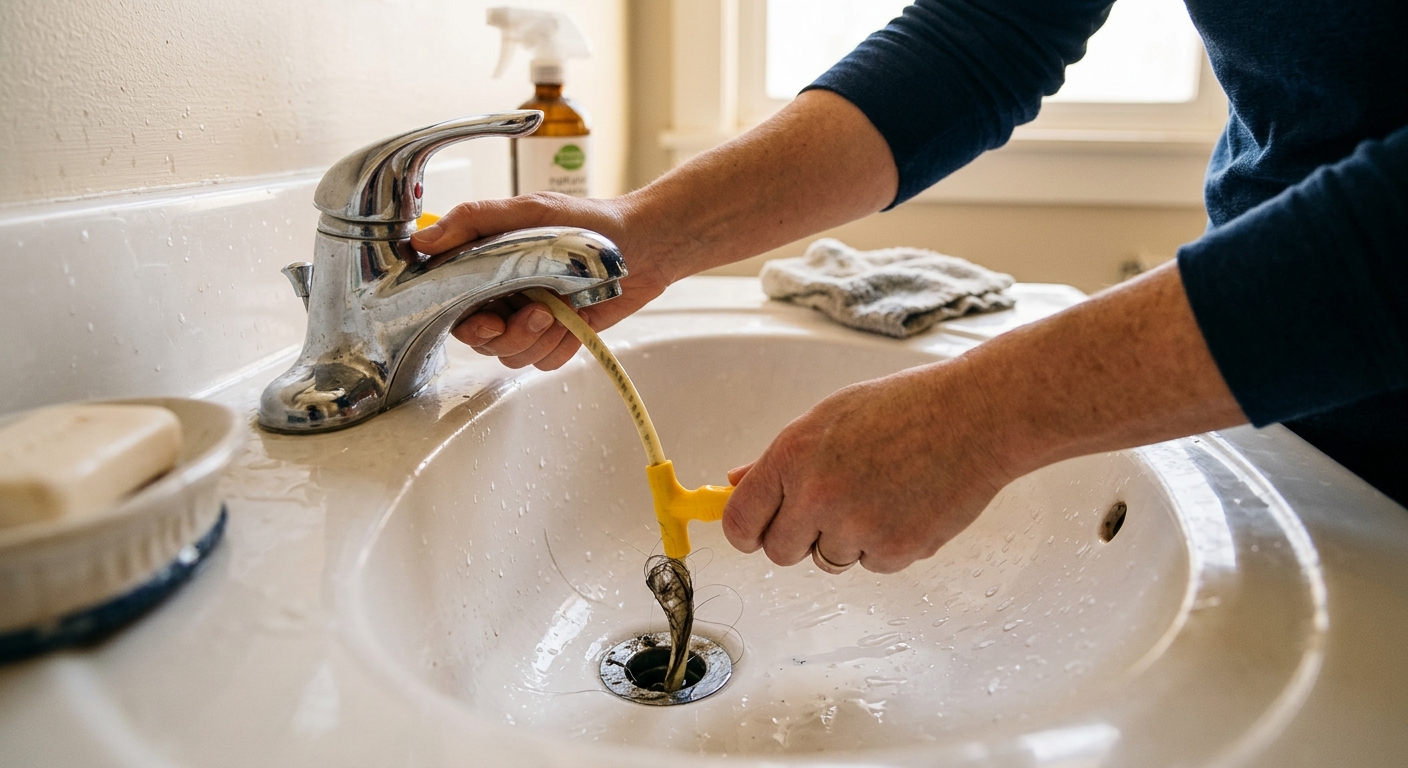
- Use a plastic drain snake, zip-it tool, or a straightened wire hanger with a small hook bent at the tip to probe 4 to 6 inches down into the drain. Rotate as you pull up to catch and extract the hair mat.
- Repeat the insertion two to three times until no more debris comes out. Dispose of the hair mass directly in the trash, never back down the drain.
- Boil a full kettle of water (approximately 4 cups) and slowly pour it down the drain in two or three stages, allowing 10 seconds between each pour. This flushes soap scum residue clinging to the trap walls. Skip this step for PVC pipes and use the hottest tap water instead.
- Run the tap at full pressure for 30 seconds to confirm the drain is flowing freely. Replace the stopper or screen.
- For a bathroom sink, block the overflow hole (the small hole near the top of the basin) with a wet rag or tape. This creates a sealed system so the plunger generates effective pressure rather than pushing air back out the overflow.
- Fill the sink or tub with 2 to 3 inches of water to cover the plunger cup. Place a standard cup plunger directly over the drain opening, ensuring a full seal around the rim.
- Plunge firmly with 15 to 20 short, rapid strokes, then pull up sharply to break the seal. Repeat this cycle three to four times. If the clog loosens, you will feel the water pull down quickly.
- If plunging does not clear the drain, feed a hand-crank drain snake (also called a drum auger) into the drain opening. Push it in slowly until you feel resistance, then crank the handle clockwise to hook or break apart the clog.
- Once you feel the resistance release, slowly retract the snake while continuing to crank clockwise. Pull the debris out completely and dispose of it in the trash.
- Run hot tap water at full pressure for 60 seconds to flush remaining debris through the trap. If flow is still slow, the clog may be farther down the line and a licensed plumber with a motorized auger or hydro-jetter may be needed.
Why It Works: The Benefits
A bottle of chemical drain cleaner costs $8 to $15 and rarely works on moderate or severe clogs, leading to repeat purchases. A drain snake or hair catcher costs $10 to $25 once and handles hundreds of clogs over its lifetime, saving the average household $100 to $300 per year.
Sodium hydroxide-based drain cleaners raise pipe temperatures to 250 degrees Fahrenheit during the reaction, which softens and warps PVC joints and accelerates corrosion in older metal pipes. Mechanical clearing involves zero heat or chemical reaction, making it completely safe for all pipe materials including PVC, ABS, copper, and galvanized steel.
Chemical treatments require 15 to 30 minutes of wait time and often require a second application, yet still leave debris inside the pipe. A drain snake or hair removal tool physically extracts the clog in 5 to 15 minutes with a single attempt, restoring full flow immediately.
Mechanical tools remove the entire clog mass rather than dissolving a channel through it. This means the drain stays clear 3 to 5 times longer between cleanings compared to chemical treatments, which leave residual buildup that re-clogs faster.
Liquid drain cleaners are classified as corrosive hazardous materials and cause chemical burns on skin contact and serious eye injury from splashing. Mechanical methods require only basic gloves, eliminating the risk of chemical exposure for you, children, and pets in the home.
💰 Savings Impact by Action
Switching to mechanical clearing eliminates $120 to $300 per year in repeat chemical drain cleaner purchases that rarely solve the root problem.
Up to 70% of drain service calls are for clogs that homeowners can clear themselves with a $15 to $25 tool, avoiding $150 to $400 minimum service fees.
Installing a silicone hair catcher over shower and tub drains prevents up to 90% of bathroom drain clogs from forming, nearly eliminating recurring drain maintenance.
Eliminating caustic chemical cleaners reduces accelerated pipe joint degradation, extending the serviceable life of PVC drain pipes by an estimated 20 to 30%.
🏠 Key Concepts Explained
The Science Behind It
The physics behind mechanical drain clearing comes down to one principle: remove the obstruction rather than trying to dissolve or flush it. A hair mat that has been building in a P-trap for months is held together by interlocking strands coated in soap scum, a waxy compound formed when fatty acid molecules in soap bond with calcium and magnesium ions in hard water. This matrix is dense enough to resist water pressure and partially resists sodium hydroxide, which is why chemical cleaners only punch a temporary channel through the mass rather than eliminating it.
A zip-it tool or drain snake works by physical engagement. The barbed edges of a zip-it catch individual hair strands on the way down and pull the entire bonded mass out as a unit on the way up. A drain snake’s auger tip either hooks the clog for extraction or rotates through it, breaking the bonded matrix into pieces small enough to flush. The rotational force from cranking the handle multiplies the applied torque significantly, allowing the cable to push through compacted debris that water pressure alone could never dislodge.
The baking soda and vinegar combination popular online produces a vigorous fizzing reaction, but the science is clear: acetic acid in vinegar and sodium bicarbonate neutralize each other to produce carbon dioxide gas, water, and sodium acetate. This reaction has essentially no ability to dissolve hair, cut through grease, or break apart solid debris. The fizzing creates the visual impression of aggressive cleaning, but studies show it delivers little more drain-clearing power than plain hot water. Mechanical tools are the only reliably effective non-chemical solution backed by consistent plumbing industry results.
Frequently Asked Questions
▼ I tried the zip-it and plunger and the drain is still slow. What else can I do?
If both methods fail, the clog is likely beyond the P-trap, sitting further down the branch drain line. Try a longer hand-crank drum auger that can reach 15 to 25 feet into the pipe. If that still does not resolve it, or if you notice gurgling sounds from nearby fixtures, the blockage may be in the main drain stack and you should call a licensed plumber who can use a motorized auger or hydro-jetter.
▼ Can renters unclog a drain without landlord permission?
Yes. Using a plunger, zip-it tool, or hand-crank drain snake is considered normal maintenance and does not constitute any modification to the property. You are not disassembling pipes or altering fixtures. Document the clog with a quick video before and after, and notify your landlord in writing if the issue recurs, since persistent clogs may indicate a building-level plumbing problem that is the landlord’s responsibility to fix.
▼ How do I know if the clog is in my drain or in the main sewer line?
If only one fixture is draining slowly, the clog is almost certainly local to that drain’s P-trap or branch line. If two or more fixtures are slow simultaneously, or if flushing the toilet causes water to back up in the tub or sink, you have a main sewer line blockage. Main line clogs require professional equipment and are not safely addressed with DIY tools.
▼ Why does my drain smell bad even after I cleared the clog?
The odor usually comes from biofilm coating the inside of the P-trap and drain pipe, or from a dry P-trap that has lost its water seal (common in guest bathrooms that are rarely used). Flush a cup of baking soda down the drain followed by hot tap water to help neutralize odors. For a guest bathroom, run the tap for 30 seconds to refill the trap, which blocks sewer gas from entering the room.
▼ Is it safe to use a drain snake in an older home with galvanized pipes?
Use a drain snake carefully in homes with galvanized steel pipes older than 40 years. Galvanized pipes corrode from the inside out, and the interior walls can be rough or partially collapsed. Feed the snake gently without forcing it, and do not use power attachments. If the snake meets resistance that feels like a pipe wall rather than a soft clog, stop and call a plumber, since you may be approaching a corroded section that needs replacement.
Quick Tips
- Clean your bathroom drain stoppers and hair catchers every week during your regular cleaning routine. It takes 30 seconds and prevents 90% of future clogs.
- Never pour cooking grease, bacon fat, or oil down any drain. Pour it into an empty can or jar, let it solidify, and throw it in the trash.
- Run the hot tap for 30 seconds after each use of a kitchen drain to help move grease and soap residue through the trap before it can solidify and accumulate.
- Keep a zip-it or plastic drain snake under every bathroom sink. A $3 tool that you have immediately available is far more useful than one you have to go buy when the drain is already backed up.
- If your home has hard water above 120 ppm, a monthly flush with a cup of baking soda followed by hot water (not vinegar) can help minimize mineral deposits on pipe walls, slowing the rate at which biofilm builds up.
Variations for Your Situation
- Apartment or Rental: Renters can safely use a zip-it tool, cup plunger, and hand-crank snake without landlord permission since no fixtures are modified. Avoid removing the P-trap entirely since reassembly errors can cause leaks that become a liability issue. A $3 silicone hair catcher installed over the drain opening (no tools required) is the single best renter-safe prevention measure available.
- Tight Budget (under $10): A wire coat hanger bent into a hook at one end works almost as well as a commercial zip-it tool for hair clogs and costs nothing. Combined with a kettle of hot water and firm plunging with any rubber plunger you already own, you can clear most bathroom drain clogs for zero dollars. The only purchase worth making at this budget is a $3 silicone drain screen to prevent future clogs.
- Older Home (pre-1980): Homes built before 1980 often have galvanized steel drain pipes with significant interior corrosion, making hair and grease clogs more frequent and harder to clear. Be gentle with snake tools to avoid snagging on rust. If clogs recur every few weeks despite regular clearing, the pipe interior may be so corroded that the effective diameter has shrunk significantly, and pipe replacement may be more cost-effective than ongoing maintenance. A plumber with a small camera inspection tool (typically $100 to $200) can confirm the pipe condition before you commit to replacement.