Electric baseboard heaters are among the least efficient ways to heat a home. At roughly 3 to 4 cents per kilowatt-hour more than the national average for gas heat equivalent, homeowners with all-electric baseboard systems often face heating bills 25 to 50% higher than neighbors with forced-air systems. But the money is only half the problem. Baseboard heat is notoriously slow to respond, stratifies warm air near the ceiling, and leaves floors cold, creating comfort complaints that no thermostat setting seems to fix.
The good news is that baseboard heat does have one genuine advantage: each room has its own independent heater and thermostat, which means you can dial in precise zone control without a major retrofit. Most homeowners never take advantage of this, leaving every heater cranked to the same setting and paying for heat in rooms that are rarely occupied. A few targeted changes to how you use and manage these heaters can make a dramatic difference in both comfort and cost.
This guide covers practical, low-cost strategies specifically designed for baseboard-heated homes, from free behavioral changes you can make today to weekend DIY upgrades in the $50 to $200 range. We will also cover the building science behind why baseboard heat feels so uneven, and what you can do to work with the system rather than against it.
What You’ll Need
Click on an item below to shop for the recommended items for this recipe on Amazon.
As an Amazon Associate, we earn from qualifying purchases.
How to Do It
- Walk every room and check that all furniture, rugs, and drapes are at least 6 to 12 inches away from each baseboard heater. Even partial obstruction cuts heat output significantly and creates a fire risk.
- Set unoccupied bedrooms and guest rooms to 60 to 62 degrees F using the existing wall or baseboard thermostat. Living areas and frequently used rooms can stay at 68 degrees F during the day.
- Set your bedroom thermostats to 65 degrees F at night rather than 68 to 70 degrees F. Most people sleep better in a cooler room, and this single change saves 3 to 5% per degree setback.
- Reverse your ceiling fan direction to clockwise and set it on the lowest speed. This gently pushes the warm air pooled at the ceiling back down to living level without creating a draft.
- Feel around window frames, door thresholds, and electrical outlets on exterior walls with your hand on a cold day. Mark any drafts you feel with tape or a sticky note for sealing later.
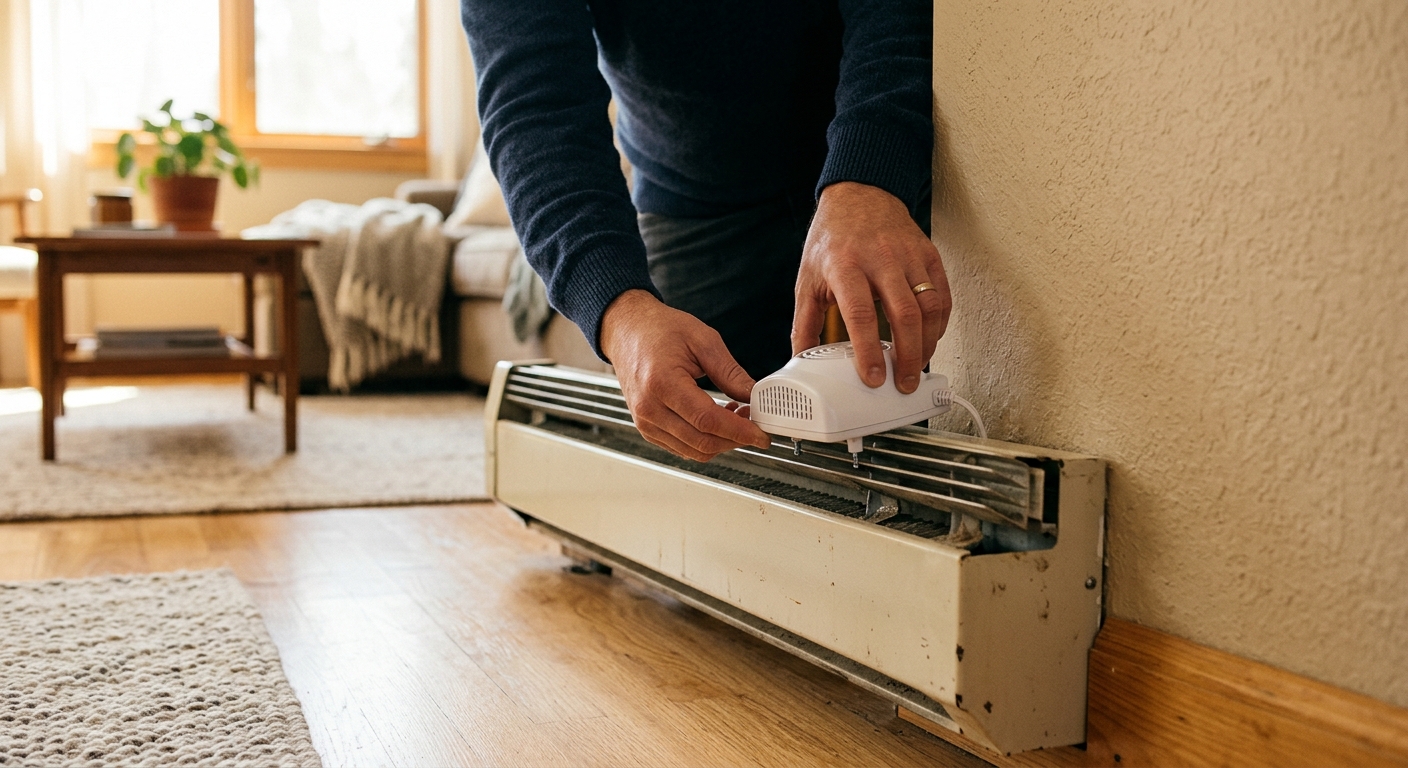
- Vacuum or brush the fins of every baseboard heater with a soft brush attachment. Dust and debris act as insulation and reduce heat output by 10 to 15%. Do this at the start of every heating season.
- Seal window perimeter gaps using a paintable acrylic caulk rated for interior use. Apply weatherstripping to door bottoms and sides where you felt drafts. A $6 tube of caulk and a $12 door sweep can stop more heat loss than an hour of extra heating.
- Add thermal or insulated curtains to large windows on north and west-facing walls. Close them at sunset and open them on sunny days to capture solar gain. Thermal curtains cost $25 to $60 per window and can reduce window heat loss by 25 to 40%.
- Replace imprecise bimetallic baseboard thermostats with electronic line-voltage thermostats such as the Cadet Electronic or King K321. These cost $35 to $65 each, control temperature to within 1 degree F, and many include setback scheduling. Replace only the thermostats in the rooms you use most for the best return.
- Install foam gaskets behind all electrical outlet and switch covers on exterior walls. These $3 packs take two minutes per outlet and block a surprising amount of cold-air infiltration.
- Check that your attic has at least R-38 insulation directly above living spaces. In baseboard-heated homes, a poorly insulated ceiling is the single largest source of heat loss. Adding blown insulation to reach R-49 can save 15 to 25% on heating and costs $0.50 to $1.50 per square foot DIY with rented equipment.
- Identify which rooms account for the most heating. Bedrooms, home offices, and living rooms are the best candidates. Hallways and bathrooms usually need only basic temperature maintenance.
- Purchase line-voltage smart thermostats compatible with 240-volt baseboard systems, such as the Mysa Smart Thermostat or Stelpro Ki. These cost $70 to $120 each and include app control, scheduling, and geofencing.
- Turn off the circuit breaker for the room you are working in and verify with a non-contact voltage tester. Remove the old thermostat and photograph the existing wiring before disconnecting anything.
- Install the new smart thermostat following the manufacturer’s wiring diagram. Most line-voltage smart thermostats connect to two hot wires and a ground, with no neutral required.
- Set up the app and program heating schedules tailored to each room’s actual use. Use geofencing to automatically drop temperatures when everyone leaves the house. The Mysa app reports estimated savings and tracks energy use per room.
- After 30 days review the energy data in the app and adjust schedules. Most homeowners find 2 to 3 rooms they were overheating and capture $10 to $30 per month in savings from scheduling alone.
Why It Works: The Benefits
Proper zone setbacks combined with air sealing can reduce electric heating consumption by 15 to 30%, translating to $150 to $400 in annual savings for a typical 1,500 square foot home paying average electricity rates.
Adding a small ceiling fan on low speed in reverse (clockwise in winter) pushes stratified warm air back down, reducing the floor-to-ceiling temperature difference from 10 degrees F to as little as 2 to 3 degrees F, making the room feel noticeably warmer at the same thermostat setting.
Replacing imprecise bimetallic thermostats with electronic line-voltage thermostats tightens the temperature swing to plus or minus 1 degree F, eliminating the 10 to 15 minute lag cycles that make baseboard heat feel sluggish and unpredictable.
Sealing window perimeter gaps and adding thermal curtains can cut radiant cold from windows by up to 40%, which directly reduces the chill you feel sitting near exterior walls regardless of thermostat setting.
Cleaning baseboard fins annually and ensuring clearance from obstructions prevents the overheating cycles that degrade heating elements, with replacement elements costing $30 to $80 each or full heater replacement at $150 to $400 installed.
💰 Savings Impact by Action
Setting unoccupied rooms to 60 to 62 degrees F and nighttime setbacks to 65 degrees F saves 3 to 5% per degree and adds up to 15% or more on a whole-home basis.
Sealing window perimeters, door thresholds, outlet gaps, and attic bypasses reduces heat loss by up to 20% in a typical baseboard-heated home with average leakage.
Replacing bimetallic thermostats with electronic line-voltage units tightens temperature control to 1 degree F, eliminating overshoot cycles and reducing runtime by roughly 10%.
Upgrading attic insulation to R-49 in a baseboard-heated home reduces ceiling heat loss by 15 to 25% depending on existing insulation depth.
Removing dust and debris from heater fins restores full heat output and reduces runtime by up to 12% in heaters that have not been serviced in several years.
🏠 Key Concepts Explained
The Science Behind It
Electric baseboard heaters are classified as convective heaters. They work by drawing cold air in at the bottom through a slot, passing it over a heated metal element, and allowing the warmed air to rise out the top by natural convection. No fan is involved, which makes them whisper-quiet but also means they depend entirely on the natural buoyancy of warm air to move heat around the room. Warm air is less dense than cool air, so it rises immediately toward the ceiling. In a leaky room with poor mixing, this creates a steep thermal gradient: the ceiling may be 75 degrees F while the floor sits at 62 degrees F, and your body, which is only 5 to 6 feet tall, feels most of the cold zone.
The fundamental challenge is that baseboard heat adds energy at the perimeter of the room at floor level, which is exactly where cold air infiltrates from windows and exterior walls. The heater pushes warm air up, cold air from the window pushes warm air out, and you get a constant loop that feels drafty even when the thermostat is satisfied. Stopping infiltration at the source by sealing window perimeter gaps and door thresholds directly reduces this loop, which is why air sealing almost always delivers better comfort than simply turning up the heat. A ceiling fan on low reverse speed breaks the stratification layer and forces the warm ceiling air back down, dramatically improving comfort without adding any energy input beyond the few watts the fan uses.
The accuracy of the thermostat is also more critical in a baseboard system than in a forced-air system. A forced-air furnace pushes a large volume of conditioned air through the house quickly, so a few degrees of thermostat error gets corrected fast. A baseboard heater responds slowly, and a bimetallic thermostat with a 5-degree F dead band means the room can cool 5 degrees F before the heater kicks on and overshoot 5 degrees F before it turns off. Electronic thermostats use a thermistor sensor accurate to within 1 degree F and a relay that switches cleanly at the setpoint, eliminating that wide temperature swing and making the room feel far more consistent.
Frequently Asked Questions
▼ My electric bill is sky-high but the house still feels cold. What is going wrong?
This combination almost always points to severe air leakage rather than a heater problem. The heaters are working hard but the heat is escaping as fast as it is produced. Start by checking the attic hatch, rim joists in the basement or crawlspace, and the top plates of interior walls in the attic, as these are the three largest air leakage points in most homes. If you can see daylight anywhere or feel a cold breeze near electrical outlets on exterior walls, you have found your problem. Sealing these areas before doing anything else will have the most dramatic effect on both bills and comfort.
▼ One room with a baseboard heater never gets warm no matter how high I set the thermostat. Why?
The most common causes are a failed heating element, a faulty thermostat, or a tripped circuit breaker. First check the breaker panel for that circuit. If the breaker is fine, feel the heater after it has been running for 10 minutes. If the unit is completely cold, the element has likely failed and needs replacement (a $30 to $80 DIY fix). If the heater gets warm but the room stays cold, the issue is almost certainly air leakage around windows or an exterior wall with inadequate insulation.
▼ Can I use a smart thermostat like Nest or Ecobee with my baseboard heaters?
No, standard smart thermostats are designed for low-voltage systems (24 volts) used with furnaces and heat pumps. Baseboard heaters run on 240-volt line-voltage circuits and require a thermostat specifically rated for that voltage. Use line-voltage smart thermostats like the Mysa or Stelpro Ki instead. They offer the same app control, scheduling, and geofencing features as Nest and Ecobee but are built for baseboard systems.
▼ My baseboard heaters make a ticking or popping noise when they start up. Is this a problem?
Light ticking and popping as the heater warms up is normal thermal expansion and not a safety concern. If the noise is loud, persistent, or accompanied by a burning smell, turn off the heater at the circuit breaker immediately. A burning smell usually means dust on the element (clean it with a vacuum), contact with an object that has shifted near the heater, or a failing element. Persistent loud banging can indicate a loose heating element bracket and should be inspected before continued use.
▼ How long will it take to see lower electric bills after making these changes?
Behavioral changes like thermostat setbacks and furniture clearance will show up in your next full billing cycle, typically within 30 days. Air sealing improvements take one full cold month to fully show up in your bill since savings compound over heating hours. Thermostat upgrades deliver measurable results within the first month. For a full picture, compare your kilowatt-hour consumption from the same month last year rather than the dollar amount, since utility rates fluctuate.
Quick Tips
- Keep interior doors open in rooms you are actively heating so warm air can circulate more freely and reduce the load on individual heaters.
- Place a door draft stopper at the base of exterior doors in rooms you are temporarily setting back. This prevents cold air from creeping under the door and chilling the floor.
- On sunny winter days, open south-facing blinds fully to capture free solar heat and allow the baseboard heater in that room to cycle less frequently.
- Check the amperage rating of your existing thermostats before buying replacements. Most 240-volt baseboard thermostats are rated for 2,000 watts or 3,750 watts. Using an undersized thermostat on a high-wattage heater is a fire hazard.
Variations for Your Situation
- Apartment or Rental: Renters in baseboard-heated units can capture most of the savings without any modifications. Focus on thermal curtains ($25 to $60 per window), ceiling fan direction reversal (if fans are present), draft stoppers under exterior doors, and turning down individual room thermostats in unoccupied spaces. These require no tools and no landlord permission. Plug-in door draft detectors and removable window film insulation kits are also renter-safe and available for under $20 at hardware stores.
- Tight Budget (under $50): Start with the three highest-return zero-cost changes: furniture clearance from all heaters, thermostat setbacks in unused rooms, and ceiling fan reversal. Then spend $6 on a tube of caulk for the worst window gaps and $3 on a pack of outlet gaskets. These four steps alone can cut heating consumption by 10 to 15% with no other investment.
- Older Home (pre-1980): Older baseboard-heated homes often have single-pane windows, minimal wall insulation, and high air leakage rates, meaning your baseline heat loss is significantly worse than a newer home. Prioritize air sealing in the attic and basement rim joists before upgrading thermostats. Consider adding interior window insulation film or secondary glazing panels to single-pane windows for $15 to $30 per window, which can cut window heat loss by 30 to 50%. Check for aluminum wiring before attempting any thermostat work and consult an electrician if you find it.