If your water heater has started sounding like a bowl of Rice Krispies or a low rumble you can hear from across the house, you are not imagining things. That popping, cracking, or rumbling noise is one of the most common water heater complaints homeowners have, and the good news is that the cause is almost always the same: sediment. Over time, minerals naturally present in your water supply, primarily calcium and magnesium, settle to the bottom of your tank and harden into a crusty layer. When the heating element or burner fires up, water trapped beneath that crust boils and forces its way through, creating those alarming sounds.
Beyond the noise, sediment is quietly costing you money every single month. The Department of Energy estimates that a heavily sediment-laden tank can lose 10 to 15% of its heating efficiency because the burner or element has to work harder and longer to heat water through an insulating layer of mineral buildup. On a typical household water heating bill of $400 to $600 per year, that is $40 to $90 in wasted energy annually. Worse, sustained overheating accelerates tank corrosion and can cut years off the life of a unit that should last 10 to 15 years.
In this post, we will explain exactly why sediment accumulates, how serious the problem is based on your water type and heater age, and walk you through two approaches to fix it: a quick partial flush you can do in about 5 minutes with no tools, and a full tank flush that delivers a deeper clean in under 30 minutes. We will also cover when the noise might signal something more serious, and what to do if flushing does not solve the problem.
What You’ll Need
Click on an item below to shop for the recommended items for this recipe on Amazon.
As an Amazon Associate, we earn from qualifying purchases.
How to Do It
- Turn the water heater’s thermostat dial to the lowest setting or ‘Vacation’ mode to avoid reheating during the flush.
- Locate the drain valve at the bottom of the tank. It looks like a hose bib or spigot, usually with a flat-head slot or a handle.
- Place a bucket beneath the drain valve or attach a short garden hose to direct water to a floor drain or outside. The water will be hot, so keep hands clear.
- Open the drain valve and let 2 to 3 gallons flow out. Watch the water in the bucket. You may see tan or brown sediment particles.
- Close the drain valve firmly when the water runs mostly clear. Do not overtighten if it is plastic, hand-tight is sufficient.
- Return the thermostat to your normal setting (120°F recommended) and allow the tank to reheat fully before using hot water.
- Turn off the cold water supply valve at the top of the heater. For gas heaters, set the gas valve to ‘Pilot.’ For electric heaters, switch off the dedicated breaker in your electrical panel.
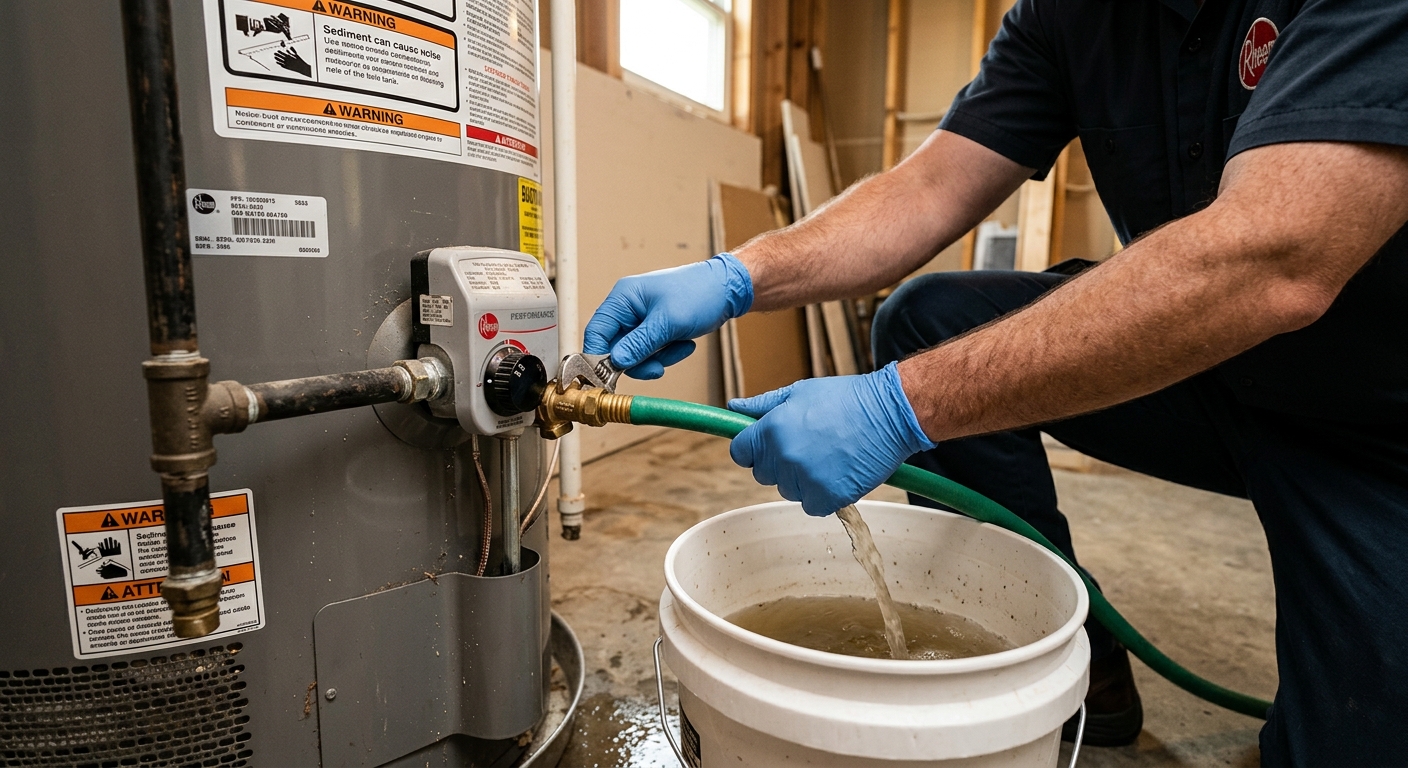
- Connect a garden hose to the drain valve and run it to a floor drain, utility sink, or outdoors. The water will be very hot (up to 140°F), so avoid contact with skin and keep children away.
- Open a hot water faucet somewhere in the house, such as a bathroom sink, to break the vacuum and allow the tank to drain freely.
- Open the drain valve fully and allow the entire tank to drain. A 40-gallon tank takes roughly 10 to 20 minutes. You will likely see sediment, discolored water, and possibly small mineral chunks early in the drain.
- Once drained, briefly reopen the cold water supply valve for 2 to 3 minutes while the drain is still open. This stirs up any remaining sediment and flushes it out. Repeat until the water runs clear.
- Close the drain valve, disconnect the hose, and fully reopen the cold water supply to refill the tank. Keep the hot water faucet open until water flows steadily from it, confirming the tank is full and air is purged.
- Restore power or relight the pilot according to your manufacturer instructions. Set the thermostat to 120°F. The tank will reach temperature in 30 to 90 minutes depending on the unit.
- Call a licensed plumber to schedule a water heater service. Ask specifically for a flush, anode rod inspection, and pressure relief valve test.
- The technician will perform a full flush and use a shop vacuum or wet-dry vac to remove compacted sediment that a gravity drain cannot shift.
- The anode rod will be inspected and replaced if more than 50% depleted. A new anode rod costs $20 to $50 in parts and adds years of corrosion protection.
- The temperature and pressure relief (TPR) valve will be tested and replaced if it has not opened in years, as stuck TPR valves are a safety hazard.
- Ask the technician about your water hardness and whether an inline sediment filter or water softener would make sense for your home, especially if you are on well water.
Why It Works: The Benefits
Removing sediment restores direct heat transfer to the water, reducing runtime by enough to cut water heating costs by 10 to 15%. On an average $500 annual water heating bill that is $50 to $75 back in your pocket each year.
Annual flushing can extend a tank’s useful life by 2 to 5 years, deferring a $800 to $1,500 replacement. That is one of the highest-return maintenance tasks a homeowner can perform.
Eliminating the sediment layer stops the nucleate boiling that causes popping and rumbling, often resolving the noise completely within a day or two of flushing.
A clean tank heats water more efficiently, meaning the first-hour delivery rating is restored and you are less likely to run out of hot water during back-to-back showers.
Sediment-driven overheating is a leading cause of premature tank failure. Removing it reduces stress on the tank liner, lowering the risk of a catastrophic leak that can cause thousands of dollars in water damage.
💰 Savings Impact by Action
Removing sediment buildup restores direct heat transfer and can reduce water heating energy consumption by 10 to 15% annually.
Lowering the thermostat from 140°F to 120°F saves 4 to 22% on water heating costs and slows future sediment formation.
Insulating the first 6 feet of hot and cold water pipes at the heater reduces standby heat loss and saves up to 4% on water heating bills.
Replacing a depleted anode rod prevents internal corrosion that shortens tank life, preserving efficiency gains and avoiding a $1,000-plus early replacement.
🏠 Key Concepts Explained
The Science Behind It
The popping noise your water heater makes is a textbook example of nucleate boiling in a confined space. As minerals precipitate from heated water and layer onto the tank floor, they create an uneven, porous crust. During heating cycles, water seeps into tiny voids within that crust and, because the crust insulates the bottom of the tank, the water directly touching the burner surface or element can locally exceed 212°F. This superheated water flashes to steam and bursts through the sediment layer in small explosive pops, exactly like what happens when you boil water in a pot that has residue on the bottom.
From an energy standpoint, sediment behaves like insulation in the worst possible location. Heat that should transfer directly into the water is instead absorbed by the mineral layer, then slowly conducted through it before reaching the water column above. The thicker the sediment, the worse this gets. Studies by the Gas Technology Institute found that just one inch of sediment on an electric water heater can increase energy consumption by 22% for that unit. Even modest quarter-inch buildup forces measurably longer heating cycles and reduces the tank’s effective capacity because the sediment occupies physical space at the bottom of the tank.
Water hardness is the primary driver of how fast your tank accumulates sediment. Water with a hardness above 120 mg/L (7 grains per gallon) is considered hard, and many U.S. municipalities deliver water in the 150 to 300 mg/L range. At those levels, a water heater set to 130°F or higher will precipitate enough calcium carbonate in 12 months to produce audible noise and measurable efficiency loss. This is why annual flushing is the universal recommendation from the American Water Works Association and water heater manufacturers, and why lowering your setpoint to 120°F is one of the simplest ways to slow sediment formation between flushes.
Frequently Asked Questions
▼ I flushed the tank but my water heater is still making noise. What now?
If the noise persists after a full flush, the sediment may be heavily compacted and too thick for a gravity drain to remove. Try the flush again with short cold-water bursts to agitate the tank floor. If noise continues, a professional with a wet-dry vacuum can extract compacted scale. Also consider whether your anode rod is depleted, as a corroding tank can produce hissing or rumbling that resembles sediment noise.
▼ Can I flush my water heater myself if I have a gas unit?
Yes, flushing a gas water heater is safe and follows the same steps as an electric unit. The key difference is that instead of tripping a breaker, you turn the gas valve to the ‘Pilot’ position rather than fully off. When you are done and the tank is refilled, simply turn the valve back to your desired temperature setting. Never set a gas heater back to full operation with an empty tank, and always relight the pilot according to the label instructions on the unit if the flame went out.
▼ How long before I notice savings on my energy bill after flushing?
You should see improvement within the first one to two billing cycles, which is typically 30 to 60 days. The savings show up as shorter burner run times and lower gas or electric consumption. If you have a smart energy monitor or can track your utility data online, you may notice reduced water heating energy draw within the first few days after the flush.
▼ What if my drain valve is stuck or leaking after I open it?
This is common on tanks over 8 years old. If the valve leaks after closing, wrap the threads with PTFE plumber’s tape and tighten gently. If it continues to drip or will not open at all, replace the valve with a brass ball valve of the same thread size (usually three-quarters inch). This is a straightforward repair costing under $15 in parts, but you will need to fully drain the tank first or call a plumber if you are not comfortable working with the water supply shut off.
▼ Is a water heater popping noise ever dangerous?
In most cases, no. Sediment noise is a maintenance issue, not a safety emergency. However, if you hear a loud banging or hammering sound (water hammer from pressure spikes), a hissing near the TPR valve, or see water pooling around the base of the tank, those are different problems that warrant immediate attention. A weeping TPR valve or corroded tank seam should be evaluated by a licensed plumber the same day.
Quick Tips
- Set a calendar reminder to flush your water heater every 12 months, or every 6 months if your area has hard water above 7 grains per gallon.
- Lower your thermostat to 120°F. It is the EPA-recommended temperature for safety and comfort, slows mineral precipitation, and saves 4 to 22% on water heating costs versus a 140°F setting.
- If you are not sure of your water hardness, your municipal water utility publishes an annual water quality report with hardness levels. You can also buy a simple test strip kit for under $10.
- After a full flush, wrap exposed hot water pipes with foam pipe insulation ($5 to $10 at hardware stores) to reduce standby heat loss and get hot water to faucets faster.
Variations for Your Situation
- Apartment or Rental: Most renters do not have access to or responsibility for the water heater. Report the noise to your landlord or property manager in writing and request a flush or service call. In the meantime, you can reduce your own hot water use with a low-flow showerhead ($15 to $30) and ask your landlord to lower the thermostat to 120°F if it has been set higher, which benefits both parties by reducing scalding risk and energy costs.
- Tight Budget (under $20): The partial flush approach in this guide costs nothing and requires only a bucket or short hose you likely already own. Do the 5-minute partial flush every 3 to 4 months instead of a single annual full flush. Also lower your thermostat to 120°F today at zero cost. These two steps alone can recover 8 to 12% of water heating efficiency without spending a dollar.
- Older Home (pre-1990 water heater): If your water heater is more than 10 to 15 years old and has never been flushed, skip the DIY approaches and call a plumber directly. Attempting a first-ever flush on a very old tank risks a drain valve that will not reseat, a tank body that is already corroding internally, or discovering that the unit needs immediate replacement. A professional can assess the situation safely and advise on whether a flush makes sense or whether replacing it with a modern unit (which can be 30 to 50% more efficient) is the better investment.