Most homeowners know they’re supposed to change the air filter, but few realize what happens when they don’t. A dirty filter doesn’t just let dust build up in your ducts. It restricts airflow to your HVAC system, forcing the blower motor to strain against the resistance, running longer cycles just to move the same amount of air. The Department of Energy estimates a clogged filter can increase energy consumption by 5 to 15%, which on a typical $150 monthly cooling bill translates to $8 to $22 wasted every single month.
Beyond the bill, restricted airflow causes your evaporator coil to get too cold and freeze over, your heat exchanger to overheat, and your compressor to work under stress it was never designed to handle. A $10 filter left unchanged for six months can snowball into a $400 coil cleaning, a $1,200 compressor repair, or an early system replacement. The filter is the cheapest insurance policy in your house.
In this post, you’ll learn exactly how to check your filter, how often to replace it based on your specific home and household, and how to set up a simple system so you never forget again. Whether you want a two-minute fix today or a smarter long-term maintenance routine, both approaches are covered with real numbers so you can see the payback for yourself.
What You’ll Need
Click on an item below to shop for the recommended items for this recipe on Amazon.
As an Amazon Associate, we earn from qualifying purchases.
How to Do It
- Turn your thermostat to OFF or switch the system fan to OFF before touching the filter to avoid pulling loose debris into the system.
- Locate the filter slot, typically at the return air grille on the wall or ceiling, or at the air handler unit itself in a closet, attic, or basement.
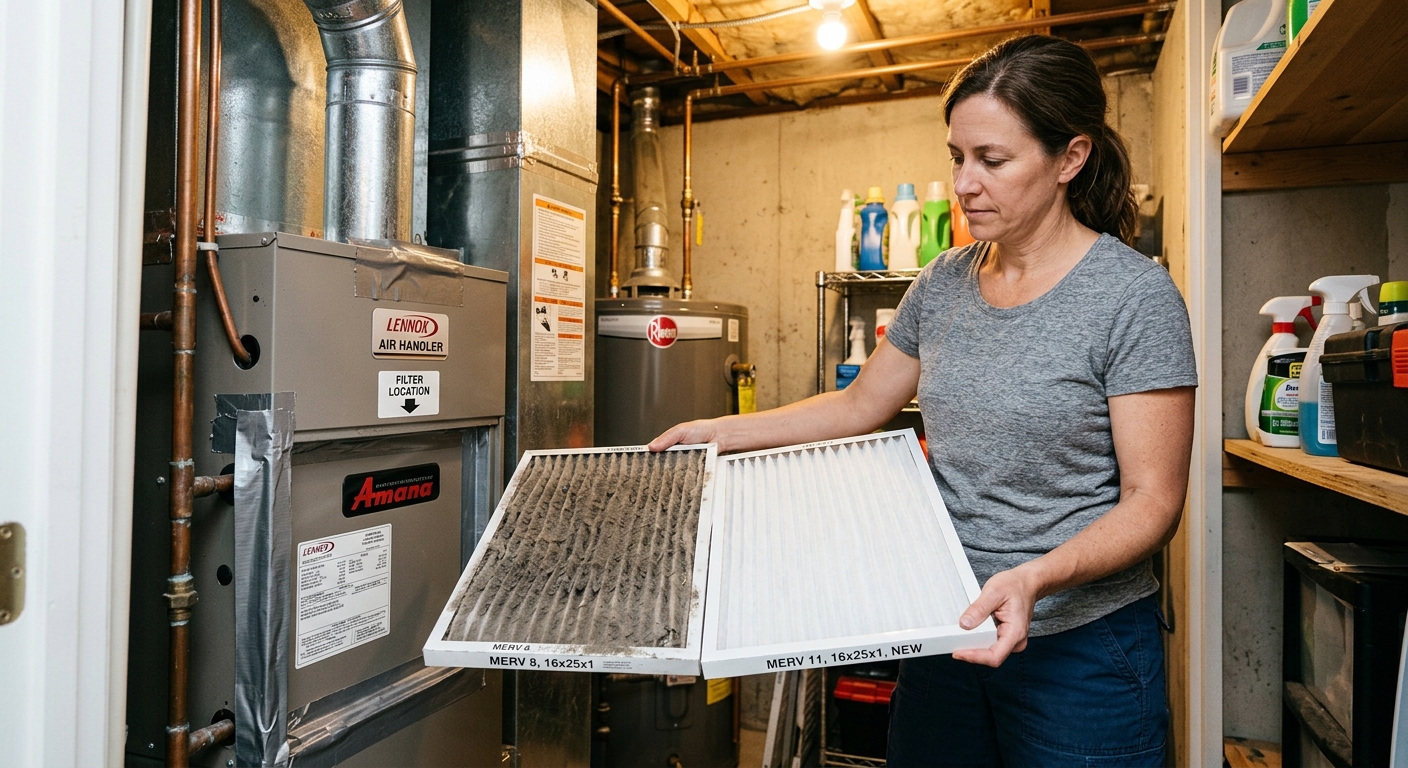
- Slide the old filter out and note the size printed on the frame (e.g. 16x25x1). Hold it up to light. If you cannot see light through it clearly, it needed replacing.
- Insert the new filter with the airflow arrow on the frame pointing toward the air handler and away from the return duct.
- Write the replacement date on the edge of the filter frame with a marker so you have a visible record without relying on memory.
- Turn the system back on and stand near a supply vent to confirm noticeably stronger airflow within a few minutes.
- Check your filter size and buy a 6-pack or 12-pack of the correct size in MERV 8 to 11 from a hardware store or online. Bulk pricing typically drops the per-filter cost to $4 to $8 each versus $12 to $20 individually.
- Store the extra filters directly next to the air handler or tape one to the side of the unit so they are in sight and within arm’s reach at swap time.
- Set a recurring calendar reminder on your phone every 60 days for a 1-inch filter, every 90 days for a 2-inch filter, and every 6 months for a 4 to 5-inch media filter. Adjust shorter (30 to 45 days) if you have pets or allergy sufferers in the home.
- On reminder day, do a 10-second visual check. Hold the filter up to a window. If it is gray and you cannot see through it, replace it. If it still looks light tan, wait another 30 days.
- Log each replacement in a notes app or on a paper calendar taped to the utility room wall. If you ever notice reduced airflow or longer system runtimes, you will have a maintenance record to show a technician.
- Once per year when you replace the filter, take 60 seconds to wipe down the return air grille with a damp cloth to prevent the grill itself from restricting airflow.
Why It Works: The Benefits
Replacing a heavily clogged filter can reduce HVAC energy consumption by 5 to 15% immediately, saving $8 to $22 per month on a $150 cooling bill with no other changes.
Proper airflow reduces stress on the compressor and blower motor, the two most expensive components in an HVAC system. A well-maintained filter schedule can add years to a system’s life, deferring a $5,000 to $10,000 replacement.
A fresh filter actively traps pollen, dust mite debris, and pet dander. Homes with pets or allergy sufferers see measurable improvements in airborne particulate levels within 24 to 48 hours of a filter swap.
Restoring full airflow allows the system to deliver conditioned air to all rooms as designed. Hot or cold spots caused by low airflow often disappear after a simple filter replacement.
Coil cleanings run $100 to $400, blower motor replacements run $400 to $600, and compressor failures can cost $1,200 to $2,800. A $6 to $20 filter replaced on schedule prevents all of these failure modes.
💰 Savings Impact by Action
Replacing a severely clogged filter restores full airflow and can reduce HVAC energy consumption by up to 15% immediately according to the U.S. Department of Energy.
Keeping the evaporator coil free of dust by maintaining a clean filter preserves heat transfer efficiency and prevents a 5 to 10% loss in cooling capacity.
Restoring proper airflow shortens each cooling cycle, reducing total compressor runtime by an estimated 10 to 12% over a full summer season.
Consistent filter changes prevent coil freeze events and premature compressor wear, avoiding repair costs that effectively inflate your annual home energy and maintenance budget by 8% or more.
🏠 Key Concepts Explained
The Science Behind It
Your HVAC system is essentially a big air pump. The blower motor pulls return air from your living space, pushes it across the evaporator coil where heat is removed, and delivers cooled air back through your supply ducts. Every component in that chain, from the blower wheel to the coil fins, is sized to handle a specific volume of air per minute, measured in CFM (cubic feet per minute). A dirty filter is a physical obstruction that reduces the CFM the system can actually move, and everything downstream suffers as a result.
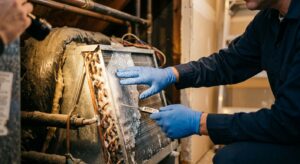
The evaporator coil is where the real damage happens. Refrigerant enters the coil as a cold, low-pressure liquid and absorbs heat from the airstream passing over it. When airflow is restricted, less warm air crosses the coil, the refrigerant absorbs less heat, and coil surface temperature drops below freezing (32 degrees F). Moisture in the air then freezes onto the coil fins instead of draining away as condensate. Ice acts as insulation, further reducing heat transfer efficiency, which causes more freezing in a feedback loop that eventually blocks the coil completely. At that point your system blows warm air and your compressor is pumping refrigerant through a partially blocked circuit under abnormal pressure, which is one of the leading causes of premature compressor failure.
The energy cost is straightforward thermodynamics. The blower motor is rated to move air at a specific resistance level. As filter resistance increases, the motor draws more current to maintain airflow, operating less efficiently on its power curve. Meanwhile, longer runtimes mean the compressor is also running more, which is the single largest electricity draw in your home, typically 2,000 to 5,000 watts. Cutting even 10 minutes off each cooling cycle by restoring proper airflow adds up to meaningful savings over a full summer season.
Frequently Asked Questions
▼ I just changed my filter but my AC is still running constantly. What’s wrong?
A fresh filter restores airflow but won’t fix problems caused by months of restricted airflow. Check whether the evaporator coil is iced over by looking at the refrigerant line near your air handler for frost or ice. If the coil is frozen, turn the system off and run the fan only for 2 to 4 hours to thaw it, then restart. If the system still runs excessively after that, low refrigerant or a failing compressor may be the issue and you should call an HVAC technician.
▼ How do I know what MERV rating to use for my system?
Check your air handler or furnace manual first since many manufacturers specify a maximum MERV rating. As a general rule, MERV 8 works well for most homes, MERV 11 is appropriate if you have pets or mild allergies, and MERV 13 should only be used in systems with variable-speed blowers or where the manufacturer specifically approves it. If you are unsure, calling your HVAC company and asking takes about two minutes and prevents a costly mistake.
▼ Can renters ask their landlord to replace the filter or do it themselves?
In most lease agreements, filter replacement is the tenant’s responsibility or at minimum permitted without landlord approval since it involves no permanent modification. Buying and installing your own filter is typically a safe and welcome action. If you are not sure, a quick text to your landlord asking to confirm the filter size and replacement schedule takes 30 seconds and documents that you are maintaining the unit responsibly.
▼ How long before I see savings on my electric bill after changing the filter?
Savings begin immediately on the next full billing cycle. Because most utilities bill monthly, you will see the difference within 30 days on a summer cooling bill. The savings will be most noticeable if the old filter was severely clogged and your system had been running long cycles to compensate. A mid-cycle change may show partial savings on the first bill and full savings on the second.
▼ My filter looks fine but my energy bill is still high. Could it be something else?
Yes. Dirty evaporator coils, refrigerant that is low by even 10%, duct leaks, and a failing capacitor on the compressor can all inflate runtime and energy use without affecting the filter. A whole-home energy audit or a standard HVAC tune-up ($80 to $150) will identify the root cause. Annual maintenance typically pays for itself in one cooling season through improved efficiency alone.
Quick Tips
- Set a phone reminder rather than relying on memory. Filter replacement rates drop dramatically when there is no external reminder system in place.
- Homes with one or more dogs or cats should plan on 30 to 45 day replacement cycles, not the 90 days printed on most filter packaging.
- If your return air grille is in the ceiling, keep a step stool nearby. Friction of access is the number one reason filters go unchanged for months.
- MERV 8 is the sweet spot for most residential systems. It captures the particles that matter most for system protection and air quality without significantly restricting airflow.
Variations for Your Situation
- Apartment or Rental: Most apartments use small 1-inch filters at a wall-mounted return grille, often in a hallway or living room. Check your lease, but replacement is almost always your responsibility. Buy a 4-pack of MERV 8 filters in the correct size (common sizes are 16x20x1 and 20x20x1) for $20 to $30 at any hardware store. Set a phone reminder every 60 days. This single habit can reduce your electricity bill by $8 to $15 per month during peak cooling season.
- Tight Budget (under $20): A single MERV 8 filter costs $6 to $10 and delivers immediate savings that exceed its cost within the first month. If budget is extremely tight, fiberglass filters cost as little as $2 to $4 each and are far better than nothing, though they only capture large particles. Prioritize getting any clean filter in place today over waiting for the perfect option. The cost of a dirty filter in wasted electricity is $8 to $22 per month, which dwarfs the cost of any filter on the market.
- Older Home (pre-1980): Homes built before 1980 often have oversized or non-standard return air grilles, duct systems that were never airtight, and air handlers that may be 20 or more years old with worn blower wheels. These systems are more sensitive to airflow restriction, not less, so filter replacement every 30 to 45 days is wise. Also inspect the filter slot for gaps and warping in older metal frames, since bypassed air is common in aging ductwork. Consider having an HVAC technician verify your system’s rated CFM and confirm the filter size and MERV rating your equipment can safely handle.