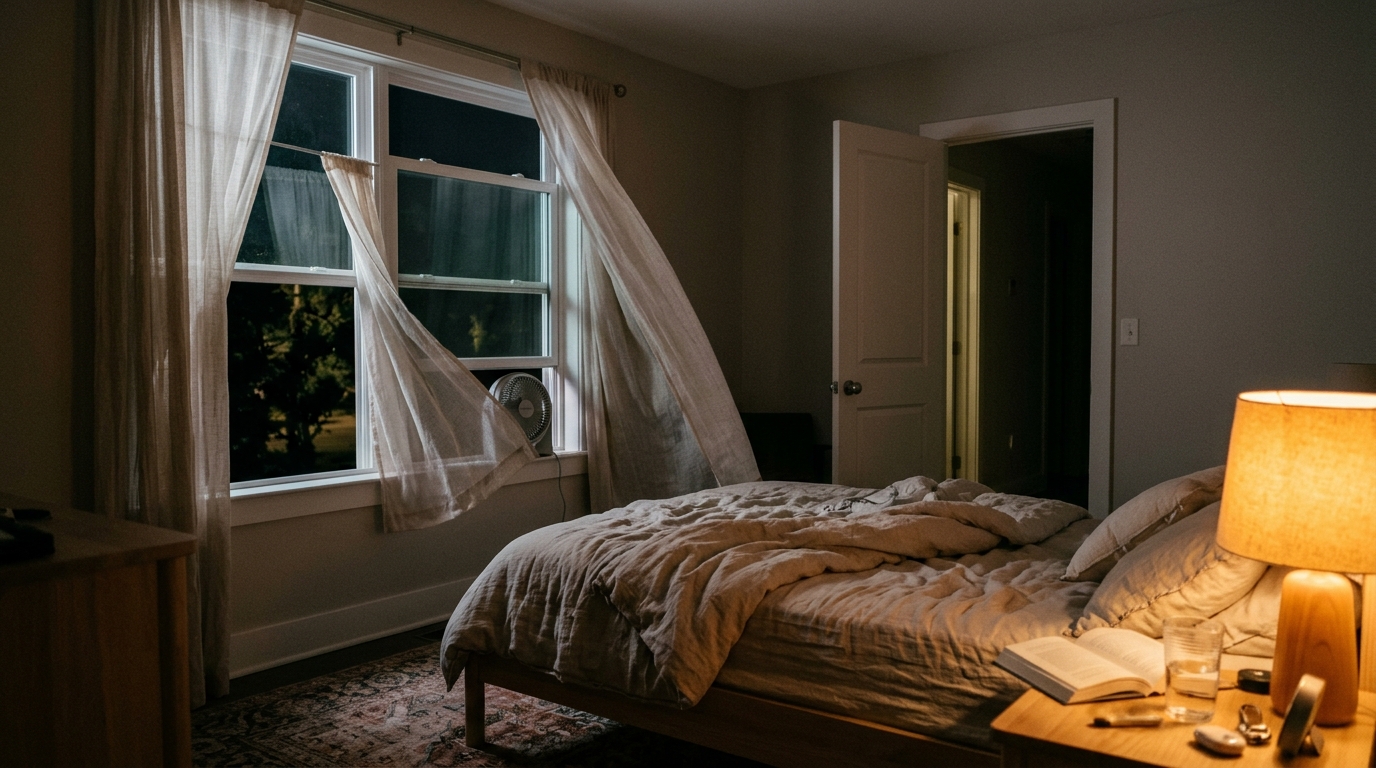
You know the feeling. The sun has gone down, the outdoor temperature has dropped into the 60s or low 70s, and your bedroom still feels like a warm cave. You crack one window, feel almost nothing, and give in to the AC. The problem is rarely the heat itself. It is that a single open window lets air in and out of the same opening, so it barely exchanges any air at all.
Cross-ventilation fixes this by giving air a complete path: an inlet where cool air enters and an outlet where warm air leaves. When you set up that path on purpose, even a light evening breeze or a cheap box fan can swap out the air in a bedroom several times per hour. The DOE notes that natural and fan-assisted ventilation can substantially reduce cooling needs in climates where nighttime temperatures drop below about 70 degrees F.
This post walks through two ways to do it: a no-cost quick fix you can start tonight, and a DIY upgrade with window fans and a few small additions that makes the setup more reliable. We also cover the building science behind why it works, when it will not work, and how to adapt it for apartments, tight budgets, and older homes.
What You’ll Need
Click on an item below to shop for the recommended items for this recipe on Amazon.
As an Amazon Associate, we earn from qualifying purchases.
How to Do It
- Check the outdoor temperature around dusk. Only start ventilating once it is cooler outside than inside, ideally below 75 degrees F.
- Open one window on the cooler, shaded side of the house, usually north or east facing. This is your intake. Open it about halfway.
- Open a second window on the opposite or adjacent wall, or open the bedroom door and a window elsewhere in the house, so air has a clear path through the room.
- Place a box fan in the outlet window facing outward, so it pushes warm air out and pulls cool air in through the intake. Run it on medium.
- Close interior doors to rooms you do not need to cool so the airflow concentrates through the bedroom.
- In the morning, close the windows and blinds before the outdoor temperature climbs above the indoor temperature to lock in the cool air.
- Buy two window fans or two box fans with window brackets. Look for models with reversible or dual-direction airflow and an adjustable speed control, typically $30 to $60 each.
- Choose your intake and outlet windows. Place one fan in the intake window facing inward and one in the outlet window facing outward, ideally on opposite sides of the room so air sweeps across the bed area.
- Use removable foam weatherstripping or cut foam board to fill gaps around the fans in the window frames, so air is forced through the fans rather than leaking around them. This improves airflow efficiency by 15 to 25%.
- Add an inexpensive plug-in timer or smart plug so the fans turn on at dusk and off before dawn, or install a simple temperature-triggered controller, about $15 to $30.
- Add window screens if your windows lack them, or a security stop or window lock so you can leave windows partly open safely overnight.
- Close blinds or add reflective shades on sun-facing windows during the day to prevent the room from baking, which gives your nighttime ventilation less heat to remove.
Why It Works: The Benefits
Replacing 4 to 6 hours of nightly AC with a 50 to 100 watt fan setup can save roughly $0.40 to $1.00 per night depending on your AC efficiency and electricity rates. Over a cooling season that adds up to $50 to $150.
Flushing a bedroom with outdoor air overnight typically lowers the room temperature 5 to 10 degrees compared with a closed-up room, and it reduces heat stored in walls and furnishings.
A box fan on low is often quieter than a window AC or the cycling of central AC, and constant air exchange reduces stuffiness and indoor pollutant buildup.
Fewer run hours means less strain on the compressor and longer system life. Cutting even 100 hours of annual runtime helps delay costly repairs.
A quality 20-inch box fan costs about $25 to $40 and uses roughly 50 to 100 watts, about one-tenth to one-twentieth of a typical central AC system.
💰 Savings Impact by Action
Replacing evening and overnight AC hours with fan-driven ventilation can cut cooling runtime by roughly 30 to 50 percent on mild nights.
A box fan uses about 50 to 100 watts compared with 2,000 to 4,000 watts for central AC, a roughly 90 to 95 percent reduction in power draw during operation.
Flushing the room with cool air lowers overnight bedroom temperature by 5 to 10 degrees, about a 20 percent improvement in comfort versus a sealed room.
Households that consistently ventilate on suitable nights often see around 10 to 15 percent lower summer cooling bills.
🏠 Key Concepts Explained
The Science Behind It
Heat flows from warmer to cooler objects, and air is a surprisingly effective carrier of that heat. During the day, your bedroom walls, ceiling, and furniture absorb solar and ambient heat. At night, if you simply leave the windows closed, the room stays warm because the stored heat has nowhere to go. Cross-ventilation replaces the warm indoor air with cooler outdoor air, and that new air pulls heat out of the room’s surfaces through convection.
The key is the pressure difference between the two openings. A fan in one window creates a small pressure imbalance, so air is drawn through the other opening and across the room. A single open window cannot do this effectively because incoming and outgoing air compete for the same opening, a problem building scientists call poor air exchange. Even a modest fan moving 1,000 to 2,000 cubic feet per minute can replace the air in a typical 12 by 14 foot bedroom with 8-foot ceilings, about 1,350 cubic feet, more than 40 times per hour at full speed.
Moving air also cools people directly. Air moving across your skin speeds evaporation of moisture, which carries away body heat, so a steady breeze can make a room feel 3 to 5 degrees cooler than the actual air temperature. That is why ventilation can feel dramatically better than the thermometer suggests. The method loses effectiveness when outdoor humidity is above roughly 70 percent or when nighttime lows stay above about 75 degrees F, which is why it works best in dry and temperate climates and during shoulder seasons.
Frequently Asked Questions
▼ Why is my AC still running all day even after I tried these fixes?
Cross-ventilation only removes heat when the outdoor air is cooler than the indoor air, so it will not help during the afternoon. Make sure you are closing windows and blinds by mid-morning, and run the AC only on the hottest hours. If the AC still runs constantly, check for attic heat gain and air leaks, which add far more load than a bedroom can shed overnight.
▼ Can renters do this without landlord permission?
Yes. Box fans and tension-mounted window fans need no installation, no drilling, and no permanent changes. Use removable foam strips for gaps and a window stop or lock for security, and check your lease for any rules about leaving windows open or blocking egress.
▼ How long before I actually notice savings on my bill?
You will feel the difference in your bedroom the first night. On your bill, expect to see about 5 to 15 percent lower cooling costs on the next billing cycle if you consistently replace several hours of nightly AC use, with larger savings in dry climates and shoulder seasons.
▼ What if my home is older than 30 years?
Older homes often have more window leakage and less attic insulation, so the cooling load is higher, but cross-ventilation can still work well, especially in houses with double-hung windows that allow both top and bottom openings. Prioritize sealing the attic and closing blinds during the day so the room starts the night cooler.
Quick Tips
- Place the fan in the window on the side of the house that is warmest or sunniest, and let the cool intake come from the shaded side, since the cooler side of the home will naturally supply the coolest air.
- Open a window a few inches on a different floor if you have two stories to add stack effect. Cool air enters low, warm air exits high.
- Keep bedroom doors open when running whole-house ventilation, or crack the door a few inches so air can complete its circuit through the room.
- Close windows and blinds by mid-morning once the outdoor temperature passes the indoor temperature, trapping the cooler overnight air inside.
Variations for Your Situation
- Apartment/Rental: Use a tension-mounted window fan ($30 to $50) in one window and open a second window or the front door with a security chain if the building allows it. A small plug-in fan on the floor aimed at the bed adds comfort for about $20 more. No installation or landlord approval needed.
- Tight Budget (under $50): Use the quick fix only. Open two windows on opposite sides at dusk, point one existing fan outward, close blinds on sun-facing windows by 9 a.m., and shut everything by mid-morning. A single $25 box fan is enough to start, and the quick fix itself costs nothing.
- Older Home (pre-1980): Take advantage of tall double-hung windows by opening the bottom sash on the cool side and the top sash on the warm side to create natural stack effect. Add an attic fan or whole-house fan ($300 to $800 installed) if you want to move large volumes of air, and seal attic bypasses first because older homes usually have more heat gain from above.