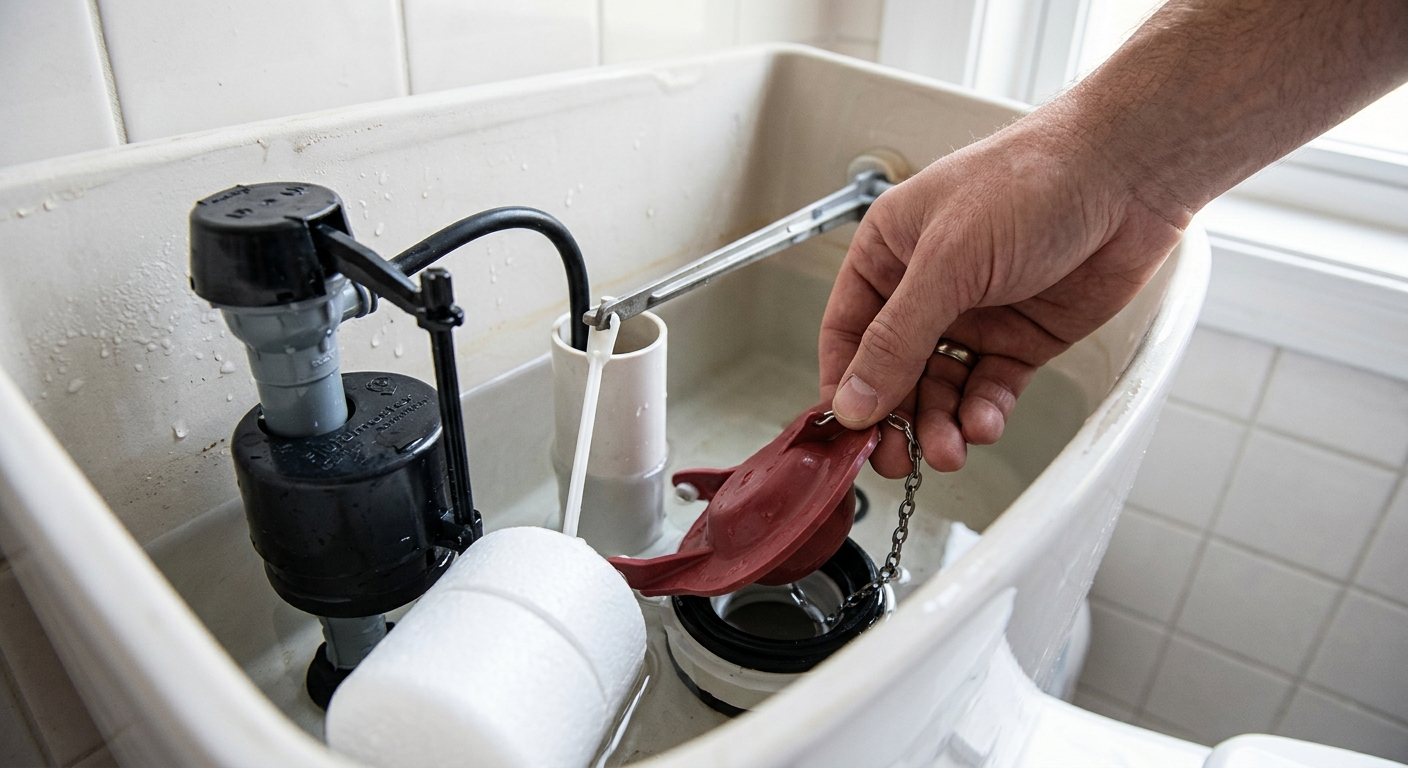
That faint hissing sound coming from your bathroom is not just annoying – it is costing you real money every single day. A constantly running toilet is one of the most common and most wasteful household problems, yet it is also one of the easiest to fix. According to the EPA, a single leaking toilet can waste up to 200 gallons of water per day, which adds up to roughly $840 per year depending on your local water rates.
The good news is that 90% of running toilet problems come down to just three parts inside the tank: the flapper, the fill valve, and the float. All three are inexpensive, widely available at any hardware store, and replaceable without a plumber. Most fixes take less than 10 minutes and cost under $15. Even a full tank rebuild kit runs just $20 to $30 and takes about an hour.
This guide walks you through diagnosing the exact cause of your running toilet and fixing it yourself, whether you have five minutes and no tools, or an afternoon and a willingness to do a more thorough repair. We will cover the quick checks, the DIY flapper swap, and when it actually makes sense to call a pro.
What You’ll Need
Click on an item below to shop for the recommended items for this recipe on Amazon.
As an Amazon Associate, we earn from qualifying purchases.
How to Do It
- Remove the tank lid and set it safely aside on a flat surface. Look at the water level – it should sit about 1 inch below the top of the overflow tube (the tall tube in the center of the tank).
- If water is spilling into or level with the overflow tube, bend the float arm downward slightly (on ball-float systems) or turn the adjustment screw on the fill valve counterclockwise to lower the water level. Flush and recheck.
- Inspect the chain connecting the handle arm to the flapper. It should have about 0.5 inch of slack. If it is too short or kinked, it holds the flapper open. Reattach it to a link that gives the right amount of slack.
- Press down firmly on the flapper with your finger while the toilet is running. If the running sound stops immediately, the flapper is not sealing and needs replacement – move to the DIY approach.
- If the running stops after your adjustments, replace the tank lid, flush once to confirm, and listen for 2 minutes to verify the toilet is silent.
- Turn off the water supply by turning the shut-off valve clockwise at the base of the toilet (behind or beside the bowl). Flush once to empty the tank.
- To replace the flapper: unhook the old flapper from the pegs on either side of the overflow tube and disconnect the chain from the handle arm. Bring the old flapper to the hardware store to match the size and brand, or buy a universal flapper for $5 to $10.
- Snap the new flapper onto the overflow tube pegs, reconnect the chain with about 0.5 inch of slack, turn the water back on, and let the tank fill. Flush and watch to confirm the flapper seals completely.
- To replace the fill valve: sponge out remaining water from the tank, disconnect the water supply line from the bottom of the tank, and unscrew the locknut holding the old fill valve in place.
- Insert the new fill valve (Fluidmaster 400A or equivalent universal model), hand-tighten the locknut, reconnect the supply line, and adjust the fill valve height so the water level sits 1 inch below the overflow tube. Turn the water back on.
- Flush 2 to 3 times and observe the tank refilling. The fill valve should shut off cleanly within 30 to 60 seconds. If it does not, fine-tune the float adjustment screw until the shutoff is clean.
- Purchase a complete toilet tank repair kit (such as the Fluidmaster 400AKR or Korky Complete Kit) for $20 to $35. These include a new flapper, fill valve, and handle assembly.
- Shut off the supply valve, flush to empty the tank, and sponge out the remaining water. Disconnect the supply line and lay down a towel to catch drips.
- Remove the old fill valve by unscrewing the locknut underneath the tank, then remove the old flapper from the overflow tube pegs.
- Install the new fill valve per kit instructions, adjusting its height so the critical water line mark sits 1 inch below the overflow tube top.
- Connect the new refill tube from the fill valve to the overflow tube, snap in the new flapper, and attach the chain with 0.5 inch of slack.
- Reconnect the supply line, turn the water on slowly, and let the tank fill completely. Flush three times, check for leaks at the supply line connection, and confirm silence within 60 seconds of each flush.
Why It Works: The Benefits
Fixing a running toilet stops waste of up to 200 gallons per day, saving the average household $50 to $840 per year depending on the severity of the leak and local water rates.
A replacement flapper costs $5 to $10, and a full fill valve kit costs $10 to $20. At average US water rates, most repairs pay for themselves within 1 to 3 days of fixing the problem.
Constant water movement in the tank accelerates wear on all internal components, and a slow leak to the floor can cause subfloor rot or mold. Fixing it now prevents a $500 to $3,000 repair later.
Eliminating the constant hissing or trickling sound removes a source of background noise that many homeowners tune out but find disruptive, especially in smaller homes or at night.
Stopping a running toilet saves up to 73,000 gallons of treated water per year per toilet, meaningfully reducing demand on municipal water systems and your household’s environmental footprint.
💰 Savings Impact by Action
Replacing a leaking flapper eliminates continuous tank drain that can waste up to 200 gallons per day, cutting household water use by 10 to 15% for a typical family.
Correcting an over-set float stops overflow waste into the bowl, reducing water consumption by 5 to 10% with zero part cost.
A new fill valve that closes cleanly eliminates the slow continuous cycling that accounts for up to 10% of total household water waste in homes with aging toilets.
Replacing all three internal components in an older toilet can reduce toilet-related water use by up to 20%, and when paired with a water-efficient flush setting, savings can reach 25%.
🏠 Key Concepts Explained
The Science Behind It
A toilet tank operates on a simple hydraulic balance. When you flush, the flapper lifts and allows tank water to rush into the bowl, creating the siphon that clears waste. As the tank empties, the dropping water level lowers the float, which opens the fill valve and begins refilling. Once the float rises back to its set point, it signals the fill valve to close, and the system sits in static equilibrium until the next flush. Any breach in this system – a leaking flapper, a float set too high, or a fill valve that will not close fully – causes continuous water movement and waste.
The flapper is the most common failure point because rubber degrades predictably over time. Exposure to chlorine in municipal water, hard water minerals, and cleaning tablets accelerates this breakdown. A flapper that has lost its flexibility or accumulated scale deposits cannot form a watertight seal against the flush valve seat, and even a tiny gap – as small as a hairline crack – allows water to trickle continuously from the tank into the bowl. The fill valve then runs constantly to compensate, which is why you hear running water even between flushes.
The float-to-fill-valve relationship governs water level. In ball-float systems, the float is a physical ball on an arm; in modern cup-float systems, the float rides up and down on the fill valve shaft itself. Either way, if the float is calibrated too high, the water level exceeds the overflow tube height and drains freely into the bowl at a rate the fill valve matches constantly. Lowering the float set point by even half an inch can immediately stop the running without replacing any parts, which is why float adjustment is always the first diagnostic step before purchasing anything.
Frequently Asked Questions
▼ I replaced the flapper but the toilet is still running. What did I miss?
If the new flapper did not stop the running, check the fill valve next using the float adjustment test – press down on the float arm with your hand and see if the running stops. If it does, the float is set too high and needs to be adjusted lower. If pressing the float makes no difference, the fill valve itself is worn and needs replacement, which is a 30-minute job with a $10 to $20 universal fill valve.
▼ My toilet runs for about 30 seconds after every flush and then stops. Is that normal?
A toilet that runs for 30 seconds after a flush is refilling the tank, which is completely normal. However, if it runs for longer than 60 to 90 seconds or cycles on and off repeatedly without a flush, that indicates either a slow flapper leak or a fill valve that is not closing cleanly at the correct water level. Try the food coloring dye test to confirm which component is causing the problem.
▼ Can renters fix a running toilet or does the landlord have to handle it?
Renters should always report a running toilet to their landlord in writing first, since the landlord is generally responsible for plumbing repairs under most lease agreements and local housing codes. That said, a flapper swap is so simple and inexpensive that many renters handle it themselves with permission, especially if landlord response times are slow. Keep your receipt and document the repair in writing to your landlord to protect yourself.
▼ How much will fixing my running toilet actually save on my water bill?
The savings depend on how severe the leak is. A slow running toilet wastes roughly 20 to 30 gallons per day, saving around $5 to $10 per month at average US water rates. A fast or constant run can waste 200 gallons or more per day, which translates to $50 to $70 per month in savings once fixed. You will typically see the savings reflected within one billing cycle after the repair.
▼ What if my shut-off valve is stuck and I cannot turn it off?
Do not force a stuck shut-off valve with a wrench since the valve body can crack and cause a much larger emergency. Instead, shut off water at the main supply valve for your home (usually near the water meter), which lets you work on the toilet safely. Once the repair is done, consider having a plumber replace the stuck shut-off valve since a functional local shutoff is essential for any future bathroom repair or emergency.
Quick Tips
- Replace flappers every 3 to 5 years proactively – a $7 part replaced on schedule prevents a $70 monthly water bill spike.
- Avoid in-tank bleach tablets. They degrade rubber flappers up to 5 times faster than normal wear, turning a 5-year part into a 1-year part.
- When buying a replacement flapper, note your toilet brand and model number (usually stamped inside the tank or on the back wall of the bowl) to get an exact-fit flapper rather than relying on a universal fit.
- After any repair, place a dry paper towel under the supply line connection and check it again after 24 hours to catch slow drips before they cause water damage.
Variations for Your Situation
- Apartment or Rental: Notify your landlord in writing before doing any repairs, since plumbing is typically their responsibility. If they are slow to respond, a flapper swap (no tools beyond your hands, no water line disconnection required) is safe to do with verbal permission and costs under $10. Keep the receipt. Avoid replacing the fill valve without explicit permission since that involves disconnecting the supply line.
- Tight Budget (under $10): Skip the hardware store entirely and start with free fixes – float adjustment and chain slack correction. If those do not work, a universal flapper from a dollar store or bargain hardware bin costs as little as $3 to $5 and solves the problem in the majority of cases. You do not need a full repair kit unless the toilet is more than 10 years old.
- Older Home with Aging Plumbing (pre-1990): In homes with older galvanized or original supply lines, inspect the flexible supply hose connecting the wall to the toilet before touching anything. If it looks corroded, kinked, or has white mineral buildup at the connectors, replace it at the same time as your tank parts – a new braided stainless supply line costs $8 to $12 and is a worthwhile upgrade that prevents supply line bursts, which are among the most common causes of interior water damage.