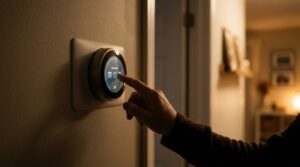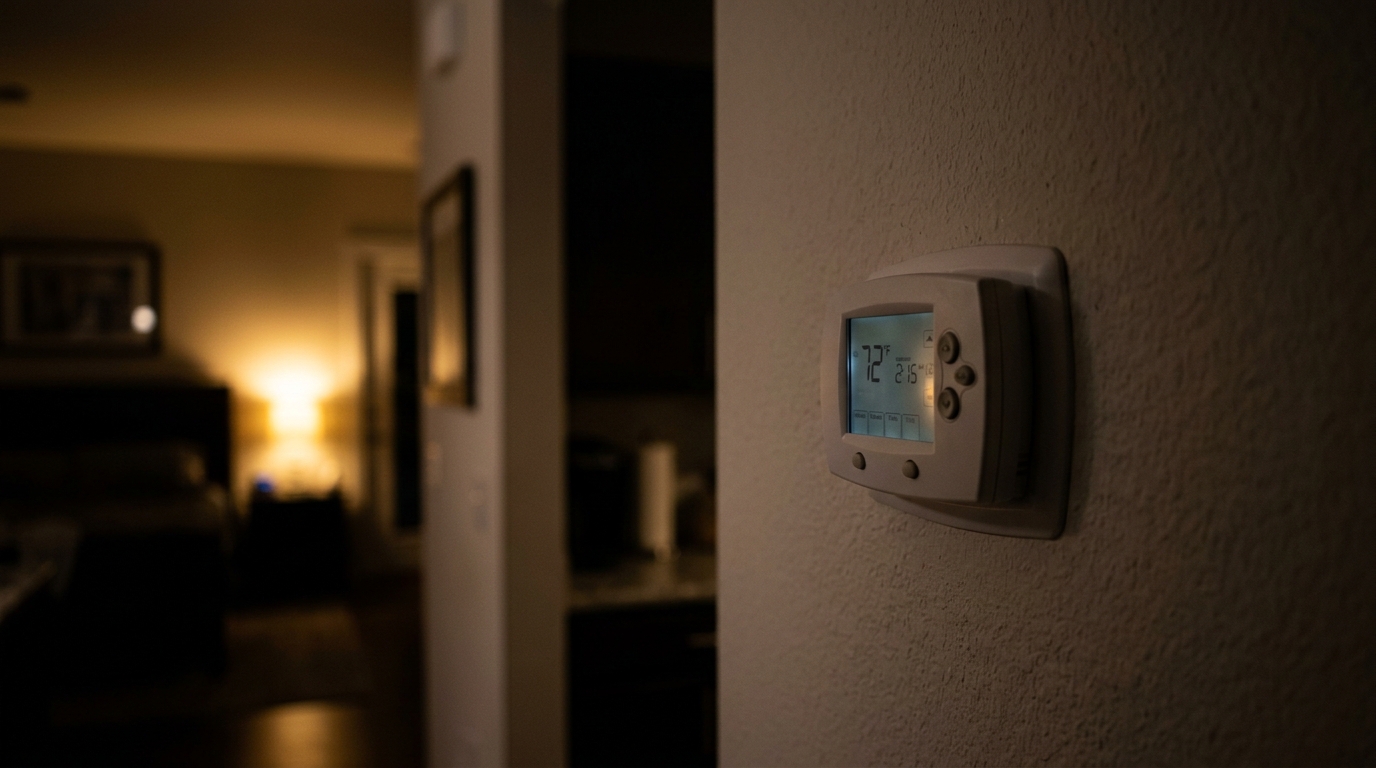
Most homeowners install a programmable thermostat, set a quick night schedule, and assume the savings will roll in. The U.S. Department of Energy says you can save about 1% on heating and cooling for every degree you set back for eight hours. But that math only works when the schedule matches how your home and your HVAC system actually behave overnight.
Here is where it goes wrong. Setbacks that are too deep force a heat pump onto expensive backup strip heat. Wake times set to the exact minute you get up mean the house is still cold when your feet hit the floor. Bedroom comfort suffers, so people override the schedule, and the thermostat’s “hold” mode quietly cancels every savings benefit. Wiring mistakes and bad sensor placement make things worse.
This post walks through the most common night schedule errors, shows you two ways to fix them (a 15-minute quick fix and a more thorough DIY reset), and explains the building science behind why recovery time, setback depth, and thermostat location matter so much. By the end you should have a night schedule that saves money and still feels comfortable.
What You’ll Need
Click on an item below to shop for the recommended items for this recipe on Amazon.
As an Amazon Associate, we earn from qualifying purchases.
How to Do It
- Check how many manual overrides you make per week. If you hit hold or bump the temperature often, the schedule is the problem, not the thermostat.
- Set your bedtime setback to 3 to 4 degrees below your daytime setting for heat pumps, or 5 to 8 degrees for gas or oil furnaces. In summer, set cooling up by 3 to 4 degrees.
- Move the wake-up time to 30 to 60 minutes before you actually get up. A furnace needs time to recover 1 to 2 degrees per hour.
- Turn off any adaptive or smart recovery feature if it ignores your schedule and fires early. Otherwise, enable it and let it learn for one to two weeks.
- Remove temporary hold settings and run the schedule untouched for one full week before judging results.
- Check where the thermostat sits. If it is within 3 feet of a supply vent, in direct sunlight, on an exterior wall, or near the kitchen, relocating it or adding a remote sensor can fix false readings.
- Add a remote room sensor in the bedroom if your smart thermostat supports it. This lets the system prioritize the room where you sleep rather than a hallway.
- Verify wiring and thermostat type match your system. Heat pumps need the right setting for O/B reversing valve and auxiliary heat staging. A wrong configuration can lock the system into strip heat.
- In the installer or advanced menu, set heat pump auxiliary lockout to roughly 35 to 40 degrees F outdoor temperature so strip heat only runs when truly needed.
- Set cycles per hour and recovery options to the manufacturer’s recommendation (typically 3 to 5 cycles per hour for furnaces, 2 to 3 for heat pumps).
- Log nighttime temperatures for 3 to 5 nights with your thermostat’s history or a $15 indoor thermometer to confirm the schedule is hitting targets.
- Ask the technician to check thermostat compatibility, wiring, and configuration for staging, reversing valve, and aux heat.
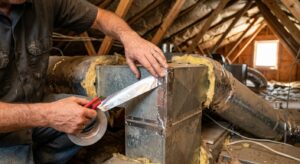
- Have duct leakage, airflow, and refrigerant charge tested, since poor airflow makes recovery slower regardless of thermostat settings.
- Request a recommendation on setback depth for your specific equipment type and climate.
- Ask whether a zoning or secondary thermostat for the bedroom wing makes sense.
Why It Works: The Benefits
A properly tuned night schedule can save 5 to 10% annually, which is roughly $100 to $180 for a household spending $1,800 a year on climate control.
Research on sleep suggests most people sleep best in a bedroom around 65 to 68 degrees F. A well-built schedule hits that range during sleep instead of fighting it.
Avoiding aggressive overnight recovery reduces short cycling and heavy startup loads, which can extend equipment life over time.
Pre-recovery scheduling means the house reaches your target temperature when you wake, so you stop overriding the schedule and keep your savings intact.
Gentle 2 to 4 degree setbacks on a heat pump keep it out of strip heat mode, which can cost two to three times more to run.
💰 Savings Impact by Action
Setting back 7 to 10 degrees for eight hours saves about 1% per degree on furnace systems, roughly 7 to 10% annually.
Starting recovery before wake time prevents overrides, protecting about 3% of savings that manual holds would erase.
Keeping a heat pump out of auxiliary heat during winter mornings can cut heating costs by up to 10% on cold nights.
Correct thermostat location or a remote sensor prevents false readings that cause over-cycling, saving around 4%.
🏠 Key Concepts Explained
The Science Behind It
A house is a heat reservoir. Air makes up only a small part of its thermal mass. Drywall, framing, flooring, and furniture hold most of the stored heat. When you drop the thermostat 8 degrees overnight, the air cools quickly, but the structure cools more slowly. In the morning, the system has to reheat both the air and those cooled surfaces, which is why recovery can take longer than expected and why the air feels warm before the walls and floors do.
Savings come from reducing the temperature difference between inside and outside. Heat loss through walls, windows, and air leaks is roughly proportional to that difference, so every degree of setback shaves a little off energy use for as long as the setback lasts. This is why the DOE estimate is about 1% per degree for eight hours. A longer, deeper setback saves more in theory, but recovery energy and comfort problems eat into the gain.
Heat pumps add another wrinkle. They move heat rather than create it, which makes them very efficient, but their output drops as outdoor temperatures fall. When a thermostat calls for a large temperature jump, the control may engage electric resistance auxiliary heat to catch up. That heat is usually 2 to 3 times more expensive per unit of delivered warmth. A shallow setback or a gradual ramp keeps the heat pump doing the work and keeps your bill down.
Frequently Asked Questions
▼ Why does my heat pump run on expensive backup heat every morning?
Your morning temperature jump is probably too large, so the system calls for strip heat to catch up. Reduce the overnight setback to 2 to 4 degrees, start recovery earlier, and check that your aux heat lockout is set to roughly 35 to 40 degrees F outdoor temperature.
▼ Can renters do this without landlord permission?
Adjusting the schedule on an existing programmable thermostat needs no permission. Replacing the thermostat or changing wiring usually does, so ask first. A plug-in smart plug thermostat for a space heater or window AC is a renter-friendly alternative.
▼ How long before I actually notice savings on my bill?
Expect to see changes within the first full billing cycle, though weather swings can hide them. Compare usage per heating or cooling degree day against last year for a fair read, and give the new schedule at least 30 days.
▼ What if my home is older than 30 years?
Older homes lose heat faster and recover more slowly, so use shallower setbacks of 3 to 5 degrees and start recovery earlier. Sealing leaks and adding attic insulation will make any schedule work better.
▼ Why does my bedroom feel colder than the thermostat says?
The thermostat may be reading a warmer hallway or living area. Add a remote sensor in the bedroom, check that bedroom vents are open, and look for drafts around windows and the door.
Quick Tips
- Use a 3 to 4 degree setback for heat pumps and 5 to 8 degrees for gas furnaces as a starting point, then adjust based on comfort.
- Start morning recovery 45 to 60 minutes before you wake instead of at wake time.
- Keep the thermostat away from vents, sunlit walls, and kitchens, or use a remote sensor.
- Review your thermostat’s weekly history and count manual overrides. Fewer than two per week means your schedule fits your life.
Variations for Your Situation
- Apartment/Rental: Keep your existing thermostat and focus on schedule changes, which cost nothing. If you have a window AC or portable heater, a $15 to $30 plug-in timer or smart plug lets you run a night schedule without touching anything permanent.
- Tight Budget (under $50): Fix your schedule for free, add a $10 to $15 indoor thermometer in the bedroom to verify conditions, and use a $5 to $10 draft stopper at the bedroom door. This costs almost nothing and removes most override triggers.
- Older Home (pre-1980): Use smaller setbacks of 3 to 5 degrees, expect longer recovery, and prioritize air sealing and attic insulation ($100 to $500 in DIY materials) to hold temperature more steadily overnight.
- Heat Pump Home: Use a 2 to 4 degree setback or a gradual ramp, confirm auxiliary heat lockout, and consider a smart thermostat with heat pump-specific logic to avoid strip heat.