Lie on the floor next to your front door on a windy night and slide your hand along the threshold. If you feel moving air, you are paying to heat the outdoors. A gap of just 1/4 inch across a standard 36 inch door adds up to roughly 9 square inches of open hole. According to the U.S. Department of Energy, air leaks like this can account for 5 to 30 percent of a home’s heating and cooling costs, and exterior door bottoms are among the worst offenders.
The problem gets worse overnight. When the sun goes down, outdoor temperatures drop, your furnace cycles less often as you lower the thermostat, and the house develops a pressure imbalance that pulls cold air in low and pushes warm air out high. That draft you feel on your ankles at 2 a.m. is real, and it makes your bedroom or living room feel several degrees colder than the thermostat says.
In this post we walk through two ways to fix it: a no-tools stick-on sweep you can install in 10 minutes, and a screw-on aluminum and vinyl sweep that lasts for years. You will also learn how to diagnose the gap, what savings to realistically expect, and the mistakes that cause new sweeps to fail within a year.
What You’ll Need
Click on an item below to shop for the recommended items for this recipe on Amazon.
As an Amazon Associate, we earn from qualifying purchases.
How to Do It
- Close the door and measure the gap at both corners and the middle, since the gap is often uneven. Use a business card as a rough gauge: if it slides under easily, the gap is at least 1/32 inch and likely much bigger.
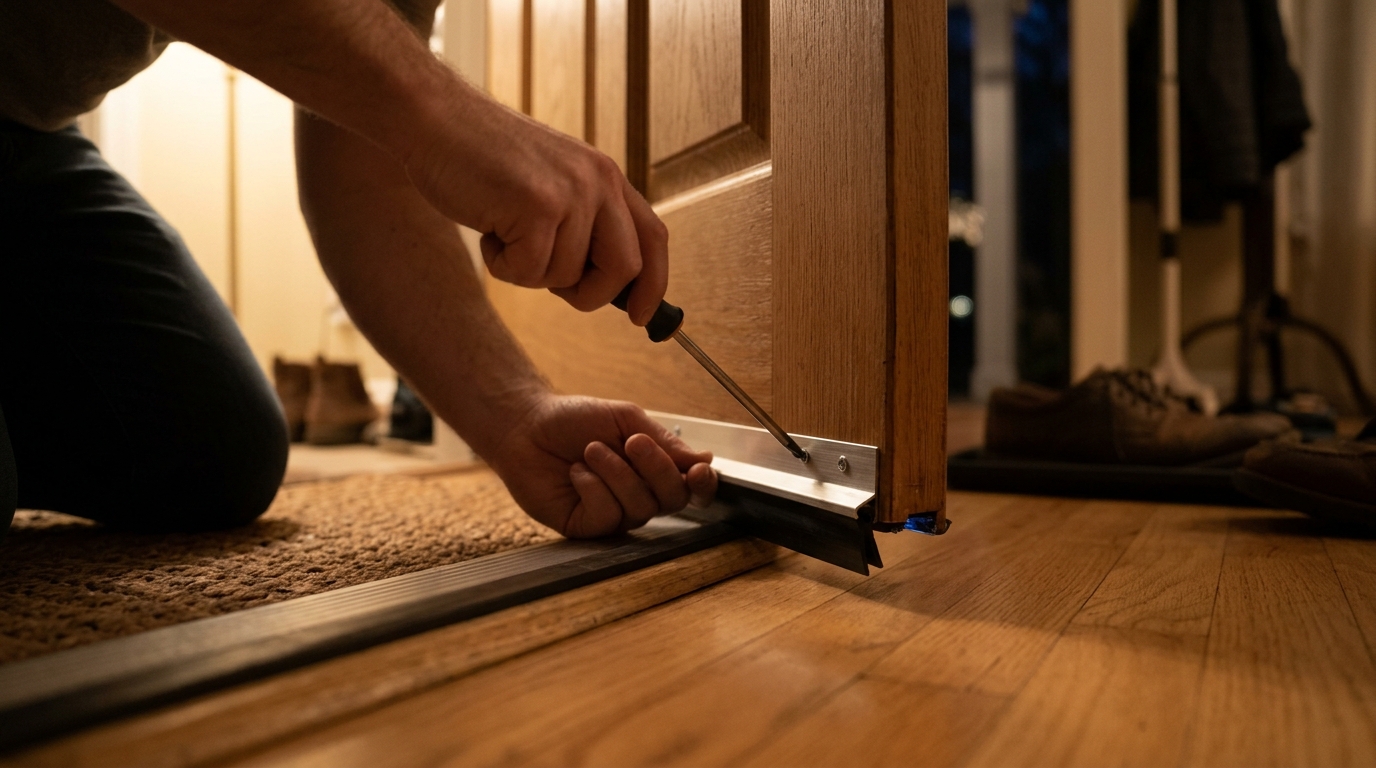
- Cut the sweep to the exact width of the door bottom using scissors or a hacksaw, depending on whether it is vinyl or aluminum-backed.
- Clean the bottom 2 inches of the door interior face with rubbing alcohol and let it dry completely. Adhesive will not bond to dust, grease, or moisture.
- Peel the backing and press the sweep along the door bottom so the flexible fin just touches the threshold when the door is closed. Hold firm pressure for 30 seconds.
- Open and close the door a few times. The sweep should drag lightly but not bind. If it sticks, raise it slightly or trim the fin.
- Remove the old sweep if there is one, and note how it was mounted. Clean any leftover adhesive, dirt, or caulk from the door bottom.
- Measure the door width and cut the aluminum track to length with a hacksaw. File the cut edge smooth. Cut the vinyl insert 1/4 inch shorter than the track so it slides in without bunching.
- Hold the sweep against the interior face of the door with the vinyl fin touching the threshold. Mark screw holes with a pencil, keeping the fin compressed by about 1/16 inch for a good seal.
- Drill pilot holes and fasten with the included screws. Use a level to keep the sweep straight so it contacts the threshold evenly across the full width.
- Test the seal by closing the door with a sheet of paper under the sweep. You should feel light resistance when pulling it out. Also check at night with a flashlight outside: no light should show under the door.
Why It Works: The Benefits
Sealing a leaky door bottom can trim 5 to 10 percent off your annual energy use. On a $2,000 yearly bill that is $100 to $200 saved for a $10 to $25 part.
Stopping the draft at floor level raises the felt temperature near the door by 3 to 5 degrees, so you can often lower the thermostat 1 to 2 degrees without noticing.
A proper sweep blocks the gap that lets in street noise, wind whistle, and rain splatter, which can reduce perceived exterior noise noticeably.
The same gap that lets in cold air lets in insects, mice, leaves, and dust. A tight seal blocks most of them without chemicals.
With less cold air creeping in, the furnace cycles less often during the coldest hours, which reduces wear and extends equipment life.
💰 Savings Impact by Action
Sealing a leaky exterior door bottom can reduce annual heating costs by roughly 5 to 10 percent.
A properly fitted sweep eliminates most of the airflow through the door bottom gap.
In summer, a tight door keeps hot, humid air out and trims cooling costs by about 3 to 6 percent.
Less cold air infiltration means fewer heating cycles overnight, reducing runtime by several percent.
🏠 Key Concepts Explained
The Science Behind It
Air moves through any opening when there is a pressure difference between two sides. In winter, warm indoor air is less dense and rises, creating positive pressure near the ceiling and negative pressure near the floor. That is called the stack effect, and it pulls cold outdoor air in through low openings like the gap under your door. The bigger the temperature difference and the taller the house, the stronger the effect.
The amount of heat you lose depends on both the size of the gap and the pressure pushing air through it. Because air leakage scales roughly with the square root of the pressure difference, even small improvements in sealing matter. Closing a 1/4 inch gap on a 3 foot door removes about 9 square inches of open area. Blower door tests regularly show that a single unsealed exterior door can account for several percent of a home’s total leakage.
A door sweep works by placing a flexible barrier between the moving air and the opening. Vinyl and silicone fins compress slightly against the threshold, forming a continuous seal. Brush sweeps are better for rough or uneven thresholds but allow some air to pass through the bristles, so they are best used where dust and debris are a concern. For most homes, a vinyl or silicone fin on an aluminum track delivers the best balance of sealing performance and durability.
Frequently Asked Questions
▼ I installed a sweep but I still feel a draft near the door. What is wrong?
The draft is probably coming from somewhere else on the door. Check the weatherstripping along the sides and top, the threshold itself, and the gap around the frame. Hold a lit incense stick near each edge on a windy day and watch where the smoke moves.
▼ Can renters install a door sweep without losing their deposit?
Yes. An adhesive sweep attached to the interior face of the door can be removed with a hair dryer and a little adhesive remover, and it rarely damages paint. Check your lease for rules about modifications, and if in doubt, ask your landlord, since a tighter door usually benefits them too.
▼ How long before I notice savings on my energy bill?
You will feel the comfort improvement the first night. On the bill, expect a 2 to 5 percent drop in the first heating season for one door, and more if you seal several. Compare usage month over month rather than dollars, since rates change.
▼ What if my door has a big gap, like 1 inch or more?
A standard sweep will not bridge a gap that large. Use a heavy-duty door bottom with a deeper fin, install a taller threshold, or add a door shoe that wraps the bottom of the door. If the door is warped or sagging, rehanging it may be the real fix.
▼ My sweep scrapes the floor and is hard to open. How do I fix it?
The sweep is mounted too low. Loosen the screws, raise it about 1/16 inch, and retighten. If it still drags, trim the fin with a utility knife so it only lightly brushes the threshold.
Quick Tips
- Test your doors at night with a flashlight shining from the outside while someone checks inside. Any visible light means air is moving through that gap too.
- Replace sweeps every 3 to 5 years, or sooner if you notice the fin is cracked, flattened, or no longer touching the threshold.
- Do not forget the garage entry door and basement door. Doors between conditioned and unconditioned spaces leak just as much as the front door.
- For sliding patio doors, use a bottom track weatherstrip or a sliding door sweep designed for the track, not a standard door sweep.
Variations for Your Situation
- Apartment/Rental: Use an adhesive-backed vinyl sweep on the interior face of the door, about $8 to $12. It installs in 10 minutes with no drilling and removes cleanly with a hair dryer when you move out.
- Tight Budget (under $20): Cut a strip of dense foam or a rolled towel as a temporary barrier, then buy a basic $8 to $12 adhesive sweep. Even a cheap sweep beats leaving the gap open, and you can upgrade later.
- Older Home (pre-1980): Doors in older homes often have uneven gaps, worn thresholds, and out-of-square frames. Use a brush or adjustable sweep that handles varying gaps, and plan to replace the threshold too, since old thresholds often leak as much as the door bottom.
- Garage and Basement Doors: Choose a heavy-duty sweep with a thicker fin, since these doors see more abuse and often have rougher thresholds. Sealing them keeps cold garage and basement air from seeping into living areas.