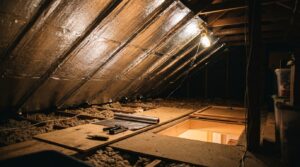
On a hot summer day, your attic can reach 130 to 160 degrees Fahrenheit. The sun bakes the roof deck, and that heat soaks into the rafters, insulation, and ductwork. Here is the part most people miss: the attic does not cool off when the sun sets. Stored heat keeps radiating down through the ceiling for hours, which is why upstairs bedrooms can still feel stuffy at midnight and why your AC keeps running when it seems like it should be done for the day.
An attic fan on a timer attacks this problem directly. Instead of running whenever a thermostat says so, or not at all, you schedule the fan to run during the coolest part of the night, typically from about 10 p.m. to 6 a.m., when outdoor air is well below attic temperature. The fan pulls the cooler outside air through your soffit vents, pushes the hot attic air out, and resets the attic to a much lower starting temperature before the next day’s sun hits.
This post covers two ways to do it: a quick fix that uses a plug-in timer or a smart plug on an existing fan, and a DIY upgrade that installs a dedicated hardwired timer or a combination thermostat and humidistat control. You will also see the mistakes that cause this trick to backfire, such as starving the fan of intake air or accidentally pulling conditioned air out of your living space.
What You’ll Need
Click on an item below to shop for the recommended items for this recipe on Amazon.
As an Amazon Associate, we earn from qualifying purchases.
How to Do It
- Locate your attic fan’s power connection and confirm it is a cord-and-plug model on a grounded outlet. If the fan is hardwired, skip to the DIY Upgrade approach.
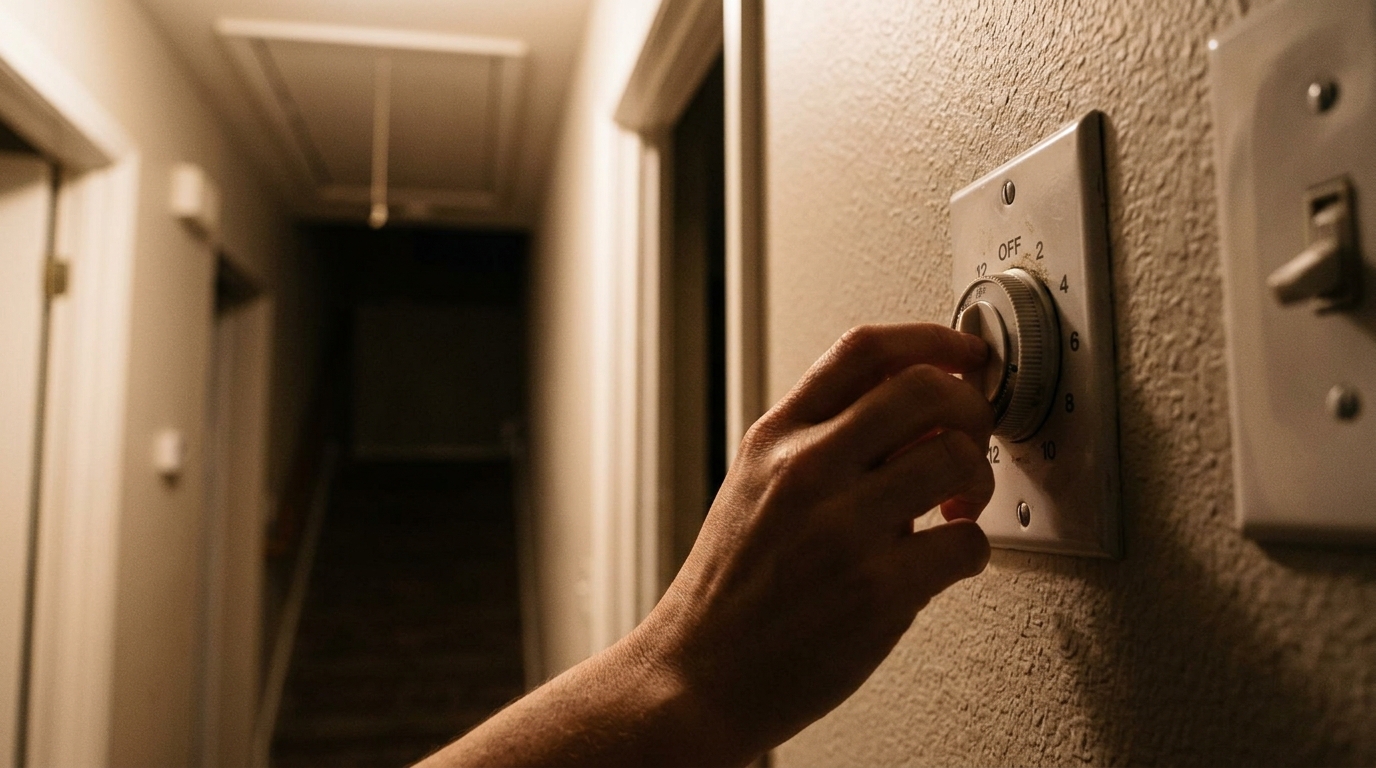
- Check the fan’s wattage on its label and choose a heavy-duty timer or smart plug rated for at least that load, ideally 15 amps. Mechanical timers with 30-minute increments work well and need no Wi-Fi.
- Set the schedule to run the fan from about 9 or 10 p.m. until 6 or 7 a.m., or about two hours before sunrise at minimum. Adjust later based on when outdoor temperatures actually fall below your attic temperature.
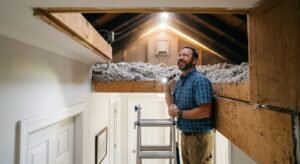
- Crack a window or confirm your soffit vents are clear so the fan has makeup air. Check that no insulation is blocking the soffit vents from inside the attic.
- Disable the fan’s built-in thermostat if it is set too high, or set it to around 100 to 110 degrees so the timer is not fighting a thermostat that never lets the fan run at night.
- After a week, check attic temperature at sunrise with an inexpensive thermometer and fine-tune the on and off times.
- Turn off power to the attic fan at the breaker and confirm it is dead with a non-contact voltage tester before touching any wires.
- Choose a control: a wall-mounted programmable timer switch rated for the fan’s motor load, or an adjustable attic fan thermostat with a built-in timer or hygrostat option. Models with adjustable ranges of roughly 70 to 130 degrees give you the most control.
- Mount the new control at the existing switch location or at the fan, following the manufacturer’s wiring diagram. Connect the line, load, and neutral as directed, and cap unused wires.
- Program the control to run the fan during overnight hours, and set a thermostat limit so the fan also stays off when attic air is already cooler than about 80 to 85 degrees, saving energy on mild nights.
- Restore power, run the fan manually first, and confirm air is moving freely through the soffit vents by holding a tissue near a vent.
- Review attic temperatures for 7 to 10 days and adjust the schedule seasonally, running longer in July and August and shorter in spring and fall.
Why It Works: The Benefits
Reducing attic temperatures by 20 to 30 degrees can cut ceiling heat gain significantly, often lowering summer cooling costs by 5 to 15% in homes with older or thin insulation.
A flushed attic means less radiant heat from the ceiling at bedtime, which can drop upper-floor room temperatures by 2 to 5 degrees overnight.
Lower attic temperatures reduce the load on your air conditioner, especially for ductwork that runs through the attic, where duct heat gain can account for 10 to 30% of cooling loss.
Extreme attic heat accelerates shingle aging and degrades insulation and wiring. Keeping peak temperatures down helps protect your roof over the long term.
At 150 to 250 watts for 8 hours, a nightly fan run costs about 15 to 30 cents, so the savings usually outweigh the electricity used.
💰 Savings Impact by Action
Lowering overnight attic temperature by 20 to 30 degrees can reduce ceiling heat gain and cooling costs by roughly 5 to 15%.
A cooler attic reduces heat gain in ducts that run through it, which can account for 10 to 30% of cooling loss in uninsulated systems.
Less heat radiating from the ceiling at night lets your thermostat satisfy more quickly and cycle less often.
Running a 150 to 250 watt fan only at night keeps operating cost near 15 to 30 cents per night and avoids daytime demand charges on some plans.
🏠 Key Concepts Explained
The Science Behind It
Heat moves in three ways: conduction, convection, and radiation. During the day, the sun heats the roof by radiation, shingles and decking conduct that heat inward, and the trapped air in the attic warms by convection. Fiberglass and cellulose insulation slow conduction but do not stop it. At sunset, the roof sheds heat slowly, and the attic’s thermal mass, meaning all that warm wood and insulation, keeps releasing stored energy for hours.
An attic fan replaces that hot air with cooler outdoor air, a process called heat dumping. The rate of heat removal depends on airflow in cubic feet per minute (CFM) and the temperature difference between the attic and the outside air. Because night air in many climates drops 15 to 30 degrees below daytime highs, overnight is when each cubic foot of air moved carries away the most heat. A well-sized fan can exchange the full volume of the attic 10 to 15 times per hour or more.
The goal is to lower the attic’s starting temperature for the next morning, which delays when it climbs back to extreme levels, reducing the hours of strong downward heat flow. Because heat transfer through the ceiling is proportional to the temperature difference across it, a 20 degree reduction in attic temperature can cut ceiling heat gain by a meaningful fraction. That is why timers matter: running the fan at the right time captures most of the benefit while minimizing electricity use and the risk of pulling in humid or unconditioned air.
Frequently Asked Questions
▼ Why is my AC still running all day even after I set up the attic fan timer?
The fan only reduces heat coming from the attic, not heat from sunny windows, poor insulation, or leaky ducts. Check that attic insulation is at least R-38 and inspect for ducts with gaps or missing insulation. If the attic is still above 130 degrees at midday, your intake venting may be too small.
▼ Can renters do this without landlord permission?
Usually not. Attic access and fan installation typically fall under the landlord’s responsibility. As a renter, ask the landlord to add a timer to an existing fan, or focus on window-based strategies such as a window fan on a timer to pull in cool night air, which is renter safe.
▼ How long before I actually notice savings on my bill?
You may notice cooler upstairs rooms within the first night or two. Bill savings show up in the next one or two billing cycles, ideally compared to the same month last year, since weather affects usage. Expect roughly 5 to 15% lower cooling costs in a hot attic situation.
▼ What if my home is older than 30 years?
Older homes often have thinner insulation and more air leaks into the attic, so the trick can help more but carries more risk of pulling conditioned air upward. Seal ceiling bypasses first and verify combustion appliances are properly vented before running the fan regularly.
▼ Will the fan bring humid air into my attic and cause moisture problems?
It can if you run it on very humid nights. Use a hygrostat or skip the fan when outdoor relative humidity is above about 70 to 80%. Dry nights in typical summer climates are ideal.
Quick Tips
- Pair the fan with air sealing: closing gaps around recessed lights, attic hatches, and plumbing penetrations prevents the fan from depressurizing your living space.
- Check that insulation has not been pushed over soffit vents. Baffles (rafter vents) keep the airflow channel clear.
- Use a seasonal schedule: run longer overnight in peak summer, and skip the fan entirely in cool or very humid weather.
- Add a low-cost wireless thermometer in the attic so you can see actual temperature trends and tune the timer with real data.
Variations for Your Situation
- Apartment/Rental: Attic fans usually are not an option, so use a window fan on a plug-in timer ($15 to $25) set to pull cool air in through a window on one side of the unit and push hot air out on the other from about 9 p.m. to 6 a.m. Close blinds during the day to reduce solar gain.
- Tight Budget (under $50): Buy a mechanical plug-in timer ($10 to $15) for an existing cord-and-plug fan, clear any blocked soffit vents for free, and add a $10 attic thermometer to track results. That combination delivers most of the benefit for the lowest cost.
- Older Home (pre-1980): Prioritize sealing ceiling penetrations and checking that soffit vents are open before adding a timer, since older homes often have leaky ceilings that let the fan pull conditioned air upward. A thermostat-controlled fan with a night timer ($80 to $150) is a better fit than a simple on-off timer.