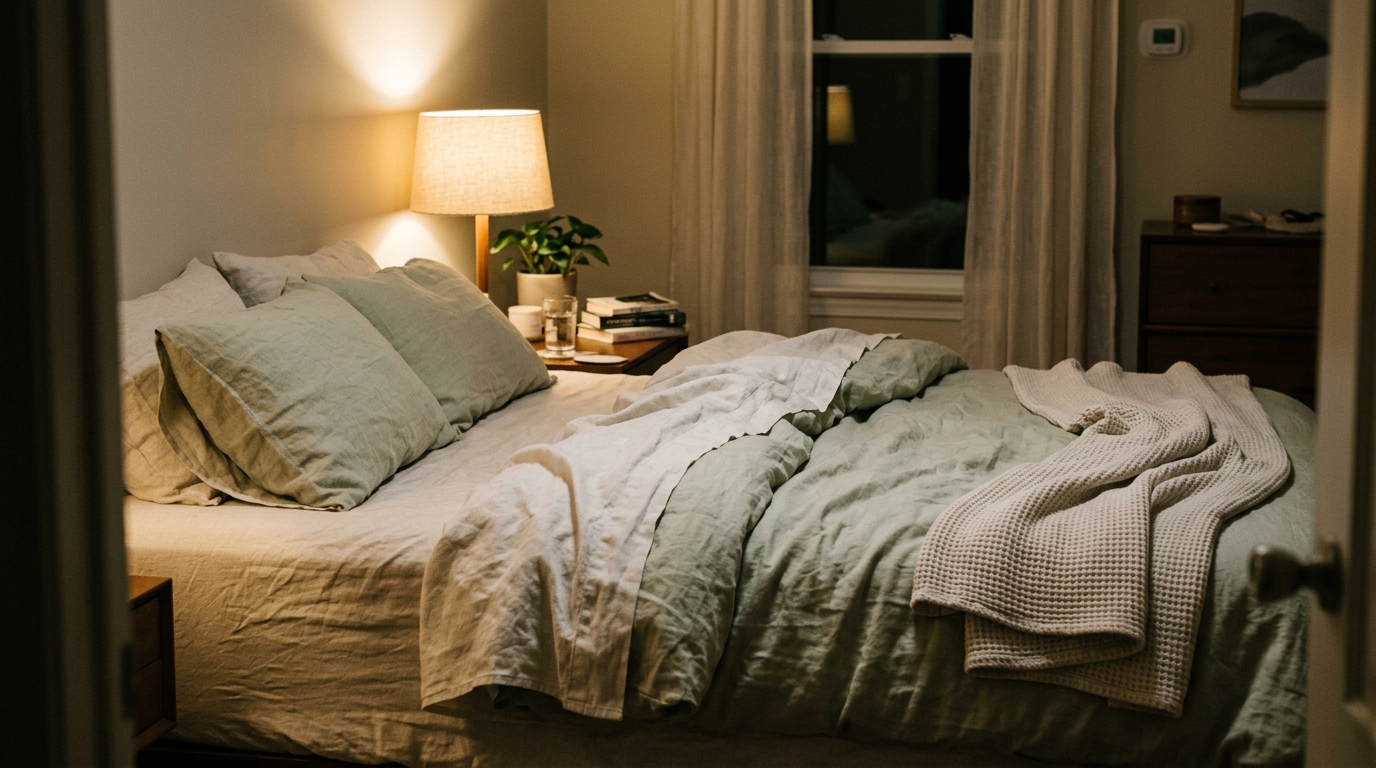
You set the thermostat to 70, the bedroom is technically cool, and you still wake up sweaty at 2 a.m. The culprit is often not the room air but the microclimate under your covers. Polyester sheets, memory foam, and heavy comforters trap body heat and moisture right against your skin, so your body feels hot even when the air around the bed is not.
That mismatch is expensive. When people feel warm in bed, they lower the thermostat, run fans on high, or leave the AC cycling all night. The U.S. Department of Energy estimates that you can save roughly 1% on cooling costs for every degree you raise the thermostat setting for an 8-hour stretch. If better bedding lets you move from 70 to 74 degrees overnight, that adds up to real savings over a cooling season.
This post covers a quick, low-cost bedding swap and a deeper sleep-surface upgrade, plus the building science behind why fabric choice changes how cool you feel. You do not need to touch your HVAC system, and most of these changes are renter friendly.
What You’ll Need
Click on an item below to shop for the recommended items for this recipe on Amazon.
As an Amazon Associate, we earn from qualifying purchases.
How to Do It
- Check your current sheet tags. If they say polyester, microfiber, or ‘brushed,’ set them aside for winter and look for 100% cotton percale, linen, or Tencel/lyocell instead.
- Remove heavy layers like a thick comforter or quilt. Replace with a single lightweight cotton blanket, a thin duvet, or just a top sheet during the hottest months.
- Choose a percale weave over sateen if you sleep hot. Aim for a thread count in the 200 to 400 range, since higher counts often mean denser, warmer fabric.
- Wash new sheets once before use to soften the fibers and improve airflow, and skip fabric softener, which can coat fibers and reduce breathability and moisture wicking.
- Raise your nighttime thermostat setting by 2 degrees the first night, then another 1 to 2 degrees over the next few nights as you adjust, until you find the warmest setting that still lets you sleep comfortably.
- Add a breathable mattress pad or topper made of wool, cotton, or latex, or a cooling-fiber pad, to sit between you and a dense memory foam mattress. This reduces heat retention from the surface you lie on.
- Layer your bedding in this order: breathable fitted sheet, light top sheet or percale flat sheet, and a seasonally appropriate cover such as a linen duvet or lightweight cotton quilt.
- Swap synthetic pillows for ones with breathable covers and a fill that allows airflow, such as shredded latex or a cotton-wrapped pillow, since your head holds a lot of heat.
- Program your thermostat to ramp from your daytime setting to a warmer bedtime setting. For example, keep 74 to 76 degrees from bedtime until early morning, then return to your normal temperature before you wake.
- Pair the setup with a ceiling fan running on low in a counterclockwise direction to boost evaporative cooling across your skin at a cost of only pennies per night.
- Track your comfort and your bills for two to four weeks, adjusting the thermostat setpoint up by 1 degree at a time until you find the point where you start to feel warm again.
Why It Works: The Benefits
Raising your overnight setpoint from 70 to 74 degrees can cut cooling energy by about 3 to 5% on the hours it applies, based on the DOE rule of roughly 1% per degree. Over a hot summer, that is often $15 to $40 saved.
Breathable fabrics reduce moisture buildup and heat trapping, so many people report waking less often. Better sleep quality is a comfort gain that is hard to put a price on.
When the bed itself stops overheating, you rely less on ceiling fans on high and constant AC cycling, which reduces both electricity use and noise.
Natural-fiber sheets like cotton percale and linen typically last 5 to 10 years with proper care, outlasting many cheap microfiber sets that pill and lose their feel after a year or two.
A breathable base layer paired with a lighter or heavier top layer lets you adjust for the season without replacing everything, so the investment pays off in winter too.
💰 Savings Impact by Action
Raising the overnight setpoint by 4 degrees saves roughly 4% on cooling energy during those hours, using the DOE rule of about 1% per degree.
A ceiling fan lets you feel about 4 degrees cooler, allowing a higher setpoint and cutting cooling use by up to 8% for the hours it runs.
Removing a heavy comforter reduces body heat trapping, helping you tolerate a warmer room and saving roughly 5% on nighttime cooling.
A breathable mattress pad reduces heat retention in dense foam, supporting a 1 degree higher setpoint worth about 3% in savings.
🏠 Key Concepts Explained
The Science Behind It
Your body sheds heat in four ways: conduction, convection, radiation, and evaporation. In bed, bedding disrupts all four. Tightly woven, low-breathability fabrics reduce convection by blocking airflow and reduce evaporation by trapping moisture, so heat and humidity build up in the thin layer of air next to your skin. That is why your skin can feel hot and sticky even in a room that is a comfortable temperature.
Natural fibers like cotton and linen are hygroscopic, meaning they absorb moisture from your skin and release it into the air. As that moisture evaporates, it carries heat away, a small but meaningful cooling effect similar to how sweating works. Linen in particular has long, hollow-ish fibers that move moisture and air efficiently, which is why it feels cool to the touch. Synthetic microfiber, by contrast, tends to repel water and trap it against skin, which raises perceived temperature and humidity.
The energy savings come from the relationship between comfort and setpoint. Thermal comfort studies, including the ASHRAE 55 standard, show that people can tolerate a wider range of air temperatures when they control insulation and moisture at the skin. Because cooling load rises as the gap between indoor and outdoor temperature grows, every degree you raise the indoor setpoint reduces the work your AC has to do, which is where the roughly 1% per degree DOE savings rule comes from.
Frequently Asked Questions
▼ Why is my AC still running all day even after I swapped my bedding?
Bedding changes how comfortable you feel at night but does not affect your daytime cooling load, which is driven by sun exposure, insulation, and air leaks. Check for sealing and insulation issues, and use a programmable thermostat to raise the setpoint when you are away. Bedding is one piece of the puzzle, not the whole system.
▼ Can renters do this without landlord permission?
Yes, bedding is the most renter-friendly efficiency upgrade because nothing about your home is modified. You can also take it with you when you move. Pair it with a smart plug for a fan or a portable thermostat sensor if you cannot change your central thermostat.
▼ How long before I actually notice savings on my bill?
You will feel the comfort difference the first night, but the bill impact shows up over a full billing cycle or two. If you raise your overnight setpoint by 4 degrees, expect roughly 3 to 5% less cooling energy during those hours, which often translates to $5 to $15 per month in hot climates.
▼ What if my home is older than 30 years?
Older homes often have leakier ducts and weaker insulation, so bedrooms can run warmer than the thermostat reading. Breathable bedding still helps, but also check for sun-facing windows and attic insulation. Blackout curtains and sealing air leaks can amplify the benefit of your bedding swap.
▼ Is linen worth the extra cost over cotton percale?
Linen typically costs more but breathes slightly better and lasts longer, making it a strong choice for very hot sleepers in humid climates. Cotton percale is a more budget-friendly option that performs nearly as well for most people. If you are unsure, start with percale and upgrade later.
Quick Tips
- Choose 100% cotton percale, linen, or Tencel for sheets, and avoid microfiber and sateen if you sleep hot.
- Skip fabric softener on bedding, since it coats fibers and reduces both breathability and moisture wicking.
- Raise your overnight thermostat setting 1 to 2 degrees at a time so your body can adjust without losing sleep.
- Use a ceiling fan on low to add evaporative cooling, since it costs only a few cents per night to run.
- Wash sheets weekly in warm water, since body oils and sweat build up in fibers and reduce airflow over time.
Variations for Your Situation
- Apartment/Rental: Focus on bedding and a small clip or tower fan, since you likely cannot change central HVAC settings. A set of cotton percale sheets runs $60 to $120, and a breathable mattress pad adds $50 to $100. Add a $20 thermostat-compatible window shade or reflective film (check your lease) to reduce afternoon heat gain in the bedroom.
- Tight Budget (under $50): Strip heavy layers off the bed and use a single lightweight cotton sheet or thin blanket. Thrift stores and discount retailers often carry 100% cotton sheets for $15 to $30. Pair this with raising your nighttime thermostat by 2 degrees and running a ceiling fan on low for no added cost.
- Older Home (pre-1980): Bedrooms in older homes often run 3 to 6 degrees warmer than the thermostat reading because of weaker attic insulation and leaky ductwork. Start with breathable bedding, then add a bedroom window shade or insulated curtain ($30 to $80) and check that bedroom supply vents are not blocked by furniture.