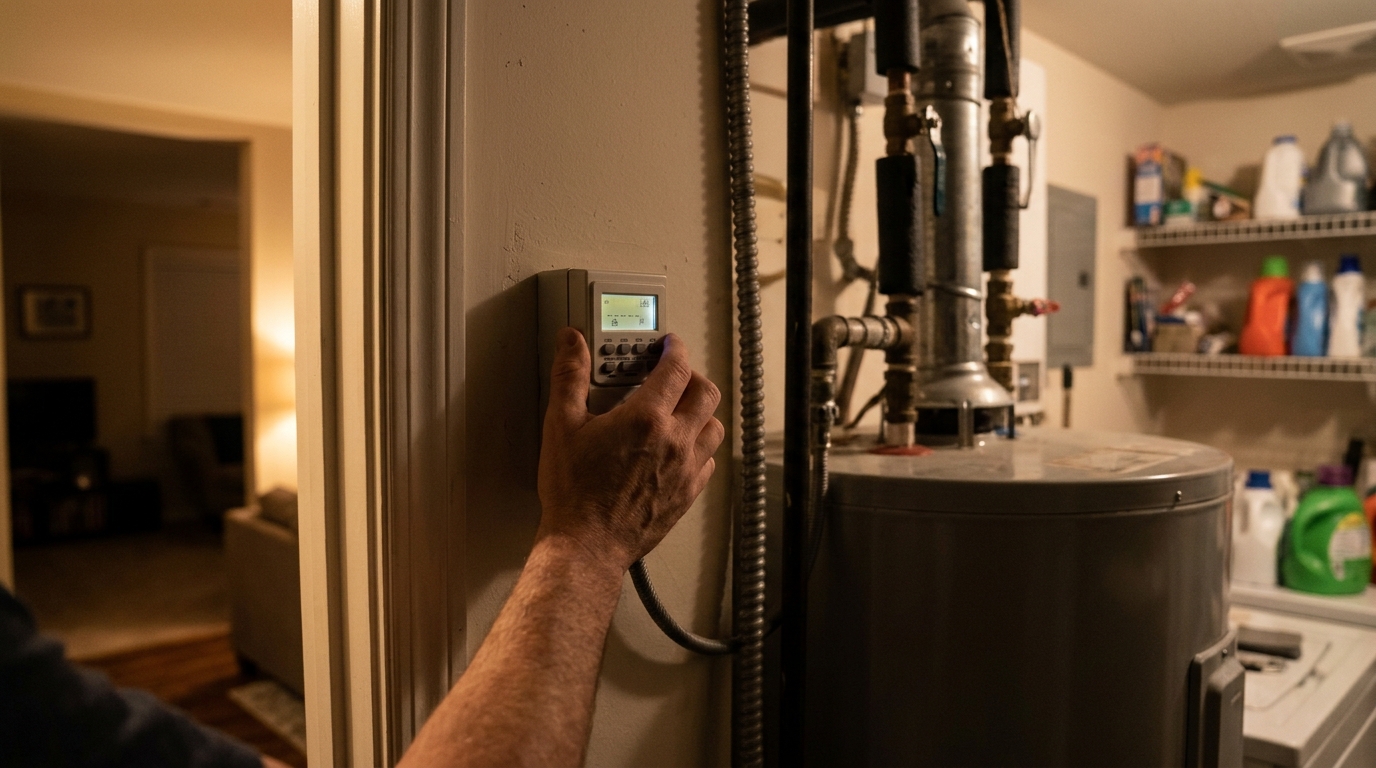
Water heating is typically the second largest energy expense in a home, accounting for roughly 14 to 18% of utility costs according to the U.S. Department of Energy. A standard electric tank water heater can use 3,500 to 4,500 kWh per year, and if your utility uses time-of-use (TOU) rates, the price of that electricity can double or triple between off-peak and peak windows.
The problem is that most water heaters heat on demand, which means they fire up right after you take a shower or run the dishwasher. Those moments often land squarely in the evening peak window, commonly 4 PM to 9 PM, when rates are highest. Your tank is well insulated and holds heat for hours, so there is a smarter way to schedule when it heats.
This post walks you through the timer settings that work for most households, two ways to set them up (one that takes about 20 minutes and one that automates everything), and how to do it safely without risking cold showers or bacterial growth in your tank.
What You’ll Need
Click on an item below to shop for the recommended items for this recipe on Amazon.
As an Amazon Associate, we earn from qualifying purchases.
How to Do It
- Find your utility’s TOU rate schedule online or on your bill and write down the exact peak hours (commonly 4 PM to 9 PM on weekdays).
- Check your water heater for a built-in schedule or vacation mode. Many Rheem, A. O. Smith, and heat pump models include scheduling in the control panel or app.
- Set the heating window to run overnight and early morning, such as 10 PM to 6 AM, and block heating from 4 PM to 9 PM.
- Set the tank temperature to 125 to 130 degrees F so the stored hot water lasts through the peak window. Do not go below 120 degrees F.
- Test it for a week. If you run out of hot water in the evening, add a short heating window from 1 PM to 3 PM or raise the setpoint by 5 degrees.
- Turn off the breaker for the water heater at the main panel and confirm power is off with a non-contact voltage tester.
- Install a 240V water heater timer (a 40A to 50A double-pole timer) or a smart load controller in the electrical line between the breaker and the water heater, following manufacturer wiring instructions.
- Program the timer to allow heating from roughly 9 PM to 6 AM, plus an optional 12 PM to 3 PM window if you want a midday top-off on weekends or if you have solar.
- Turn the breaker back on and confirm the timer is energizing and de-energizing the heater at the correct times.
- Optional: Pair with a smart controller that reads your utility’s rate signal and automatically avoids peak pricing, adjusting for seasonal rate changes.
- Monitor your hot water availability for two weeks and adjust the heating windows as needed.
Why It Works: The Benefits
On a TOU plan with a 2x peak-to-off-peak price difference, shifting heating off-peak can cut water heating costs by 10 to 15%, often $40 to $90 per year.
Avoiding peak hours reduces demand when the grid is most stressed, which can lower your utility’s need for expensive peaking power plants and can qualify you for demand response rebates.
Concentrating heating into one or two defined windows instead of constant cycling can slightly reduce element on-off cycles, which supports longer equipment life.
With a 40 to 50 gallon tank heated before the evening peak, most households have enough hot water for showers, dishes, and laundry without any noticeable difference.
If you have rooftop solar, scheduling heating for midday lets you use your own generation to heat water, effectively storing solar energy as hot water.
💰 Savings Impact by Action
Moving heating out of peak hours on a TOU plan can cut water heating costs by 10 to 15%
Adding a tank blanket to an older heater reduces standby losses by 25 to 45%, saving about 4 to 9% of water heating energy
Lowering from 140 to 120 degrees F saves roughly 4 to 22% on standby losses, per DOE estimates
Insulating the first 6 feet of hot water pipe reduces heat loss and can save 3 to 4% on water heating
🏠 Key Concepts Explained
The Science Behind It
A tank water heater is essentially a thermal battery. Water has a high specific heat, meaning it takes about 8.3 BTU to raise one gallon by one degree F. A 50-gallon tank heated from 60 to 125 degrees F stores roughly 27,000 BTU, or about 8 kWh of energy. Because modern tanks are wrapped in 2 to 3 inches of polyurethane foam insulation, they lose heat very slowly, usually 2 to 4 degrees F over eight hours of no use.
That slow heat loss is what makes timer-based strategies work. Instead of heating water on demand during expensive peak hours, you charge the tank during cheap hours and draw it down during peak hours. Because standby losses are small compared to the price difference between peak and off-peak electricity, the net savings are real. For example, if peak power costs 32 cents per kWh and off-peak costs 12 cents, shifting 8 kWh of daily water heating saves about $1.60 per day, or roughly $580 per year in the best case, though most households see $40 to $150 because only part of their usage falls in the peak window.
The key constraint is the minimum temperature. Keeping the tank at 120 degrees F or higher prevents Legionella growth, so your timer must never allow the tank to sit below that threshold for extended periods. Raising the setpoint slightly before the off window gives you a thermal buffer that stays above 120 degrees F through the entire peak period.
Frequently Asked Questions
▼ Why am I running out of hot water in the evening after setting a timer?
Your heating window is likely too short or your setpoint is too low. Raise the tank temperature by 5 to 10 degrees F, or add a 2 to 3 hour top-off window in the early afternoon before the peak starts. If you still run out, your tank may be undersized for your household.
▼ Can renters do this without landlord permission?
Usually only if the water heater is accessible and has a built-in schedule or app control, since changing the setting is not a modification. Wiring a 240V timer requires permission and often a licensed electrician. Ask your landlord, since many are open to it when you offer to cover the cost and it can lower utility use.
▼ How long before I notice savings on my bill?
You should see the difference on your very next bill, but the amount depends on your rate plan and usage. Most households on a TOU plan save $4 to $12 per month. Compare the same month year over year, or track kWh by hour if your utility offers a smart meter portal.
▼ What if my home is older than 30 years?
Older homes often have older water heaters that lose more standby heat, so a tank wrap and pipe insulation become more important before adding a timer. Also have the tank inspected, since sediment buildup in aging tanks can cause longer recovery times and may need flushing.
▼ Will a timer make my water heater work harder or wear out faster?
No. Heating once overnight is just as easy on the elements as heating a few times throughout the day, and sometimes easier. The main risk is sediment, which you can manage by flushing the tank once a year.
Quick Tips
- Wrap an older tank (10+ years) with an insulating jacket rated R-8 or higher. It costs about $25 and cuts standby losses by 25 to 45%.
- Insulate the first 6 feet of hot and cold pipes leaving the tank with foam pipe sleeves to reduce heat loss and prevent thermosiphoning.
- Run dishwashers and washing machines after 9 PM or on weekends when off-peak rates apply, so you are not drawing down the tank during peak hours.
- Check your utility’s website for water heater rebates. Many offer $50 to $300 for smart controllers or heat pump water heaters and some offer bill credits for load shifting.
Variations for Your Situation
- Apartment/Rental: If you cannot modify wiring, look for a water heater with built-in scheduling or ask your landlord about a smart controller installed by an electrician. Many tenants also see savings from simply lowering the setpoint to 120 degrees F (free) and running laundry and dishwashers after 9 PM.
- Tight Budget (under $50): Skip the hardware. Check for a built-in vacation or schedule mode, lower the thermostat to 120 to 125 degrees F, add a $20 to $25 tank blanket, and shift dishwasher and laundry use off-peak. These steps alone can save 8 to 12% of water heating costs.
- Older Home (pre-1980): Older tanks often have thin insulation and may be installed in unconditioned spaces like garages or crawl spaces. Prioritize a tank blanket, pipe insulation, and a sediment flush before adding a timer, since these steps reduce standby losses and improve how long your stored hot water lasts through peak hours.
- Solar Homes: Schedule heating for 11 AM to 3 PM and raise the setpoint to 140 degrees F with a mixing valve. This turns your tank into a solar battery and can cut grid water heating costs by 50% or more.