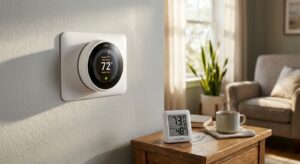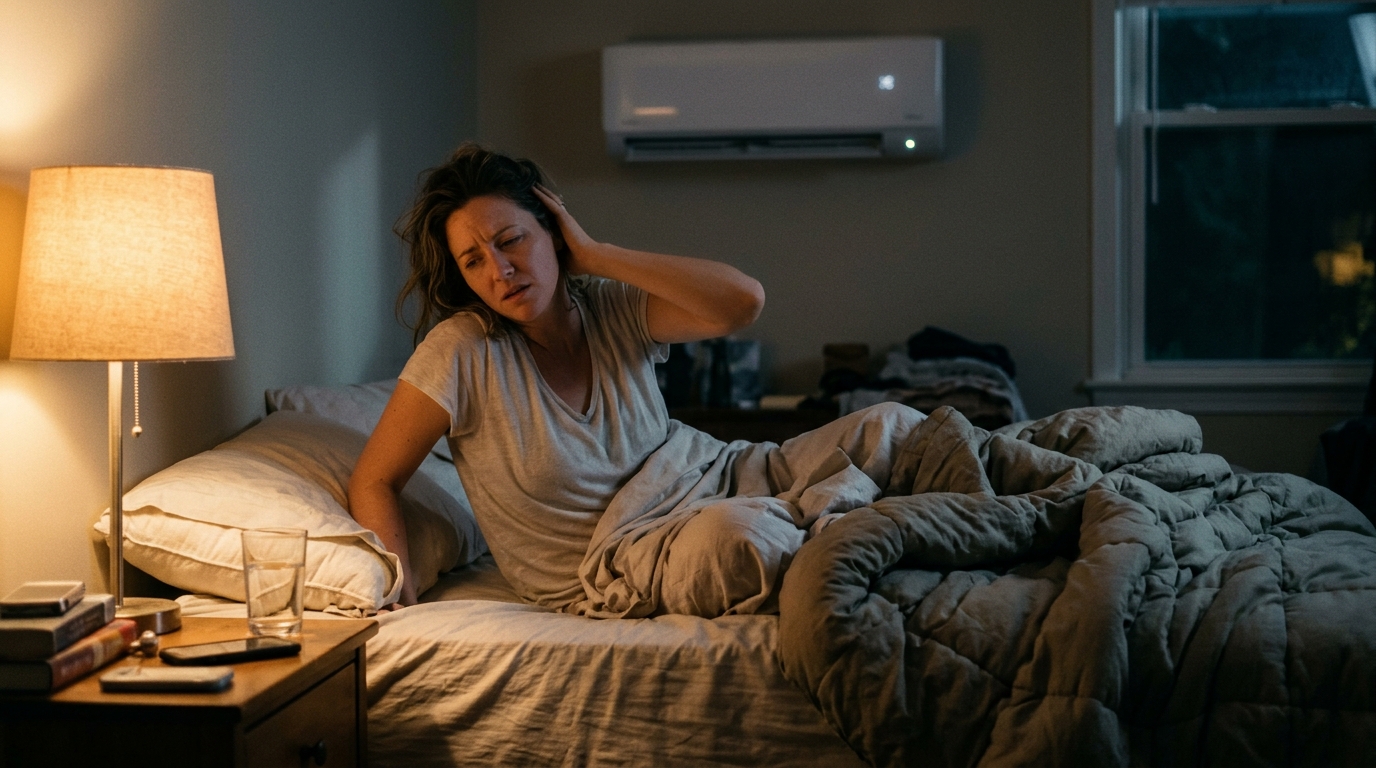
You set the thermostat to 72°F, hear the AC cycling all night, and still wake up at 3 a.m. kicking off the covers or staring at the ceiling in a damp T-shirt. It is one of the most common comfort complaints homeowners have, and it is rarely a sign that your air conditioner is too small or broken.
The real culprits are usually hiding in plain sight. Your thermostat is measuring the temperature in a hallway or living room, not your bedroom. Your attic is still radiating stored heat into the ceiling long after sunset. Your supply vents may be delivering barely any air to the room where you actually sleep. And your body itself has to shed heat to stay asleep, which is harder when your bedding and mattress trap it.
This post walks through why bedrooms run hot overnight even with the AC on, then gives you two practical paths: a free-to-cheap quick fix you can do tonight, and a more thorough DIY upgrade that tackles airflow and heat gain at the source. Most homeowners can cut bedroom temperature swings by 3 to 6°F without buying a new system.
What You’ll Need
Click on an item below to shop for the recommended items for this recipe on Amazon.
As an Amazon Associate, we earn from qualifying purchases.
How to Do It
- Open the bedroom supply vent fully and make sure no furniture, curtains, or bedding blocks it. Hold your hand over it while the AC is running and confirm you feel strong airflow.
- Leave the bedroom door open at night, or undercut the door by about 1 inch (or add a transfer grille) so air can return to the central return. Closed doors with no return path starve the room of cool air.
- Change your HVAC filter if it has been more than 60 to 90 days. A clogged filter can cut airflow by 15 to 30% and is the most common cause of weak vents.
- Close blinds and curtains on sun-facing windows by midafternoon so the room is not storing solar heat before bedtime. Blackout or cellular shades work best.
- Run a ceiling fan on the counterclockwise setting (or a small bedside fan) so air moves across your skin. This can make the room feel 3 to 4°F cooler and lets you raise the thermostat setting a degree or two.
- Swap flannel or heavy bedding for breathable cotton, linen, or bamboo sheets and a lighter blanket, and consider a cooling mattress pad if your mattress runs hot.
- Place a standalone thermometer or smart sensor in the bedroom for 3 nights to find out how warm the room actually gets compared with the thermostat reading. Log the temperature at 10 p.m., 2 a.m., and 6 a.m.
- Add a smart thermostat with a remote room sensor (about $130 to $250) and place the sensor in the bedroom. This lets the system cool based on the temperature where you sleep rather than the hallway.
- Inspect accessible ducts in the attic or crawlspace for disconnected sections, crushed flex duct, and leaky joints. Seal joints with mastic or foil tape (not cloth duct tape) and spend about $20 to $40 on supplies. Duct leaks can waste 20 to 30% of conditioned air.
- Check attic insulation depth. If you see less than R-38 (roughly 12 to 14 inches of blown insulation), add more. DIY blown-in or batts cost about $1 to $2 per square foot and meaningfully cut ceiling heat gain.
- Seal air leaks around recessed lights, attic hatches, and wiring penetrations with caulk, foam, and weatherstripping so hot attic air stops leaking into the bedroom.
- Install a window film or exterior shade on west- and south-facing bedroom windows to block solar gain, which can reduce window heat gain by 50 to 70%.
- If one room is still too warm, have an HVAC tech check the duct size and damper settings, and consider a $200 to $600 return air or booster fan fix for that room.
Why It Works: The Benefits
Sleep research consistently points to bedroom temperatures of roughly 65 to 68°F as ideal. Getting your room into that range can reduce nighttime waking and help you spend more time in deep sleep.
Balancing airflow and blocking heat gain reduces compressor runtime. Many homeowners see 5 to 15% lower cooling energy use, which is roughly $10 to $30 a month in a typical summer.
When the system is not fighting constant heat gain or restricted airflow, it runs fewer long cycles. That can extend equipment life and reduce the risk of frozen coils from poor airflow.
Fixing the bedroom problem usually tightens up the whole home. Hot and cold spots shrink, and you stop overcooling the main floor just to get the bedroom bearable.
Most hot bedroom complaints trace back to airflow, insulation, or controls rather than equipment capacity, so you avoid a $6,000 to $12,000 replacement you may not need.
💰 Savings Impact by Action
Sealing leaky ducts can recover 20 to 30% of conditioned air that would otherwise be lost to the attic or walls.
Adding insulation to R-38 can cut ceiling heat gain by 15 to 25%, making upstairs bedrooms noticeably cooler overnight.
Blocking sun with shades or film can reduce window heat gain by 50 to 70%, trimming total cooling load by roughly 10 to 15%.
Replacing a clogged filter restores airflow and can improve system efficiency by 5 to 15%.
Running a fan lets you raise the thermostat 3 to 4°F at the same comfort level, saving about 8 to 12% on cooling.
🏠 Key Concepts Explained
The Science Behind It
Your AC does not cool your house in a uniform way. It removes heat and moisture from the air at the thermostat’s location and distributes that cooled air through ducts. If your bedroom gets less air than the room where the thermostat lives, or gains heat faster than it can shed it, the thermostat can be satisfied while the bedroom stays warm. This is why temperature differences of 4 to 8°F between rooms are common in two-story homes.
Heat gain overnight is often driven by the attic. A roof surface can reach 150°F or more on a sunny afternoon, and that heat conducts into the attic air, insulation, and framing. Even after the sun sets, the stored energy keeps flowing downward into ceilings for several hours. The higher the thermal resistance of your insulation (measured as R-value), the slower this heat moves. Upgrading from R-19 to R-38 cuts that heat transfer roughly in half.
Finally, human comfort is not just about air temperature. Your body sheds heat through radiation, convection, and evaporation. High humidity, trapped bedding, and still air all reduce your ability to dump heat, so a 72°F room can feel like 78°F. Moving air across your skin with a fan boosts convective and evaporative cooling, and keeping indoor humidity between 40 and 50% lets sweat do its job. Fixing both the room’s heat load and your body’s ability to shed heat is what actually lets you sleep through the night.
Frequently Asked Questions
▼ Why is my AC still running all night but the bedroom is still hot?
The thermostat is likely in a cooler spot, or the bedroom is not getting enough airflow. Check that the vent is open and unblocked, replace a dirty filter, and place a thermometer in the bedroom to see how far off it is. If the room is consistently 4°F or more warmer than the thermostat reading, a remote sensor, duct repair, or added return path is the next step.
▼ Can renters do this without landlord permission?
Yes, most of the quick fix is renter-safe. You can use blackout curtains, a fan, breathable bedding, a cooling mattress pad, and removable window film, and you can swap the HVAC filter if the lease allows. Skip duct sealing and insulation work, and report weak airflow or a broken AC to your landlord in writing.
▼ How long before I actually notice savings on my bill?
Comfort improvements are immediate, often the first night. Bill savings show up in the next full billing cycle, typically 5 to 10% lower cooling costs from filter changes and shading, and up to 15% when you also seal ducts and add insulation. Compare against the same month last year to account for weather.
▼ What if my home is older than 30 years?
Older homes usually have less attic insulation, leakier ducts, and single-pane or early double-pane windows, so bedrooms run hotter overnight. Prioritize attic air sealing and insulation to R-38 or higher, then duct sealing. These upgrades often pay back in 2 to 5 years and improve comfort more than any equipment change.
▼ Should I just lower the thermostat to 68°F?
That usually wastes energy without fixing the actual problem. Each degree lower raises cooling costs by roughly 3 to 5%, and if the issue is airflow or attic heat, the bedroom will still lag behind the rest of the house. Fix the cause first, then drop the setpoint a degree or two for sleep if you want.
Quick Tips
- Pre-cool the bedroom 30 to 60 minutes before bed by setting the thermostat 2 to 3°F lower, then let it float back up once you are asleep.
- Run bathroom and kitchen exhaust fans sparingly at night. They pull conditioned air out of the house and draw hot attic air in through leaks.
- Use a ceiling fan on low and make sure it spins counterclockwise in summer. Turn it off when you leave the room since fans cool people, not rooms.
- Check the supply vent temperature with a thermometer. Air should be 15 to 20°F cooler than the room air. If it is not, have your AC serviced for low refrigerant or a dirty coil.
Variations for Your Situation
- Apartment/Rental: Focus on what you control. Use blackout curtains ($25 to $60), removable reflective window film ($15 to $30), a quiet tower or box fan ($30 to $60), and breathable cotton or percale sheets ($40 to $100). Keep the bedroom door open or add a door stop for airflow, change the filter if you are permitted, and ask your landlord to check the vent and thermostat if the room runs much warmer than the rest.
- Tight Budget (under $50): Change the HVAC filter ($8 to $20), open and unblock the vent, close sun-facing blinds by noon, run a fan, and swap to lightweight sheets or just a single sheet. Add foil tape ($8) to visibly loose duct joints you can reach, and use a $10 thermometer to track results. These steps alone often drop bedroom temperature 2 to 4°F.
- Older Home (pre-1980): Start with attic air sealing and insulation, since leaks and thin insulation are the biggest drivers. Seal around the attic hatch, light fixtures, and wall top plates, then bring insulation to R-38 to R-49. Have the ducts tested or at least visually inspected for gaps, and consider replacing leaky window treatments with insulated cellular shades. Expect higher up-front cost ($500 to $2,500) but a 2 to 5 year payback and a major comfort gain.