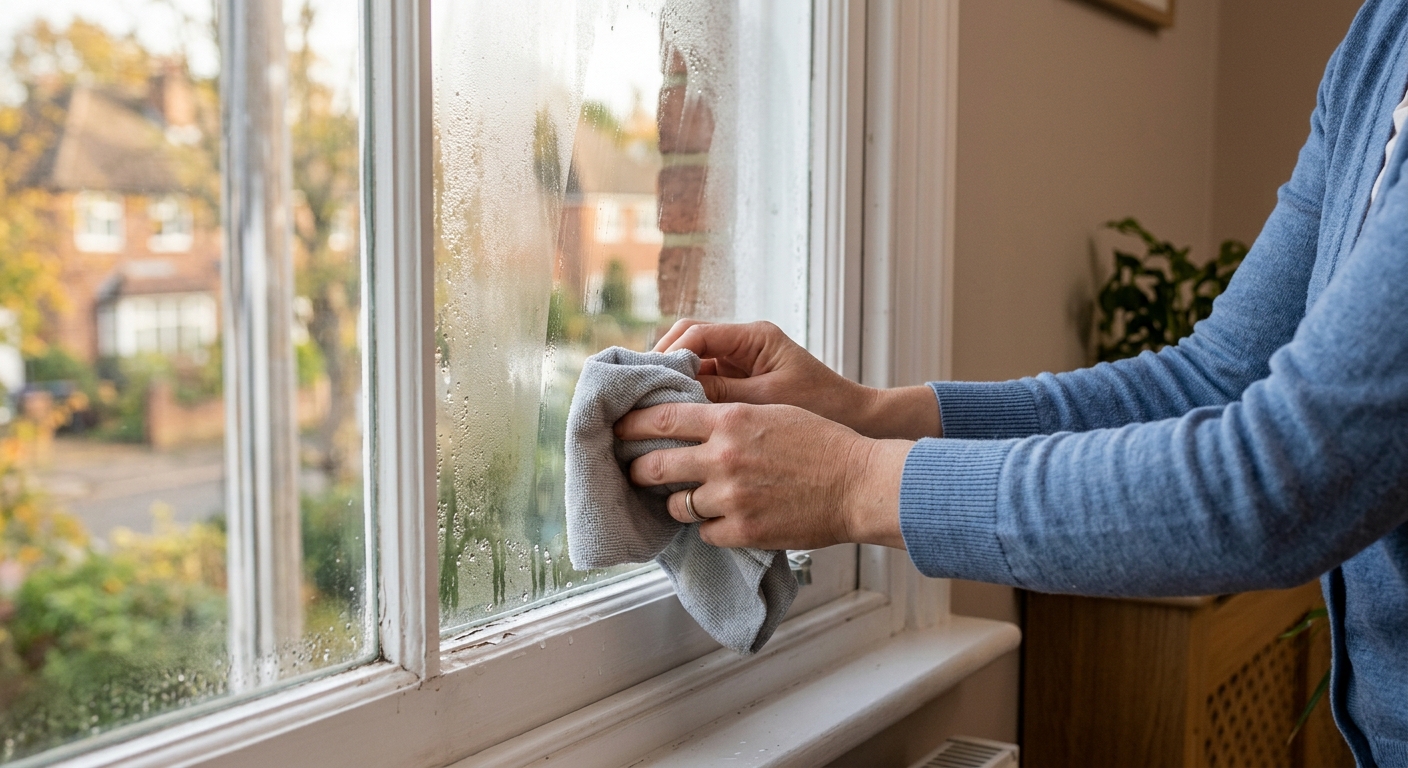
That foggy film on your windows every morning is not just an annoyance. It is your home telling you that indoor humidity is high enough to deposit liquid water on the coldest surface in the room. Left unchecked, that moisture migrates into wall cavities, soaks insulation, and creates the dark, damp conditions that mold thrives in. The EPA estimates that mold remediation in a single room costs between $500 and $3,000, making prevention one of the most cost-effective moves a homeowner can make.
Condensation forms when warm, humid indoor air contacts a surface cold enough to drop the air below its dew point. In winter, single-pane windows can sit at 25 to 35 degrees Fahrenheit on the interior surface even when your thermostat reads 68 degrees. At typical indoor humidity levels of 40 to 50 percent, that is more than enough to trigger condensation on every window in the house. The fix is almost never the window itself. It is controlling humidity and improving the thermal performance of the glass.
This guide covers exactly what causes condensation on windows, how to measure whether your humidity is in a safe range, and practical steps from zero-cost ventilation habits to targeted DIY upgrades that stop moisture before it reaches your walls. Whether you rent an apartment or own a 1960s ranch house, there is an approach here that fits your situation and budget.
What You’ll Need
Click on an item below to shop for the recommended items for this recipe on Amazon.
As an Amazon Associate, we earn from qualifying purchases.
How to Do It
- Buy a digital hygrometer (under $15 at any hardware store) and place it in the room with the worst condensation. Check the reading first thing in the morning. If it reads above 50 percent, humidity is your primary problem.
- Run bathroom exhaust fans during every shower and for 20 minutes afterward. Run the kitchen exhaust fan anytime you boil water or cook on the stovetop. These two habits alone can reduce whole-house RH by 5 to 10 percent.
- Crack a window 1 to 2 inches in the kitchen or bathroom while cooking or bathing if your exhaust fans are weak or absent. Even a small amount of cross-ventilation flushes humid air out before it spreads.
- Move houseplants away from windows during winter. Grouping several plants near cold glass significantly raises the local humidity right at the surface most likely to condense.
- Open window coverings (blinds and curtains) during daylight hours so warm air can circulate across the glass surface, keeping it slightly warmer and above the dew point.
- Inspect every window frame interior where it meets the drywall or trim. Press a thin strip of tissue paper along the joint and watch for movement. Any flutter indicates air infiltration that brings cold air against the glass and allows humid interior air to escape into the wall cavity.
- Apply paintable acrylic latex caulk to any gaps between the window trim and the surrounding wall. For larger gaps (over 1/4 inch), use a backer rod first to fill the void, then caulk over it. This single step can reduce air leakage at windows by 20 to 30 percent.
- Apply V-strip or foam weather stripping around any operable sashes that feel drafty. Press the weather stripping firmly into the channel so it compresses when the window closes. Replace it every 3 to 5 years or when it no longer springs back.
- Apply interior window insulator film kits (available at hardware stores for $10 to $20 per window) to your worst-performing single-pane windows. The film creates a still-air buffer that raises the interior glass surface temperature by 10 to 15 degrees, often enough to eliminate condensation entirely at typical indoor humidity levels.
- Install a plug-in dehumidifier rated for the square footage of your most affected space. For a bedroom or living room, a 20 to 30-pint-per-day unit ($80 to $150) is typically sufficient. Set the target humidity to 45 percent and let it run continuously on auto mode. Empty or connect the drain hose to a floor drain.
- Re-check your hygrometer one week after completing all steps. If morning humidity is consistently below 50 percent and condensation has stopped, you have solved the problem. If it persists, evaluate your exhaust fan capacity or consider a whole-house ventilation upgrade.
- Schedule a home energy audit ($150 to $400) or ask an HVAC contractor to do a blower door test. Homes with less than 0.35 air changes per hour naturally are prime candidates for mechanical ventilation.
- Choose between an Energy Recovery Ventilator (ERV) or Heat Recovery Ventilator (HRV). ERVs transfer both heat and moisture and work best in humid climates. HRVs transfer heat only and work best in cold, dry climates where you want to exhaust moisture. Your contractor can advise based on your climate zone.
- Have the unit installed in-line with your existing HVAC ductwork or as a standalone ducted system. A properly sized ERV or HRV exchanges stale, humid air with fresh outdoor air while recovering 70 to 80 percent of the heat energy, so you are not paying to heat cold outdoor air.
- Set the ventilation rate to meet ASHRAE 62.2 minimums (roughly 7.5 CFM per person plus 1 CFM per 100 square feet of floor area). Most units have a simple control dial or smart home integration.
- Schedule an annual filter cleaning and semi-annual core inspection to maintain efficiency. ERV and HRV cores can last 20 years with proper maintenance.
Why It Works: The Benefits
Keeping indoor humidity below 50 percent eliminates the primary condition mold needs to colonize. Remediation for mold in a wall cavity typically costs $500 to $3,000 per affected area, so prevention pays for itself after a single avoided incident.
High humidity makes air feel warmer but also increases the energy your heating system expends to condition moisture-laden air. Reducing indoor RH from 55 to 40 percent can cut heating-related energy use by 5 to 15 percent in cold climates according to DOE data.
Homes with chronic window condensation typically have elevated dust mite populations and mold spore counts. Controlling humidity below 50 percent reduces dust mite reproduction by up to 80 percent, directly improving asthma and allergy symptoms.
Repeated wet-dry cycles cause wood frames to swell and shrink, degrading paint, caulk, and the wood itself. Stopping condensation can extend painted wood window frame life by 10 to 20 years, deferring costly window replacement.
At the right humidity level (30 to 50 percent), indoor air feels comfortable at lower thermostat settings. Many homeowners find they can lower the thermostat 1 to 2 degrees after fixing humidity issues and feel equally comfortable, saving an additional 2 to 4 percent on heating bills.
💰 Savings Impact by Action
Caulking and weather stripping window frames reduces conditioned air infiltration at windows by up to 20 percent, lowering both heating costs and indoor moisture load.
Consistent use of bathroom and kitchen exhaust fans reduces whole-house relative humidity by 5 to 10 percent, the single most impactful free action for condensation control.
Interior window insulator film raises glass surface temperature by 10 to 15 degrees Fahrenheit, cutting heat loss through single-pane windows by up to 35 percent and eliminating condensation at moderate humidity levels.
Lowering indoor RH from 55 to 40 percent reduces the moisture load on your heating system and can cut total winter heating energy use by 5 to 15 percent in cold climates.
A properly sized energy or heat recovery ventilator recovers 70 to 80 percent of the heat from exhausted air while continuously controlling indoor humidity, nearly eliminating condensation in tight modern homes.
🏠 Key Concepts Explained
The Science Behind It
Condensation is governed by the relationship between air temperature and its capacity to hold water vapor. Warm air can hold significantly more moisture than cold air. When indoor air at 68 degrees Fahrenheit and 45 percent relative humidity contacts a window surface at 35 degrees, the air immediately adjacent to the glass cools rapidly. Once it drops below its dew point (around 46 degrees in this example), it can no longer hold all its moisture in vapor form and releases it as liquid water on the glass surface.
The key leverage point is raising the surface temperature of the glass. A single-pane window in a cold climate can have an interior surface temperature of 20 to 35 degrees on a cold night, well below the dew point of any reasonably humidified indoor space. Double-pane low-e glass, by contrast, keeps the interior surface temperature at 50 to 55 degrees even on very cold nights, dramatically reducing the window’s ability to trigger condensation. Window insulator film works on the same principle: it traps a thin layer of still air against the glass, acting like a second pane and raising the visible surface temperature by 10 to 15 degrees.
The second lever is reducing the dew point of the indoor air itself by lowering relative humidity. For every 5-percent reduction in indoor RH, the dew point drops by roughly 3 to 4 degrees Fahrenheit. Dropping indoor humidity from 55 to 40 percent lowers the dew point from about 55 degrees to 40 degrees, which means window surfaces must be much colder before condensation begins. Combined, these two approaches (warmer glass surface plus lower indoor dew point) create a wide safety margin that keeps your windows dry even on the coldest nights.
Frequently Asked Questions
▼ I lowered my humidity to 45 percent but I still have condensation. What am I missing?
At 45 percent RH, condensation on a window means the glass surface temperature is dropping below 45 degrees Fahrenheit, which typically indicates single-pane glass, a failed double-pane seal, or a severe thermal bridge at the frame. Apply window insulator film to that specific window as an immediate fix and verify that the seal on any double-pane unit has not failed. A failed IGU seal appears as a hazy or foggy appearance between the panes and requires professional glass replacement.
▼ My windows are fine but I see water damage on the wall below them. What is causing that?
Water on the wall below a window without obvious glass condensation usually points to air infiltration through the window frame or sill, not surface condensation. Humid indoor air is moving through the wall assembly, hitting the cold sheathing, and condensing inside the wall where you cannot see it. Seal the interior perimeter of the window frame with caulk immediately and check the exterior flashing and caulk for gaps. If the drywall is already soft or discolored, probe for mold before sealing and consider calling a contractor.
▼ Can I use a whole-house humidifier in winter and still avoid window condensation?
Yes, but you need to dial the humidifier output back as outdoor temperatures drop. A common guideline: when outdoor temps are 20 to 0 degrees Fahrenheit, keep indoor humidity at 25 to 30 percent maximum. Between 0 and 10 degrees, hold at 20 to 25 percent. Many whole-house humidifiers have an outdoor temperature sensor that adjusts automatically. Without this adjustment, humidifiers are one of the most common causes of severe window condensation and hidden wall moisture in cold climates.
▼ I rent my apartment and cannot install anything. What can I actually do?
Focus on free ventilation habits first: always run the bathroom fan during and 20 minutes after showers, crack a window slightly while cooking, and move plants away from cold glass. You can also buy a small portable dehumidifier ($60 to $120) and set it to 45 percent. If your bathroom or kitchen fan is clearly underperforming, notify your landlord in writing since ventilation is typically a landlord maintenance responsibility in most states.
▼ My new double-pane windows still have condensation on the outside in the morning. Is something wrong?
Exterior condensation on high-efficiency double-pane windows is actually a sign the windows are working correctly. The glass is so well-insulated that its outer surface stays near the outdoor air temperature overnight, allowing dew to form on it just like it forms on a car windshield. This exterior condensation evaporates quickly after sunrise and causes no damage to the window or your home.
Quick Tips
- Set your dehumidifier to 45 percent in fall and gradually lower it to 35 to 40 percent as outdoor temperatures drop. This seasonal adjustment prevents condensation as glass temperatures fall with the weather.
- Check that your dryer exhaust vent is fully connected and venting outdoors. A disconnected or leaking dryer duct dumps several gallons of water vapor per week directly into your living space and is one of the most overlooked sources of excess indoor humidity.
- Replace exhaust fan grilles in bathrooms older than 15 years. Fan blades accumulate dust and run at a fraction of their rated CFM. A $40 to $80 replacement fan rated at 110 CFM makes a significant difference in how quickly moisture clears after a shower.
- After identifying and fixing condensation, leave a light-colored towel on the sill for two weeks as a simple moisture test. Any persistent dampness in the towel indicates moisture is still getting through and the source needs further investigation.
Variations for Your Situation
- Apartment/Rental: Renters cannot modify HVAC systems or install exhaust fans, but they have strong options. Buy a plug-in digital hygrometer ($12 to $15) to confirm humidity is above 50 percent, then add a portable dehumidifier set to 45 percent in the most affected room. Apply temporary removable window insulating film (products like 3M Indoor Window Insulator are renter-safe and leave no residue). Report persistent inadequate ventilation to your landlord in writing, as most state housing codes require functional bathroom exhaust ventilation.
- Tight Budget (under $50): Start with the hygrometer ($12) to confirm humidity is the issue. Spend the rest on a tube of acrylic caulk ($6) and a roll of V-strip weather stripping ($12) to seal window frames, plus a window film kit for your worst window ($15 to $20). The ventilation habit changes (running fans, cracking windows, moving plants) cost nothing and can drop indoor RH by 5 to 10 percentage points on their own. This under-$50 combination addresses both the humidity load and the glass surface temperature simultaneously.
- Older Home (pre-1980): Homes from this era almost always have single-pane windows, wood frames with degraded glazing compound, and no mechanical exhaust ventilation worth mentioning. Prioritize re-glazing any window where the putty has cracked or pulled away from the glass (a $10 tube of glazing compound per window), then apply window film to all single-pane windows in bedrooms. Replace any exhaust fan that is more than 15 years old. A whole-house dehumidifier ($250 to $500) that integrates with your furnace blower is often the most practical long-term solution for older homes that cannot be tightly air-sealed without major renovation.