Every summer night, millions of homeowners leave their AC running while cooler outdoor air sits just on the other side of the window screen. Once outdoor temperatures drop below your indoor temperature, typically around 8 to 10 PM in most climates, your home becomes its own cooling machine if you know how to use it. Strategic nighttime ventilation is one of the oldest and most effective passive cooling techniques available, and it costs almost nothing to implement.
The average American household spends around $265 per year on air conditioning, according to the U.S. Energy Information Administration. Cutting even a third of those overnight AC hours can save $50 to $90 annually with zero equipment purchases. In mild climates like the Pacific Northwest or high-desert regions, homeowners who master nighttime ventilation can eliminate AC use almost entirely during shoulder seasons.
This post walks you through the building science behind why nighttime ventilation works, two practical approaches from a quick no-cost setup to a more effective DIY fan system, and the specific mistakes that prevent most homeowners from getting real results.
What You’ll Need
Click on an item below to shop for the recommended items for this recipe on Amazon.
As an Amazon Associate, we earn from qualifying purchases.
How to Do It
- Check the outdoor temperature at 8 PM. If it is at least 5 degrees cooler than your indoor temperature, nighttime ventilation will work tonight. Use a weather app or a simple outdoor thermometer.
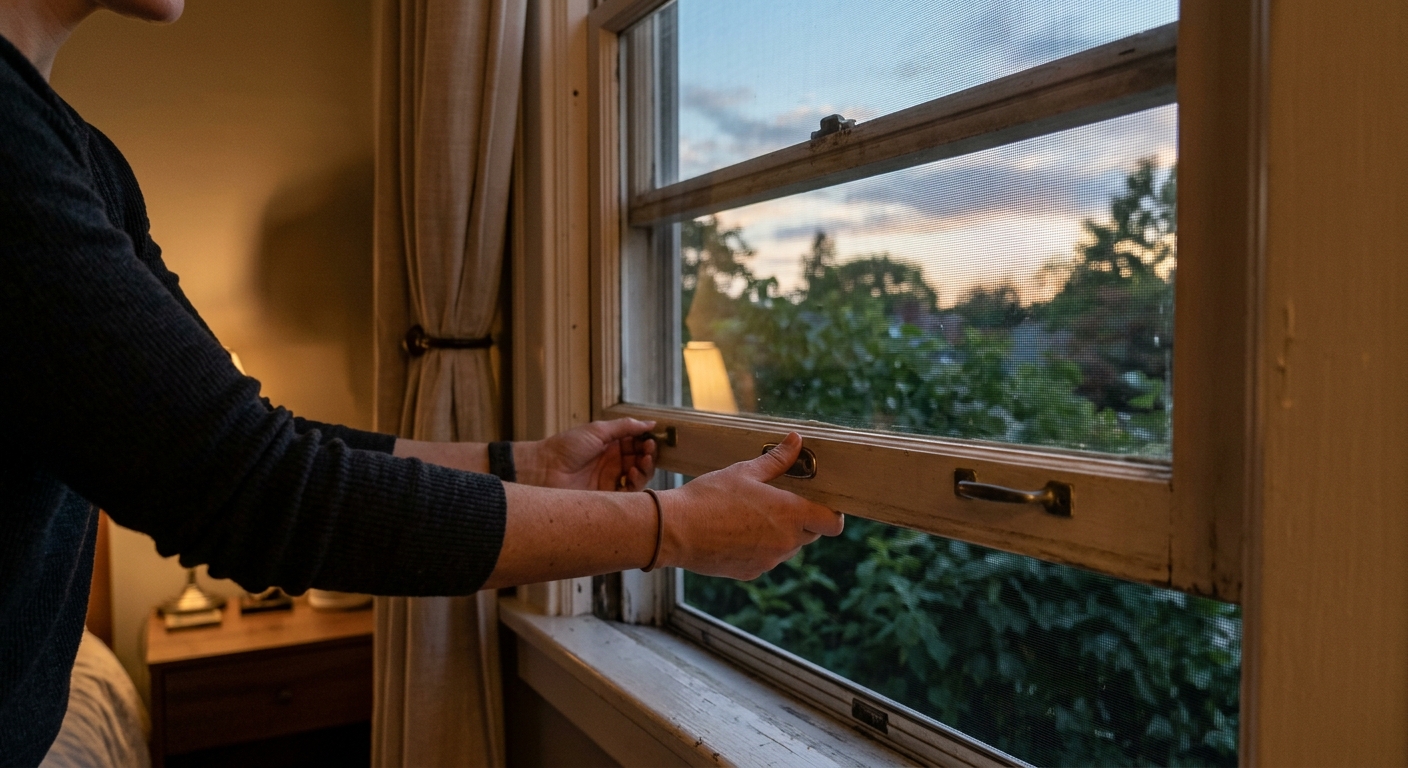
- Open windows on opposite sides of each room or zone to create cross ventilation. For a rectangular floor plan, open windows on the north and south sides rather than two windows on the same wall.
- Use the stack effect by opening lower windows on the cooler side of the house (usually north or shaded side) and upper windows or skylights on the opposite side to let warm air escape upward.
- Turn ceiling fans to counterclockwise rotation at medium or high speed to pull warm air up and push cooler incoming air across occupants. This makes 76 degrees feel like 71 degrees.
- Set a phone alarm for 30 minutes after your local sunrise time. When the alarm goes off, close all windows and draw blinds or curtains before outdoor air warms past your indoor temperature to lock in the cool air.
- Purchase a reversible twin-window fan with a built-in thermostat or timer (20 to 50 dollars for a basic model, 60 to 120 dollars for a programmable unit). Install it in a window on the side of the house that faces away from the prevailing breeze, set to exhaust mode to pull air through the home.
- Open intake windows on the opposite side of the home from the exhaust fan. Keep intake openings roughly equal in total area to the fan window opening. Larger intake area slightly improves airflow efficiency.
- Open interior doors throughout the home so air can move freely from intake windows to the exhaust fan without dead-ending in hallways.
- Program the fan thermostat to activate when outdoor temperature drops to 68 to 70 degrees and shut off if it rises above that threshold. If your fan lacks a thermostat, set a timer to run it from 9 PM to 6 AM.
- Place a box fan in the doorway of your bedroom facing outward (toward the hallway) to pull cooler intake air directly across your sleeping area before it reaches the exhaust fan.
- In the morning, turn off the fan, close all windows, and lower blinds or cellular shades on east and south-facing windows to prevent solar gain from reheating the space you just cooled.
Why It Works: The Benefits
Replacing 6 to 8 hours of overnight AC with free nighttime ventilation can cut cooling energy use by 10 to 30% depending on your climate. In mild climates, this translates to $30 to $90 in summer savings with zero upfront cost.
Research from the National Sleep Foundation shows people fall asleep faster and stay asleep longer when bedroom temperatures are between 60 and 67 degrees. Natural ventilation routinely achieves this range overnight without the dry air and noise that AC systems produce.
Every hour your AC does not run is an hour of compressor wear you avoid. Cutting overnight AC runtime extends equipment life and reduces the frequency of refrigerant and maintenance issues, which average $150 to $300 per service call.
A home that vents down to 68 to 70 degrees overnight gives your AC a much smaller temperature gap to close the next day, reducing cooling load by up to 25% during morning and afternoon peak hours when electricity rates are often highest.
Flushing several air changes through your home overnight dilutes accumulated indoor pollutants including VOCs from furniture and cleaning products, carbon dioxide, and humidity. Most homes benefit from 4 to 6 complete air changes during a nighttime ventilation session.
💰 Savings Impact by Action
Replacing 6 to 8 hours of overnight AC runtime with natural ventilation reduces nightly cooling energy use by up to 25% of total summer AC consumption.
A home cooled to 68 to 70 degrees overnight reduces the next day’s AC cooling load by up to 20% by lowering the thermal mass baseline before daytime heat gain begins.
A window fan uses 50 to 100 watts versus 1,200 to 3,500 watts for central AC, cutting ventilation energy cost by roughly 90% when fans replace compressor runtime.
Running ceiling fans during nighttime ventilation increases perceived cooling by the equivalent of about 4 degrees, allowing thermostat setpoints 4 to 8 degrees higher before occupants feel warm.
🏠 Key Concepts Explained
The Science Behind It
Your home behaves like a thermal battery. During the day, sunlight and outdoor heat push energy into your walls, roof, floors, and furniture through conduction and radiation. All of that stored energy gets released slowly after sunset, which is why your attic is still 110 degrees at 9 PM even though outdoor temps have dropped to 75. Nighttime ventilation works by using moving air to carry that stored energy out of your home’s thermal mass faster than it would dissipate on its own.
The physics behind cross ventilation and the stack effect are straightforward. Air moves from high pressure to low pressure. Wind striking the windward side of your home creates a slight positive pressure zone, while the leeward side sits at negative pressure. Open a window on each side and air flows through to equalize that pressure difference. The stack effect adds a vertical component: warm air inside is less dense and rises, creating a low-pressure zone near the ceiling. High-mounted exhaust openings allow that buoyant warm air to escape, drawing cooler denser air in through low openings below. Together, these two effects can move 1,000 to 3,000 cubic feet of air per minute through a typical home with no fan required on a breezy night.
A window fan amplifies this by actively depressurizing the leeward side of the home, pulling outdoor air through regardless of wind conditions. At a typical airflow rate of 800 to 1,500 CFM, a window fan can fully replace the air volume in a 1,500 square foot home every 8 to 12 minutes. Over six hours of overnight ventilation, that is 30 to 45 complete air changes, enough to flush nearly all stored daytime heat out of the building envelope and bring surface temperatures of walls and floors close to outdoor ambient levels before sunrise.
Frequently Asked Questions
▼ I opened my windows but the house barely cooled down. What went wrong?
The most common cause is opening windows on the same side of the house, which creates no meaningful airflow. Verify that your intake and exhaust windows are on opposite sides of the home and that interior doors are open so air can travel freely through the floor plan. Also confirm the outdoor temperature is actually lower than indoors before opening up.
▼ My house feels more humid in the morning after ventilating overnight. Is that normal?
Yes, and it is a sign that your local nighttime dew point is too high for effective ventilation. Check the dew point on your weather app before opening windows. If it is above 60 degrees, skip natural ventilation that night and run your AC instead, which dehumidifies as it cools. High-humidity climates like Florida and the Gulf Coast are often poor candidates for overnight ventilation in peak summer.
▼ How long before I see the savings show up on my electric bill?
You should see a measurable difference within your first full billing cycle if you ventilate consistently on eligible nights. Compare your kilowatt-hour usage month over month rather than dollar amounts, since rates vary. A 10 to 20% reduction in kWh during summer months is a realistic first-cycle result for most climates.
▼ Can I do this in an apartment where I cannot open all the windows?
Yes, with limitations. Focus on creating the best cross ventilation possible with the windows you can access. A reversible window fan in one window set to exhaust, paired with a box fan pulling air from a hallway or adjacent room, can move meaningful airflow even in a single-exposure apartment. Avoid this strategy if your unit faces a noisy or polluted street at night.
▼ What if I forget to close the windows before outdoor temperatures rise?
Close them immediately, lower all blinds on sun-facing windows, and give your home 30 to 60 minutes to stabilize before deciding whether to run the AC. The damage is recoverable if you catch it within an hour of sunrise. Setting two phone alarms, one at sunrise and one 45 minutes later as a backup, prevents this from becoming a habit that erases your nightly savings.
Quick Tips
- Focus on bedroom ventilation first. Sleeping cooler improves health and reduces the temptation to flip the AC back on at 2 AM, which erases all your nighttime savings.
- Use a hygrometer app or dedicated weather station to check outdoor dew point, not just temperature. If dew point exceeds 60 degrees, keep windows closed and run your AC instead.
- Dark window screens significantly reduce nighttime airflow. Clean your screens annually and consider replacing standard fiberglass mesh with a higher-flow insect screen to improve passive ventilation by 10 to 15%.
- Insulated cellular shades closed during the day reduce the daytime heat load that nighttime ventilation has to overcome. Every degree cooler your home starts the night, the more effective your ventilation session becomes.
Variations for Your Situation
- Apartment or Rental: Renters with limited window access should start with a reversible twin window fan (around $40 to $60) placed in the bedroom window set to intake mode, which pulls outdoor air directly across the sleeping area. Pair it with a box fan in the living room doorway facing outward to exhaust warm air. No landlord permission is needed for portable fans. This setup can drop bedroom temps 5 to 8 degrees overnight even without whole-home airflow.
- Tight Budget (under $20): Skip the fan purchase entirely and focus on the morning lockdown and cross ventilation strategy from the quick fix approach. The single highest-impact zero-cost action is closing windows and blinds before 7 AM. Homeowners who do this consistently report a 5 to 10 degree difference in afternoon indoor temperatures compared to leaving windows open or forgetting to close up before work.
- Older Home (pre-1980): Older homes typically have more air leakage, which helps passive ventilation but also means they reheat faster after sunrise since the envelope does not hold cool air as well. Prioritize adding cellular shades or exterior window film to south and west windows before relying on nighttime ventilation, as reducing daytime heat gain gives nighttime cooling a smaller load to overcome. Also check that existing window screens are intact, as older screens often have gaps or tears that invite pests during overnight openings.