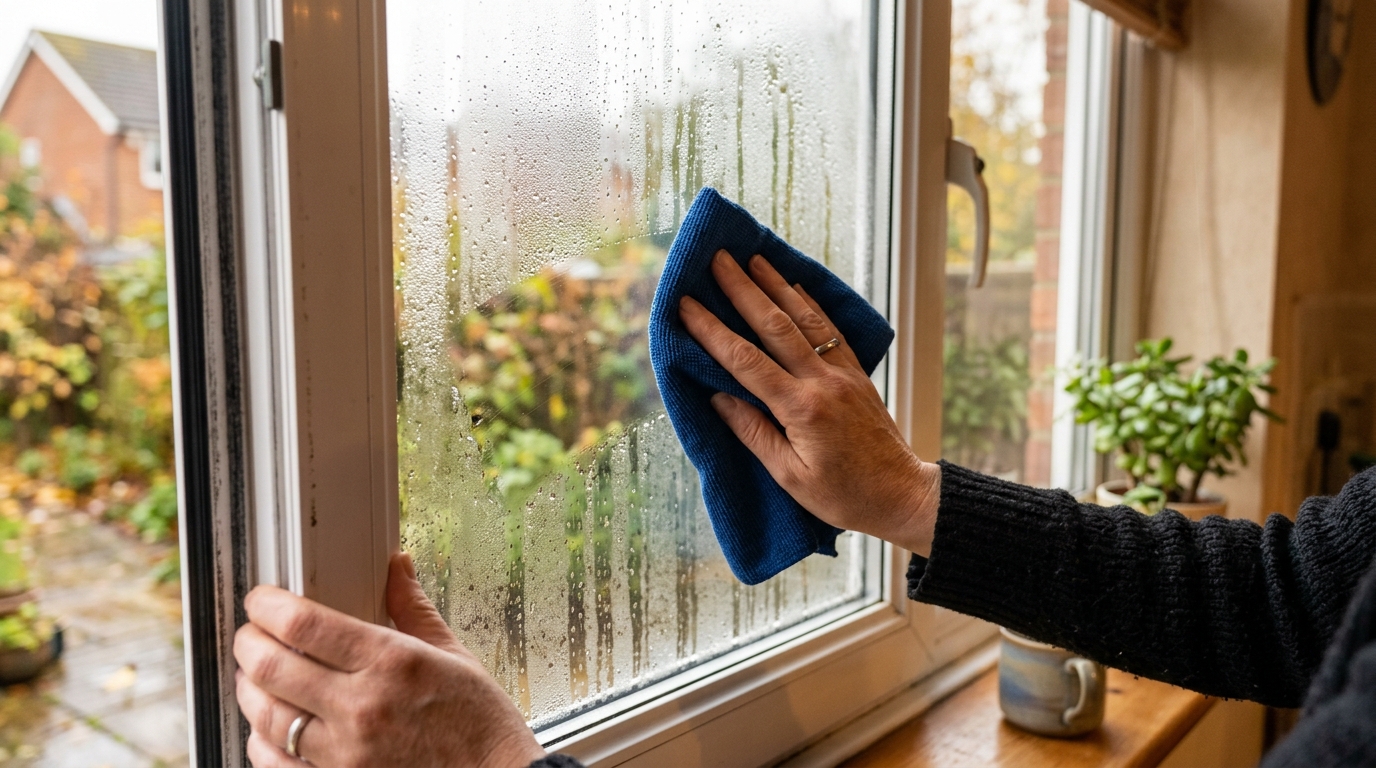
Every winter morning, millions of homeowners wipe down foggy windows and think nothing of it. But that moisture is not just water on glass. It is a warning sign that your home’s humidity levels are out of balance, your windows may be failing, or your ventilation is not keeping pace with daily moisture production. Left unchecked, condensation causes wood rot in frames and sills, peeling paint, mold growth behind trim, and even structural damage to the wall assembly around the window.
Window condensation falls into two main categories: exterior condensation, which is harmless and actually a sign of good insulation, and interior condensation, which is the problem worth solving. Interior condensation forms when warm, humid indoor air contacts a cold glass surface and the moisture drops out of the air as liquid. The fix requires either lowering indoor humidity, raising the surface temperature of the glass, or improving air circulation near the window. This post covers all three levers.
Whether you are dealing with light seasonal fogging or chronic water pooling on the sill that is staining and swelling the wood, the approaches below will help you diagnose the root cause and fix it at the right level, from free behavioral changes all the way to window replacement when it is truly warranted.
What You’ll Need
Click on an item below to shop for the recommended items for this recipe on Amazon.
As an Amazon Associate, we earn from qualifying purchases.
How to Do It
- Check your indoor humidity with a hygrometer (under $15 at any hardware store). If the reading is above 50% in winter, excess humidity is your primary problem, not the windows.
- Run bathroom exhaust fans during every shower and for 20 minutes after. Run the kitchen range hood every time you cook, even for short sessions. These two habits alone can reduce indoor humidity by 5 to 10 percentage points.
- Move any houseplants away from windows. A single large plant can add significant moisture to its immediate surroundings, pushing the local humidity near the glass above the dew point even when the rest of the room is fine.
- Open window blinds and curtains during the day to allow room-temperature air to circulate against the glass, raising the glass surface temperature by 2 to 5°F and reducing condensation potential.
- Set your humidifier (if you have one) to a winter setpoint of 35 to 40% RH rather than a comfortable-feeling 50%. Whole-home humidifiers are often over-set and are a top cause of chronic winter condensation.
- Inspect every window in the home on a cold day. Hold your hand around the interior trim and feel for cold drafts. Use a stick of incense to detect airflow you cannot feel. Mark any leaky windows with tape.
- Remove the interior trim (window casing) carefully on leaky windows using a pry bar and utility knife to cut the paint line. Behind the casing you will find the gap between the rough opening framing and the window frame, which is often empty or filled with old fiberglass batt scraps that do not air-seal.
- Fill the gap with low-expansion window and door foam (not standard expanding foam, which can warp frames). Apply in a single bead around the full perimeter and allow to cure for 1 hour before reinstalling trim.
- Recaulk the interior joint between the window frame and the drywall or plaster using a paintable latex caulk. Tool the bead smooth with a wet finger, let dry 2 hours, and paint to match.
- If sill condensation is pooling, apply a clear silicone caulk bead along the interior sill-to-frame joint to prevent water intrusion into the wood and direct any moisture toward the center of the sill where it can evaporate rather than soaking into end grain.
- Install a plug-in dehumidifier in chronically damp rooms (basements, rooms over garages) set to 45% to complement the air sealing work. A 30-pint unit costs $130 to $180 and handles up to 1,500 square feet.
- Confirm IGU failure by checking if the fogging is between the panes and does not wipe off. If condensation is only on the interior surface, try the DIY approach first. Between-pane fog means the insulating gas is gone and the seal is broken.
- Contact a window glass specialist (separate from a full window replacement contractor) to quote an IGU-only replacement. In many cases the frame is still in good shape and replacing just the glass unit costs $150 to $350 per window versus $500 to $1,000 for full replacement.
- If the frames are also damaged (soft wood, cracked vinyl, corroded aluminum) get quotes for full window replacement. Prioritize windows that face north or are in rooms with chronic condensation problems for the greatest impact.
- Specify at minimum double-pane Low-E glass with argon fill for replacements. This configuration keeps the inner pane 10 to 15°F warmer than single pane glass in the same outdoor conditions, eliminating most condensation risk at typical indoor humidity levels.
- Ask the contractor about proper installation flashing and air sealing as part of the scope. A new window installed without proper rough opening air sealing will underperform its rated efficiency by 20 to 30% and may still produce condensation at the frame edges.
Why It Works: The Benefits
Chronic window sill moisture creates the ideal environment for mold within 24 to 48 hours of sustained wetness. Eliminating condensation at the source removes the moisture feeding mold growth and protects wood frames from the rot that can cost $500 to $3,000 per window to repair.
A drafty, poorly sealed window can account for 10 to 25% of a home’s heating energy loss. Air sealing the window frame perimeter alone, a task that costs under $20 in materials, can reduce that loss significantly with results showing on the next monthly bill.
Reducing excess humidity to the 30 to 45% range discourages dust mites, mold spores, and other allergens that thrive in humid environments, making the air measurably healthier, especially for allergy and asthma sufferers.
Moisture is the primary enemy of window frames, especially wood. Controlling condensation can add 10 to 20 years to the functional life of quality wood or composite frames, delaying a replacement cost that averages $400 to $1,000 per window installed.
Cold window surfaces create a radiant chill effect, making occupants feel cold even when the thermostat reads 70°F. Improving window insulation and reducing drafts raises the mean radiant temperature of the room, so it actually feels warmer at the same thermostat setting.
💰 Savings Impact by Action
Sealing the rough opening gap around window frames with low-expansion foam reduces conditioned air loss through the window assembly by up to 20%, with material costs under $30.
Lowering indoor RH from 55% to 40% in winter reduces the latent heat load your heating system must overcome, trimming heating energy use by roughly 10 to 12% in humid climates.
Interior shrink film applied to single-pane windows creates a dead-air insulating gap that reduces heat loss through those windows by up to 35% for a season.
Replacing a failed double-pane IGU with a new Low-E argon unit restores the window to its original U-factor, reducing heat loss through that window by 20 to 25% versus a degraded seal.
Running bathroom and kitchen exhaust fans consistently reduces whole-home humidity by 5 to 10 percentage points, lowering the heating energy needed to maintain comfort by roughly 10%.
🏠 Key Concepts Explained
The Science Behind It
Condensation is a phase change governed by one simple rule: water vapor in air will condense into liquid the moment it contacts a surface colder than the air’s dew point temperature. The dew point is not fixed. It moves with both temperature and humidity. At 70°F and 40% relative humidity, the dew point is about 45°F. At 70°F and 60% relative humidity, the dew point climbs to 55°F. This is why lowering indoor humidity is so powerful: you are literally moving the condensation threshold below what your windows can reach, making condensation physically impossible at that glass temperature.
Window glass temperature in winter is determined by the U-factor of the glass assembly and the outdoor temperature. A single-pane window (U-factor around 1.0) in 20°F outdoor air will have an interior glass surface temperature around 28 to 35°F, well below the dew point of almost any occupied indoor space. A double-pane Low-E window (U-factor around 0.30) in the same conditions will hold its interior surface at roughly 54 to 58°F, which is above the dew point of a room kept at a reasonable 35 to 45% RH. This is why upgrading glazing is the permanent solution when behavioral changes are not enough.
Air movement matters too. The thin layer of air immediately against the cold glass cools down and becomes denser, sliding down the pane in a slow convective current. This pulls more warm humid room air toward the glass continuously, feeding condensation. Heavy curtains trap this cold air against the glass, making condensation dramatically worse. Opening curtains and using ceiling fans on low to gently circulate room air disrupts this cold-air pooling effect, raising effective glass surface temperature by 2 to 4°F in measurable testing, enough to keep many borderline windows condensation-free.
Frequently Asked Questions
▼ Why do only some of my windows get condensation and not others?
Windows that face prevailing winds, are shaded from direct sun, or sit above poorly insulated walls will always be colder than others, hitting the dew point first. North-facing windows and those in rooms with higher moisture production (bathrooms, kitchens, rooms with many plants) are the usual suspects. Fix the highest-humidity rooms first and you will likely solve the problem across the whole house.
▼ There is fog between my window panes, not on the surface. Is that different?
Yes, and it requires a different fix entirely. Between-pane fogging means the gas seal on your insulated glass unit has failed and outside air or moisture has infiltrated the space between panes. You cannot wipe it off or ventilate it away. The glass unit itself needs replacement, which a window glazier can often do without replacing the entire frame for $150 to $350 per window.
▼ I already have double-pane windows. Why am I still getting condensation?
Double-pane windows reduce but do not eliminate condensation risk if indoor humidity is too high or the frame is poorly air-sealed. Check your indoor RH first: if it is above 45% in winter, lower it to 35 to 40% and the problem will likely resolve. Also check the frame edges and corners, where condensation on double-pane windows almost always appears first due to thermal bridging through the frame rather than the glass center.
▼ My window sills are staining and the paint is peeling. How serious is this?
Staining and peeling paint are signs that moisture has already penetrated the wood and the damage has been ongoing long enough to be visible. Press the sill wood firmly with your thumb. If it feels soft or spongy, rot has started and you need a contractor to assess whether the sill can be repaired with epoxy filler or needs replacement. Fixing the condensation source is urgent at this point, not optional.
▼ Can I use a dehumidifier in just one room to fix condensation in that room?
Yes, and it is often the fastest solution for a single problem room. A 30-pint portable dehumidifier set to 40 to 45% RH will control moisture in a room up to 1,500 square feet and will typically resolve window condensation within one to two cold nights. Empty the tank daily or run a drain hose to a floor drain. Budget $130 to $180 for a quality unit.
Quick Tips
- Set your whole-home humidifier to follow the outdoor temperature: 35% RH when it is 20°F outside, 40% when it is 30°F, and no more than 45% when it is above 40°F outside.
- Run your bathroom exhaust fan on a timer set for 20 to 30 minutes so it keeps running after you leave the shower, even if you forget to switch it off manually.
- Check that your clothes dryer vents fully to the outside. A partially blocked or disconnected dryer duct dumps a gallon or more of moisture into your home per drying cycle, enough to cause condensation all by itself.
- Apply interior window film (shrink-wrap film kits cost $10 to $25 per window) to single-pane windows as a winter-only measure. The air gap created by the film raises inner surface temperature by 10 to 15°F, dramatically reducing condensation while cutting heat loss by up to 35%.
Variations for Your Situation
- Apartment/Rental: Renters cannot modify frames or install ventilation fans, but they can control humidity with a portable dehumidifier ($130 to $180), add interior window insulation film ($10 to $25 per window, fully removable), and keep curtains open during the day. Report persistent between-pane fogging or sill rot to the landlord in writing, as these are maintenance issues the building owner is responsible for.
- Tight Budget (under $50): Focus first on the zero-cost behavioral changes: run exhaust fans longer, move plants away from windows, and open curtains during daylight. A $10 to $15 hygrometer and a $5 to $10 tube of caulk for obvious gaps around the frame interior are the highest-return purchases. Interior window film kits for the worst window run $15 to $25 and can cut condensation on that window overnight.
- Older Home (pre-1980): Homes of this era almost universally have single-pane glass, minimal frame air sealing, and high natural air leakage that paradoxically kept condensation manageable by diluting indoor moisture. As older homes get weatherized and tightened, condensation often appears for the first time. Prioritize adding mechanical exhaust ventilation (a $25 to $80 timer on existing bath fans) alongside any air sealing work. Interior window film is the most cost-effective condensation fix for single-pane windows before budget allows full replacement.