Vaulted ceilings are one of the most sought-after architectural features in American homes, but they come with a comfort penalty most buyers never see coming. Because heat rises, those soaring ceilings act like a giant thermal sponge in winter and a heat trap in summer, creating dramatic temperature swings that leave you sweating near the roofline and freezing at floor level. Homeowners with vaulted spaces routinely report 8 to 12 degree Fahrenheit differences between head height and the upper reaches of the room.
The problem is not just comfort. Your HVAC system works overtime trying to compensate for stratified air, poor insulation at the roofline, and limited airflow control, inflating energy bills by 15 to 30% compared to a similar home with standard 8-foot ceilings. The good news is that most of these issues have practical, affordable solutions that do not require tearing out your ceiling or buying a new HVAC system.
This guide covers the building science behind why vaulted ceilings misbehave, then walks you through a range of fixes from free thermostat tricks to ceiling fan upgrades and professional air sealing, so you can choose the approach that fits your budget and timeline.
What You’ll Need
Click on an item below to shop for the recommended items for this recipe on Amazon.
As an Amazon Associate, we earn from qualifying purchases.
How to Do It
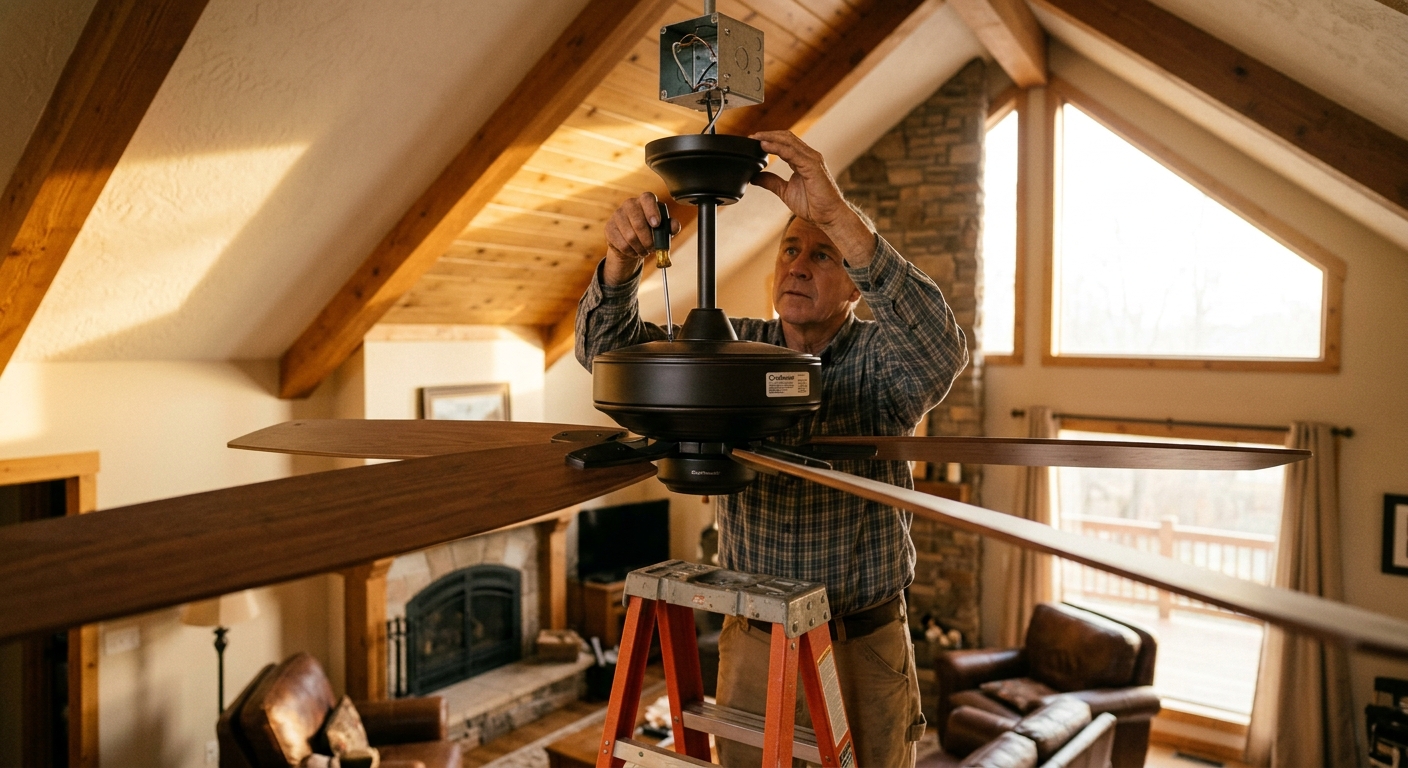
- Locate the direction switch on your ceiling fan, usually a small toggle on the motor housing or an option in the fan’s app if it is a smart fan. In winter, set the fan to spin clockwise when viewed from below, which pushes the warm air pooled at the peak back down along the walls.
- Set fan speed to the lowest setting in winter. High speed creates a wind chill effect that makes occupants feel colder even as it mixes the air. Low speed provides gentle destratification without discomfort.
- In summer, switch the fan to counterclockwise rotation and increase speed. The downdraft creates an evaporative cooling effect that lets you raise your thermostat setpoint by 4 to 6 degrees Fahrenheit with no loss in perceived comfort.
- Adjust your thermostat setback schedule to account for the improved mixing. In winter, try lowering your setpoint by 2 degrees and see if the fan alone compensates. Many homeowners find they can set back to 66 to 68 degrees Fahrenheit instead of 70 to 72 after enabling winter fan mode.
- If you have multiple vaulted rooms, repeat the direction check for every ceiling fan in those spaces. Even one fan in reverse while others run forward can create competing airflow patterns that reduce effectiveness.
- Inspect all recessed can lights, ceiling fan boxes, and any HVAC registers in the vaulted ceiling. Hold a lit incense stick near each fixture on a windy day and watch for smoke movement, which indicates air leakage. Mark each leaky location.
- For recessed can lights, purchase airtight LED retrofit kits ($15 to $25 each) that replace the old trim and bulb with a sealed unit. Alternatively, install fire-rated recessed light covers from the attic side if your vaulted ceiling has accessible rafter bays. Seal the perimeter of each cover with acoustical sealant.
- Apply paintable latex caulk around any visible gaps where the ceiling meets walls, around ceiling fan mounting boxes, and along crown molding seams. Focus especially on the peak or ridge of the vaulted ceiling where stack effect pressure is highest.
- If your existing ceiling fan is smaller than 52 inches or does not have a winter reverse mode, replace it with an Energy Star certified fan sized appropriately: 52 to 60 inches for rooms up to 400 square feet, 60 to 72 inches for larger vaulted spaces. Larger fans move more air at lower, quieter speeds.
- Install the new fan on a fan-rated adjustable-length downrod so the blade sits 8 to 9 feet above the finished floor, not up at the vaulted ceiling peak where it would circulate air nobody benefits from. Most fans include downrod extensions up to 72 inches; measure your ceiling height before purchasing.
- After completing air sealing, do a final draft check with the incense stick at each previously leaky location. Confirm smoke hangs still before closing up ladders and tools.
- Hire a building performance contractor to conduct a blower door test combined with a thermal imaging scan of your vaulted ceiling. This identifies exactly where insulation is thin or missing and where air is escaping, so money is not spent on areas that do not need it. Expect to pay $200 to $400 for this diagnostic.
- Based on the scan results, have the contractor inject closed-cell spray foam insulation into accessible rafter bays from the exterior by removing a section of roofing, or from interior via small drilled holes. Closed-cell foam provides R-6.5 per inch, allowing a meaningful R-value even in shallow rafter cavities where batts would fall short.
- Request that the contractor also foam-seal every penetration in the vaulted ceiling plane including wiring chase points, fan boxes, and HVAC boot connections. This single step often reduces whole-house air leakage by 20 to 35% in older vaulted ceiling homes.
- Ask your HVAC contractor to rebalance supply and return airflow for the vaulted space. Many vaulted rooms are undersupplied because the original ductwork was designed for a lower ceiling volume. Adding a second supply register positioned high in the room (near the peak) helps in summer while keeping the low register for winter.
- Consider adding a mini-split ductless unit dedicated to the vaulted space if HVAC rebalancing alone proves insufficient. A 9,000 to 12,000 BTU mini-split can condition a large vaulted room independently at high efficiency (SEER ratings of 20 to 30) with a payback period of 4 to 7 years in high-use climates.
Why It Works: The Benefits
Combining ceiling fan use with basic air sealing typically reduces HVAC runtime by 10 to 20%, translating to $150 to $400 per year in savings for an average home depending on climate and fuel type.
Running a ceiling fan in reverse at low speed during winter can reduce the floor-to-ceiling temperature difference from 10 degrees Fahrenheit down to 2 to 3 degrees, making every part of the room feel comfortable without touching the thermostat.
When stratification is corrected and air leaks are sealed, your furnace or AC runs shorter cycles to hit the setpoint, extending equipment life and reducing maintenance costs over time.
Addressing insulation and air sealing at the roofline eliminates the seasonal frustration of a room that is stuffy in summer and drafty in winter, making the space genuinely livable in all conditions.
💰 Savings Impact by Action
Running a ceiling fan in reverse at low speed during winter reduces heating energy use by 5 to 10% by returning trapped warm air to the occupied zone.
Sealing recessed lights, fan boxes, and ceiling penetrations in a vaulted space reduces conditioned air loss by 15 to 25% in a typical pre-2000 home.
Upgrading rafter bay insulation to closed-cell spray foam reduces roofline heat transfer by up to 20%, cutting both heating and cooling loads year-round.
Lowering the heating setpoint by 2 degrees Fahrenheit (made possible by better air mixing) saves approximately 4 to 5% on heating bills per degree of setback.
Adding solar shades or cellular blinds to skylights and south-facing windows in a vaulted room reduces summer cooling load by 15 to 30% in sun-intensive climates.
🏠 Key Concepts Explained
The Science Behind It
The root cause of vaulted ceiling discomfort is a law of physics called buoyancy-driven stratification. Air at different temperatures has different densities: warm air at 75 degrees Fahrenheit weighs about 1.5% less per cubic foot than cool air at 55 degrees. That small density difference is enough to create a persistent layering effect where warm air floats upward and stays there until something forces it to mix. In a room with a 16-foot vaulted ceiling, the temperature difference between the floor zone (where you sit) and the peak can easily reach 8 to 12 degrees Fahrenheit with no air circulation.
Ceiling fans break stratification through forced convection. In winter reverse mode, the fan’s clockwise rotation pushes the stagnant warm air at the peak outward toward the walls and down, where it re-enters the occupied zone. This is not just about moving air: it creates a continuous circulation loop that keeps the air column well-mixed. Research from Lawrence Berkeley National Laboratory shows that destratification fans can reduce heating energy use by 5 to 15% in tall spaces by allowing thermostat setpoints to be lowered without sacrificing comfort at floor level.
On the envelope side, vaulted ceilings suffer because the rafter cavity that holds insulation is far shallower than a flat-ceiling attic. A standard 2×10 rafter (actual depth: 9.25 inches) filled with fiberglass batts delivers roughly R-30, well below the DOE’s recommended R-49 to R-60 for most U.S. climate zones. Worse, every rafter acts as a thermal bridge, conducting heat around the insulation. Closed-cell spray foam addresses both problems: its higher R-value per inch squeezes more performance into a shallow cavity, and because it adheres fully to the rafter surfaces, it eliminates air movement through the assembly that degrades batt performance further.
Frequently Asked Questions
▼ Why is my vaulted ceiling room still uncomfortable even with the ceiling fan running?
The most common reason is fan placement: if the fan is mounted at the ceiling peak on a short rod, it is circulating air in an empty zone above your head. Measure the distance from the floor to the fan blades. If it is more than 9 feet, you need a longer downrod to bring the fan into the occupied zone. The second common cause is fan size: a 42-inch fan in a large vaulted room simply cannot move enough air to overcome stratification.
▼ My energy bills are high but I cannot afford spray foam insulation. What is the most cost-effective fix?
Start with air sealing, which delivers the best return per dollar spent. Focus on recessed lights, ceiling fan boxes, and any HVAC penetrations in the vaulted ceiling. A $30 to $50 investment in caulk and recessed light retrofit kits can reduce air leakage meaningfully at almost no cost. After that, switching your ceiling fan to winter mode costs nothing and immediately reduces heating load.
▼ Can I add insulation to my vaulted ceiling myself without a contractor?
If your vaulted ceiling has an accessible attic space above part of the roof, you can add blown-in insulation there yourself with rented equipment (about $75 to $150 per day). However, true cathedral ceilings that follow the roofline with no attic access require professional spray foam injection, and attempting to batt-insulate enclosed rafter bays from inside is generally not effective and can trap moisture. Have a contractor assess your specific ceiling type before buying materials.
▼ Why does one side of my vaulted room feel fine but the other side is always drafty or too warm?
Asymmetric discomfort in a vaulted room usually points to two culprits: uneven duct distribution (one supply register serving both sides of a large room) or solar exposure differences on opposite roof slopes. Check whether your HVAC supply vents are positioned to reach both zones, and consider adding a booster fan in an undersupplied duct run. If the warm side corresponds to a west or south-facing roof slope, reflective roof coating or additional insulation on that slope will help more than airflow adjustments.
▼ How long will it take to see lower energy bills after making these changes?
Ceiling fan direction changes show up in the very next billing cycle, typically reducing heating costs by 5 to 10% in winter months. Air sealing results appear within one to two billing cycles as tighter envelope performance accumulates. Spray foam insulation projects typically show measurable bill reductions within the first full heating or cooling season, with full payback on investment in two to five years depending on local energy costs and climate.
Quick Tips
- In summer, close blinds or install solar shades on skylights and south-facing windows in vaulted spaces. Up to 30% of a room’s cooling load can enter through unshaded glass on a hot day.
- If your vaulted ceiling has a skylight, check the weatherstripping around its curb every two to three years. Skylight seals degrade faster than wall window seals due to UV exposure and thermal cycling, and a leaky skylight is one of the worst air leakage sites in a vaulted ceiling.
- Use a simple indoor thermometer with a min/max memory function to measure the actual temperature swing in your vaulted room before and after changes. Real data helps you confirm whether your fixes are working and quantify the improvement.
- When choosing a replacement ceiling fan for a vaulted space, look for an Energy Star certified model with a DC motor. DC-motor fans use 30 to 50% less electricity than traditional AC-motor fans and are significantly quieter, which matters when the fan needs to run at low speed for extended periods.
Variations for Your Situation
- Apartment or Condo with Vaulted Ceilings: Renters cannot modify insulation or ductwork but can make a significant difference with ceiling fan direction adjustments and draft blocking. If your unit does not have a ceiling fan, purchase a floor-standing tower fan with oscillation and position it to circulate air toward the upper walls. Use thermal curtains ($30 to $80 per panel) on any skylights or tall windows, and place a draft snake along the base of exterior doors below the vaulted space. These steps combined can reduce perceived temperature swings by 3 to 5 degrees at no permanent modification.
- Tight Budget (Under $50): Focus entirely on the ceiling fan direction switch (free), thermostat setback adjustments (free), and a single tube of paintable caulk ($6 to $10) to seal visible gaps at ceiling-wall joints and around any visible penetrations. If your fan lacks a reverse mode, a clip-on style directional fan ($25 to $40) aimed at the peak and set to blow downward can approximate the destratification effect. These zero-to-low-cost steps alone can deliver 5 to 10% heating savings.
- Older Home Built Before 1980: Homes from this era frequently have minimal or degraded insulation in vaulted rafter bays and may have original single-pane skylights. Prioritize a professional blower door test first, as air leakage in pre-1980 vaulted ceilings is often 3 to 5 times higher than modern construction. Budget for professional air sealing before any insulation upgrade, since sealing first maximizes the return on every insulation dollar. Also check for aluminum single-pane skylight glazing and replace with double-pane low-e units, which can reduce heat loss through each skylight by 40 to 50%.