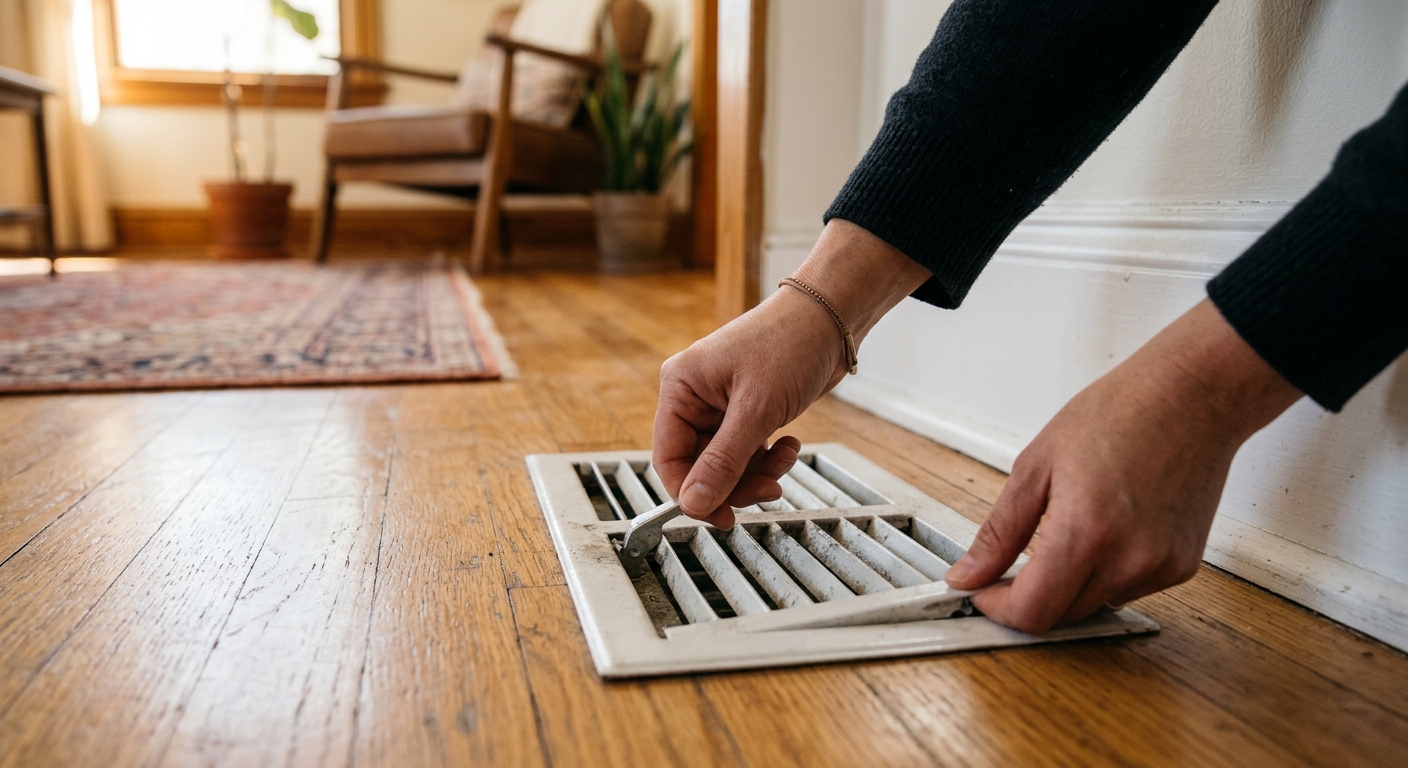
It sounds like common sense: if nobody is using the guest room or basement office, why pay to heat or cool it? Close the vent, redirect the air, and pocket the savings. Millions of homeowners do exactly this, and almost all of them end up paying more on their energy bills as a result. The logic feels right, but the physics of how forced-air HVAC systems work tells a very different story.
Your heating and cooling system was designed by an engineer to move a specific volume of air through every duct in your home. When you close a vent, that air does not disappear. It builds up pressure inside the duct system, strains your blower motor, pushes conditioned air out through duct leaks into unconditioned spaces like attics and crawlspaces, and can even cause your heat exchanger to crack or your evaporator coil to freeze. Studies by the Lawrence Berkeley National Laboratory found that duct leakage alone can account for 20 to 30 percent of a home’s heating and cooling costs, and closing vents makes that leakage dramatically worse.
This post explains exactly why closed vents backfire, what is actually happening inside your duct system when you shut one off, and what you can do instead to genuinely lower your bills without harming your equipment. Whether you want a free fix you can do right now or a longer-term upgrade, there is a practical path forward for every budget.
What You’ll Need
Click on an item below to shop for the recommended items for this recipe on Amazon.
As an Amazon Associate, we earn from qualifying purchases.
How to Do It
- Walk every room in your home and open all supply vents fully, including rooms you rarely use. Flip the lever or rotate the louver to the fully open position.
- Check that no furniture, rugs, or curtains are blocking any supply or return vents. Air needs a clear path in and out of every room.
- Locate your return air grilles (the larger vents that pull air back to the system, usually in hallways or main living areas) and make sure none of them are blocked or partially closed.
- Set your thermostat fan to AUTO rather than ON. Running the fan continuously when the system is not conditioning air moves unconditioned air and wastes electricity.
- Leave interior doors between rooms open as much as possible to allow air to circulate back to return vents. A closed door with no return vent creates a pressurized room that forces air out through gaps.
- Purchase mastic duct sealant (not standard duct tape, which fails within a few years) and foil-backed tape rated for HVAC use. A $15 tub of mastic and one roll of foil tape handle most accessible leaks.
- Access your attic, basement, or crawlspace and visually inspect every duct joint and connection you can reach. Look for gaps, separated joints, or sections where insulation has slipped off.
- Apply mastic sealant with a paintbrush or gloved hand over every joint, seam, and connection. Press foil tape over larger gaps first, then coat with mastic for a durable seal. Allow 4 hours to cure.
- If individual rooms feel consistently too hot or too cold, adjust airflow by partially closing vents in rooms that are overly comfortable to redirect pressure toward problem rooms. This is called balancing, and it is the correct use of vent dampers at 25 to 50 percent closed, not fully shut.
- Install door undercut clearance of at least 0.75 inches on interior doors that separate supply-only rooms from hallways with return vents. This allows air to return to the system even when doors are closed. A door saw or rasp can trim existing doors.
- Consider adding a transfer grille (a simple louvered grille installed through the wall between a problem room and a hallway) for rooms that must remain closed. These cost $15 to $40 and dramatically reduce pressure buildup.
- Schedule a Manual D duct assessment or blower door test with a certified HVAC technician or home energy auditor. They will measure actual airflow at each register using a flow hood and compare it to your system’s design specs.
- Request a duct leakage test (duct blaster test). This pressurizes your ducts and measures how much air escapes. A leakage rate above 10 percent of system airflow is considered problematic and worth fixing.
- Have the technician professionally seal all accessible and inaccessible duct leaks using mastic and insulation. Professionally sealed systems can recover 20 to 30 percent of lost conditioned air.
- Ask about adding dedicated return air pathways to rooms that are frequently closed off. A technician can install jump ducts or transfer grilles that allow air to return to the system without leaving doors open.
- Request a final balancing report showing CFM at each register. A well-balanced system delivers within 10 percent of target airflow to every room.
Why It Works: The Benefits
Reopening vents and addressing duct leakage can reduce heating and cooling costs by 10 to 30 percent, with the Lawrence Berkeley National Laboratory reporting average savings of 20 percent when duct systems are sealed and operating at design pressure.
Running your system at proper static pressure reduces wear on the blower motor, compressor, and heat exchanger, potentially adding 3 to 5 years to the life of your equipment and avoiding early replacement costs averaging $5,000 to $12,000.
Balanced airflow eliminates hot and cold spots caused by pressure imbalances, making every room within 2 to 3 degrees Fahrenheit of your thermostat setting rather than the 8 to 12 degree swings common in homes with closed vents.
An AC system running at proper airflow removes moisture efficiently. Restricted airflow from closed vents can reduce dehumidification capacity by up to 40 percent, leading to clammy, uncomfortable air even when the temperature reads correctly.
Preventing coil freezes, cracked heat exchangers, and blown blower motors eliminates repair bills that typically range from $400 for a coil thaw and inspection to $2,500 or more for a heat exchanger replacement.
💰 Savings Impact by Action
Sealing accessible duct leaks recovers 20 to 30 percent of conditioned air that was escaping into unconditioned spaces, directly reducing how long your system runs.
Reopening closed vents and balancing airflow reduces blower motor electricity consumption by up to 15 percent by returning the system to its design operating pressure.
Replacing a clogged filter with a clean MERV-8 filter restores proper airflow and can cut energy use by 5 to 10 percent immediately at zero cost beyond the filter price.
Adding door undercuts or transfer grilles to rooms with closed doors reduces room pressurization and cuts the amount of conditioned air forced out through wall and ceiling gaps by up to 12 percent.
🏠 Key Concepts Explained
The Science Behind It
Your forced-air HVAC system operates like a closed loop. The blower pulls air from your living space through return vents, conditions it through the heat exchanger or evaporator coil, and pushes it back out through supply ducts at a pressure and volume calibrated to match your home’s specific layout. This calibration, done by the original installer using a process called Manual D design, accounts for every room, every duct run, and every register. The system is balanced when the supply side and return side are moving equal volumes of air.
When you close a supply vent, you do not reduce the volume of air the blower is trying to move. The blower keeps spinning at the same speed, but now it is pushing air into a more restricted system. This raises what HVAC engineers call static pressure, the resistance the blower works against. Higher resistance means the blower motor draws more electricity while delivering less airflow. Simultaneously, the higher pressure inside the ducts pushes harder against every tiny gap and unsealed joint, increasing the rate at which conditioned air escapes into your attic or crawlspace. You are paying to condition air and then actively driving it out of your house.
On the cooling side, reduced airflow has a second critical effect. The evaporator coil works by absorbing heat from warm air passing over its surface. If not enough air moves across the coil, its surface temperature drops below the freezing point of the moisture it is collecting, and ice forms on the coil. Ice acts as insulation, reducing heat transfer further, which causes more ice to form. Within hours, the coil can be completely encased in ice and moving almost no air at all. Your AC compressor continues running and consuming electricity while cooling nothing, and the stress on the compressor can shorten its life from a typical 15 to 20 years down to 10 or less.
Frequently Asked Questions
▼ I reopened all my vents but one room is still freezing cold in summer and boiling hot in winter. What is wrong?
This is almost always a duct balance issue, meaning that room is getting too much or too little airflow relative to its size and heat load. Start by checking whether the duct serving that room is the right size and whether any sections are kinked, disconnected, or heavily leaking before the air reaches the register. A partially closed damper inside the duct itself (separate from the register) may also be set incorrectly. An HVAC technician can measure CFM at that register and adjust the system in about an hour.
▼ My energy bills are high and my house never reaches the set temperature. Could closed vents be the reason?
Yes, closed vents are a common contributor. When static pressure rises, your system moves less air per cycle, so it runs longer to reach setpoint and sometimes never gets there on very hot or cold days. Reopen all vents, replace the air filter, and check that no return vents are blocked. If the problem persists after 48 hours, your system may also be low on refrigerant or have a failing blower motor, both of which require a licensed technician.
▼ Can closing vents actually damage my HVAC system permanently?
Yes, in two specific ways. Chronic high static pressure accelerates blower motor wear and can burn out the motor in 3 to 5 years instead of the typical 10 to 15. On gas furnaces, the resulting reduced airflow causes the heat exchanger to overheat repeatedly, which can crack it and create a carbon monoxide leak, a serious safety hazard. If you have been closing vents for more than a year, schedule an inspection that includes a heat exchanger check.
▼ What about homes with a zoned HVAC system? Is closing vents still bad?
True zoning systems use motorized dampers installed inside the ducts, controlled by a zone controller that also manages a bypass damper to relieve excess pressure. These systems are designed to reduce airflow to zones safely. Manual vent registers at the room level are not part of a zoning system and should still be left open. If you want true zone control, a contractor can add a bypass damper and zone controller for $800 to $2,500 depending on your system.
▼ How long until I see a difference on my utility bill after reopening vents and sealing ducts?
You should see improvement within the first full billing cycle after making changes, typically 30 days. Reopening vents reduces blower motor strain immediately, and the savings show up in that month’s electricity consumption. Duct sealing savings build over a full heating or cooling season. Track your bills against the same month from the previous year to account for weather differences, or use your utility’s online comparison tool if available.
Quick Tips
- If you genuinely want to reduce conditioning in a rarely used room, keep the vent at least 50 percent open and keep the door open to allow return airflow. Fully closed is never the right answer.
- Rooms consistently 5 or more degrees warmer than the thermostat setting usually have a duct balance problem, not a vent-closing opportunity. The fix is more airflow to that room, not less to others.
- Check your air filter monthly. A clogged filter raises static pressure just as much as closed vents and is the single most overlooked cause of HVAC inefficiency.
- If your home has a zoning system with motorized dampers, those are designed to partially close with matched bypass dampers that prevent pressure buildup. Manual vent registers are not zoning systems and should not be used as a substitute.
Variations for Your Situation
- Apartment or Rental: Renters cannot modify ductwork but can make a big difference by keeping all registers fully open, ensuring furniture does not block vents, and placing a thin rubber door stop under interior doors to maintain 0.75-inch clearance for return airflow. Report any rooms that are consistently 5-plus degrees off to your landlord, as this is a maintenance issue. A $10 to $20 clip-on fan placed near a vent can help distribute airflow in problem rooms without any permanent changes.
- Tight Budget Under $50: Focus on the zero-cost steps first: open all vents, clear furniture from registers, and open interior doors. Then spend $15 on a tub of mastic sealant and seal every accessible duct joint you can reach in your basement, crawlspace, or attic. This single investment typically recovers 8 to 12 percent of lost conditioned air. Skip the professional assessment for now and prioritize the filter: a $10 MERV-8 filter replaced every 60 days does more for system efficiency than most paid upgrades.
- Older Home Pre-1980: Homes built before 1980 often have undersized return duct systems that create chronic negative pressure in living spaces, making the closed-vent problem even worse. Start by counting your return vents. A home under 2,000 square feet should have at least two large return grilles. If you only have one small central return, adding a second return is one of the highest-impact upgrades you can make, typically costing $200 to $500 installed. Also assume your ducts are leaking 30 percent or more until tested, so prioritize sealing visible joints in unconditioned spaces before any other efficiency project.