Portable air conditioners are one of the most popular cooling solutions for renters, older homes, and rooms that central AC struggles to reach. But there is a widespread setup mistake that quietly destroys their performance: a poorly sealed or improperly routed exhaust hose. When hot exhaust air leaks back into the room, or when unconditioned outdoor air seeps in around the window kit, your portable AC works twice as hard to cool half as much. The result is a high electric bill and a room that never quite cools down.
The core problem comes down to physics. A portable AC pulls heat out of your room air and dumps it through an exhaust hose to the outside. If that hot exhaust leaks back in, or if the window panel gaps let in outdoor air at 90 degrees Fahrenheit, the unit is fighting a battle it cannot win. Studies and real-world tests show that a typical portable AC with a leaky window kit can lose 30 to 50 percent of its rated BTU capacity before it cools a single cubic foot of air effectively.
In this post, you will learn exactly which mistakes homeowners make, how to diagnose your own setup in under five minutes, and two concrete approaches to fix the problem, ranging from a free quick fix to a more permanent DIY seal-up. You will also find the building science behind why this happens, real savings numbers, and troubleshooting answers for the most common portable AC complaints.
What You’ll Need
Click on an item below to shop for the recommended items for this recipe on Amazon.
As an Amazon Associate, we earn from qualifying purchases.
How to Do It
- Turn off and unplug the unit. Visually inspect every joint where the exhaust hose connects to the back of the AC and to the window panel adapter. Press each connection firmly to reseat it, as loose push-fit connectors are the most common source of hot air leakage.
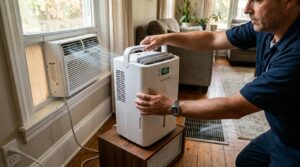
- Run your hand slowly along all four edges of the window panel while the unit is running. Feel for warm air blowing inward or warm air escaping outward. Mark any gaps with a piece of tape so you can address them.
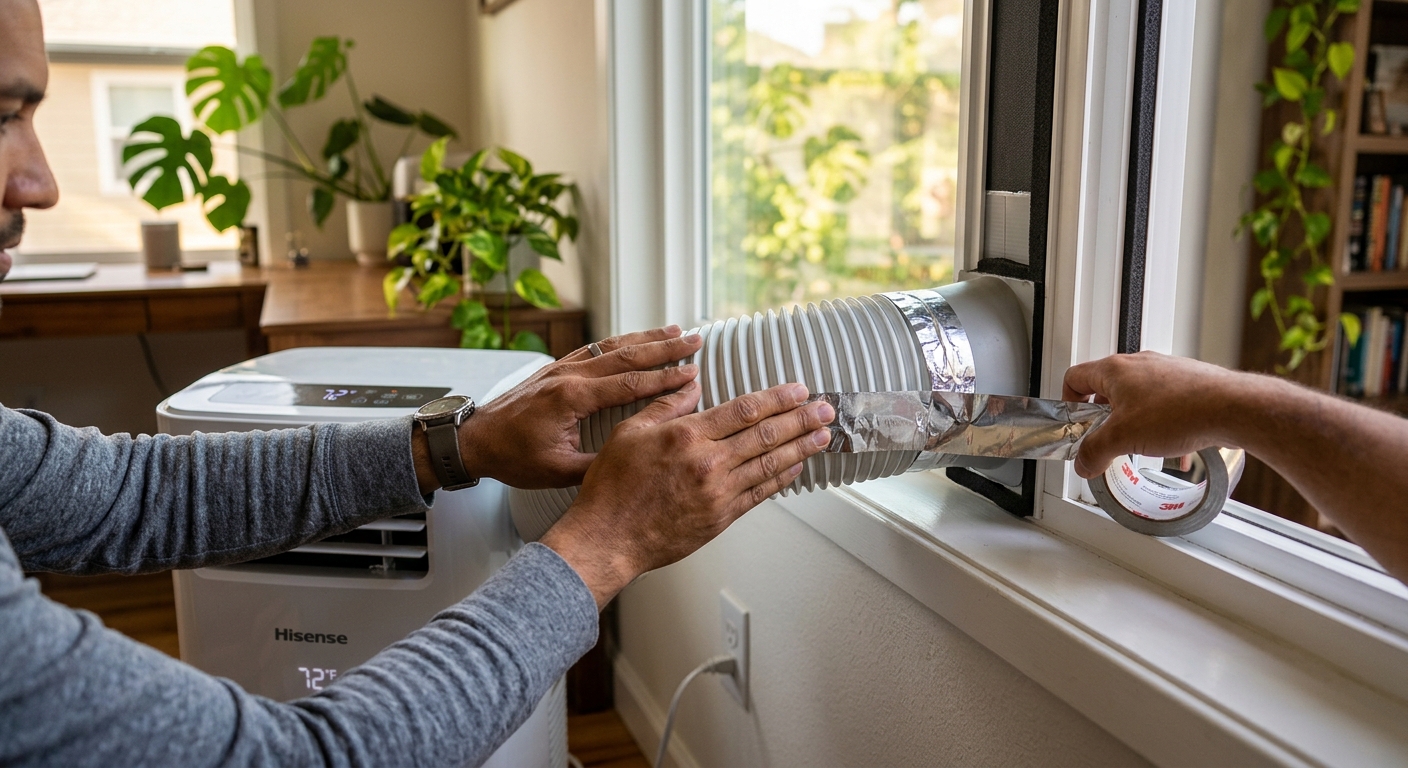
- Apply standard HVAC foil tape or even painter’s tape along every gap in the window panel, including the top edge, side edges, and the seam where the hose adapter meets the panel. Foil tape costs about $6 and creates a tighter seal than the plastic panel alone.
- Shorten the exhaust hose to the minimum length needed to reach the window, avoiding any bends tighter than a 12-inch radius. A compressed or kinked hose dramatically restricts hot air exhaust and forces the compressor to work harder.
- If your window has extra space above or beside the panel, stuff the gap tightly with a folded towel, foam pipe insulation, or a pool noodle as a temporary block. Any physical barrier is better than leaving an open gap.
- Plug the unit back in, run it for 15 minutes, and re-check all sealed areas for warmth. A properly sealed kit should produce no detectable warm air infiltration along the window edges.
- Measure the exact dimensions of your window opening and the gap between the stock panel and the window frame on all sides. Purchase a sheet of rigid foam board insulation (R-6 per inch, 1-inch thickness is sufficient) cut to fill the entire window opening as a replacement or supplement to the plastic panel.
- Cut the foam board to fit the window opening snugly using a utility knife and straightedge. Cut a circular hole sized to fit your exhaust hose adapter snugly. Most exhaust hoses use a 5 to 6 inch diameter fitting.
- Press the foam panel into the window opening. Apply self-adhesive foam weatherstripping around all four edges of the panel where it contacts the window frame, creating a compression seal when the window sash closes onto it.
- Insert the exhaust hose adapter through the foam cutout and seal around the perimeter of the adapter with a bead of paintable latex caulk or additional foam weatherstripping. Allow caulk to cure per label directions before running the unit.
- Close the window sash firmly onto the top of the foam panel. If there is any gap between the closed sash and the panel, add an additional strip of foam weatherstripping to the top edge of the panel to compress-seal that gap.
- Run the unit for 30 minutes and do a final inspection with your hand along all seams. For the most rigorous check, hold a lit incense stick near each edge while the unit runs: any infiltration will visibly deflect the smoke toward you.
Why It Works: The Benefits
Properly sealing the window kit and exhaust hose connection can restore 30 to 50 percent of the cooling output you are currently losing, effectively giving you the full BTU performance you paid for without buying a new unit.
A portable AC running at reduced efficiency runs longer cycles to meet the thermostat setpoint. Fixing the seal can cut runtime by 20 to 40 percent, translating to $15 to $40 per month in electricity savings during peak cooling season depending on your rate and usage.
With hot exhaust no longer recirculating into the space, the room reaches your target temperature 25 to 35 percent faster, reducing the discomfort window when you first turn the unit on.
Compressors that run shorter, more efficient cycles experience less thermal stress. Reducing unnecessary runtime by 20 to 40 percent can meaningfully extend the operational life of the unit beyond its typical 8 to 10 year lifespan.
Sealing out humid outdoor air allows the unit to dehumidify the room air more effectively, improving comfort at higher thermostat setpoints. Many homeowners find they can raise the set temperature by 2 to 3 degrees Fahrenheit without any loss of comfort once infiltration is eliminated.
💰 Savings Impact by Action
Eliminating exhaust recirculation and infiltration through the window panel can recover 30 to 50 percent of lost cooling capacity, restoring effective BTU output toward the unit’s nameplate rating.
Reducing hose length and eliminating kinks cuts exhaust backpressure and can improve airflow by 15 to 25 percent, reducing compressor runtime for the same cooling output.
Replacing the stock plastic panel with 1-inch rigid foam board reduces conducted heat gain through the window opening by approximately 85 percent, cutting a small but measurable supplemental heat load.
A clean air filter maintained every two weeks restores full evaporator airflow and recovers up to 15 percent of cooling output lost to restriction in heavily used units.
Running a ceiling fan in the same room allows a 3 to 4 degree Fahrenheit thermostat setback with equivalent comfort, reducing compressor runtime by roughly 10 percent per degree of setback.
🏠 Key Concepts Explained
The Science Behind It
The fundamental physics at work here is the first law of thermodynamics: energy cannot be destroyed, only moved. Your portable AC moves heat from inside your room to outside via the refrigerant cycle. The exhaust hose is the delivery mechanism, carrying hot compressed air (and the heat harvested from your room) to the outdoors. When that hose or its window connection leaks, you are literally pumping heat back into the space the unit is trying to cool, forcing the compressor to remove the same heat twice.
The negative pressure issue with single-hose units compounds this problem. When the unit exhausts air outside, it must replace that air volume from somewhere. If the room is relatively well-sealed, it draws air from around doors and other gaps. If the window panel has openings, outdoor air at 85 to 95 degrees Fahrenheit rushes in to fill the void. This infiltration air carries both sensible heat (temperature) and latent heat (humidity), and the AC must process all of it before the room temperature drops. This is why a single-hose portable AC in a leaky installation often cools a room to only 78 to 80 degrees Fahrenheit even when set to 72, regardless of its BTU rating.
Rigid foam board outperforms the stock plastic panel for one key reason: thermal conductivity. The thin plastic panels included with most portable ACs have virtually no insulating value, so they conduct heat from the outdoor air directly into your room, adding a small but measurable heat load. One inch of rigid foam board provides approximately R-6 insulation value, cutting that conducted heat gain by roughly 85 percent compared to the plastic panel. Combined with an airtight perimeter seal, a foam panel installation gets the window opening as close to airtight and thermally neutral as possible, allowing the unit to operate near its rated performance.
Frequently Asked Questions
▼ Why is my portable AC running constantly but the room stays warm?
The two most likely causes are a leaky window seal allowing hot air infiltration and an undersized unit for the room. First, seal the window kit using the steps above and check that the exhaust hose has no kinks or sharp bends. If cooling is still inadequate, calculate the room’s BTU requirement (roughly 20 BTU per square foot as a baseline) and compare it to your unit’s SACC rating, which is the DOE’s standardized real-world rating that is often 20 to 30 percent lower than the older BTU marketing number on the box.
▼ Can renters seal the window panel without damaging the apartment?
Yes. A foam board panel cut to fit the window opening sits in place without adhesives or fasteners and removes cleanly with no damage. Foam weatherstripping with a peel-and-stick backing can be removed carefully without paint damage on most window frames. Avoid permanent caulk on any surface you cannot repaint before move-out, and always get your landlord’s written approval for any window modification as a precaution.
▼ My window is too wide for the included plastic panel. What do I do?
Most included panels extend to 48 to 50 inches, which does not cover a wide or sliding glass door opening. Cut a piece of rigid foam board to fill the remaining gap and seal it to the existing panel with foil HVAC tape on both sides. For very wide openings, you can use two foam panels side by side. The goal is zero uncovered gap between the panel assembly and the window frame on all sides.
▼ How long before I notice savings on my electric bill after sealing the window?
You should notice faster room cooldown within the first hour of use. The electric bill impact will show up on your next monthly statement, typically reflecting 15 to 30 percent less runtime for the unit. If your billing cycle is mid-month, the full effect may not be visible for 4 to 6 weeks after the fix.
▼ Is it worth fixing my portable AC or should I just buy a window unit?
If your window accepts a traditional window AC, a properly installed window unit will almost always outperform a portable AC of the same BTU rating because it has no exhaust hose losses and no negative pressure infiltration. Window units typically deliver their full rated BTU capacity and use 15 to 25 percent less electricity than a comparable portable unit. However, if your window style, lease terms, or HOA rules prohibit window units, the sealing improvements in this post get your portable AC as close to its rated performance as physically possible.
Quick Tips
- Position the unit as close to the window as possible so the exhaust hose runs as short and straight as the setup allows, ideally under 4 feet with no bends.
- Place the portable AC in the part of the room where you spend the most time rather than near the door, since cooled air stays low and stratifies quickly in larger spaces.
- Run a ceiling fan on low in the same room to circulate the cooled air and allow you to raise the thermostat setpoint by 2 to 4 degrees Fahrenheit without sacrificing comfort.
- Clean the air filter every two weeks during heavy use. A clogged filter reduces airflow across the evaporator coil and can drop cooling output by 10 to 15 percent while increasing energy draw.
Variations for Your Situation
- Apartment/Rental: Focus on the no-damage foam board panel approach since you cannot permanently modify the window frame. Purchase pre-cut foam insulation panels sized for standard windows (available at hardware stores for $8 to $15) or cut your own from a $12 sheet of rigid foam. Use peel-and-stick foam weatherstripping for the perimeter seal and foil tape at the hose adapter. Document the window condition with photos before and after installation to protect your security deposit.
- Tight Budget (under $50): The free quick fix covers most of the gain. If you have $6 to $8, a roll of foil HVAC tape is the single highest-impact purchase you can make. It seals the hose connection joints and window panel gaps far more effectively than duct tape or painter’s tape and costs less than one hour of wasted AC runtime. Skip the foam board upgrade for now and focus on eliminating every detectable air gap with tape alone.
- Older Home with Non-Standard Windows: Casement windows, jalousie windows, and older double-hung windows with irregular frames often cannot accept the stock panel kit at all. The foam board approach is your best option here. Cut rigid foam to fill the entire window opening, use a jigsaw or hole saw for the hose adapter cutout, and seal the perimeter with a generous bead of removable rope caulk (about $4 per roll) that peels off cleanly at the end of the season. This creates a fully custom airtight panel for under $25.