If you live in a climate where summer nights regularly drop below 70 degrees Fahrenheit, you may be paying for air conditioning you do not actually need. Central AC is an energy-intensive machine that can account for 12 to 27 percent of a typical home’s annual electricity bill. Yet for many homeowners, the real heat problem is not outdoor temperatures but the heat that builds up inside the house throughout the day and lingers well into the evening.
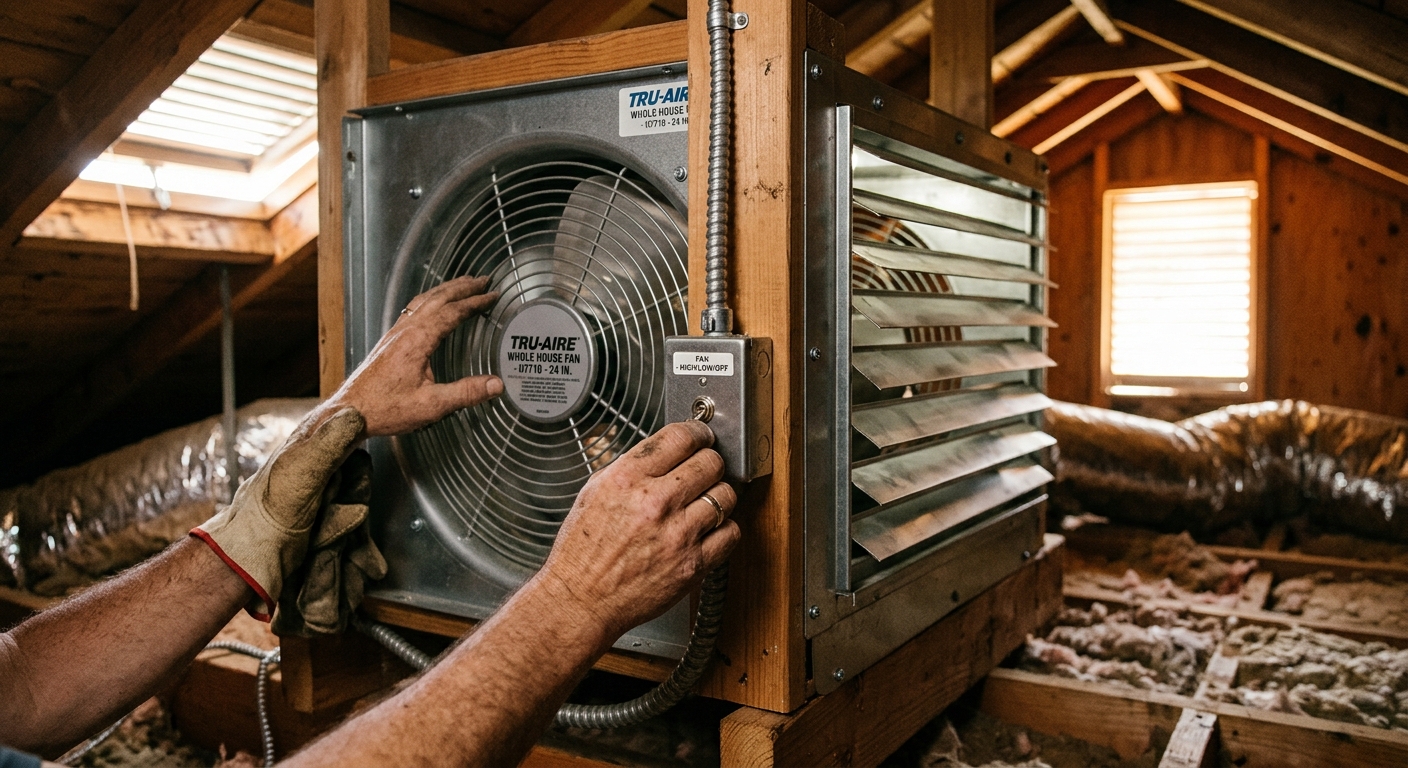
A whole-house fan is a large, ceiling-mounted ventilation fan installed between your living space and attic. When outdoor temperatures fall in the evening, you open a few windows and flip the switch. The fan draws cool outdoor air in through the windows, pushes the hot indoor air up into the attic, and vents it outside through your soffit and ridge vents. The result is a complete air exchange in your home within a few minutes, dropping indoor temperatures by 5 to 10 degrees Fahrenheit and creating a steady breeze that makes 75 degrees feel like 68.
This post covers how whole-house fans work, what size and type to buy, what installation actually costs, and how to calculate whether one makes financial sense for your specific climate and home. We will also cover common mistakes, the best fan models on the market, and a realistic look at payback periods so you can decide with confidence.
What You’ll Need
Click on an item below to shop for the recommended items for this recipe on Amazon.
As an Amazon Associate, we earn from qualifying purchases.
How to Do It
- Wait until outdoor temperature drops to at least 5 degrees below your current indoor temperature, typically after 8 PM in most climates.
- Open windows on the ground floor on the shaded or cooler side of your home, and open windows in upstairs bedrooms.
- Place one or two box fans in upper-story windows facing outward to exhaust hot air, which pulls cooler air in through the lower windows.
- Turn off your AC, set your ceiling fans to run counterclockwise at high speed, and monitor indoor temperature over 30 to 45 minutes.
- If your indoor temperature drops 3 to 5 degrees in that window, your home and climate are good candidates for a whole-house fan installation.
- Track how many evenings per week this strategy is viable. If it works at least 4 nights per week from May through September, a whole-house fan will likely pay for itself within 3 years.
- Choose your fan size by calculating your home’s square footage and multiplying by 1.5 to get your target CFM. For a 2,000 sq ft home, look for a fan rated at 3,000 CFM. Popular models include the QuietCool QC CL-3100 and the Air Vent 54301 for standard installations.
- Confirm your attic has adequate net free vent area before purchasing. Measure your soffit and ridge vents and confirm you have at least 1 square foot of net free area for every 750 CFM of fan capacity. Add vents if necessary before installing the fan.
- Choose the installation location, typically a central hallway ceiling on the top floor, and cut the ceiling opening according to the fan manufacturer’s template. Most fans require a 24×24 to 30×30 inch opening.
- Mount the fan frame to the ceiling joists using the hardware provided. For belt-drive or insulated shutter models, follow the manufacturer’s guide for mounting the motor in the attic separately from the shutter assembly below.
- Run a dedicated 120V circuit from your electrical panel to the fan location, or connect to an existing nearby circuit rated for the fan’s amperage. Install the wall switch or timer control according to the wiring diagram. If you are not comfortable with electrical panel work, hire an electrician for just the circuit run, which typically costs $100 to $200.
- Seal any gaps around the fan housing with weatherstrip foam and confirm the shutter closes fully when the fan is off to prevent conditioned air loss in winter. Test the fan on low and high speed and check that all window screens are intact before first use.
- Get quotes from at least two HVAC contractors or whole-house fan specialists. Specify that you want an insulated shutter model such as the QuietCool ES-7000 or Tamarack HV1000 if energy efficiency in winter is a priority.
- Ask the contractor to perform a Manual J calculation or at minimum assess your attic venting before sizing the fan. Proper sizing is the single most important factor in performance.
- Request that the contractor install a timer switch or a smart switch compatible with your home automation system so you can automate evening operation without remembering to turn it off before temperatures rise in the morning.
- After installation, ask the contractor to walk you through the optimal window-opening strategy for your specific floor plan, which rooms to open and which to leave closed for best airflow.
- Confirm the insulated shutter has an R-value of at least R-4.5. Insulated models prevent the fan housing from becoming a thermal bypass in winter, which is a significant energy loss on uninsulated shutter fans in cold climates.
Why It Works: The Benefits
Homeowners in mild-to-moderate climates report reducing cooling costs by 50 to 90 percent during the spring and fall shoulder seasons, and by 30 to 50 percent even in summer months when the fan handles evenings and nights while AC only runs during peak afternoon heat.
A correctly sized whole-house fan can drop indoor air temperature by 5 to 10 degrees Fahrenheit in under 5 minutes, compared to 30 to 60 minutes for central air conditioning to achieve the same result after a hot afternoon.
Whole-house fans completely replace your indoor air multiple times per hour, flushing out VOCs, cooking odors, humidity, and allergens that accumulate in tightly sealed, air-conditioned homes. This is a meaningful benefit for households with allergy or asthma sensitivities.
A modern two-speed whole-house fan uses 200 to 600 watts, compared to 2,000 to 5,000 watts for a central AC system. Running a whole-house fan for 8 hours costs roughly 15 to 50 cents at average US electricity rates versus $1.60 to $4.00 for central AC.
Every hour the whole-house fan handles cooling is an hour your AC compressor is not running. Homeowners who use whole-house fans strategically often extend the service life of their AC system by 2 to 5 years, which represents $3,000 to $7,000 in deferred replacement cost.
💰 Savings Impact by Action
Running a whole-house fan instead of AC during mild spring and fall months reduces cooling electricity use by up to 80 percent for those billing periods.
Using the fan for evening and overnight cooling instead of AC during summer cuts nightly cooling costs by 50 percent or more when outdoor temps fall below 70 degrees.
Flushing superheated attic air with outdoor air reduces radiant heat load through the ceiling by up to 25 percent, lowering the work required from AC during afternoon peak hours.
Homeowners who use whole-house fans strategically typically reduce total annual AC runtime by 25 to 35 percent, extending compressor life and reducing maintenance costs.
A whole-house fan uses 200 to 600 watts versus 2,000 to 5,000 watts for central AC, representing 88 to 92 percent lower operating cost per hour of use.
🏠 Key Concepts Explained
The Science Behind It
The physics behind a whole-house fan come down to two simultaneous mechanisms: convective air exchange and evaporative cooling. When you open windows at ground level and exhaust air at the ceiling, you create a chimney effect that draws the warmest air, which rises naturally, out of your living space first. The replacement air coming in through lower windows has had less contact with sun-heated surfaces and enters at close to true outdoor temperature. This exchange happens at 2,000 to 5,000 CFM, meaning your entire home’s air volume can be replaced every 3 to 7 minutes.
The second mechanism is evaporative cooling on your skin. Even when indoor and outdoor temperatures are equal, moving air at 2 to 3 miles per hour across your skin increases evaporative heat loss enough to lower your perceived temperature by 4 to 7 degrees Fahrenheit. This is the same physical principle that makes 85 degrees in a breeze feel more tolerable than 80 degrees in still, humid air. A whole-house fan maintains this airflow through every room simultaneously, which no combination of ceiling fans can replicate at the same scale.
The attic cooling effect is a third, often overlooked benefit. An attic sitting at 140 degrees Fahrenheit contains an enormous amount of stored heat that radiates downward through your ceiling insulation all evening long. A whole-house fan running at 3,000 CFM can drop attic temperature by 30 to 50 degrees in under 15 minutes by flushing that superheated air out through ridge and soffit vents and replacing it with ambient outdoor air. This directly reduces the radiant heat load on your living space, making it easier for your home to stay cool even after you shut the fan off and close the windows in the early morning.
Frequently Asked Questions
▼ My whole-house fan is running but the house is not getting much cooler. What is wrong?
The most common cause is insufficient open window area. You need at least 2 to 3 square feet of open window per 1,000 CFM of fan capacity, and the windows need to be on the windward or shaded side of the house. The second most likely cause is that outdoor temperatures are still higher than indoor temperatures, meaning you started the fan too early in the evening. Check the thermometer outside and wait until it reads at least 3 to 5 degrees cooler than indoors before running the fan.
▼ How do I know if my attic has enough venting for a whole-house fan?
Calculate your fan’s CFM rating and divide by 750. That gives you the minimum net free vent area in square feet required. A 3,000 CFM fan needs 4 square feet of net free area across all your soffit, gable, and ridge vents combined. Vent labels list net free area, or you can use the rule of thumb that a standard 16×8 inch louvered soffit vent provides about 50 to 65 square inches of net free area. If you are short on venting, adding soffit vents costs about $5 to $15 per vent and takes about 20 minutes each with a hole saw.
▼ Can I use a whole-house fan in a humid climate like Florida or Houston?
Whole-house fans are significantly less effective in consistently humid climates where the dew point stays above 65 degrees even at night. In these regions, the incoming outdoor air brings substantial moisture that can make occupants feel clammy and can raise indoor humidity enough to encourage mold growth. Homeowners in high-humidity climates should monitor dew point with a $15 hygrometer and only run the fan on low-dew-point evenings. In coastal Southeast climates, a whole-house fan may only be usable 30 to 40 days per year, which extends the payback period considerably.
▼ Will a whole-house fan work in my two-story home?
Yes, and two-story homes often benefit more than single-story homes because heat stratifies heavily on upper floors where bedrooms typically are. Install the fan in the second-floor hallway ceiling and open windows on both floors to create airflow throughout the whole structure. Open fewer windows on the second floor relative to the first so that ground-floor air is drawn up through stairwells and hallways, cooling lower living areas before exiting through the fan.
▼ What happens to the whole-house fan in winter? Will it leak heat?
An uninsulated shutter fan is a significant thermal bypass in winter, essentially a large hole in your ceiling covered only by lightweight metal louvers that close imperfectly. Standard shutter fans can lose the equivalent of 10 to 20 percent of your home’s heat through the attic in cold months. The solution is either an insulated fan model with a built-in sealed cover rated at R-4.5 or higher, or a DIY insulation pillow that you place over the shutter each fall. Premade insulation covers are available for $30 to $60 and take about 5 minutes to install each season.
Quick Tips
- Run the fan starting at dusk when outdoor temps first drop below indoor temps. Running it too early when outside is still warmer than inside will pump heat in, not out.
- Open windows in rooms farthest from the fan to pull fresh air through the most living space before it exits. Rooms directly below the fan get less benefit from cross-ventilation.
- In humid climates, check the dew point, not just the temperature. If the dew point is above 60 degrees, incoming air will feel muggy even if it is cool and may raise indoor humidity uncomfortably.
- Combine your whole-house fan with ceiling fans on low speed to extend comfort further into warm evenings. The whole-house fan handles bulk air exchange while ceiling fans provide localized evaporative cooling in occupied rooms.
Variations for Your Situation
- Apartment/Rental: Renters cannot install a whole-house fan but can achieve a meaningful portion of the same effect using window fans in a push-pull configuration. Place one fan in a bedroom window facing outward to exhaust air, and open windows on the opposite end of the apartment to draw cool air through. A 20-inch box fan like the Lasko 3723 at $35 moved to the highest window in your unit and set to exhaust creates a mini stack effect that can drop interior temperature 3 to 5 degrees on cool evenings.
- Tight Budget (under $50): Skip the fan purchase entirely and focus on optimizing natural ventilation. Map your prevailing evening wind direction using a free weather app, then open windows on the upwind side low and windows on the downwind side high. Use two $25 box fans in upstairs windows facing outward to assist the stack effect. This zero-to-$50 approach captures roughly 30 to 40 percent of the cooling benefit of a whole-house fan during ideal conditions.
- Older Home (pre-1980): Homes built before 1980 often have less attic insulation and more natural air infiltration, which means a whole-house fan may see diminishing returns since the building already leaks air informally. Before installing a whole-house fan in an older home, air seal the attic floor around light fixtures, plumbing penetrations, and the tops of interior walls. This $100 to $300 air sealing investment makes both your AC and your whole-house fan dramatically more effective and should be done first.