You turn on the shower, then stand there waiting. And waiting. Maybe you brush your teeth, check your phone, or just stare at the wall while cold water swirls down the drain. This frustrating delay is not just annoying – it is quietly expensive. A household that waits two minutes for hot water at multiple fixtures can waste 10,000 gallons or more per year, adding $50 to $150 annually to water and sewer bills alone, before counting the energy cost of reheating a tank that cools between uses.
The root cause almost always comes down to distance. Hot water sitting in your pipes cools down between uses, and when you open a faucet, all that cold water has to push through before the hot supply reaches you. The longer the pipe run from your water heater to the fixture, the longer the wait. In homes with the water heater in a basement or garage far from the master bath, delays of 90 seconds to three minutes are common. Some layouts are genuinely worse than others, but most homeowners can dramatically cut that wait with low-cost or no-cost strategies.
This post covers the building science behind why hot water delivery is slow, three approaches ranging from a free thermostat adjustment to a plug-in recirculation pump installation, and real numbers on what each option saves. Whether you rent or own, there is at least one practical step you can take today.
What You’ll Need
Click on an item below to shop for the recommended items for this recipe on Amazon.
As an Amazon Associate, we earn from qualifying purchases.
How to Do It
- Turn off your water heater or set it to vacation mode before working near it. You do not need to drain anything for pipe insulation.
- Measure the pipe runs from your water heater to the first 10 to 15 feet of hot water supply line. These are the most critical sections to insulate.
- Purchase pre-slit foam pipe insulation from any hardware store. Match the inside diameter to your pipe diameter, typically 0.5 inch or 0.75 inch for residential copper or CPVC.
- Slide the foam sleeve over each pipe section, pressing the slit closed as you go. Secure seams with a strip of foil HVAC tape every 12 to 18 inches for a lasting seal.
- Extend insulation along any runs in unconditioned spaces: basement, crawlspace, or garage. Every insulated foot reduces standby heat loss.
- Turn your water heater back on and test a fixture you previously timed. Many homeowners report noticeably shorter waits after the first cold-weather night.
- Choose a demand-activated recirculation pump kit, such as the Watts 500800 or Grundfos Comfort Series. These kits include the pump, a crossover valve, and a wireless button. No dedicated return line is required.
- Shut off power to your water heater at the breaker and close the cold-water supply valve feeding the heater.
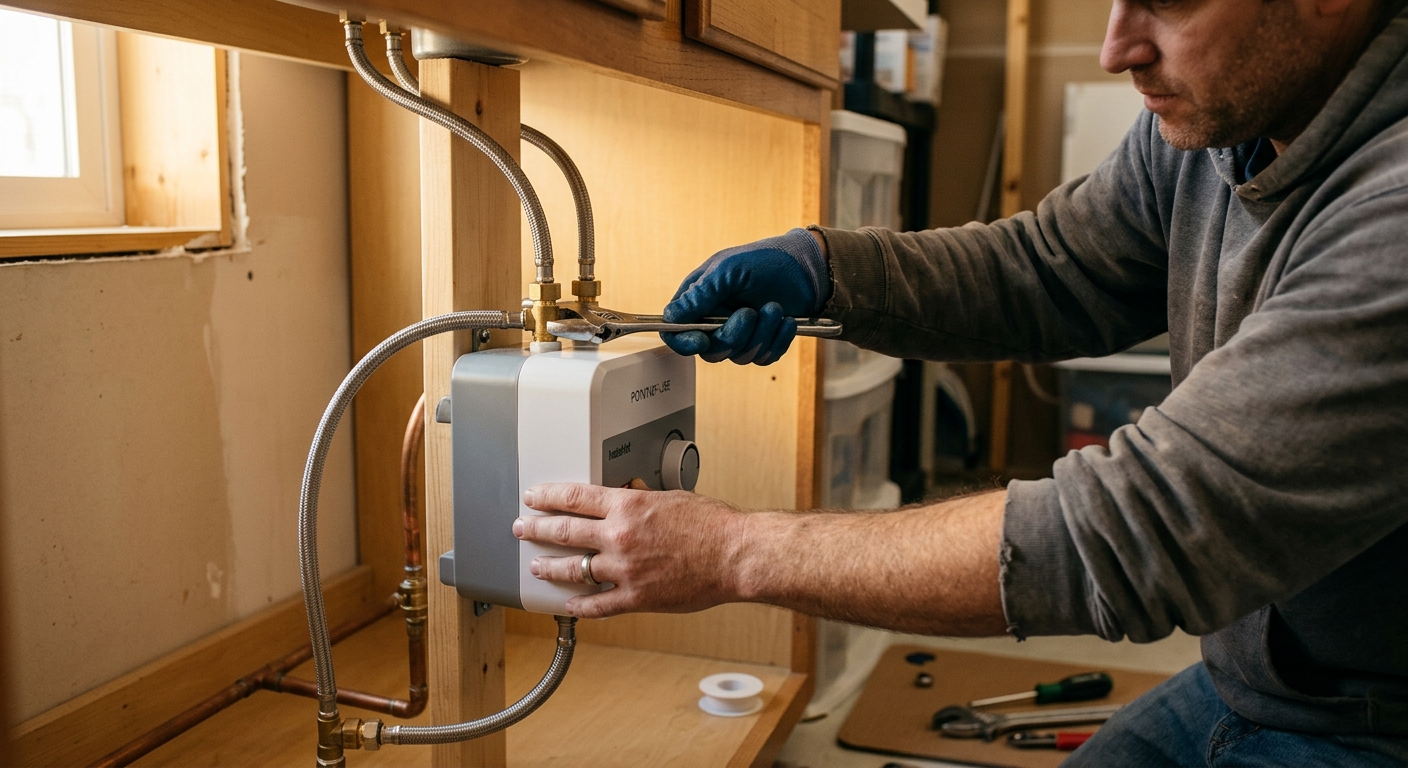
- Install the pump on the hot water outlet port of your water heater using the fittings included in the kit. Hand-tighten, then snug with an adjustable wrench. Do not overtighten on threaded plastic fittings.
- Install the included crossover valve under the sink farthest from the water heater. This valve allows cool water in the hot line to return through the cold line back to the heater, bypassing the need for a dedicated return pipe.
- Mount the wireless activation button near that sink or in a hallway. Press it 30 to 60 seconds before you need hot water and the pump delivers it rapidly.
- Restore power and water supply. Run the pump through two or three cycles while checking all connections for drips. Adjust the pump timer if your kit has a built-in shutoff to avoid running past demand.
- Optionally, pair the pump with a smart timer or motion sensor for hands-free operation, particularly useful near the primary shower.
- Hire a licensed plumber to evaluate your current pipe layout and determine the optimal return line routing. Request a quote that includes both parts and labor.
- The plumber installs a dedicated 0.5-inch return line running from the furthest fixture back to the water heater inlet, creating a true closed loop.
- A small circulation pump, typically 1/25 horsepower or less, is mounted at the water heater on the return line. On professional systems this is often thermostatically or timer controlled.
- A programmable timer or smart controller is set to run the pump only during peak use hours, for example 6 to 8 a.m. and 7 to 9 p.m., minimizing electricity use to $3 to $8 per month.
- After installation, verify that cold water lines are not warming up significantly at any fixture, which would indicate a crossover valve leak or incorrect check valve orientation.
- Combine with pipe insulation on the loop itself for maximum efficiency and the fastest delivery times.
Why It Works: The Benefits
Cutting the wait from 90 seconds to under 15 seconds at a 2 gpm shower can save 2,500 to 5,000 gallons per year in a typical household, reducing water and sewer bills by $50 to $100 annually.
Insulating hot water pipes reduces standby heat loss by 25 to 45%, which the DOE estimates can lower water heating costs by 3 to 4% – saving $10 to $20 per year for the average home.
Hot water that arrives in under 20 seconds eliminates a genuine daily friction point, especially on cold mornings when the wait feels longest and the temptation to let water run is highest.
When occupants stop waiting and just step into what they expect to be hot water, scalding injuries happen. Faster, more predictable hot water delivery makes showers safer, especially for children and elderly residents.
Recirculation systems that keep water moving reduce the on-off thermal cycling of the heater tank, which can modestly extend heater lifespan and reduce sediment buildup from repeated cold-water draws.
💰 Savings Impact by Action
Insulating hot water pipes reduces standby heat loss by 25 to 45%, translating to a 3 to 4% reduction in annual water heating costs per DOE estimates.
Cutting average wait time from 90 seconds to 15 seconds at a 2 gpm fixture eliminates up to 2,500 gallons per year in a typical three-person household.
A demand recirculation pump can eliminate nearly all purge waste at targeted fixtures, reducing hot water energy use at those points by 10 to 15% annually.
Dropping water heater temperature from 140°F to 120°F reduces standby heat loss by approximately 4 to 6% due to lower temperature differential with surrounding air.
🏠 Key Concepts Explained
The Science Behind It
Hot water delivery delay is fundamentally a volume and insulation problem. Your water heater stores water at a set temperature, typically 120°F, but the moment heating stops, the water in the pipes between the heater and your fixture begins losing heat to its surroundings. In an unconditioned basement at 55°F, uninsulated copper pipe can drop the water temperature by 20 to 30°F in 20 minutes. By morning, that water is fully cold, and you have to purge the entire pipe volume before hot water arrives.
The physics of heat transfer through pipe walls is governed by the temperature difference between the water inside and the air outside, the surface area of the pipe, and the thermal resistance of the pipe wall and any insulation. Bare copper has a thermal conductivity of about 223 W/m°K, which is extremely high, meaning it transfers heat away from water very efficiently. Adding even inexpensive foam insulation with a conductivity of roughly 0.04 W/m°K reduces heat loss by a factor of 50 or more per unit thickness. This is why just a half-inch foam sleeve makes a meaningful practical difference.
Recirculation systems solve the problem differently by addressing volume rather than insulation. Instead of waiting for cold water to purge, a circulation pump keeps hot water moving through the pipe loop continuously or on demand, so the water at the fixture is always close to the heater temperature. The tradeoff is a small, constant heat loss from the pipe loop itself, plus pump electricity. A well-designed demand system that runs only when activated limits this loss to the brief pump cycle, making it far more efficient than older timer-based or always-on systems that were common in the 1990s and 2000s.
Frequently Asked Questions
▼ I installed pipe insulation but the wait is just as long. Did I do something wrong?
Pipe insulation slows heat loss but does not eliminate the wait if the pipe run is very long or if water in the pipes has fully cooled to room temperature. If your wait is longer than 60 seconds, insulation alone is unlikely to cut it to under 20 seconds. You likely need a recirculation pump to address the pipe volume problem directly. Check that you insulated the full run from the heater, not just the section near the heater itself.
▼ My cold water has gotten warm after I installed a recirculation pump. Is something wrong?
This is a known and normal behavior with demand-type pumps that use a crossover valve. When the pump runs, slightly cooled hot-line water crosses over into the cold return line temporarily. It should clear within 10 to 20 seconds of running the cold tap. If warm water persists for more than 30 seconds, the crossover valve may be stuck open or incorrectly installed. Check that the valve is installed on the hot side under the far sink, not on the cold side.
▼ Can I do this in a rental apartment?
Pipe insulation is the one renter-safe option since it involves no permanent changes and can be removed when you leave. Self-sealing foam sleeves require no tools and no alterations to any fixture. For a recirculation pump, you would need landlord permission since it involves modifying the water heater connections. Ask your landlord directly as many are open to it since it reduces water waste, which can lower building utility costs.
▼ How much will a recirculation pump add to my electricity bill?
A demand-activated pump draws about 25 to 75 watts but only runs for 30 to 90 seconds per activation. If you trigger it 10 times per day, annual electricity use is under 5 kWh, costing less than $1 per year. A continuous-run pump drawing 75 watts 24 hours a day uses about 657 kWh per year, which at $0.14 per kWh costs roughly $92 per year. This is why demand or timer-controlled systems are strongly preferred over always-on systems.
▼ Does this work with a tankless water heater?
Yes, but with a caveat. Most tankless heaters require a recirculation kit or bypass kit designed for the unit, because continuous low-flow through the heat exchanger can cause the heater to fire repeatedly in a short-cycling pattern, reducing efficiency and potentially voiding the warranty. Brands like Rinnai, Navien, and Noritz sell compatible recirculation accessories. Check your model’s documentation or the manufacturer website before buying a third-party pump.
Quick Tips
- Time your current wait with your phone before making any changes. This gives you a real baseline to compare against after insulation or pump installation.
- Insulate both the hot and cold water pipes near the water heater. Cold pipes in warm spaces can sweat and gain heat, which reduces their efficiency and affects comfort.
- If you have a tankless water heater, recirculation systems require a bypass kit specific to that unit. Check your manufacturer guidelines before purchasing a pump.
- Set your water heater timer or smart controller to shut the recirculation pump off from midnight to 5 a.m. when no one is using hot water, saving electricity without any comfort sacrifice.
Variations for Your Situation
- Apartment/Rental: Focus on pipe insulation as the only no-permission-required option. Buy self-sealing foam pipe insulation sleeves at a hardware store for under $15 and wrap any exposed hot water pipes under your sink or in accessible utility areas. This keeps water in those short runs warmer between uses and costs nothing to remove when you leave. For faster hot water at the shower, ask your landlord in writing about a demand recirculation pump, framing it as a water-saving upgrade that benefits the building.
- Tight Budget (under $50): Start with pipe insulation on the first 15 feet of hot water supply line leaving the heater, which costs $10 to $20 and delivers the highest return per dollar spent. If your water heater is set above 120°F, lowering it to exactly 120°F reduces standby losses at no cost. Finally, fill a pitcher with the cold water you purge each morning and use it for plants or coffee, effectively recycling the waste without spending anything.
- Older Home (pre-1980): Older homes often have longer pipe runs, original galvanized steel pipes with scale buildup that slows flow, and water heaters in distant utility rooms. These factors compound the delay. Prioritize a full pipe insulation wrap on all accessible runs in the basement or crawlspace, and seriously consider a demand recirculation pump since the pipe volumes involved make insulation alone insufficient. If your pipes are original galvanized steel, consult a plumber about repiping options as corroded pipes reduce flow rate and make hot water delivery worse regardless of insulation.