Your electric utility charges you for how much power you use, but on most standard rate plans, it does not care when you use it. Time-of-use (TOU) pricing changes that equation by charging significantly less for electricity used during off-peak hours, typically nights, early mornings, and weekends, and more during the peak demand window of roughly 4 to 9 p.m. on weekdays. The price difference is not trivial: peak rates can run 2 to 3 times higher than off-peak rates on many utility plans.
The good news is that shifting your energy use to cheaper hours does not require you to sit in the dark or sweat through summer evenings. It requires understanding which appliances draw the most power, programming a few smart devices, and letting automation do the heavy lifting. Most homeowners who make the switch report saving 15 to 25% on their monthly bills without any meaningful change to their daily comfort.
This guide walks you through how TOU rates work, how to evaluate whether your utility offers them, and how to systematically shift your biggest loads to off-peak windows using everything from free phone reminders to smart home automation. Whether you want a zero-cost quick start or a more complete smart-home setup, there is an approach here that fits your budget and home.
What You’ll Need
Click on an item below to shop for the recommended items for this recipe on Amazon.
As an Amazon Associate, we earn from qualifying purchases.
How to Do It
- Log into your utility account online or call customer service and ask specifically whether a time-of-use rate plan is available in your area. Many utilities offer TOU as an optional plan but do not advertise it prominently.
- Request a copy of the rate schedule and identify your peak window hours and the exact price per kilowatt-hour for peak vs. off-peak periods. Write these down somewhere visible, like a sticky note on your washer.
- Set a recurring phone alarm or calendar reminder labeled ‘Peak Hours Start’ at 4 p.m. (or whatever your plan specifies) on weekdays. This creates a daily trigger to avoid large appliance use.
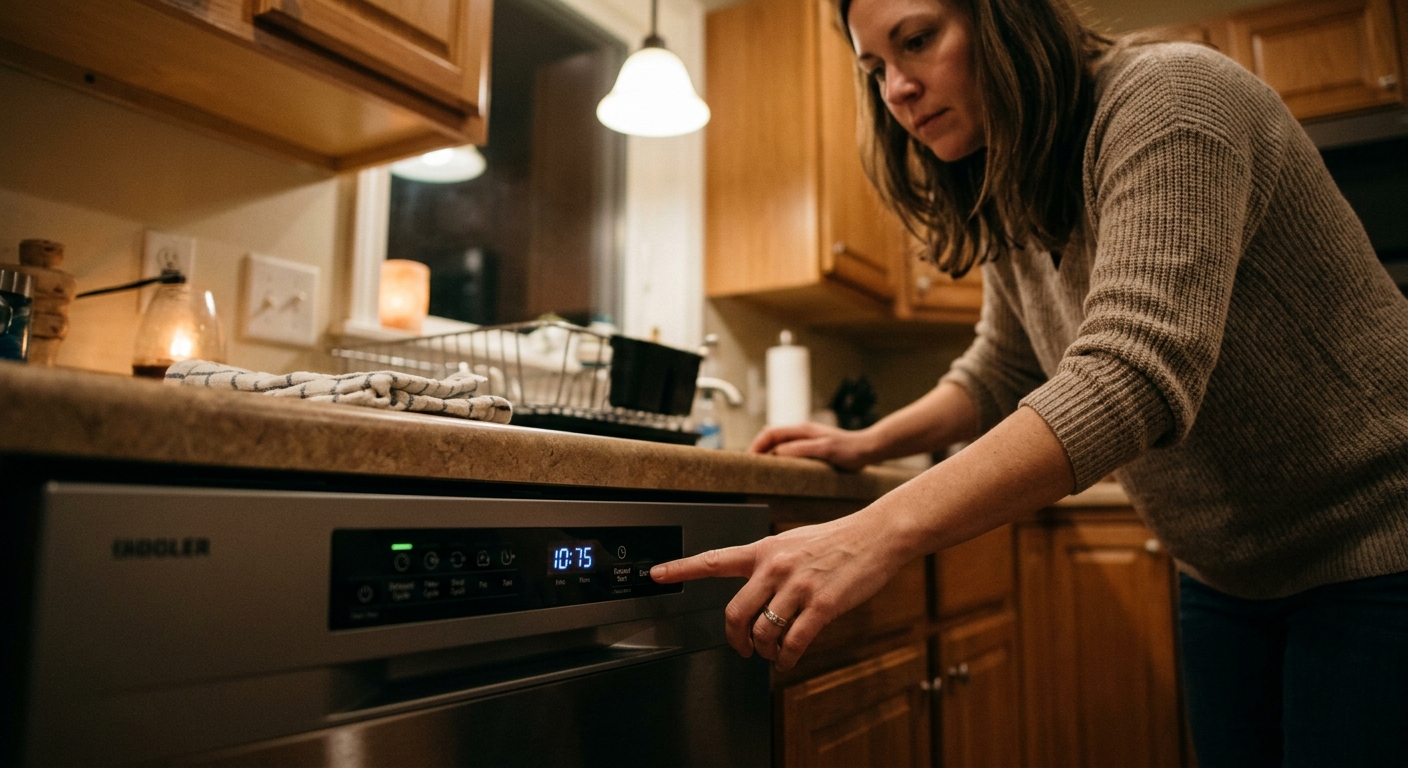
- Shift your dishwasher to run after 9 p.m. using its built-in delay-start feature. If yours does not have one, simply run it before bed. The same applies to your clothes washer and dryer.
- Review your last electric bill to identify your three highest-usage days of the month. Most utility apps and websites now show hourly usage data. Use this to spot which habits drive peak consumption.
- After one full billing cycle on the TOU plan, compare your bill against the same month the prior year (adjusting for weather). Calculate whether you are ahead or need to shift additional loads.
- Install a smart thermostat (Ecobee, Google Nest, or Honeywell T6 Pro) if you do not already have one. Program a pre-cooling schedule: set the home to 70 to 72 degrees from 1 to 3:30 p.m., then allow it to drift to 76 to 78 degrees during the 4 to 9 p.m. peak window. Resume normal setpoints after 9 p.m.
- Purchase smart plugs ($10 to $15 each) for your window AC units, space heaters, and any other high-wattage plug-in appliances. Use their companion apps to create schedules that block operation during peak hours automatically.
- Connect your EV to off-peak charging: most EVs have a built-in scheduled charging feature in the vehicle settings or manufacturer app. Set departure time and the vehicle will back-calculate when to start charging, landing entirely in off-peak hours.
- If your utility offers a smart meter app or a home energy monitor (brands include Sense or Emporia Vue at $100 to $150), install it to get real-time kilowatt readings by circuit. This reveals hidden peak draws you may not have suspected, such as a second refrigerator or sump pump.
- Set up a utility bill alert in your utility account app. Most utilities now allow you to set a mid-month usage alert that estimates your bill so far. Use this as an early-warning system before the billing cycle closes.
- After two billing cycles, download your hourly usage data from your utility portal and look for any recurring spikes during the 4 to 9 p.m. window. Use this data to identify remaining optimization opportunities and confirm your savings are tracking toward the 15 to 25% target.
- Get quotes from at least three licensed electrical contractors for a home battery storage system such as a Tesla Powerwall (13.5 kWh), Enphase IQ Battery, or Franklin WH. Size the system to cover your peak-hour load, typically 5 to 10 kWh for a 2,000 square foot home.
- Ask each installer whether your utility supports TOU-optimized battery dispatch. Some utilities partner directly with storage systems to automatically charge during off-peak and discharge during peak, maximizing arbitrage without manual management.
- Pair battery storage with a solar array if your home and budget allow. The combination allows you to generate free electricity during the day, store excess, and deploy it during the peak-rate evening window when grid power costs the most.
- Have your electrician install a whole-home energy monitor at the main panel to give you circuit-level data. This is essential for validating that the system is charging and discharging on the correct schedule and that no phantom loads are undermining your savings.
- After installation, apply for any available federal tax credits (the Inflation Reduction Act provides a 30% tax credit for battery storage systems installed after 2022) and check your state’s net metering and storage incentive programs to shorten the payback period.
Why It Works: The Benefits
Households that shift 30 to 40% of their usage to off-peak hours on a 3-to-1 TOU plan typically see 15 to 25% reductions in their monthly electric bills, often $25 to $80 per month depending on home size and climate.
Pre-cooling strategies and delay-start appliances mean your home stays comfortable and laundry still gets done on your schedule. The shift happens in the background.
Electric vehicle owners who charge exclusively during off-peak hours (typically 9 p.m. to 7 a.m.) can save $400 to $900 per year on charging costs alone, depending on their utility’s rate spread.
Homes with solar panels benefit doubly: solar production aligns with midday off-peak or low-rate windows, and excess generation exported to the grid may earn better off-peak net metering credits depending on your utility.
Shifting loads off-peak reduces strain on the grid during high-demand periods, which can prevent rate increases and outages that ultimately affect every ratepayer in your area.
💰 Savings Impact by Action
Shifting dishwasher, laundry, and water heater operation to off-peak hours reduces peak energy charges by up to 20% on a typical 2-to-3-to-1 rate spread plan.
Scheduling EV charging exclusively during off-peak overnight hours can reduce total household electric bills by 10 to 15% for homes where EV charging represents a significant portion of usage.
Pre-cooling the home to 70 to 72 degrees before peak hours begin reduces HVAC compressor runtime during peak windows by up to 40%, cutting peak-rate cooling costs by roughly 8% of the total bill.
Automating plug-in high-draw appliances with scheduled smart plugs eliminates unintentional peak-hour usage and typically saves 4 to 6% on monthly bills with no ongoing effort.
Home battery systems charged at off-peak rates and discharged during peak hours can capture 20 to 30% in net electricity cost reductions on plans with a significant rate spread.
🏠 Key Concepts Explained
The Science Behind It
Time-of-use pricing is grounded in the real-time economics of electricity generation. Utilities must maintain enough generation capacity to meet the highest demand moment of the year, which in most of the U.S. occurs during summer weekday evenings when air conditioning, cooking, and lighting all overlap. Building and maintaining that peak-capacity infrastructure is expensive, so utilities recover those costs by charging higher rates during the hours when demand actually spikes. When you shift loads to off-peak hours, you are helping the utility flatten its demand curve, which is genuinely cheaper to serve.
The thermal mass pre-cooling strategy works because buildings store energy in their physical structure. Concrete floors, drywall, furniture, and even the air volume in a well-sealed home act as a thermal battery. If you cool that mass to 70 degrees before 4 p.m., it releases that coolness slowly over the next 3 to 4 hours, keeping occupants comfortable even as the thermostat setpoint rises. A well-insulated home with low air leakage will hold the pre-cooled temperature long enough to coast through the entire peak window with minimal compressor operation. This is why improving your home’s air sealing and insulation amplifies TOU savings beyond what rate-shifting alone achieves.
Battery storage systems take this logic one step further by enabling true energy arbitrage. A home battery charged at 10 cents per kilowatt-hour during off-peak hours and discharged during a 35-cent peak window captures a 25-cent-per-kilowatt-hour spread on every kilowatt-hour cycled. A 10 kWh battery fully cycled daily generates roughly $912 in annual savings at that spread, which at a $6,000 installed cost after incentives represents a 6 to 7 year payback period, improving as rate spreads widen over time.
Frequently Asked Questions
▼ I switched to a TOU plan but my bill went up. What went wrong?
This almost always means peak-hour usage did not actually decrease after the switch. Download your hourly usage data from your utility portal and identify which hours between 4 and 9 p.m. are still showing high consumption. Common culprits are an electric water heater without a timer, an EV still charging in the evening, or a pool pump running on its original schedule. Address these specific loads before concluding TOU is not right for your home.
▼ My utility does not offer TOU rates. Are there other ways to get similar savings?
Yes. Some utilities offer a simpler peak-time rebate program where you earn bill credits for reducing usage during specific demand events, without switching your base rate structure. Others offer budget billing or tiered rates where reducing overall consumption drops you into a lower price tier. Contact your utility’s energy efficiency department and ask what demand-response or time-based programs exist. If none do, focus on reducing total kilowatt-hour consumption through insulation, air sealing, and appliance upgrades instead.
▼ Does time-of-use pricing work if I work from home all day?
It can, but the math changes. Work-from-home households have less flexibility to shift daytime loads and may have higher peak-hour usage due to cooking dinner and running appliances while also being home all day. Run a 3-month trial and compare bills carefully. If savings do not materialize, many utilities will let you revert to the standard rate. Pre-cooling and automated appliance scheduling matter even more for households that are home during peak hours.
▼ How long before I see savings on my actual bill after switching?
Most utilities bill monthly, so your first full TOU billing cycle will show results within 30 to 45 days of enrollment. However, your first bill may be a partial cycle split between your old rate and the new TOU rate, which can make it hard to read. Wait for the second full TOU bill and compare it against the same month from the prior year, adjusting for significant weather differences, for a clean comparison.
▼ Can I use TOU savings strategies in an apartment where I cannot control the HVAC?
Absolutely. Focus on the loads you do control: dishwasher delay-start, laundry timing, EV charging if applicable, and high-draw plug-in appliances like space heaters and window air conditioners. Smart plugs with built-in scheduling cost $10 to $15 each and work in any rental without landlord approval. If your utility offers TOU, enroll and use the plug-in appliance strategy for meaningful savings even without HVAC control.
Quick Tips
- Check whether your utility charges a demand fee in addition to energy charges. Some commercial-style rates that have migrated to residential plans charge for your single highest 15-minute draw of the month, not just total usage. If so, spreading out appliance starts matters as much as timing them.
- Run your dishwasher with the heated dry option turned off. Air drying saves 15% of dishwasher energy, reduces runtime into peak hours, and extends the life of your dishes and gaskets.
- If you have a gas dryer, your TOU exposure from laundry is mostly limited to the electric motor and controls, just 300 to 400 watts instead of 5,000 watts for an electric dryer. Focus your peak-avoidance efforts on electric resistance loads first.
- Most smart thermostats, including Ecobee and Nest, have a built-in TOU mode or utility partnership program that automates pre-cooling schedules based on your rate plan. Check your thermostat’s app settings before programming manually.
Variations for Your Situation
- Apartment/Rental: Renters cannot modify central HVAC schedules, but can enroll in TOU plans and automate plug-in loads. Buy two or three smart plugs ($10 to $15 each, brands include Kasa or Wemo) and put window AC units, space heaters, and any high-wattage appliances on off-peak schedules. Use your dishwasher’s delay-start and set laundry to run after 9 p.m. This approach costs under $50 and requires no landlord permission.
- Tight Budget (Under $50): Enroll in your utility’s TOU plan for free, then focus entirely on zero-cost behavior shifts: run the dishwasher and laundry after 9 p.m., pre-cool the home before 4 p.m. using your existing thermostat, and set your phone alarm to remind you when peak hours begin and end. Households with an EV should immediately enable the vehicle’s built-in scheduled charging feature, which is free and can save $400 to $900 per year by itself.
- Older Home (Pre-1980): Older homes with poor insulation and high air leakage lose pre-cooled air quickly, which limits how long a pre-cooling strategy stays effective. Before relying on TOU thermal mass strategies, seal obvious air leaks around windows, doors, and attic hatches (cost: $20 to $80 in weatherstripping and caulk). Even modest air sealing improvements extend the pre-cooling window by 30 to 60 minutes, which may be enough to coast through the peak window. Pair with TOU enrollment for compounding benefits.