Most homeowners blame their HVAC system when rooms feel clammy, musty, or impossible to keep comfortable. But in many cases, the real culprit is moisture. Relative humidity above 60% makes the air feel warmer than it actually is, forces your air conditioner to work harder, and creates ideal conditions for mold growth. According to the EPA, excess indoor moisture is one of the top contributors to poor indoor air quality in American homes.
The frustrating part is that serious moisture problems rarely announce themselves with a dramatic leak. More often, they creep in slowly through condensation on windows, musty odors in closets, or paint that keeps peeling no matter how many times you repaint. By the time visible mold appears, the problem has usually been building for weeks or months behind walls and under floors.
This post walks you through the six clearest warning signs that your home has a moisture problem worth addressing, explains what each sign means structurally and scientifically, and gives you practical steps ranging from free fixes you can do right now to professional remedies for serious cases. Whether you are dealing with a damp basement or a humid upstairs bedroom, there is an approach here that fits your situation and budget.
What You’ll Need
Click on an item below to shop for the recommended items for this recipe on Amazon.
As an Amazon Associate, we earn from qualifying purchases.
How to Do It
- Buy or borrow a digital hygrometer (available for $10 to $15 online) and place it in each room for 24 hours. Readings consistently above 60% confirm a humidity problem worth addressing immediately.
- Check your six warning signs: condensation on windows, peeling paint on exterior walls, musty odors in closets or basement, visible mold or dark staining on grout or caulk, warped wood floors or door frames that stick, and allergy symptoms that improve when you leave the house.
- Run bathroom and kitchen exhaust fans for at least 15 minutes after every shower or cooking session. Verify your fans actually vent outside by holding a tissue near the grille – it should pull firmly toward the fan.
- Check that clothes dryer exhaust vents fully to the outside. A disconnected or clogged dryer duct can dump 1 to 2 gallons of water vapor per load directly into your laundry room.
- Inspect the soil grading around your foundation. The ground should slope away from the house at least 6 inches over the first 10 feet. Flat or inward-sloping ground channels rain directly into your basement or crawlspace.
- Set your AC thermostat fan switch to AUTO rather than ON. Running the fan continuously re-evaporates moisture that collected on the evaporator coil back into your home instead of draining it away.
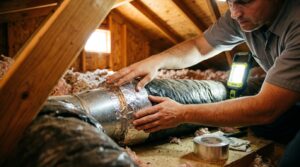
- Air seal your home’s major bypass points using caulk and expanding foam. Focus on plumbing penetrations under sinks, gaps around recessed lights in the ceiling below an attic, and the sill plate where the wood framing meets the foundation. A well-sealed home can reduce moisture infiltration by 20 to 30%.
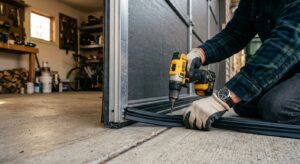
- Install foam weatherstripping on all exterior doors and replace the door sweep if light is visible under the door. Humid outside air infiltrating under a single door can add meaningful moisture load in summer.
- Add a vapor barrier in your crawlspace if one is missing or damaged. Use 6-mil polyethylene sheeting overlapped 12 inches at seams and taped. Crawlspace moisture is responsible for up to 40% of the air quality in the living space above it, according to building science research.
- Install a standalone dehumidifier in the basement or main living area. Size it to your space: 30 to 50 pints per day for spaces up to 1,500 square feet, 50 to 70 pints for larger spaces. Set the target humidity to 50%. Units in the $180 to $280 range typically pay back in energy savings and reduced AC runtime within 18 months.
- Re-caulk around all bathtubs, showers, and window frames using mold-resistant silicone caulk. Remove old caulk completely before applying new material to ensure adhesion. This prevents hidden cavity moisture from slow leaks inside walls.
- Clean your AC evaporator coil and condensate drain line. Pour a cup of diluted bleach down the condensate drain access port near your air handler annually to prevent clogs. A blocked drain causes water to back up and overflow, sometimes into walls or ceilings.
- Hire a certified home inspector or building performance contractor to perform a blower door test. This pressurizes the home and reveals exactly where air and moisture are entering. Tests typically cost $250 to $450 and give you a clear remediation priority list.
- Have an HVAC technician check that your system is correctly sized. Oversized AC units short-cycle, meaning they cool the air quickly but do not run long enough to remove moisture. Replacing an oversized unit with a properly sized variable-speed system can reduce humidity complaints by 40 to 60%.
- Hire a licensed waterproofing contractor if water is entering through foundation walls or the basement floor. Interior drain tile systems with a sump pump run $3,000 to $8,000 for an average basement but permanently resolve hydrostatic water intrusion.
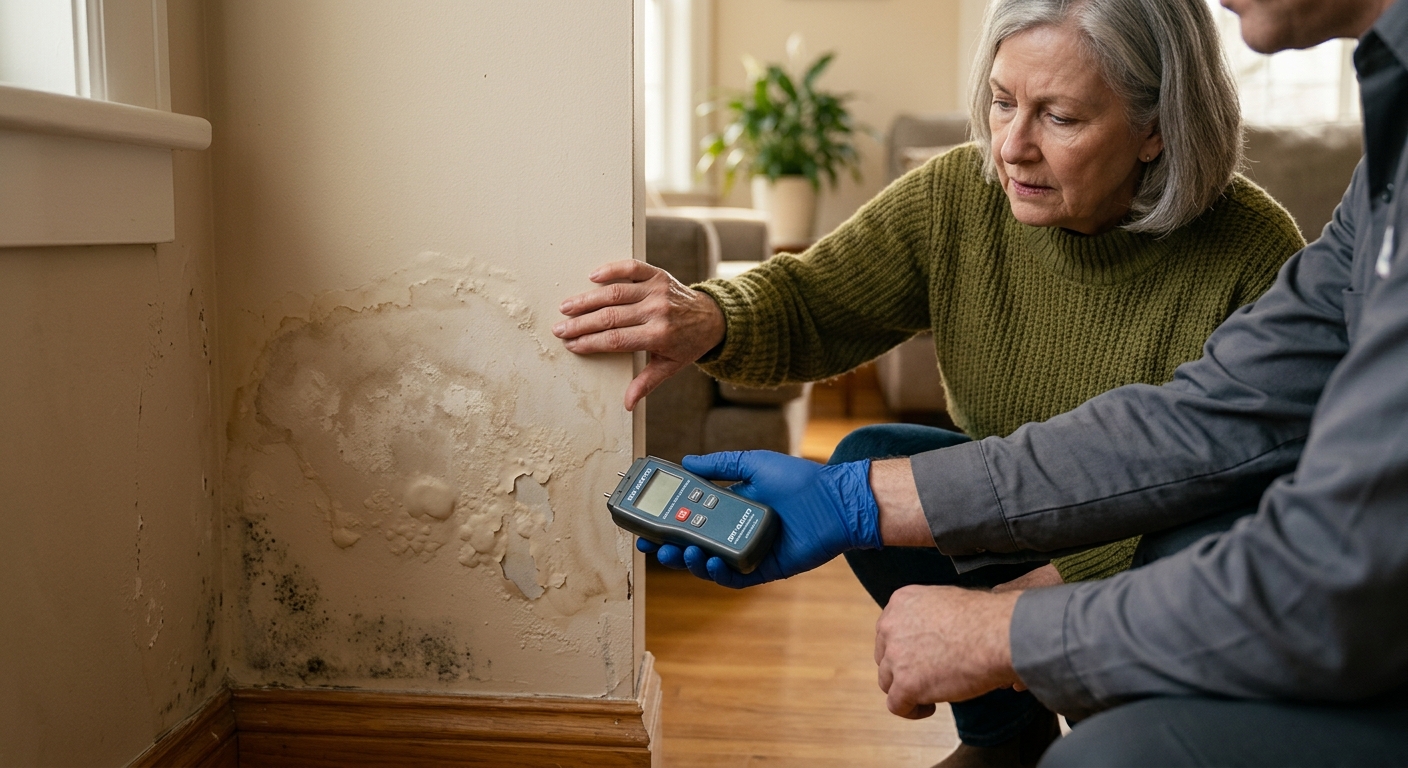
- If mold is present in wall cavities or the attic, hire an IICRC-certified mold remediation firm. They will contain the area, remove affected materials, treat surfaces with antimicrobial agents, and document the work. Costs range from $1,500 to $6,000 for a single room.
- Consider a whole-house dehumidifier integrated into your HVAC duct system. These units handle 70 to 120 pints per day, maintain precise humidity levels throughout the home, and typically cost $1,200 to $2,500 installed with a payback of 3 to 5 years in energy savings and reduced AC wear.
Why It Works: The Benefits
Reducing indoor relative humidity from 65% to 50% can lower perceived temperature by 3 to 4°F, letting you raise your thermostat setpoint and cut cooling costs by 10 to 15% without sacrificing comfort.
Unchecked moisture causes wood rot, corrodes fasteners, and destroys drywall. Remediation after mold damage averages $2,000 to $6,000 for a single room. Addressing moisture early costs a fraction of that.
Maintaining relative humidity between 40 and 50% inhibits mold, dust mites, and bacteria. The EPA links high indoor humidity to increased respiratory symptoms, allergies, and asthma episodes.
Rooms that feel sticky and hard to cool are almost always fighting a moisture load, not a cooling capacity problem. Controlling humidity makes temperatures feel stable and comfortable throughout the home.
When your AC constantly battles excess moisture, it runs longer cycles and accumulates biological growth on evaporator coils. Proper humidity control can extend equipment life by 2 to 5 years and reduce maintenance calls.
💰 Savings Impact by Action
Reducing indoor RH from 65% to 50% lowers the effective cooling load, allowing a thermostat setback of 3 to 4°F and cutting cooling energy use by up to 15%.
Sealing gaps at the sill plate, crawlspace, and penetrations reduces humid air infiltration and lowers total HVAC energy use by 15 to 20% in leaky homes.
Installing a full crawlspace vapor barrier and sealing vents reduces whole-house humidity load by up to 40%, translating to 15 to 18% savings on cooling costs.
Consistently venting bathroom and kitchen moisture outside rather than into the home reduces the latent load your AC must handle, saving up to 8% on cooling runtime.
Addressing moisture before visible mold appears avoids remediation costs of $2,000 to $6,000 per room, representing a 30% or greater reduction in long-term home maintenance costs.
🏠 Key Concepts Explained
The Science Behind It
Water vapor behaves differently from liquid water, which is why moisture problems are so hard to detect until damage is done. Air has a maximum capacity to hold water vapor that rises steeply with temperature. When warm humid air contacts a cooler surface such as a basement wall, a window pane, or the back of a closet, it releases that water as condensation. This is the dew point in action, and it explains why moisture damage so often appears far from any visible leak.
Your air conditioner removes moisture as a byproduct of cooling. Warm humid air passes over the evaporator coil, which is typically 40 to 45°F in a properly operating system. The coil is cold enough to drop the air below its dew point, causing water to condense on the coil and drain away. When humidity is extremely high, this process becomes the dominant task your AC performs, and it has less capacity left for actual temperature reduction. This is why a humid 78°F room feels far more uncomfortable than a dry 78°F room, and why your system runs continuously without reaching the set temperature.
The stack effect adds another layer of complexity. In summer, hot outdoor air is denser than cooled indoor air, so pressure differences drive humid outside air in through any gap at or below grade: crawlspace vents, sill plate cracks, and foundation penetrations. This air then migrates upward through the house, picking up additional moisture from occupant activity before exhausting through upper-level gaps. Sealing the bottom of the thermal envelope and controlling crawlspace humidity has an outsized effect on whole-house moisture levels because it interrupts this continuous flow of humid outside air before it even enters the living space.
Frequently Asked Questions
▼ My hygrometer shows 65% humidity but I do not see any mold or water stains. Is it really a problem?
Yes, 65% is high enough to support mold growth on surfaces you cannot see, including inside wall cavities, behind drywall, and under carpet padding. It also means your AC is working significantly harder than it needs to. Start with the free fixes: set the fan to AUTO, run exhaust fans longer, and check your crawlspace. If humidity stays above 55% after two weeks, add a dehumidifier.
▼ Why does my basement always smell musty even though I do not see any water or mold?
Musty odor is caused by microbial volatile organic compounds (MVOCs) produced by mold colonies that may be invisible to the naked eye or hidden under concrete paint, behind stored items, or inside block wall cavities. The smell alone is enough reason to act. Start by improving air circulation, adding a dehumidifier, and inspecting the exterior grading and downspout extensions. If the odor persists after two to three weeks of humidity control, hire a contractor with a moisture meter to probe the walls.
▼ Can renters do anything about a moisture problem without landlord permission?
Renters can legally use portable dehumidifiers, plug-in hygrometers, and bathroom exhaust fan timers without modifying the unit. Document any visible mold, peeling paint, or condensation with dated photos and submit a written maintenance request to your landlord immediately. In most states, landlords are legally required to address moisture and mold issues that affect habitability, and documented requests create a paper trail that protects your rights.
▼ I fixed an obvious leak but the musty smell and high humidity are still there. What did I miss?
Fixing the water source stops new moisture from entering but does not remove the moisture already absorbed into building materials. Drywall, wood framing, and insulation can hold significant moisture for weeks after a leak is repaired. Run a dehumidifier continuously set to 45% in the affected area, increase ventilation, and give it two to four weeks. If humidity readings on a moisture meter inside the wall are still above 19%, the materials need to be dried professionally or removed to prevent mold growth.
▼ My AC runs constantly in summer but the house still feels humid. Is my unit broken?
Constant runtime with persistent humidity often means the unit is oversized, undersized, or has a refrigerant issue. An oversized unit short-cycles and does not run long enough to dehumidify properly, while an undersized unit is overwhelmed. Have an HVAC technician check refrigerant charge and measure actual system capacity against your home’s Manual J load calculation. A properly sized variable-speed system maintains humidity far more effectively than an oversized single-stage unit.
Quick Tips
- Target a year-round indoor relative humidity of 40 to 50%. Below 30% causes dry skin and static electricity; above 60% encourages mold and dust mites.
- Point downspout extensions at least 4 feet away from the foundation. A standard downspout dumps 100 gallons of water per inch of rainfall within inches of your basement wall.
- Replace standard bathroom exhaust fans with models rated at 110 CFM or higher, and add a built-in humidity sensor so the fan runs automatically after showers without relying on occupant habits.
- Check window weep holes on the exterior frame of sliding and casement windows. These small holes drain condensation and rain, but they get clogged with debris and paint. Clear them with a toothpick annually.
Variations for Your Situation
- Apartment/Rental: Renters cannot modify HVAC or seal the building envelope, so focus on portable solutions. A 30-pint dehumidifier ($120 to $180) in the bedroom or living area, a hygrometer to monitor levels, and a plug-in bathroom fan booster can reduce indoor humidity by 5 to 10 percentage points. Always document moisture issues in writing to your landlord, as most jurisdictions require landlords to maintain habitable humidity levels.
- Tight Budget (under $50): Start with zero-cost behavioral changes: switch the thermostat fan to AUTO, extend exhaust fan runtime to 20 minutes after every shower, and move stored items away from exterior basement walls to improve air circulation. A $12 digital hygrometer lets you track whether these steps are working. Redirecting downspout extensions ($8 to $15 each) can meaningfully reduce basement moisture if grading is the primary culprit.
- Older Home (pre-1980): Homes built before modern building codes often have no vapor barrier in the crawlspace, single-pane windows, and minimal wall insulation, making them far more vulnerable to moisture infiltration. Prioritize crawlspace encapsulation first, as it addresses the largest moisture entry point in most older homes. Expect to also find disconnected or missing bathroom exhaust fans, which were not required by code before the 1980s. Adding exhaust fans with humidity sensors and sealing attic bypasses will have the highest impact for the investment.