Every summer, millions of pet owners face the same dilemma: leave the air conditioning running all day while they are at work, or risk coming home to an overheated animal. The default answer, crank the AC and pay the bill, is understandable but expensive. Running central air continuously during an 8-hour workday can cost $4 to $8 per day depending on your climate and system size, adding up to $80 to $160 over a single month.
The good news is that keeping pets safe and comfortable during summer does not require treating your home like a refrigerator. Dogs and cats tolerate heat differently than humans, and targeting their specific needs, rather than cooling every cubic foot of your home, opens up a much smarter set of strategies. Blocking radiant heat gain, improving airflow in the rooms your pets actually use, and dialing in a precise thermostat schedule can reduce your cooling runtime by 30 to 50 percent without compromising your pet’s safety.
This post walks you through the building science behind why homes get so hot during the day, the fastest no-cost fixes you can apply today, and the targeted upgrades that pay for themselves in a single summer. You will also find breed-specific guidance, troubleshooting answers, and a clear breakdown of what each strategy actually saves.
What You’ll Need
Click on an item below to shop for the recommended items for this recipe on Amazon.
As an Amazon Associate, we earn from qualifying purchases.
How to Do It
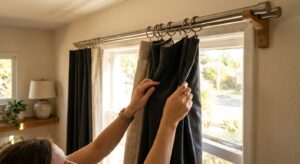
- Close blinds and curtains on all south- and west-facing windows before you leave for work. This single step blocks 50 to 70 percent of incoming solar heat gain and can reduce room temperature by 5 to 10 degrees by mid-afternoon.
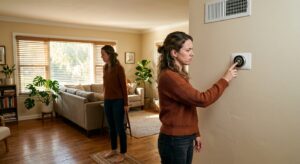
- Raise your thermostat setpoint to 78 to 80 degrees Fahrenheit for the hours you are away. Most healthy dogs and cats are safe up to 80 to 82 degrees with airflow. For brachycephalic breeds like pugs or Persian cats, keep the limit at 76 to 78 degrees.
- Designate one shaded interior room as your pet’s daytime zone. Close doors to sunny rooms so your pet naturally retreats to the coolest part of the house and the AC does not have to fight solar heat in those spaces.
- Fill an extra water bowl and place both in the designated cool room. Hydration is the most critical variable in heat tolerance, and having two bowls prevents an empty dish from becoming a risk.
- Lay a damp towel on the tile or hardwood floor in the cool room. Pets will seek it out, and evaporative cooling from a wet surface can drop the local felt temperature by 4 to 6 degrees.
- Install blackout cellular shades or thermal curtains on south- and west-facing windows. Cellular shades provide an R-3 to R-5 insulation value and reduce solar heat gain by up to 80 percent compared to bare glass. Budget $20 to $50 per window at home improvement stores.
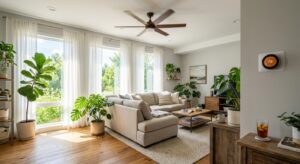
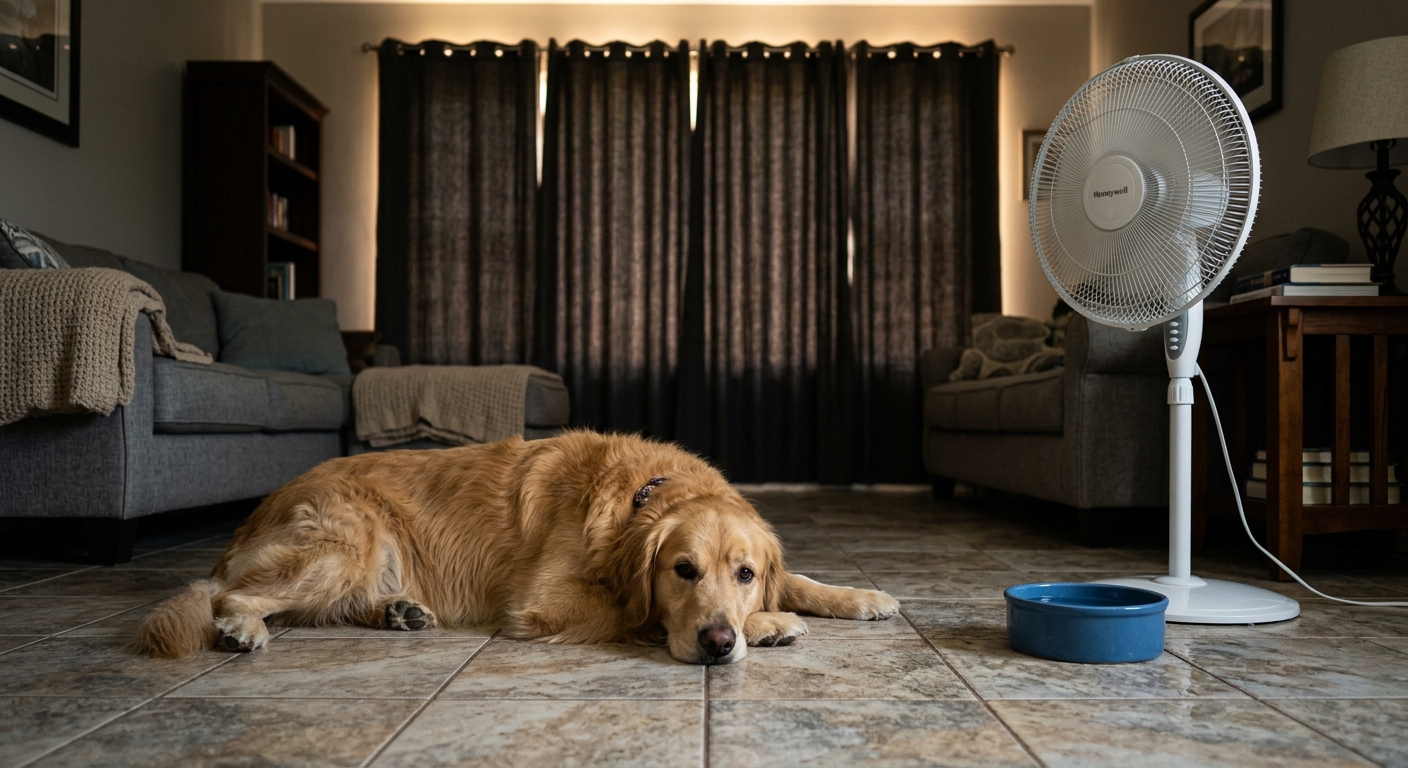
- Set up a tower fan or box fan in your pet’s designated cool room, positioned to create cross-ventilation if possible or aimed at the floor level where your pet rests. A moving airflow of 2 to 3 mph lowers felt temperature by 5 to 8 degrees, allowing a higher thermostat setpoint without sacrificing comfort.
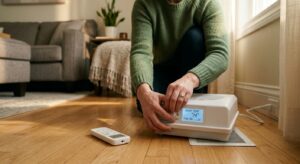
- Program a smart thermostat or basic programmable thermostat with a pet-safe schedule: 74 to 76 degrees from 6 to 8 a.m. while you prep to leave, 78 to 80 degrees from 8 a.m. to 4 p.m. while away, then a ramp back to 72 to 74 degrees starting 30 minutes before you arrive home. This schedule alone can save 10 to 15 percent on cooling costs.
- Purchase a self-cooling gel mat or elevated mesh cot for your pet’s resting spot. Gel mats use pressure-activated cooling gel that absorbs body heat passively with no electricity. Elevated cots allow airflow beneath the pet, which is significantly cooler than floor contact with carpet. Both cost $20 to $40.
- Close supply vents in unused rooms such as guest bedrooms or formal dining rooms and verify the pet zone vent is fully open. This redirects cooled air toward the space that needs it most and reduces the volume your system must cool. Note: do not close more than 20 to 25 percent of vents in a forced-air system to avoid pressure imbalance.
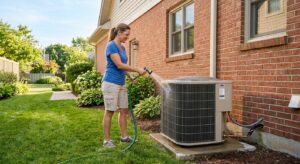
- Check and replace your AC filter if it is more than 60 days old. A clogged filter reduces airflow efficiency by 10 to 15 percent, meaning your system works harder and cools less effectively. A clean MERV 8 to 10 filter restores full performance immediately.
- Install a smart thermostat with remote monitoring such as an Ecobee or Nest if you have not already. The key feature is remote adjustment via smartphone, allowing you to lower the setpoint immediately if outdoor temperatures spike unexpectedly or you get delayed coming home.
- Add a wireless temperature and humidity sensor in your pet’s room. Smart thermostats like the Ecobee support remote sensors that let the system optimize based on that specific room’s temperature rather than the hallway where the thermostat lives. This can reduce both overcooling and under-cooling by 10 to 20 percent.
- Apply window film to south- and west-facing glass. Solar control window film blocks 45 to 70 percent of solar heat gain without blocking daylight, costs $30 to $80 per window installed as a DIY project, and pays back in 1 to 2 summers in hot climates.
- Add attic hatch insulation if your pull-down attic stairs or hatch are uninsulated. Attic hatches lose more heat per square foot than almost any other surface in the home. A simple insulated cover kit costs $30 to $60 and can reduce attic-driven heat gain by 10 to 15 percent in the rooms directly below.
- Consider a portable evaporative cooler for dry climates with humidity below 50 percent. In low-humidity regions, evaporative coolers consume 75 percent less energy than refrigerant AC and can cool a single room by 10 to 15 degrees. They are not effective in humid climates.
Why It Works: The Benefits
Raising your away setpoint from 74 to 80 degrees and combining it with window treatments and a pet-zone fan can reduce daytime cooling costs by 20 to 40 percent, saving $30 to $90 on a typical summer electric bill.
Active airflow from a fan lowers the effective felt temperature for pets by 5 to 8 degrees, reducing heat stress risk without requiring the thermostat to drop any further.
Every hour your compressor does not run extends equipment life. Cutting daily runtime from 10 hours to 6 hours can add years to a system that costs $5,000 to $12,000 to replace.
Targeted cooling strategies like directing a fan into a shaded room eliminate hot spots that cause pets to pace or pant, creating a consistently comfortable rest space without overcooling the whole house.
Better airflow helps manage humidity, which matters for pet comfort. High humidity above 60 percent makes it harder for dogs to cool themselves through panting, so improving air circulation directly reduces heat stress risk.
💰 Savings Impact by Action
Closing blinds or installing thermal curtains on sun-facing windows reduces solar heat gain by 50 to 80 percent, cutting daytime cooling load by up to 20 percent.
Raising the away setpoint from 74 to 80 degrees saves approximately 6 to 8 percent per degree, totaling 15 percent or more in daytime cooling costs.
Running a fan in the pet zone allows a 5 to 8 degree higher thermostat setpoint without reducing comfort, saving 10 to 12 percent on cooling energy.
Solar control window film blocks 45 to 70 percent of heat gain through glass, reducing the cooling load from sun-exposed windows by up to 18 percent of total system demand.
Replacing a clogged air filter restores full system airflow efficiency, improving cooling output by 10 to 15 percent at no additional energy cost.
🏠 Key Concepts Explained
The Science Behind It
The primary reason homes heat up so dramatically during the day is solar radiation, not just outdoor air temperature. Glass transmits short-wave solar energy directly into a room, where it strikes surfaces and converts to long-wave heat that cannot escape back through the glass. This greenhouse effect can raise a sun-exposed room’s temperature 15 to 20 degrees above the rest of the house by early afternoon, forcing your AC to work far harder than the outdoor temperature alone would require. Blocking sunlight before it enters is 5 to 10 times more effective than trying to remove that heat with refrigerant cooling after it has already entered the space.
Dogs and cats cool themselves primarily through panting and conduction, not sweating. Panting works by evaporating moisture from the respiratory tract, which requires both airflow and manageable humidity. When indoor relative humidity exceeds 60 percent, evaporative cooling from panting becomes much less effective, meaning a humid 80-degree room is significantly more dangerous than a dry 80-degree room. This is why improving airflow and managing indoor humidity, which a properly functioning AC already does as a side effect of dehumidification, matters as much as the actual temperature setpoint.
Thermal mass is a passive ally you likely already have. Concrete slabs, ceramic tile, and stone surfaces have high specific heat capacity, meaning they absorb large amounts of heat energy with only modest temperature rises. A tile floor that stays at 68 to 72 degrees acts as a continuous heat sink for a pet resting on it, pulling body heat away through conduction far more efficiently than any fabric or carpet surface. Orienting your pet’s rest area toward these naturally cool surfaces, especially in a shaded interior room, leverages free physics that costs nothing to run.
Frequently Asked Questions
▼ What temperature is actually safe for dogs and cats when home alone?
Most healthy adult dogs and cats can tolerate indoor temperatures up to 80 to 82 degrees Fahrenheit provided they have fresh water, good airflow, and access to a cool surface like tile. Puppies, senior pets, overweight animals, and flat-faced breeds should be kept below 78 degrees. If your pet is panting heavily, drooling excessively, or acting lethargic when you return home, lower your setpoint by 2 to 3 degrees and ensure a fan is running in their space.
▼ My AC runs all day and the house is still 82 degrees. What is wrong?
If your system runs continuously and cannot reach setpoint, it is either undersized for the heat load, low on refrigerant, or has a dirty coil or filter restricting airflow. Start by replacing the air filter and checking that all supply vents are open. If that does not help within a day, call an HVAC technician to check refrigerant charge and coil condition, as these are not DIY repairs and a refrigerant-short system can be damaged by continued operation.
▼ Can I leave a window AC unit running just for my pet’s room?
Yes, and this is often the most cost-effective approach for homes where pets occupy one specific room. A 5,000 to 8,000 BTU window unit costs $0.05 to $0.10 per hour to run, compared to $0.40 to $0.80 per hour for central air cooling the entire home. Set it to 76 to 78 degrees, close the room door, and you can save 50 to 70 percent compared to running central AC all day.
▼ Will a box fan pointed at my pet actually help if there is no AC?
A fan moving air across a pet can lower the felt temperature by 5 to 8 degrees through convective cooling, but only if the air temperature is below the pet’s body temperature of about 101 to 102 degrees Fahrenheit. On days where indoor air exceeds 90 degrees, a fan alone is not sufficient and can actually accelerate dehydration. Always pair fan use with cool fresh water and a cool surface, and set a firm indoor temperature limit at 85 degrees as an emergency threshold.
▼ Does leaving lights on affect how hot it gets for my pets?
Yes, more than most people expect. A single incandescent 60-watt bulb produces about 210 BTUs of heat per hour. LED bulbs of equivalent brightness produce only about 30 BTUs per hour. If you have several lights left on during the day, switching to LEDs or simply turning off unnecessary lights can meaningfully reduce the internal heat load your AC must overcome, especially in smaller rooms.
Quick Tips
- Pre-cool your home to 70 to 72 degrees in the early morning before 8 a.m. when electricity rates and outdoor temps are lowest, then let the thermostat rise to 78 to 80 degrees during peak daytime hours.
- Freeze a water bottle wrapped in a towel and place it near your pet’s rest spot. As it melts slowly over 4 to 6 hours it provides passive evaporative cooling and a cool surface to lean against.
- Use a smart plug with a timer to run a fan only during the hottest hours, typically 11 a.m. to 4 p.m., saving electricity while providing airflow exactly when it matters most.
- Check your attic temperature on a hot day. If it exceeds 130 degrees, your ceiling is radiating significant heat downward into living spaces. Adding attic ventilation or radiant barrier foil can reduce this load by 10 to 25 percent.
Variations for Your Situation
- Apartment/Rental: Renters cannot modify ductwork or install window film permanently, but you can use tension-mounted blackout curtains, a portable tower fan, a self-cooling gel mat, and a window AC unit if the lease allows it. A 6,000 BTU portable or window AC unit running 8 hours costs roughly $0.40 to $0.60 per day, far less than central system operation in many buildings. If your lease prohibits window units, focus on thermal curtains and a fan plus a frozen water bottle as a passive cooling supplement.
- Tight Budget (under $50): Focus on zero-cost behavioral changes first: close blinds on sunny windows, raise the thermostat to 78 to 80 degrees, designate the coolest room as the pet zone, and keep multiple water bowls filled. Then spend $10 to $15 on a box fan and $5 to $10 on a frozen water bottle or damp towel rotation. This combination can reduce cooling costs by 15 to 25 percent with an investment of under $25.
- Older Home (pre-1980): Homes built before 1980 typically have single-pane windows, minimal insulation, and high air leakage, meaning solar and conductive heat gain is far more severe than in newer construction. Prioritize window treatments and attic insulation above all else. If your attic insulation is below R-19, adding blown-in insulation to R-38 can reduce ceiling heat transfer by 40 to 50 percent and is one of the highest-ROI upgrades available, often paying back in 3 to 5 years while immediately reducing peak indoor temperatures by 4 to 8 degrees.