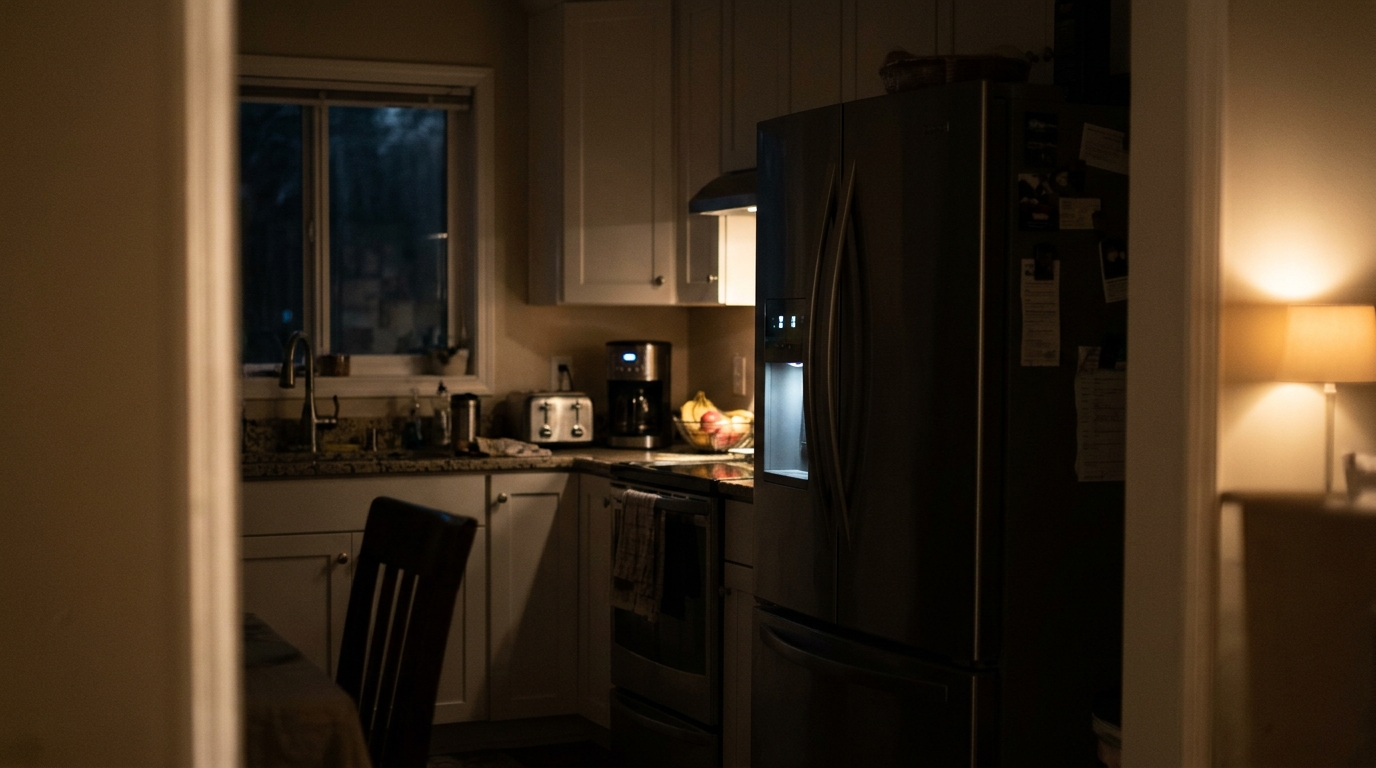
Most appliances take a break when you do. Your refrigerator does not. A typical full-size fridge uses between 300 and 800 kWh per year depending on age, size, and condition, which works out to roughly $45 to $120 annually at the national average rate of about 16 cents per kWh. That adds up to a steady, unglamorous drain on your budget, and an older unit in a hot garage or a cramped kitchen can cost far more.
Overnight is an interesting window. The door stays closed, so the energy being used is not fighting warm air rushing in from a midnight snack run. Instead, it goes toward maintaining temperature against heat leaking through the walls and door gasket, running the defrost cycle, and working against whatever condition the coil and airflow are in. In other words, overnight draw is a clean look at how efficient your fridge actually is when no one is messing with it.
In this post, we cover why the draw happens, which settings and habits matter most, and two practical approaches: a no-cost quick fix you can finish in about 20 minutes, and a more thorough DIY tune-up that targets the biggest hidden energy wasters. We also include troubleshooting answers, variations for renters and older homes, and realistic savings numbers so you know what to expect.
What You’ll Need
Click on an item below to shop for the recommended items for this recipe on Amazon.
As an Amazon Associate, we earn from qualifying purchases.
How to Do It
- Place an appliance thermometer in a glass of water on the middle shelf and another in the freezer. Check readings after 8 hours, ideally overnight.
- Adjust the settings to hit 37 to 40 degrees F in the fridge and 0 to 5 degrees F in the freezer. Every few degrees colder than needed can add roughly 5% to energy use.
- Do the dollar bill test on each door: close the door on a bill and tug it. If it slides out with no resistance, your gasket is not sealing well.
- Wipe down the gaskets with warm soapy water to remove sticky residue that prevents a tight seal, then dry them completely.
- Clear space around the unit. Leave about 1 to 2 inches of clearance at the back and sides so heat can escape, and keep the top free of clutter.
- Keep the fridge reasonably full. If it is mostly empty, fill gaps with water bottles or containers of water to add thermal mass.
- Unplug the refrigerator and pull it gently away from the wall. Place a cardboard sheet or towel on the floor first to protect flooring.
- Locate the condenser coils. They are usually on the back, though many newer models hide them behind a kick plate at the bottom front. Check your owner’s manual if unsure.
- Vacuum loose dust with a brush attachment, then use a long, narrow coil cleaning brush to dislodge packed-in debris. Finish with another vacuum pass.
- Clean the evaporator fan and drip pan if accessible. Mold and dust buildup there can reduce airflow and cause odors.
- Inspect the door gaskets for cracks, tears, or flattened sections. Replacement gaskets for most models cost $20 to $50 and press into the door channel in about 15 minutes.
- Check that the unit is level. Adjust the front feet so the door swings closed on its own, which helps the gasket seal.
- Plug the fridge back in and verify temperatures with your thermometers after 24 hours, then fine-tune if needed.
- Plug a plug-in energy meter (about $20) into the outlet for 24 to 48 hours to measure actual kWh use. Multiply daily use by 365 to estimate annual cost.
- Compare that figure against the EnergyGuide label of a new ENERGY STAR model. Units made before 1993 can use 1,000 kWh or more per year, while a new 18 cubic foot model often uses 350 to 450 kWh.
- Calculate payback by dividing the net purchase price after rebates by annual savings. A 20 year old fridge using 1,100 kWh per year replaced by a 400 kWh model can save around $110 per year.
- If you replace it, recycle the old unit through a utility program or retailer. Do not move it to the garage as a spare, which defeats the purpose.
Why It Works: The Benefits
Cleaning coils and fixing temperature settings can cut refrigerator energy use by 10 to 25%, which is typically $10 to $30 per year on a standard unit and more on an older one.
A compressor that runs less often experiences less wear. Keeping coils clean and gaskets sealed can help a fridge reach or exceed its typical 12 to 15 year lifespan.
Holding a steady 37 to 40 degrees F in the fridge and 0 degrees F in the freezer slows bacterial growth and reduces freezer burn, which means less wasted food.
A fridge with clean coils and proper airflow runs for shorter stretches, so you hear fewer long compressor hums and rattles after the house goes quiet.
Every watt a fridge consumes ends up as heat in your kitchen. Cutting its draw slightly eases the load on your air conditioner during summer.
💰 Savings Impact by Action
Removing dust from condenser coils improves heat rejection and can reduce compressor run time by 10 to 30% in dirty units.
Moving from an overly cold setting to 37 to 40 degrees F in the fridge and 0 degrees F in the freezer saves roughly 5% for every few degrees.
Replacing or cleaning leaky gaskets cuts warm air infiltration and reduces frost buildup and defrost energy by around 5 to 10%.
Moving a fridge out of a hot garage or away from the oven can reduce its energy use by 10 to 20% for each 10 degrees F drop in ambient temperature.
Filling empty freezer space with water containers adds thermal mass and reduces compressor cycling.
🏠 Key Concepts Explained
The Science Behind It
A refrigerator does not create cold. It moves heat from inside the cabinet to the room. The compressor pressurizes refrigerant, which releases heat through the condenser coils on the back or bottom, then expands and absorbs heat from the interior through the evaporator. The harder it is to dump that heat into the room, the longer the compressor has to run. Dust on the coils acts like a blanket, and a warm or cramped location reduces the temperature difference that drives heat transfer.
Overnight energy draw is dominated by three things: heat leaking in through insulation and gaskets, the defrost cycle, and the compressor recovering from earlier door openings. With no one opening the door, any extra runtime is a sign of inefficiency. A tight gasket, clean coils, and the correct set point reduce the heat the system must remove and the time it takes to remove it.
Thermal mass also plays a quiet role. Water holds a large amount of heat per unit of volume, so a well-stocked fridge or freezer resists warming when the compressor is off. That means longer off periods and fewer startups, and compressor startups are among the more energy-intensive moments in the cycle. This is why a nearly empty freezer often costs more to run than a full one.
Frequently Asked Questions
▼ Why does my fridge seem to run constantly at night?
A fridge that runs more than about 50% of the time usually has dirty condenser coils, a failing door gasket, or a set point that is too cold. Start by cleaning the coils and doing the dollar bill test on both doors. If it still runs nonstop after that, a failing fan motor or low refrigerant may be to blame, and a technician should take a look.
▼ Is it cheaper to unplug a spare fridge or keep it running?
Unplugging is almost always cheaper unless you actively use it. An older spare fridge can use 600 to 1,000 kWh per year, costing $100 to $160 annually. If you only need extra space a few times a year, unplug it, prop the door open slightly to prevent mold, and plug it in for the occasions you need it.
▼ How long before I actually notice savings on my bill?
The savings show up on your next billing cycle, but they are small enough to be hard to spot on a monthly statement. A plug-in energy meter lets you measure the before and after directly. Expect savings of roughly 1 to 2.5 dollars per month from the DIY tune-up.
▼ My fridge is older than 15 years. Should I replace it or just tune it up?
Measure its actual energy use with a plug-in meter first. If it uses over 800 kWh per year, a new ENERGY STAR model will likely pay for itself in 7 to 10 years, faster with utility rebates. If it uses under 500 kWh, a tune-up is the smarter move.
▼ Does a fuller fridge really use less energy?
Yes, within reason. Cold food and drinks act as thermal mass, so the compressor cycles less often. Just do not overpack, because blocked air vents prevent proper circulation and cause warm spots.
Quick Tips
- Let hot leftovers cool on the counter for 30 to 45 minutes before refrigerating, but never leave food out longer than 2 hours.
- Keep your freezer at least two-thirds full, using containers of water or ice packs to fill empty space.
- Use the fridge’s vacation or energy-saver mode during extended absences if it has one.
- Avoid placing the fridge next to the oven, dishwasher, or a sunny window, since external heat forces longer runtimes.
- Skip the old basement or garage spare fridge unless you truly need it, since it can cost $100 or more per year to run.
Variations for Your Situation
- Apartment/Rental: You usually cannot replace the fridge, but you can still do almost everything in the quick fix. Check the temperature with a $8 thermometer, clean the gaskets, vacuum the coils (landlords rarely object to this), and keep clearance behind the unit. If the gasket is torn or the fridge is clearly failing, send your landlord a written maintenance request that includes the energy meter reading.
- Tight Budget (under $50): Focus on the free steps: lower the set point to the correct range, clean the gaskets with soapy water, vacuum the coils, and fill empty freezer space with water jugs. A $10 thermometer is the only purchase worth making. Together these steps can save 10 to 15% on the fridge’s energy use at essentially no cost.
- Older Home (pre-1980): Older homes often have refrigerators tucked into tight alcoves or placed near uninsulated exterior walls, and the original kitchen may have poor ventilation. Make sure there is clearance around the unit, avoid placing it beside a radiator or baseboard heater, and consider a plug-in meter to check whether a decades-old fridge is the culprit behind a stubbornly high bill.