Most homeowners assume a kilowatt-hour costs the same at 6 p.m. as it does at 2 a.m. For millions of households, that is no longer true. Time-of-use (TOU) rate plans, now offered by a large and growing share of U.S. utilities, charge a premium during peak demand windows (often 4 p.m. to 9 p.m.) and a steep discount overnight. The gap can be dramatic. Off-peak rates are often 30 to 60 percent lower than peak rates, and in some markets the spread is even wider.
A dishwasher is one of the best appliances to shift because it does not need you standing next to it. A modern ENERGY STAR dishwasher uses roughly 1.2 to 1.8 kWh per cycle, with most of that going to heating water and running the drying element. That is not a huge number on its own, but it adds up, and the real win is that you can move the load to a cheaper window without changing how clean your dishes get. The same logic applies to your laundry, EV charger, and water heater boost cycles.
Here is the honest part: if you are on a flat-rate plan where every hour costs the same, running the dishwasher at midnight saves you nothing on rate. You may still save a little through other effects (like less strain on your AC during hot evenings), but the big payoff is a TOU plan. This post walks through how to find out which plan you are on, how to set up your dishwasher to run at the right time, and how to make sure the savings are real.
What You’ll Need
Click on an item below to shop for the recommended items for this recipe on Amazon.
As an Amazon Associate, we earn from qualifying purchases.
How to Do It
- Log into your utility account or call customer service and ask whether you are on a time-of-use plan. Write down the peak, shoulder, and off-peak hours and the price per kWh for each.
- Look up your dishwasher’s delay start feature in the manual or on the control panel. Most models let you pick a delay of 1 to 24 hours.
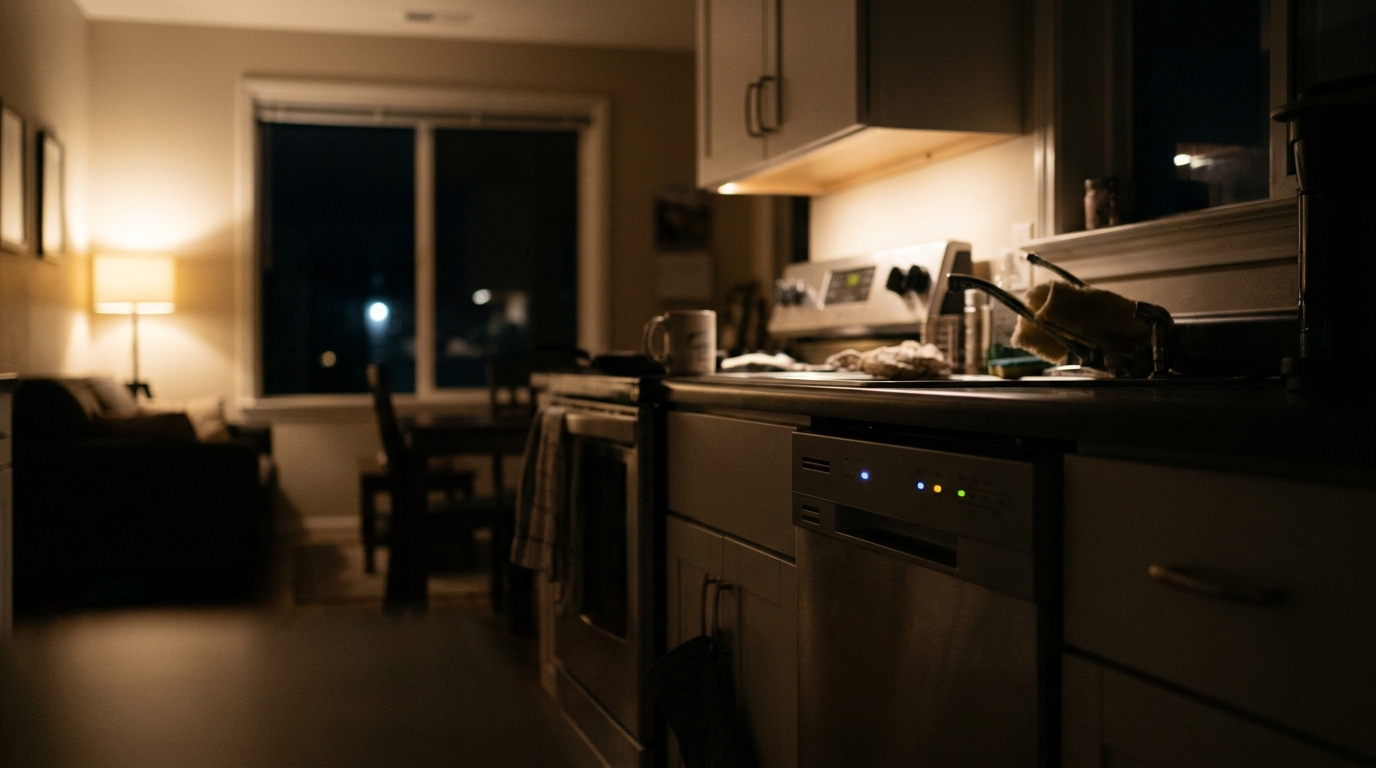
- After dinner, load the dishwasher and set the delay so the cycle starts after your off-peak window begins (for example, 10 p.m. or midnight).
- Turn off the heated dry or select an air dry or energy saver option to trim another 15 to 30 percent from the cycle.
- Check your next two bills or your utility’s online usage dashboard to confirm the cycle is landing in the cheaper window.
- Check whether your dishwasher plugs into an outlet under the sink or is hardwired. Only plug-in models are candidates for a smart plug.
- Buy a smart plug rated for at least 15 amps and verify the dishwasher’s wattage fits within the plug’s rating (most are 1,200 to 1,800 watts).
- Set the dishwasher to the cycle you want and leave it powered on in its normal ready state, then plug the smart plug into the outlet and the dishwasher into the plug.
- In the smart plug app, create a schedule that turns power on at the start of your off-peak window. Test it once while you are home to confirm the dishwasher begins the cycle when power returns.
- Alternatively, if your dishwasher is a newer Wi-Fi model, use the manufacturer’s app to schedule a cycle directly, with no plug needed.
- Review a week of usage in your smart plug or utility app and adjust the start time if the cycle is spilling into a more expensive window.
- Compare ENERGY STAR certified dishwashers, which use about 12 percent less energy and 30 percent less water than standard models. Look for models with built-in delay start and a condensation or fan dry option.
- Ask your utility about additional TOU plans or ultra-low overnight rates. Some offer a super off-peak rate as low as 4 to 6 cents per kWh.
- Have the new unit installed (or install it yourself if you are comfortable with plumbing and electrical hookups) and confirm the water supply temperature is at least 120 degrees F.
- Run the new dishwasher on its eco cycle with delay start, and track your first full billing cycle to measure the change.
Why It Works: The Benefits
On a TOU plan with a 20 cent peak rate and an 8 cent off-peak rate, a 1.5 kWh cycle costs about 30 cents at peak and 12 cents overnight. That is a savings of about 18 cents per load, or roughly $50 to $60 per year at one load a day.
Moving the cycle overnight keeps the added heat and steam out of your living space during the warmest part of the evening, which can modestly reduce AC runtime in summer.
A delayed cycle that finishes by 3 or 4 a.m. gives dishes hours to air dry and cool, so you unload them first thing with no waiting.
Shifting load away from peak hours reduces strain on the grid and, in many regions, means your appliance runs on cleaner or less carbon-intensive generation.
Once you are comfortable running one appliance off-peak, shifting laundry, EV charging, and water heating can save a few hundred dollars a year combined on a steep TOU plan.
💰 Savings Impact by Action
Running a cycle in a TOU off-peak window can cut that cycle’s electricity cost by 30 to 60 percent compared to peak rates.
Skipping the heated dry element trims about 15 to 30 percent from a single cycle’s energy use.
Running one full load instead of two partial loads cuts energy and water use per dish by roughly half.
ENERGY STAR certified dishwashers use about 12 percent less energy than standard models, plus roughly 30 percent less water.
🏠 Key Concepts Explained
The Science Behind It
A dishwasher cycle has three energy-hungry phases: heating the incoming water, running the wash and rinse pumps, and drying. The water heating phase dominates. Raising the temperature of a few gallons of water from about 120 degrees F to the 130 to 140 degrees F that many dishwashers need for sanitizing takes real energy, and electric resistance heating converts electricity to heat at close to 100 percent efficiency. That means the cost of that phase tracks the price of electricity almost one for one.
Electricity prices vary by time because supply and demand on the grid change throughout the day. Late afternoon and evening bring peak demand from cooking, lighting, and air conditioning, so utilities rely on peaker plants that cost more to run. Overnight, demand falls and cheaper baseload generation covers most of the need, so utilities pass those savings on through lower off-peak rates. A dishwasher that shifts from a peak window to an off-peak window is simply buying the same kilowatt-hours at a lower price.
The air-drying step matters too. A heated dry element can draw 500 to 1,000 watts for 30 to 60 minutes, adding up to 0.3 to 0.6 kWh per cycle. Condensation drying and air drying lean on the stored heat in the dishes and the cooler air overnight, which is free. Combining a late-night start with an air dry option layers two savings together: a lower rate per kWh and fewer kWh used in the first place.
Frequently Asked Questions
▼ Will running my dishwasher at midnight save money if I am on a flat electric rate?
No, not on rate alone. With a flat rate, a kilowatt-hour costs the same at noon or midnight, so the main benefit is less evening heat in your kitchen. Ask your utility about a time-of-use plan, and compare it to your current plan using a few months of your usage history before switching.
▼ My dishes come out wet or spotty after a delayed overnight cycle. What is going wrong?
Turn off heated dry only if you are using a rinse aid, since rinse aid helps water sheet off dishes and air dry cleanly. Refill the rinse aid dispenser, and crack the door open slightly after the cycle ends if your model allows it. Hard water can also cause spotting, so a monthly vinegar or dishwasher cleaner run helps.
▼ Is it safe to run my dishwasher while I am asleep?
For a well-maintained, modern dishwasher, yes. Check door seals, supply hoses, and the drain line every few months for cracks or drips. If your unit is more than 10 to 12 years old or has ever leaked, consider running it while you are home until you replace or service it.
▼ How long before I actually notice savings on my bill?
One dishwasher load a day saves roughly $10 to $60 per year on a typical TOU plan, which shows up as only a few dollars per month. You will see a larger change if you shift laundry, EV charging, and water heating too. Look at your next full billing cycle and compare it to the same month last year.
▼ What if my dishwasher has no delay start feature?
Use a smart plug if the dishwasher is a plug-in model, or simply load it before bed and start it manually at the start of your off-peak window. If your schedule makes that hard, replacing an old unit with an ENERGY STAR model that includes delay start often pays back in part through lower water and energy use.
Quick Tips
- Run the dishwasher only when it is full. A half-empty load costs nearly the same as a full one, so you pay double per dish.
- Skip the pre-rinse. Modern dishwashers and detergents handle food residue, and scraping instead of rinsing saves several gallons of hot water per load.
- Run the kitchen hot water tap until it is warm before starting the dishwasher so the first fill is hot, which shortens heating time.
- Use your utility’s online dashboard or a smart meter portal to see hourly usage and confirm your cycle lands in the cheap window.
- Pair the dishwasher with other deferrable loads like laundry and EV charging to stack savings in the same off-peak window.
Variations for Your Situation
- Apartment/Rental: Check your lease and utility setup first, since some apartments have bundled or master-metered electricity where TOU rates do not apply. If you pay your own bill, delay start is a no-permission, no-modification option, and a $15 to $20 smart plug works for plug-in dishwashers without altering anything in the unit.
- Tight Budget (under $50): Skip any purchase and use the dishwasher’s built-in delay start, turn off heated dry, and only run full loads. Call your utility to ask about a TOU or overnight rate plan, which costs nothing to switch to and can start saving immediately.
- Older Home (pre-1980): Older homes often have dishwashers that are 15 or more years old, with less efficient heating and drying. Have the hoses and connections inspected, run only on shorter eco cycles if available, and consider replacing the unit with an ENERGY STAR model, which can cut water use by about 30 percent and energy use by about 12 percent. Also check that your water heater is set to 120 degrees F to avoid wasting energy on over-heated supply water.