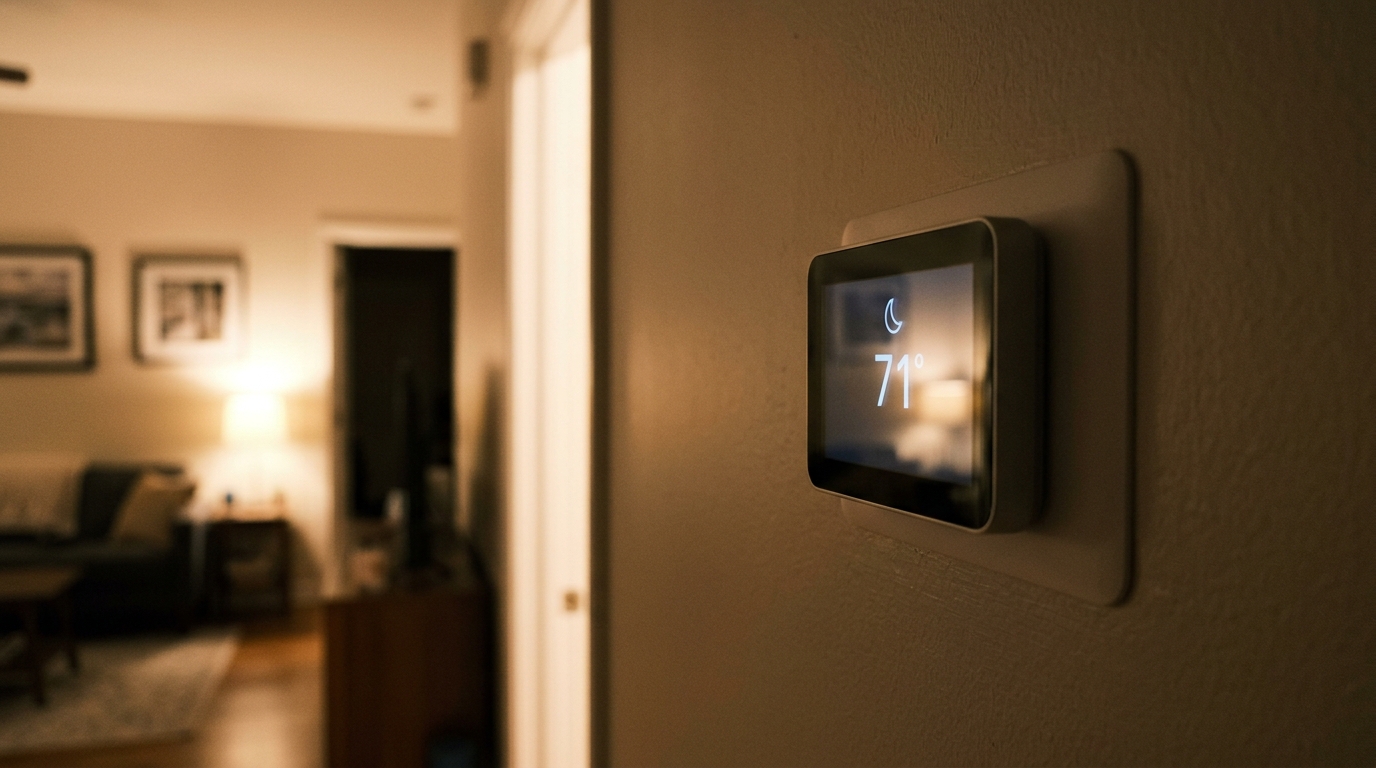
If you have ever woken up at 3 a.m. too hot, too cold, or to the sound of your furnace blasting after a long dip in temperature, your night mode may be working against you. Many homeowners set their overnight temperature once, often copying the factory default or a number that felt right on one particular evening, and never touch it again. Meanwhile, the setting runs for roughly 7 to 9 hours every single night, which is about a third of your entire year.
The U.S. Department of Energy estimates that turning your thermostat back 7 to 10 degrees Fahrenheit for 8 hours a day can save around 10% a year on heating and cooling. But that number comes with fine print. Set the setback too aggressive, and a heat pump may kick on its expensive backup heating strips in the morning. Set it too mild, and you leave real savings on the table. Set the wrong start or end time, and you either pay to condition an empty room or wake up to a cold house.
This post walks through how to find the right night setting for your home and system type, from a 15-minute quick fix to a more thorough DIY tune-up. You will learn why the right number differs between a gas furnace, a heat pump, and a central AC, and how to avoid the common mistakes that quietly erase your savings.
What You’ll Need
Click on an item below to shop for the recommended items for this recipe on Amazon.
As an Amazon Associate, we earn from qualifying purchases.
How to Do It
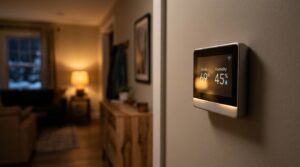
- Check what your thermostat’s night or sleep setting is right now. Many default to 70 degrees in winter, which barely saves anything.
- For winter with a gas, oil, or electric furnace, set the overnight temperature to 62 to 66 degrees F, about 4 to 8 degrees below your daytime setting.
- For winter with a heat pump, limit the setback to 2 to 3 degrees (for example, 68 down to 65) to avoid triggering auxiliary heat.
- For summer cooling, set the night temperature to 74 to 78 degrees F, or 4 to 6 degrees above your daytime setting, if your bedroom stays comfortable.
- Start the sleep period 30 minutes after your usual bedtime and end it 30 to 60 minutes before you wake so the house is warm or cool when you get up.
- Live with the new schedule for one week, then adjust by 1 degree at a time based on comfort.
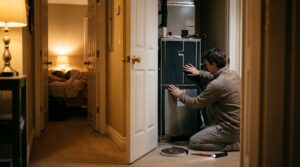
- Identify your system type (gas furnace, heat pump, electric baseboard, or central AC) from the equipment label or manual, since the best setback differs for each.
- If your thermostat lacks multi-period scheduling or has a clunky interface, install a programmable or smart thermostat. Most models take 30 to 45 minutes and need only a screwdriver.
- Create a separate weekday and weekend schedule so your wake time and bedtime match real habits, rather than using one setting for all seven days.
- Enable features like adaptive recovery, early-start, or smart ramping so the system begins recovering before your wake time instead of all at once.
- Place a cheap indoor thermometer in your bedroom to compare against the thermostat reading, since the thermostat hallway location may not match where you actually sleep.
- Track your utility bill for two full billing cycles and compare against the same months last year, adjusting your setback by 1 to 2 degrees if you want more savings or more comfort.
- Schedule an HVAC technician to inspect duct leakage, airflow, and refrigerant charge, since system issues can make any night setting ineffective.
- Ask the technician to verify that your heat pump’s auxiliary heat lockout temperature and staging are configured correctly.
- If bedrooms are always too hot or cold at night, request a quote for zoning dampers or a ductless mini-split to condition sleeping areas separately.
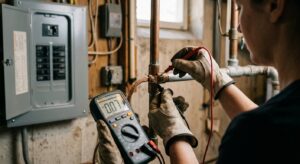
- Confirm your thermostat is wired and calibrated correctly, including any compatibility settings required for multi-stage equipment.
Why It Works: The Benefits
A properly tuned night setback typically saves 5 to 10% on heating and cooling, which is roughly $75 to $200 per year for the average U.S. household spending about $1,500 to $2,000 on climate control.
Cooler bedrooms in winter (60 to 67 degrees F) and not-too-warm bedrooms in summer (about 68 to 72 degrees F) support deeper sleep and fewer middle-of-the-night wakeups.
Eliminating frequent short cycles and avoiding aggressive recovery pushes reduces strain on compressors, blower motors, and heating elements, which can help extend system life.
Pre-recovery scheduling means your house reaches the target temperature just as you wake, instead of making you wait or crank the thermostat.
A gentler 2 to 3 degree overnight change can keep a heat pump out of expensive backup mode, avoiding spikes that can double the cost of morning recovery.
💰 Savings Impact by Action
A 7 to 10 degree setback for 8 hours, per DOE guidance, saves about 10% annually on heating for furnace systems.
Raising the cooling setpoint 4 to 6 degrees overnight typically trims 5 to 10% off cooling costs.
Matching start and end times to your real routine recovers roughly 3% by avoiding wasted conditioning hours.
Avoiding auxiliary heat with a gentle setback can cut winter heat pump electricity use by 5 to 10%.
Sealing leaks makes setbacks hold longer and can reduce overall heating and cooling use by up to 15%.
🏠 Key Concepts Explained
The Science Behind It
Heat flows from warm to cold at a rate proportional to the temperature difference. When you lower your indoor temperature at night in winter, you shrink the difference between inside and outside, and your home loses heat more slowly. That reduced loss, summed over 8 hours, is where the savings come from. Importantly, the energy needed to bring the house back up is generally less than the energy you saved by letting it drift lower, because the house loses heat slowly while you are sleeping.
The catch is system efficiency during recovery. Furnaces and air conditioners run happily in long cycles, while heat pumps become less efficient as outdoor temperatures drop and when forced into auxiliary resistance heat. Resistance heating converts one unit of electricity into one unit of heat, while a heat pump can deliver 2 to 4 units of heat per unit of electricity under good conditions. That is why a gentle setback often beats an aggressive one for heat pump owners.
Finally, the building envelope determines how much you can safely drift. Well-sealed and insulated homes lose heat slowly, so they stay comfortable longer and recover more efficiently. Leaky homes cool quickly at night and can take hours to rebound, which reduces net savings. Sealing air leaks and adding attic insulation therefore makes every night mode setting more effective.
Frequently Asked Questions
▼ Why is my AC or furnace still running all night even with a setback?
Check that your schedule is actually saving, since some thermostats revert to a hold or manual mode. Also check for duct leaks or an oversized system, which can cause constant cycling. If the setback is correct and the system still runs nonstop, have an HVAC technician check airflow and refrigerant.
▼ Can renters use a night setback without landlord permission?
Yes, if the thermostat is already programmable you can change the schedule freely. If you want to install a smart thermostat, ask first or swap back the original when you leave. A plug-in space heater or a window AC unit on a smart plug can also provide controlled night comfort without touching the central system.
▼ How long before I notice savings on my bill?
You will usually see a measurable change within one full billing cycle, roughly 30 days. Compare the same month last year and adjust for weather using heating or cooling degree days, since a mild month can hide the effect of your new schedule.
▼ Should I turn off my heat pump or AC entirely at night?
Generally no. Turning it fully off lets the house drift far from its setpoint and forces a long, expensive recovery, especially for heat pumps. A moderate setback of 2 to 4 degrees for heat pumps and 4 to 8 degrees for furnaces and ACs is almost always more efficient and more comfortable.
▼ What if my home is older than 30 years?
Older homes tend to lose heat faster, so deep setbacks can feel colder and recover more slowly. Start with a 3 to 5 degree setback, then address air leaks and attic insulation to improve results. Sealing and insulating often pays back in 2 to 5 years and makes any night mode more effective.
Quick Tips
- Pick a nighttime setting you can live with for a full week before judging results, since comfort is subjective and takes a few nights to adjust to.
- Use extra blankets or a lightweight comforter rather than raising the thermostat, since layering costs nothing and works instantly.
- Close vents and doors in unused rooms, but not so many that you hurt system airflow, which should stay within about 20% of total vents closed at most.
- Review your schedule twice a year when daylight and routines change, so your night mode keeps matching your real life.
Variations for Your Situation
- Apartment/Rental: Stick with a programmable thermostat schedule if you have one, and add a $30 to $60 smart plug on a portable heater or window AC if you do not. A 2 to 4 degree overnight adjustment and heavier bedding can deliver most of the benefit without touching the building system.
- Tight Budget (under $50): Reset your existing thermostat’s night setting for free, add weather stripping to the bedroom door for about $10, and use a $15 indoor thermometer to verify temperatures. A free 4 to 6 degree setback can save 5% or more on its own.
- Older Home (pre-1980): Use a moderate setback of 3 to 5 degrees, seal obvious air leaks around windows, doors, and attic hatches for under $100, and consider adding attic insulation toward R-38. These steps reduce overnight heat loss and make setbacks more comfortable and effective.