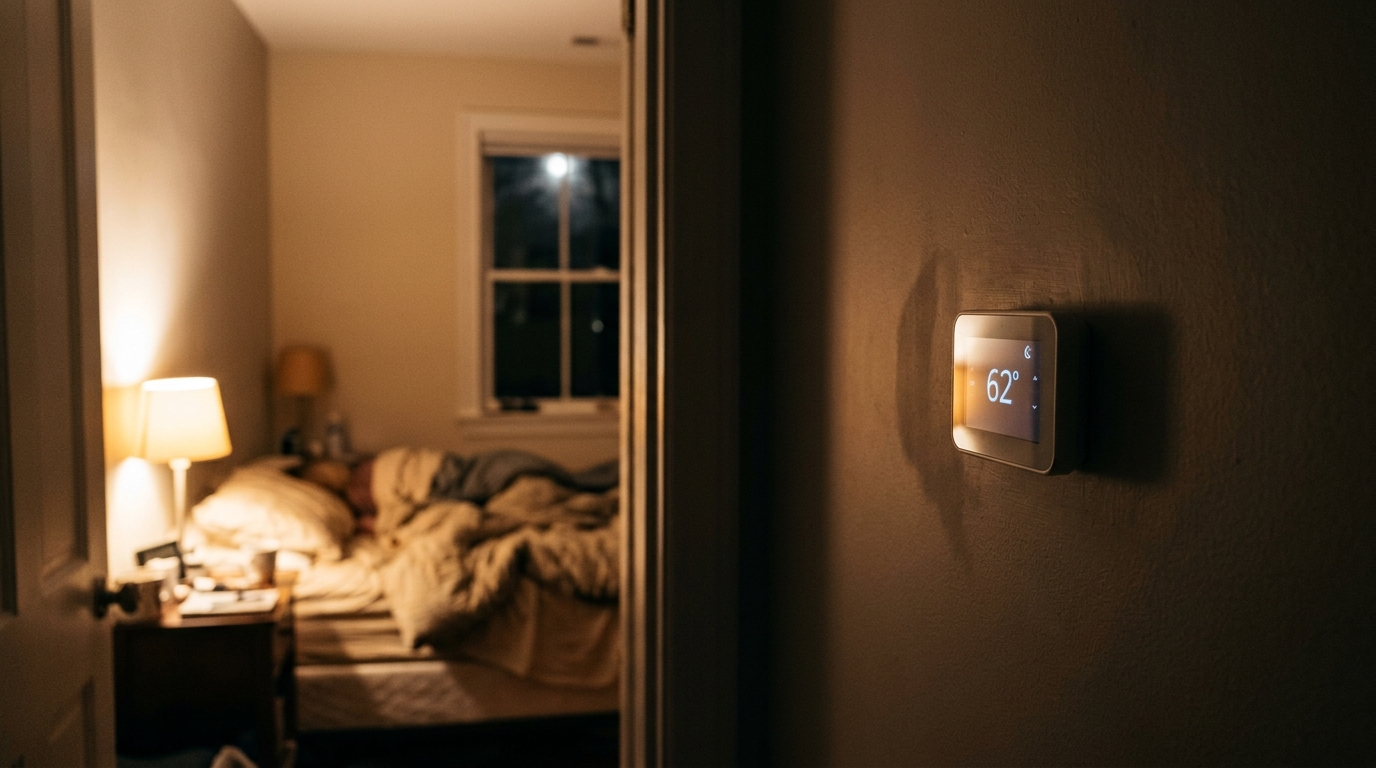
If your boiler holds the same thermostat setting from midnight to noon, you are paying to keep empty, sleeping rooms at a daytime temperature. The Department of Energy estimates that turning your thermostat back 7 to 10 degrees for 8 hours a day can save up to 10% a year on heating. The catch with boilers is that they behave differently from forced-air furnaces, so the advice you hear for furnaces does not always carry over.
Hot water and steam systems respond slowly. Water, radiators, and cast iron hold a lot of heat, which makes them wonderfully comfortable but sluggish to recover. Set the temperature back too far, or schedule the morning recovery too late, and you wake up to a cold house or a boiler running flat out for hours, which cancels the savings you were chasing.
This post walks through a nighttime setback schedule built around how boilers actually work. You will learn how much to drop the temperature, when to start the recovery, and how to choose between a quick manual approach and a programmable or smart control upgrade, with real costs and payback periods for each.
What You’ll Need
Click on an item below to shop for the recommended items for this recipe on Amazon.
As an Amazon Associate, we earn from qualifying purchases.
How to Do It
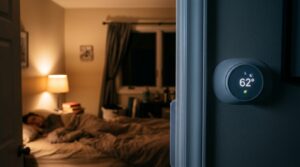
- Pick your normal daytime comfort temperature, such as 68 degrees, and a nighttime setback of 6 degrees lower, such as 62 degrees.
- Lower the thermostat about 30 minutes before you go to bed, or right as you turn in, rather than earlier in the evening when the house is still in use.
- Raise it back up roughly 60 to 90 minutes before you wake. Hydronic baseboard and radiator systems need that lead time, and cast iron radiators may need up to 2 hours.
- Keep a week of notes on how warm the house feels at wake-up time and adjust the recovery start by 15 to 30 minutes until mornings feel right.
- Skip the setback on extremely cold nights, such as when temperatures fall below about 10 degrees, if you notice the boiler struggling to recover.
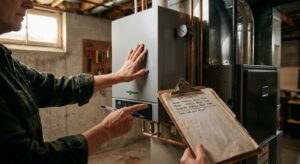
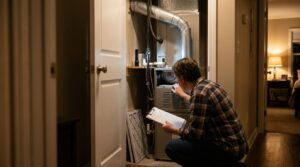
- Identify your system type: hot water or steam, number of zones, and thermostat voltage. Check the wiring labels or your boiler manual, and photograph the existing wiring before touching anything.
- Choose a thermostat labeled for hydronic or boiler use. Models with adaptive recovery or early-start learning are especially useful because they calculate how long your system needs to reach the target.
- Shut off power to the boiler at the switch or breaker, then remove the old thermostat and label each wire to match its terminal.
- Mount and wire the new thermostat following the manufacturer instructions, restore power, and confirm the boiler fires when you call for heat.
- Program a schedule such as 68 degrees from 6:30 AM to 10:00 PM, 62 degrees overnight, and a 4:30 to 5:00 AM recovery start if your system is slow. Use adaptive recovery if available.
- Review the runtime reports or your gas and oil usage after two weeks and fine-tune the setback depth and timing.
- Ask a licensed heating contractor to evaluate your boiler, piping, and existing controls and confirm whether outdoor reset and zone control are available on your model.
- Have them install or configure outdoor reset so water temperature drops automatically in milder weather, which supports efficient recovery.
- Add or rebalance zones so bedrooms can run cooler overnight while living areas keep their schedules.
- Ask for a combustion efficiency test and pump or valve check at the same visit, since a poorly tuned boiler wastes the savings from any schedule.
Why It Works: The Benefits
A consistent 6 to 8 degree overnight setback typically saves 5 to 10% on annual heating costs. On a $1,500 heating season, that is $75 to $150 per year.
Sleep researchers generally find that cooler bedrooms in the 60 to 67 degree range support more comfortable sleep, so a setback can improve rest as well as the bill.
Fewer hours at a high setpoint means fewer burner cycles overall, which reduces wear on the burner, circulator pumps, and controls over time.
A properly timed recovery means the house reaches your target temperature as you get up, not an hour later, so you save money without sacrificing comfort.
💰 Savings Impact by Action
A 6 to 8 degree overnight drop for about 8 hours cuts annual heating use by roughly 5 to 10%.
Adaptive early-start recovery avoids wasteful overshooting and can add another 2 to 4% in savings.
Lowering boiler water temperature in milder weather can improve seasonal efficiency by about 5 to 15%.
Keeping unused bedrooms cooler overnight while living areas stay comfortable trims another 4 to 8%.
🏠 Key Concepts Explained
The Science Behind It
Heat loss from a house is roughly proportional to the temperature difference between inside and outside. When you lower the indoor temperature at night, you shrink that difference, so the building loses heat more slowly the entire time it stays cooler. The energy you save is the heat you did not have to replace, and it adds up over 7 to 9 hours of setback every night of the heating season.
A common worry is that the boiler must work harder to reheat the house, wiping out the savings. In practice, the heat lost during the cooler period is gone for good, and the energy to recover is generally less than what constant heating would have consumed. The savings shrink only when recovery is rushed, the setback is extreme, or the equipment runs at poor efficiency during recovery.
Boilers add a twist because water and metal have high thermal mass. Radiators and baseboard pipes hold heat and release it gradually, which is why recovery is slow and why starting early matters. For condensing boilers, gentle recovery with lower supply water temperatures keeps return water cool enough to condense exhaust vapor and capture extra efficiency, so longer, lower-temperature runs are often the efficient choice.
Frequently Asked Questions
▼ Why is my house still cold in the morning even though I scheduled a recovery?
Your recovery likely starts too late for your system. Move the start time 30 to 60 minutes earlier and test for several days, since cast iron radiators and large hot water systems can need up to 2 hours. If it is still cold, reduce the setback depth to 4 or 5 degrees.
▼ Will a setback actually save money on a boiler, or does it just run longer to catch up?
It saves money in most homes, typically 5 to 10% annually, because the house loses heat more slowly while it is cooler. The savings shrink if the setback is extreme or if recovery pushes the boiler to run inefficiently, so moderate depth and an early, gentle recovery work best.
▼ Can I use a smart thermostat with my boiler?
Often yes, but compatibility varies. Check whether the thermostat supports your system voltage (24V, millivolt, or line voltage) and your number of zones, and look for a hydronic or adaptive recovery mode. If you have a millivolt system or an older steam boiler, confirm with the manufacturer or a heating technician before buying.
▼ How long before I notice savings on my bill?
You should see a change within the first full billing cycle, though weather swings can mask it. Compare heating degree days or use your gas or oil meter readings over two to four weeks to see the real effect, and expect most of the savings to show up during the coldest months.
▼ Is it safe to let the house get that cold on very cold nights?
A moderate setback to the low 60s is safe for most homes, but keep every plumbed area above about 55 degrees and avoid deep setbacks during extreme cold. If you have pipes along exterior walls or in unheated spaces, open cabinet doors on the coldest nights and consider a smaller setback.
Quick Tips
- Start with a 5 to 6 degree setback and increase only if mornings still feel comfortable.
- Begin recovery 60 to 90 minutes before wake-up for baseboard systems and up to 2 hours for cast iron radiators.
- Close doors and keep window coverings shut overnight to slow heat loss in bedrooms.
- Bleed air from radiators and baseboards each fall so heat distributes evenly during recovery.
- Skip deep setbacks during the coldest snaps, or shrink them to 3 or 4 degrees, to protect comfort and pipes.
Variations for Your Situation
- Apartment/Rental: If your building controls the boiler, focus on what you can adjust, such as the thermostatic radiator valve in your unit. Closing or lowering a TRV in bedrooms overnight can mimic a setback, and a $20 to $40 programmable TRV head is a renter-friendly swap you can usually remove when you move out.
- Tight Budget (under $50): Use the manual setback approach for free, then add a basic programmable thermostat for $25 to $45 if your system is compatible. Seal obvious window drafts with $10 of weather stripping to reduce overnight heat loss and keep the setback more comfortable.
- Older Home (pre-1980): Older houses lose heat faster and often have cast iron radiators with long recovery times, so use a smaller setback of 4 to 6 degrees and start recovery up to 2 hours early. Air sealing and attic insulation will improve how well the house holds temperature overnight, often delivering more savings than the schedule alone.
- Condensing Boiler Owners: Favor a gentle setback of 4 to 6 degrees with a long, low-temperature recovery and outdoor reset if available, since this keeps return water temperatures low and efficiency high.