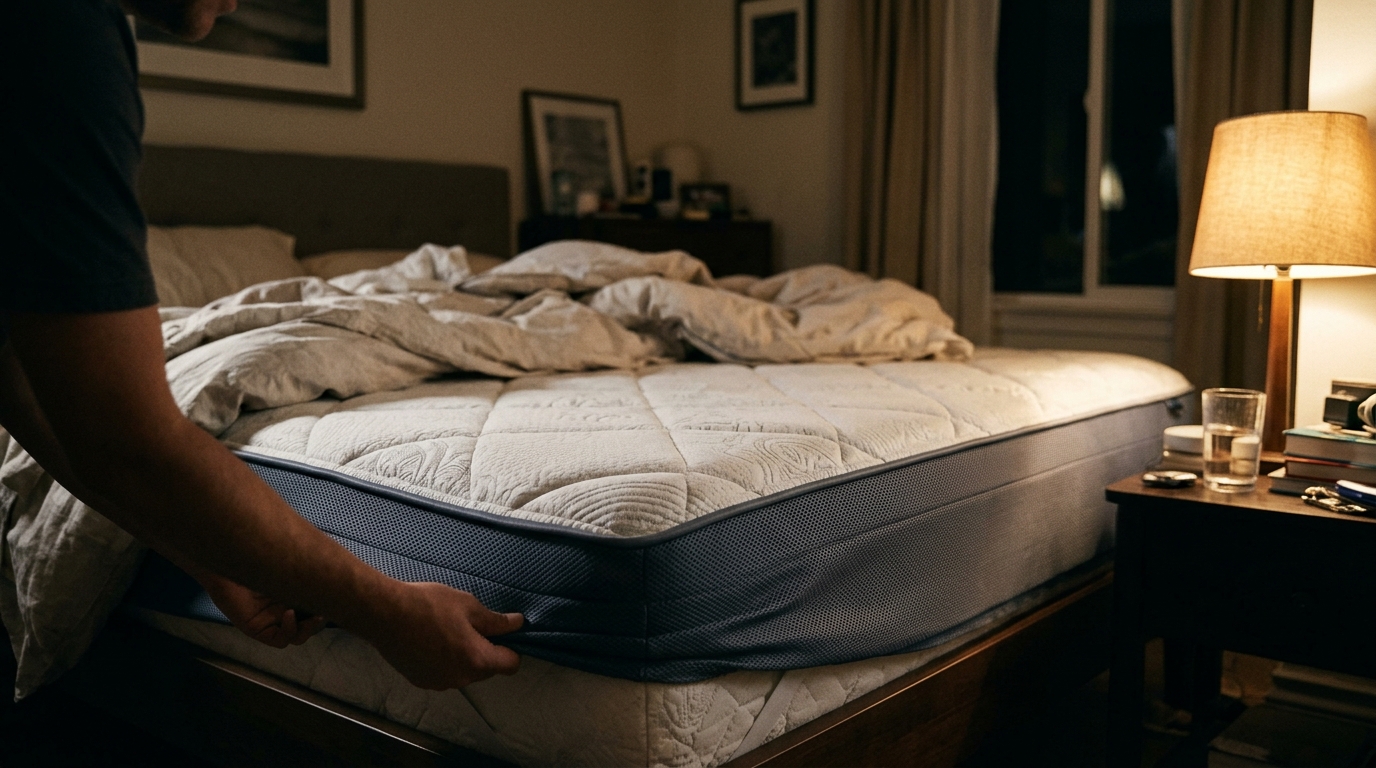
If you sleep hot, you probably know the routine: drop the thermostat to 67 or 68 degrees, run a fan, kick off the blankets, and still wake up at 3 a.m. feeling like you are sleeping on a heating pad. The problem is that you are paying to cool an entire house when the only thing that needs to be cool is a roughly 6-square-foot patch of mattress surface and the air immediately above it.
That is where cooling mattress pads come in. The category is crowded with marketing hype, from gel infusions that feel cool for ten minutes to “cooling” fabrics that do little more than breathe slightly better. But two technologies genuinely work: water-circulating pads, which pump temperature-controlled water through thin tubing in the pad, and active-airflow pads, which push room air through a ventilated layer beneath you. Both remove body heat directly at the source instead of fighting it with refrigerated air.
This post breaks down which cooling pad technologies are worth your money, how to pair them with a smarter thermostat schedule to capture real savings, and a no-cost approach to try first if you are not ready to buy anything. We will also cover the building science of why cooling the bed beats cooling the room, and the mistakes that make people return these products.
What You’ll Need
Click on an item below to shop for the recommended items for this recipe on Amazon.
As an Amazon Associate, we earn from qualifying purchases.
How to Do It
- Strip the bed down to breathable layers. Remove any mattress topper made of dense memory foam or polyester fill, and swap synthetic sheets for cotton percale, linen, or bamboo-viscose, which wick moisture and release heat faster.
- Replace your comforter with a lightweight cotton blanket or a single sheet. Heavy bedding can trap 2 to 4 degrees of extra heat around your body.
- Place a box fan or tower fan so it moves air across the bed rather than directly at your face. A 20 to 40 watt fan costs pennies a night and aids evaporative cooling.
- Raise your thermostat 2 degrees at bedtime as a test, for example from 70 to 72. Do this for a week and note how you sleep before going further.
- If you want a low-cost upgrade, add a cooling mattress topper made with open-cell or phase-change material for $30 to $60. Expect mild, short-lived benefit rather than all-night cooling.
- Choose a system with a quiet pump and a thin pad layer. Look for a control unit rated under 40 decibels, adjustable temperature down to at least 55 to 60 degrees, and a pad that sits under your fitted sheet rather than replacing your mattress.
- Place the control unit on the floor beside or at the foot of the bed with at least a few inches of clearance for airflow. Keep it off carpet that blocks vents and away from curtains.
- Fill the reservoir with distilled water and add the manufacturer’s recommended cleaning treatment or a small amount of mild additive. Distilled water prevents mineral buildup and algae in the tubing.
- Lay the pad flat on the mattress, connect the hoses, and cover with a fitted sheet. Run the pad for 15 to 30 minutes before bed to pre-cool the surface.
- Start at a bed temperature of about 68 degrees and adjust 1 to 2 degrees at a time over several nights. Most people settle between 64 and 72 degrees.
- Raise your thermostat setpoint to 74 to 76 degrees overnight, or use a programmable thermostat to step up 2 degrees every hour or two until you hit your target.
- Pick a pad with a ventilated mesh or spacer layer and a quiet blower unit. Check that the blower can pull room air through the pad rather than only pushing it across the top.
- Position the blower unit at the foot of the bed with clear airflow on the intake side. Do not tuck it under blankets, which can cause overheating and reduce performance.
- Layer the pad under a thin, breathable fitted sheet. Thick mattress protectors or quilted covers block airflow and defeat the purpose.
- Run it on a medium setting for the first few nights, then dial up or down. Airflow pads typically cool the surface by 4 to 8 degrees below your body temperature, not below room temperature, so combine with a thermostat setting of 72 to 75.
Why It Works: The Benefits
Raising your nighttime setpoint from 68 to 74 degrees can cut overnight AC runtime by 20 to 30 percent. For a typical home, that is roughly $10 to $25 per month in peak summer, minus about $3 to $8 per month in pad electricity.
Maintaining a bed surface around 68 to 72 degrees can reduce night sweats and tossing and turning. Many users report fewer wake-ups and more time in deep sleep.
Dual-zone water pads let each side of the bed hold its own temperature, typically anywhere from 55 to 110 degrees. That ends the thermostat standoff without heating or cooling the whole house for one person.
Fewer and shorter run cycles during off-peak overnight hours reduce wear on your compressor. It also keeps you out of higher-priced time-of-use periods if your utility charges them.
Most water-circulating pads can also warm the bed, which lets you lower your winter thermostat setting at night. A few degrees of setback in winter saves about 1 percent per degree on heating.
💰 Savings Impact by Action
Raising the overnight setpoint 4 to 6 degrees can reduce nighttime cooling energy by roughly 20 to 30 percent, which translates to about 8 percent of total summer cooling cost.
On time-of-use plans, shifting cooling off evening peak hours can cut the cost of overnight cooling by 10 to 15 percent.
Shorter, less frequent compressor cycles overnight can lower runtime 15 percent or more, easing wear on equipment.
A 30 to 60 watt pad uses only about 0.25 to 0.5 kWh per night, offsetting just 3 percent of the savings you capture.
🏠 Key Concepts Explained
The Science Behind It
Your body sheds heat through four pathways: conduction (direct contact), convection (air moving past your skin), radiation (infrared heat leaving your body), and evaporation (sweat). In a bed, a large share of your heat loss happens through conduction into the mattress and convection into the air trapped under your blankets. When the mattress itself is warm, that pathway shuts down and your body compensates by sweating and shifting position, which fragments sleep.
Cooling pads work by restoring that conductive pathway. Water has a specific heat of about 4.18 joules per gram per degree Celsius and conducts heat far better than air, so a thin layer of circulating water at 65 to 70 degrees can carry away body heat efficiently with only a 30 to 60 watt pump and chiller. Active-airflow pads do something similar through convection and evaporation, pulling dry room air across your skin and the sheet surface.
The savings come from separating two jobs that thermostats usually combine. Your AC is sized to remove heat from a whole building envelope, and every degree of setpoint reduction raises the temperature difference it has to fight against outdoors, increasing both runtime and energy use. By cooling only the microclimate around your body, you let the house sit at 74 to 76 degrees overnight, reducing heat gain through walls, attic, and windows while keeping the sleeper comfortable. The tradeoff is the small continuous draw of the pad itself, which is why net savings are modest but real, especially in hot climates and homes with time-of-use electricity rates.
Frequently Asked Questions
▼ Why is my AC still running all night even with a cooling pad?
You probably have not raised the thermostat setpoint enough, or the house is gaining a lot of heat from the attic and west-facing windows. Try a 74 to 76 degree overnight setpoint, close blinds on sun-facing windows during the day, and check that your AC is not oversized and short-cycling.
▼ Can renters use a cooling mattress pad without landlord permission?
Yes. Cooling pads sit on top of your mattress and plug into a standard outlet, so there is nothing to install or modify. They are one of the best renter-friendly comfort upgrades, especially if you cannot control central HVAC or have an old window unit.
▼ How long before I actually notice savings on my bill?
You should feel the comfort difference the first night, but bill savings show up over a full billing cycle. Compare the same month year over year or check your smart thermostat runtime reports after 2 to 4 weeks. In summer, expect a drop of about $10 to $25 per month on a typical cooling bill, minus the pad’s small electricity use.
▼ What if my home is older than 30 years?
Older homes often have leakier ducts and less attic insulation, so the AC works harder at night and a cooling pad can help more. That said, fix the biggest losses first: seal attic bypasses and add insulation to R-38 or higher if you can, then use the pad to fine-tune comfort.
▼ Is it safe to run a water-circulating pad all night?
Reputable models are designed for all-night use and have sealed, low-voltage pad components with the control unit kept off the bed. Use distilled water, check hoses for kinks or leaks, and keep the unit on a hard surface with airflow. If you notice moisture under the pad, stop and inspect it before reuse.
Quick Tips
- Pre-cool the bed for 20 to 30 minutes before you get in. A bed that starts at 68 degrees feels dramatically better than one that starts at 80 and slowly cools.
- Use a lightweight, breathable top sheet or blanket. Heavy bedding sitting on top of a cooling pad traps heat and forces the pad to work harder.
- Check your utility for time-of-use or demand pricing. Shifting cooling from your whole house to your bed during peak evening hours can multiply your savings beyond the standard 5 to 10 percent.
- Set a recurring reminder to clean and refill a water pad every 4 to 6 weeks. A clean system runs quieter, cools better, and lasts years longer.
Variations for Your Situation
- Apartment/Rental: Start with an active-airflow or single-zone water pad ($150 to $400), since both are plug-and-play and leave no marks. If your landlord controls the thermostat, a pad plus a quiet tower fan can make a 75 to 78 degree bedroom feel like 68, which is especially valuable in top-floor units.
- Tight Budget (under $50): Swap to cotton or linen sheets ($30 to $50), remove heavy bedding, point a fan across the bed, and raise your thermostat 2 degrees at night. This will not match an active pad, but it can cut sleep-time overheating noticeably for almost no money.
- Older Home (pre-1980): Pair the pad with air sealing around the attic hatch and bedroom windows, which often leak more than newer construction. A bedroom that holds 75 degrees without the AC cycling on is where a cooling pad pays off fastest, since you can shut vents or run a window unit just for sleep.
- Couples with Different Preferences: Choose a dual-zone water system ($500 to $2,000) so one partner can sleep at 62 degrees while the other stays at 72. This avoids the ‘colder house for one person’ compromise that raises bills for both.