If your home has no central air, summer nights can feel like a losing battle. Heat soaks into walls, roofs, and furniture all day, then slowly releases after sunset, keeping bedroom temperatures in the high 70s or 80s well past midnight. Sleep researchers generally point to a bedroom temperature around 60 to 67 degrees Fahrenheit as ideal for deep, uninterrupted rest, so a sweltering room is more than an annoyance. It cuts into sleep quality, mood, and next-day focus.
The good news is that you do not need to cool your entire house. Cooling a single bedroom of 150 to 250 square feet takes a fraction of the energy needed to cool a whole home. A window air conditioner sized for one room typically uses 500 to 900 watts, while central air commonly draws 3,000 watts or more. Combine that with smart heat-blocking strategies, and you can create a dedicated sleep zone that stays comfortable all night.
This guide walks through two approaches: a low-cost quick fix that relies on shade, airflow, and timing, and a more robust DIY upgrade that adds a properly sized window or portable AC and seals the room off from the rest of the house. We will also cover the building science behind why it works, what to do if you rent, and how to stretch a tight budget.
What You’ll Need
Click on an item below to shop for the recommended items for this recipe on Amazon.
As an Amazon Associate, we earn from qualifying purchases.
How to Do It
- Close blinds, shades, or curtains on sun-facing windows before the sun hits them, ideally by mid-morning. Light-colored, reflective-backed or blackout curtains block significantly more heat than sheer fabrics.
- Keep bedroom windows closed during the hottest part of the day, roughly 10 AM to 6 PM, so hot outdoor air does not enter.
- After sunset, once the outdoor temperature is lower than indoors, open the bedroom window and a window on the opposite side of the house to create cross-ventilation.
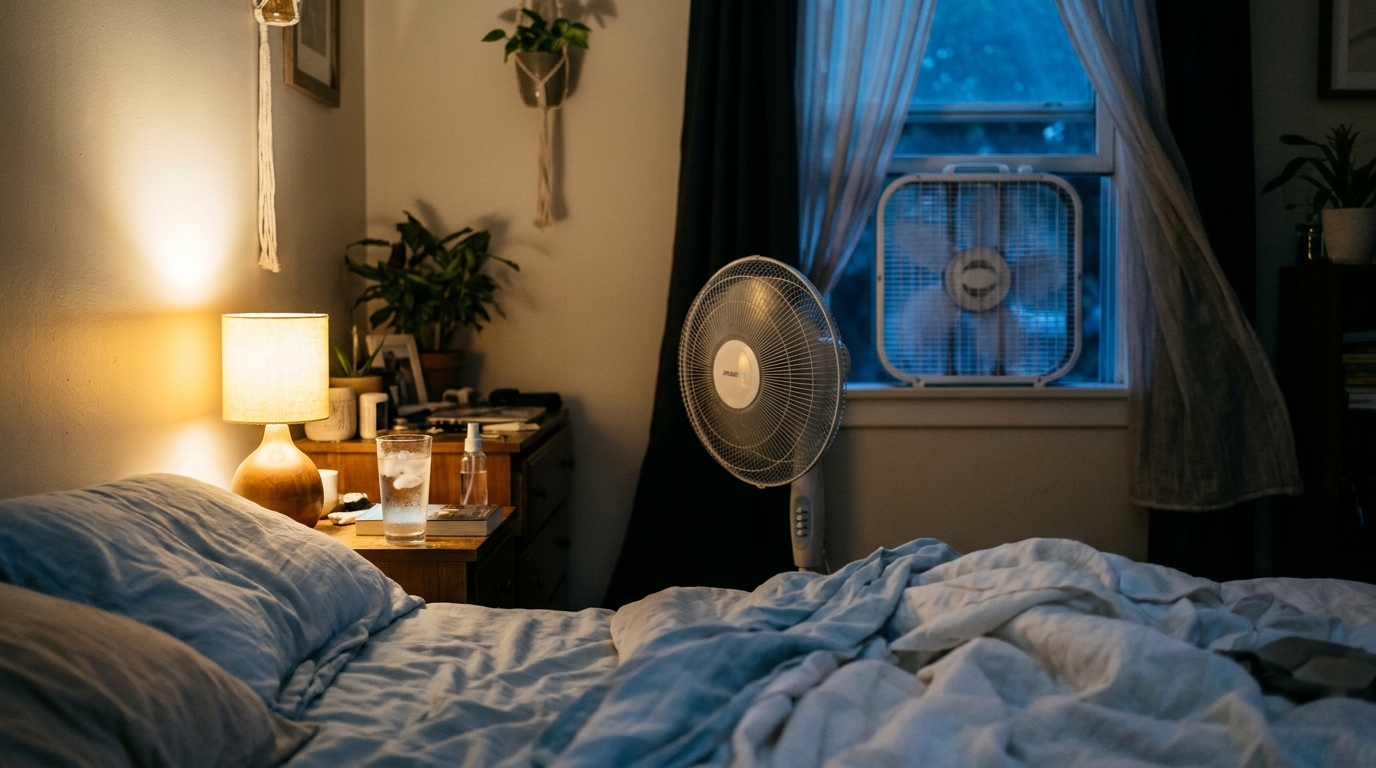
- Place a box fan in the bedroom window facing outward to exhaust hot air, or facing inward on a lower window to pull in cooler air. Running one fan in and one out is more effective than either alone.
- Aim an oscillating fan at the bed to boost skin-level cooling, and keep the bedroom door open to the cooler parts of the home if the night air is cooler.
- Swap to lightweight, breathable bedding such as cotton or linen, and consider a cooling pillow or a chilled water bottle at your feet.
- Measure your bedroom square footage and choose a properly sized unit. As a general ENERGY STAR guideline, about 5,000 BTU cools 150 to 250 square feet, 6,000 BTU handles 250 to 300, and 8,000 BTU handles 300 to 350. Add about 10 percent if the room is heavily sunny.
- Look for an ENERGY STAR certified model with a high combined energy efficiency ratio (CEER). Certified units use roughly 10 percent less energy than standard models.
- Install the unit following the manufacturer instructions, using the included side panels and foam seals to close gaps. Tilt it slightly outward so condensate drains outside if the manual calls for it.
- Seal remaining air gaps around the unit with weatherproof foam tape or removable rope caulk so hot outdoor air and insects stay out.
- Apply foam weatherstripping around the bedroom door and add a door sweep to the bottom. This isolates the cooled room and lets a smaller unit do the job.
- Hang blackout or thermal curtains on all bedroom windows and consider reflective window film on sun-facing glass to cut solar heat gain further.
- Use the AC timer or a smart plug to start cooling 30 to 60 minutes before bedtime, then set the thermostat around 68 to 72 degrees. Pair with a ceiling or oscillating fan so you can run the setpoint a few degrees higher while feeling just as cool.
Why It Works: The Benefits
Running a 5,000 to 8,000 BTU window AC for 8 hours a night costs roughly $0.50 to $1.00 per night at average U.S. electricity rates, far less than cooling an entire home.
Cooler sleeping temperatures in the 60 to 67 degree range support the natural drop in core body temperature that helps you fall asleep faster and stay asleep.
You spend about a third of your life asleep in one room. Concentrating cooling there delivers the most comfort per dollar spent.
A quality window AC costs around $150 to $400, compared with $5,000 to $12,000 or more to install central air in a home without ducts.
Most sleep zone strategies, including window units, blackout curtains, and fans, require no permanent modifications and move with you.
💰 Savings Impact by Action
Cooling one bedroom instead of the whole house can cut cooling energy use by roughly 60 to 80 percent.
Closing blinds and curtains on sun-facing windows can reduce solar heat gain by up to 30 percent or more.
Raising the AC setpoint a few degrees while using a fan can save around 3 percent per degree, or about 15 percent overall.
Sealing the bedroom door and window gaps can reduce the cooling load by around 10 percent by limiting hot air infiltration.
A certified window AC uses roughly 10 percent less energy than a standard model for the same cooling output.
🏠 Key Concepts Explained
The Science Behind It
The reason a single-room approach works so well comes down to cooling load. The amount of energy needed to cool a space depends on its volume, how much heat leaks in from outside, and how much heat is generated inside. A 200 square foot bedroom holds a tiny fraction of the air and thermal mass of an entire house, so a small, efficient cooling source can hold it at a comfortable temperature using a fraction of the power.
Heat enters a room three main ways: radiation (sunlight through windows), conduction (heat passing through walls and roof), and convection (hot air leaking in through gaps and open doors). Closing blinds and applying window film attacks radiation, which is typically the largest single source of daytime heat gain. Door sweeps and weatherstripping address convection by keeping hot air from the rest of the house out of your cooled space.
Fans add another layer without lowering air temperature. Moving air across your skin accelerates evaporation of moisture, which pulls heat away from your body. That is why a fan paired with a modest AC setpoint of 72 to 75 degrees can feel as comfortable as 68 to 70 degrees in still air, and why cross-ventilation with a window fan is such an effective low-energy way to flush stored heat on cooler nights.
Frequently Asked Questions
▼ Why is my bedroom still hot even with the window AC running?
The most common causes are an undersized unit, air leaks around the AC or door, or heavy afternoon sun hitting the windows. Add blackout curtains, seal the gaps around the unit with foam tape, and close the door with a sweep installed. If the room is very sunny or over 350 square feet, consider stepping up one size in BTU capacity.
▼ Can renters do this without landlord permission?
Mostly yes. Blackout curtains, fans, removable window film, adhesive weatherstripping, and a window AC held in place by its own brackets are generally non-permanent. Check your lease for rules about window units, and avoid drilling into window frames. Many renters use tension rods and removable foam tape to avoid any damage.
▼ How long before I notice savings on my bill?
With the quick fix, you may see a small drop within the first billing cycle if you were previously running other cooling or fans heavily. With a window AC, the savings show up when you compare against whole-house cooling or running multiple fans and portable units. Expect a nightly cost of roughly $0.50 to $1.00 for an efficient unit, which adds up to a noticeable difference over a summer.
▼ What if my home is older than 30 years?
Older homes often have more air leaks and less attic insulation, so heat builds faster and escapes less efficiently. Prioritize sealing the bedroom door and windows, adding thermal curtains, and checking attic insulation above the bedroom. Raising attic insulation to R-38 or higher can meaningfully reduce heat radiating down into upstairs bedrooms.
▼ Is it better to use a portable AC or a window AC?
Window units are generally more efficient and cheaper per BTU because they keep all the hot exhaust outside. Single-hose portable units can create negative pressure that pulls hot air into the room, reducing effectiveness. Use a portable only when a window unit will not fit or is not allowed.
Quick Tips
- Sleep on the lowest floor of your home if possible, since heat rises and basement or ground-floor rooms are often 5 to 10 degrees cooler.
- Turn off or unplug heat-producing electronics like computers, TVs, and chargers in the bedroom, since each one adds a small but real amount of heat.
- Run a ceiling fan counterclockwise in summer so it pushes air down and creates a cooling breeze, and turn it off when you leave the room.
- Freeze a few water bottles and place them in front of a fan for a quick, low-cost evaporative cooling boost on very hot nights.
Variations for Your Situation
- Apartment/Rental: Lead with a window AC sized to your bedroom, secured with the included brackets and sealed with removable foam tape, plus tension-rod blackout curtains and a plug-in oscillating fan. Total cost is typically $200 to $400, and everything comes with you when you move.
- Tight Budget (under $50): Focus on blocking the sun and moving air. Add inexpensive blackout curtains or even reflective foil or cardboard behind existing blinds, run a $20 to $30 box fan for night-time cross-ventilation, and use the afternoon close-up, evening flush routine to dump stored heat.
- Older Home (pre-1980): Expect higher baseline heat gain and more air leaks. Prioritize sealing the bedroom door and window gaps, add thermal curtains, and consider blowing additional insulation into the attic over the bedroom. These steps lower the cooling load so a smaller, cheaper AC can do the job.