If you have ever noticed that your home feels drafty near outlets, that certain rooms never quite reach the right temperature, or that your heating and cooling system runs constantly despite having insulation in the walls, the culprit is likely thermal bridging. Standard batt insulation installed between studs does a decent job insulating the cavity space, but the studs themselves, which make up roughly 25% of your wall area, conduct heat freely in and out of your home. That slow, steady energy drain adds up to hundreds of dollars every year.
Exterior rigid foam board insulation solves this problem in a way that no interior upgrade can. By wrapping the outside of your home in a continuous layer of insulation before the cladding goes on, you cover the studs, the rim joists, the headers, and every other structural element that acts as a thermal bridge. It is one of the most effective improvements in residential building science, and it is increasingly common in new construction for good reason.
This post breaks down exactly how exterior foam board works, what it costs, what you can realistically expect to save, and how to approach it whether you are a DIY-minded homeowner or planning to hire a contractor. We will cover both a manageable DIY partial installation and a full professional re-cladding project so you can make the right call for your situation.
What You’ll Need
Click on an item below to shop for the recommended items for this recipe on Amazon.
As an Amazon Associate, we earn from qualifying purchases.
How to Do It
- Identify the highest-priority wall faces, typically north-facing walls in cold climates and west or south-facing walls in hot climates, and confirm the existing siding can be removed without major structural complications.
- Remove existing cladding carefully and inspect the sheathing for any rot, moisture damage, or missing house wrap. Repair any damaged sheathing and install or replace the water-resistive barrier (WRB) such as 15-pound felt or a housewrap product before proceeding.
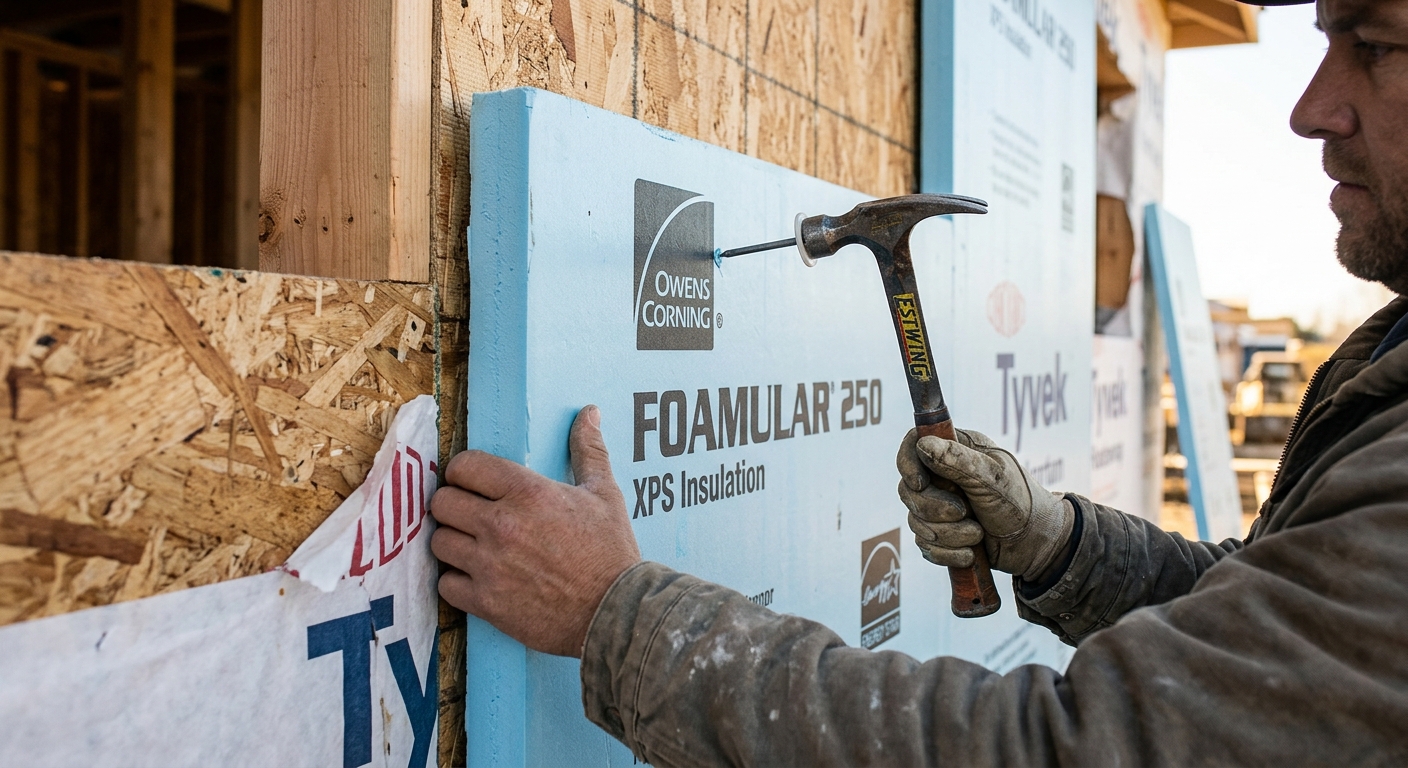
- Choose your foam type: polyisocyanurate (polyiso) offers the highest R-value per inch at R-6 to R-6.5 per inch and is best for cold climates, while XPS (extruded polystyrene) at R-5 per inch is more moisture-resistant and works well in mixed or humid climates. For a 2×4 wall, 2 inches of polyiso brings the assembly to roughly R-22 effective.
- Cut foam boards to fit using a utility knife and straightedge. Install horizontally or vertically with seams staggered if using two layers. Fasten panels temporarily with cap nails or screws long enough to reach the sheathing, then tape all seams with manufacturer-approved foam tape or house wrap tape to create the air barrier.
- Install vertical furring strips (1×3 or 1×4 strapping) over the foam, fastened with long structural screws (Headlok or similar) driven into the studs through the foam. This creates a ventilated rain screen gap that protects the foam and supports the new cladding.
- Install new cladding (fiber cement, wood, or vinyl) over the furring strips following manufacturer specs. Adjust window and door trim extensions (jamb extenders) as needed to account for the added wall thickness, typically 2 to 3 inches total.
- Get at least three bids from contractors who have experience with continuous exterior insulation assemblies. Ask specifically about their experience with rain screen cladding systems and window/door flashing details, which are the areas most prone to mistakes in these assemblies.
- Work with your contractor to choose foam type and thickness appropriate for your climate zone. In climate zones 5 and above (most of the northern US), aim for a minimum of R-7.5 continuous insulation on 2×4 walls per current energy code, which typically means 1.5 inches of polyiso or 2 inches of XPS.
- Have the contractor remove all existing cladding and inspect sheathing thoroughly. Budget for potential sheathing repairs, which are common in older homes, and get those addressed in scope before foam goes on.
- Confirm the installation sequence with your contractor: sheathing repairs, then WRB, then foam board in staggered layers if using two courses, then taped seams, then furring strips fastened with long structural screws into studs, then cladding. Window and door rough openings require careful flashing integration at each layer.
- Ask your contractor to provide documentation of the completed assembly including foam type, thickness, and R-value for your records. This documentation supports utility rebate applications and is valuable for future home sales.
- After completion, contact your utility company to apply for available insulation rebates. Many utilities offer $0.10 to $0.30 per square foot for continuous insulation upgrades, and some states offer additional tax credits that can offset 10 to 25% of the project cost.
Why It Works: The Benefits
DOE research and field studies consistently show 15 to 25% reductions in annual HVAC energy use after exterior continuous insulation is added to an existing home, with the higher end common in climates with extreme winters or summers.
Raising the interior wall surface temperature by even 4 to 8 degrees Fahrenheit in winter dramatically improves perceived comfort, allowing you to set the thermostat 2 to 3 degrees lower while feeling equally warm, compounding your savings.
By keeping the sheathing above the dew point in most conditions, exterior foam board reduces the moisture cycling that causes sheathing decay and mold. This protects the structural integrity of your walls and can extend the life of your cladding and framing by decades.
An added 1 to 2 inches of foam board plus a rain screen gap reduces exterior noise transmission noticeably, particularly traffic noise and wind, improving daily living quality at no additional cost.
Homes with improved wall assemblies and lower utility bills command a premium. A well-documented energy efficiency upgrade with verified utility savings can recoup 60 to 80% of its cost in resale value according to Remodeling Magazine’s Cost vs. Value data.
💰 Savings Impact by Action
Eliminating thermal bridging through studs raises effective whole-wall R-value by 20 to 40% compared to cavity insulation alone, directly reducing heat flow through walls year-round.
Taping foam board seams creates a secondary air barrier that can reduce wall air infiltration by 10 to 15%, cutting conditioned air loss and lowering HVAC runtime.
Continuous exterior insulation slows solar heat gain through west and south walls by 15 to 20%, reducing peak afternoon cooling demand and allowing smaller or less frequently running AC systems.
Whole-home continuous insulation applied to all wall faces reduces annual heating energy consumption by 15 to 25% in climate zones 4 through 7 based on DOE field studies.
Keeping wall sheathing above the dew point prevents the moisture cycling that causes wood decay, potentially avoiding $5,000 to $20,000 in structural repairs over the life of the home.
🏠 Key Concepts Explained
The Science Behind It
The reason exterior foam board outperforms interior upgrades comes down to where heat actually moves through a wall. In a standard 2×6 wood-framed wall with R-19 fiberglass batts, the studs, plates, and headers conduct heat at a rate roughly 15 times faster than the insulated cavities beside them. When you calculate the heat flow across the entire wall area, those framing members drag the effective whole-wall R-value down to somewhere between R-13 and R-15, regardless of how good the cavity insulation is. This is thermal bridging, and it is unavoidable with interior-only insulation strategies.
Placing even one inch of continuous foam on the exterior changes the equation completely. Because heat must now pass through the foam before it can reach the stud, the stud loses its role as a direct bridge between inside and outside. The foam acts as a thermal resistor in series with the framing rather than in parallel with it. A 2-inch layer of polyisocyanurate at R-13 added to a 2×6 wall with R-19 batts raises the effective whole-wall R-value from roughly R-14 to approximately R-24, a 70% improvement in real-world thermal resistance for a fraction of what it would cost to rebuild the wall with thicker framing.
The moisture benefits follow from the same physics. In winter, water vapor migrating from the warm interior through the wall assembly will condense wherever the wall reaches the dew point temperature. In a standard wall without exterior insulation, that dew point often falls right at or inside the sheathing, leading to chronic wetting of the wood. Exterior foam raises the temperature of the sheathing by keeping it on the warm side of a significant insulating layer, moving the condensation zone outward to a location that can safely manage moisture. This is why building scientists consistently point to exterior continuous insulation as both an energy upgrade and a moisture durability upgrade in one package.
Frequently Asked Questions
▼ How do I handle windows and doors when adding exterior foam board?
Windows and doors become inset into the wall when you add exterior foam, requiring jamb extensions to bring the interior trim flush and careful flashing to prevent water from running behind the foam at the rough opening. You can use site-built wood jamb extenders or purchase pre-made PVC extensions. The critical detail is the pan flashing at the window sill, which must be sloped outward and lapped properly over the foam and WRB below. If you are unsure about flashing sequence, this is the one detail worth paying a professional to review or install.
▼ Will adding exterior foam board cause moisture problems inside my walls?
When done correctly, exterior foam board reduces moisture problems rather than creating them, because it keeps the sheathing warmer and above the dew point. The key is using the right ratio of exterior to interior insulation for your climate zone. In climate zone 5, at least 20% of total wall R-value should come from exterior continuous insulation to keep the sheathing warm enough. The Building Science Corporation publishes specific ratios for each climate zone that are worth reviewing before you specify your foam thickness.
▼ My house is brick or stucco. Can I still add exterior foam board?
Brick veneer and traditional stucco require specialized approaches that differ significantly from standard lap siding installations. Adding foam board under new stucco is possible but requires a professional-grade drainage mat and mesh system. Re-cladding over brick typically means removing the brick, which adds significant cost. In these cases, interior insulation methods such as flash-and-batt or insulated wall furring on the interior may be more cost-effective. Consult a building science professional before disturbing an existing brick or stucco assembly.
▼ What is a realistic payback period if I do this at the same time as replacing my siding?
When timed with a siding replacement, you are paying only the marginal cost of the foam board and furring materials plus the labor to install them, since the tear-off and re-cladding labor is already budgeted. In that scenario, material costs typically run $1.50 to $3.00 per square foot for the foam and furring, and annual savings of 15 to 20% on a $2,000 heating and cooling bill translates to $300 to $400 per year. That puts the payback at 4 to 7 years for the marginal investment, which is very competitive for a building envelope upgrade.
▼ Do I need a building permit to add exterior foam board and new siding?
In most jurisdictions, yes. Re-cladding projects that alter the exterior envelope typically require a building permit, and inspectors will want to verify that continuous insulation meets current energy code minimums for your climate zone. Pulling the permit protects you because an inspector will catch flashing problems before they are buried under new siding. Always check with your local building department before starting, and be cautious about contractors who suggest skipping the permit to save time.
Quick Tips
- Time your foam board project to coincide with a siding replacement you were already planning. The marginal labor cost of adding foam while the siding is off can cut the effective payback period nearly in half.
- In cold climates (zones 5 to 7), use polyisocyanurate foam for the highest R-value per inch, but note that polyiso loses some R-value in very cold temperatures. For the outermost layer in zone 6 and 7, consider XPS which maintains its rated R-5 per inch even at sub-freezing temperatures.
- Apply foam tape to seams before installing furring strips, not after. The furring strips will compress and lock the tape in place, creating a more durable air seal than tape left exposed.
- Use a stud finder and mark stud locations on the sheathing before foam goes up. Transferring those marks to the foam surface with chalk lines makes it much easier to hit studs accurately when driving long furring strip screws.
Variations for Your Situation
- Tight Budget (under $2,000): Focus on one wall face only, prioritizing the wall with the worst thermal performance (typically the largest unshaded wall facing a harsh exposure). Even insulating one wall face delivers measurable comfort improvements in adjacent rooms and can serve as a proof-of-concept before committing to the full home. Material costs for a single 20 by 30-foot wall face run $400 to $900 depending on foam type and thickness.
- Older Home (pre-1980): Older homes often have let-in diagonal bracing instead of structural sheathing, meaning the sheathing panels between studs may be simple board sheathing or fiberboard rather than plywood or OSB. This affects how the WRB is installed and whether the sheathing can support the long fasteners needed for furring strips. Have a contractor assess the sheathing type before assuming a standard foam board installation will work. Also budget for lead paint testing if the home was built before 1978.
- New Construction or Major Addition: If you are building new or adding a large addition, exterior continuous insulation is the single highest-value envelope upgrade you can specify. The incremental cost over standard construction is modest (typically $1.50 to $4.00 per square foot of wall area) and the lifetime energy savings are substantial. Work with your builder to use 2-inch polyiso on a 2×6 framed wall, which gets you to an effective whole-wall R-value of approximately R-25 and exceeds energy code in most climate zones.