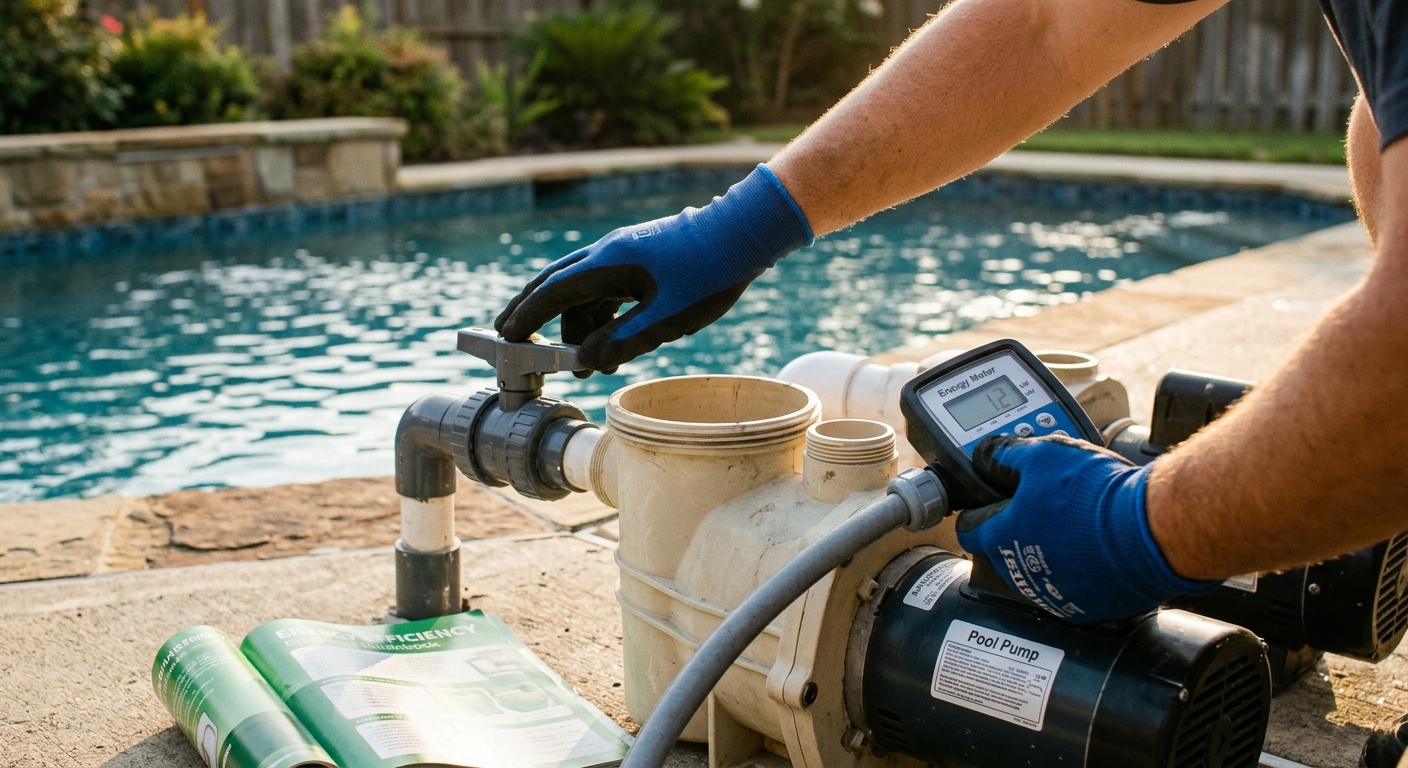
If you own a pool, you already know the joy it brings during summer. What you may not have added up is the monthly toll it takes on your energy bill. A single-speed pool pump running 8 to 12 hours a day can consume as much electricity as a central air conditioner, costing $80 to $200 per month on its own. Add in pool heating, lighting, and automatic cleaners, and total pool operating costs easily reach $150 to $400 per month during peak season.
The good news is that pool energy costs are one of the most addressable line items in a homeowner’s utility budget. Variable-speed pumps, solar covers, and smarter run schedules can slash monthly costs dramatically, often with payback periods of one to three years. Unlike many home efficiency upgrades, pool improvements deliver visible savings on your very next bill.
This guide breaks down exactly where your pool money is going, gives you real numbers to benchmark against, and walks you through practical steps from free habit changes to targeted hardware upgrades that deliver the fastest return. Whether you have a modest above-ground pool or a full inground setup with heating and automation, there is money to be recovered here.
What You’ll Need
Click on an item below to shop for the recommended items for this recipe on Amazon.
As an Amazon Associate, we earn from qualifying purchases.
How to Do It
- Locate your pump timer and reduce daily run time from your current setting to 6 to 8 hours. For most residential pools under 20,000 gallons, this is sufficient to maintain water quality. Reduce in 30-minute increments over two weeks and monitor water clarity before cutting further.
- Reschedule pump run times to off-peak hours. Set the pump to run between 9 PM and 7 AM, or early morning if your utility charges more during evening peak hours. Check your utility’s time-of-use rate schedule online or call to confirm peak windows.
- Purchase and deploy a solar cover (bubble blanket) on the pool whenever it is not in use. A correctly sized cover costs $30 to $80 for above-ground pools and $80 to $200 for inground. This single step can cut heating costs by 50 to 70% and reduce chemical use by up to 60%.
- Clean or backwash your filter. A dirty filter forces the pump to work harder, increasing energy draw by 10 to 20%. Sand filters should be backwashed when pressure rises 8 to 10 PSI above the clean baseline. Cartridge filters should be rinsed monthly.
- Check for and fix visible leaks at pump fittings, valves, and backwash lines. Even a slow drip can waste hundreds of gallons per week and force the pump to replenish and re-treat water continuously.
- Confirm your electrical panel has a dedicated 240V breaker for the pool pump and note the current amperage. Most residential pool pumps run on 20 to 30 amp circuits. This information is needed to select the correct variable-speed replacement motor.
- Select an ENERGY STAR-certified variable-speed pump sized to your pool volume and plumbing. For most inground pools, a 1.5 to 2 HP variable-speed model (Pentair IntelliFlo, Hayward TriStar VS, or equivalent) is appropriate. Check your utility’s rebate portal before purchasing, as specific models may qualify.
- Shut off power at the breaker and confirm with a non-contact voltage tester before disconnecting the existing pump. Take a photo of all wiring connections before removing anything.
- Remove the existing pump by disconnecting union fittings on the suction and discharge lines. Most pumps use 1.5 or 2-inch threaded unions that unscrew by hand or with strap wrench. Place a bucket under each connection to catch residual water.
- Mount the new variable-speed pump, reconnect the plumbing unions, and wire the motor following the manufacturer’s wiring diagram. Most variable-speed pumps use the same 240V two-hot-wire configuration as the pump they replace.
- Program the pump’s built-in controller with a low-speed filtration cycle (1,500 to 2,000 RPM for 8 hours daily) and a higher-speed cleaning or feature cycle (2,500 to 3,000 RPM for 1 to 2 hours). Restore power and monitor for leaks at all union connections for the first 30 minutes of operation.
- Audit your current heating cost by reviewing 12 months of gas or electric bills and isolating pool heater usage. Compare this to the projected annual operating cost of a heat pump (typically $600 to $1,200 per year for an average inground pool) to calculate your payback period before committing.
- Select a pool heat pump sized in BTUs to your pool surface area and target season length. A general rule is 50,000 BTUs per 10,000 gallons for moderate climates. Units from Hayward, Pentair, and AquaCal are widely supported by pool service companies.
- Have a licensed electrician install a dedicated 240V, 50-amp circuit from the main panel to the equipment pad. Heat pumps cannot share a circuit with the pump or other pool equipment.
- Place the heat pump on a level concrete pad with at least 24 inches of clearance on all sides for airflow. Position it away from fencing or walls that could restrict intake air and cause efficiency loss.
- Connect the heat pump inline between the filter output and the pool return, using CPVC or flexible PVC plumbing rated for pool equipment. A bypass loop with three valves is recommended to allow isolation for service.
- Set the heat pump to your target pool temperature (typically 78 to 82 degrees Fahrenheit), confirm the defrost cycle is enabled for cooler nights, and pair it with a solar cover to maximize retention and minimize run time.
Why It Works: The Benefits
Switching from a single-speed to a variable-speed pump alone typically saves $50 to $150 per month during swim season, with annual savings of $500 to $1,500 depending on local electricity rates and run time.
A solar cover reduces evaporation by up to 95%, saving thousands of gallons of water per season and cutting chemical consumption by 35 to 60% since chemicals leave the pool with evaporated water.
Running a variable-speed pump at lower RPMs dramatically reduces wear on seals, bearings, and the motor, potentially doubling equipment lifespan and deferring costly repairs.
A covered pool retains heat overnight and gains solar heat during the day, allowing a heater or heat pump to maintain target temperature with less run time, reducing heating costs by up to 70%.
Many utilities offer rebates of $50 to $200 for replacing single-speed pumps with ENERGY STAR-certified variable-speed models, shortening the payback period significantly.
💰 Savings Impact by Action
Replacing a single-speed pump with a variable-speed model and optimizing the run schedule reduces pump electricity consumption by 65 to 80% annually.
A solar bubble cover reduces pool heating energy requirements by up to 70% by blocking evaporative heat loss and adding passive solar gain.
Reducing daily pump run time from 12 hours to 7 hours and shifting to off-peak hours cuts pump energy costs by 25 to 40% with no hardware changes.
Switching from a gas pool heater to an electric heat pump reduces heating fuel costs by 50 to 70% due to the heat pump’s coefficient of performance of 4 to 6.
Keeping filters clean and properly backwashed reduces pump workload and energy draw by 10 to 20% compared to a clogged or neglected filter.
🏠 Key Concepts Explained
The Science Behind It
The dramatic energy savings from variable-speed pool pumps are rooted in a fundamental principle of fluid dynamics called the Affinity Law. Pump power consumption is proportional to the cube of the rotational speed. This means that reducing pump speed by just 50% cuts energy consumption to approximately 12.5% of what it was at full speed, an 87% reduction in power draw. A traditional single-speed pump running at 3,450 RPM uses the same energy regardless of whether maximum flow is actually needed at that moment, which it rarely is during basic filtration.
Evaporation is the largest source of heat loss in any outdoor pool, and the physics explain why covers are so effective. When water molecules at the surface gain enough energy to escape as vapor, they carry latent heat with them at roughly 970 BTU per pound of water evaporated. An average uncovered inground pool can lose 1 to 1.5 inches of water per week in hot, sunny, or windy conditions. That translates to hundreds of thousands of BTUs of heat energy leaving the pool each week, all of which a heater or heat pump must replace. A solar cover eliminates up to 95% of this evaporative loss by placing a physical barrier at the water surface.
Pool heat pumps exploit a different thermodynamic principle: they do not generate heat, they move it. Using a refrigerant cycle similar to a central air conditioner in reverse, a heat pump extracts thermal energy from the ambient air and transfers it to the pool water. Because moving heat requires far less energy than creating it, heat pumps deliver a coefficient of performance of 4 to 6, meaning for every 1 kWh of electricity consumed, 4 to 6 kWh of heat energy is transferred to the pool. By comparison, even a high-efficiency gas heater converts at best 95 cents of every dollar of gas into usable heat, and at current energy prices, heat pump operating costs are typically 50 to 70% lower than gas for the same pool temperature maintenance.
Frequently Asked Questions
▼ How much does it actually cost per month to run a pool pump?
A standard 1.5 HP single-speed pump running 10 hours per day at the US average electricity rate of $0.16 per kWh costs approximately $85 to $110 per month. In high-rate states like California or Connecticut, where rates exceed $0.25 per kWh, that same pump can cost $130 to $170 per month. A variable-speed pump on an optimized schedule typically reduces that to $25 to $50 per month.
▼ Will reducing pump run time cause algae or cloudy water?
It can, but only if you reduce run time too aggressively without monitoring chemistry. Start by cutting run time by 30 minutes per week and test your water chemistry every two to three days during the adjustment. If you maintain proper chlorine levels (1 to 3 ppm) and pH (7.4 to 7.6), most pools remain clear at 6 to 8 hours of daily filtration. During heat waves or heavy use periods, bump run time back up temporarily.
▼ Is a variable-speed pump worth it for a smaller above-ground pool?
For pools under 10,000 gallons with lower-horsepower pumps, the savings are real but the payback period is longer, typically 3 to 5 years compared to 1 to 2 years for large inground pools. Optimizing run time schedules and adding a solar cover deliver better immediate return for above-ground pools. If your pump is already due for replacement, choosing a variable-speed model at that point makes strong financial sense even for smaller pools.
▼ My pool heater is running constantly. What should I check first?
Start by checking whether your solar cover is deployed whenever the pool is not in use, as an uncovered pool can lose heat faster than a heater can replace it on cool nights. Next, verify your thermostat set point is not set higher than necessary: most swimmers are comfortable at 78 to 80 degrees. If the heater runs continuously even with a cover and a reasonable set point, inspect the heat exchanger for scale buildup and have a technician check refrigerant charge if it is a heat pump.
▼ Can I install a variable-speed pump myself or do I need an electrician?
Many mechanically confident homeowners successfully replace a pool pump themselves since it uses the same 240V wiring configuration as the unit it replaces. However, if you are not comfortable working with 240V circuits, hire a licensed electrician for the wiring portion and handle the plumbing connections yourself to split the cost. Always pull a permit if required in your municipality, as unpermitted electrical work at the equipment pad can create insurance and resale complications.
Quick Tips
- Run a turnover calculation: divide your pool volume in gallons by your pump’s flow rate in GPH to find out how many hours are truly needed to filter all the water once. Most pools only need one to two turnovers per day.
- Cover your pool every night, even during swim season. Overnight heat loss through radiation and convection accounts for 40 to 50% of total heating energy in a heated pool, and a cover eliminates most of it.
- Check your local utility’s website for pool pump rebates before buying any new equipment. Some utilities rebate up to $200 for ENERGY STAR variable-speed pump replacements, and a few offer on-bill financing.
- Lower your target pool temperature by 2 degrees. Each degree of reduction cuts heating energy by roughly 10 to 15%, so dropping from 82 to 80 degrees saves meaningfully over a full swim season.
- Inspect your pump basket and filter monthly. A clogged basket can reduce flow by 20 to 30%, forcing the pump to work harder for the same result and shortening motor life.
Variations for Your Situation
- Above-Ground Pool Owner: Focus first on a solar cover and timer optimization since these deliver the fastest payback on smaller pools. A $40 to $80 bubble blanket and a $25 mechanical timer reprogrammed to 6 to 7 hours of off-peak operation can cut monthly costs by 30 to 40% with minimal investment. Variable-speed pumps are available for above-ground pools in the $300 to $600 range and become worthwhile when the existing pump needs replacement.
- Tight Budget (under $100): A solar cover ($40 to $80), a mechanical pool timer ($20 to $30), and one hour spent cleaning your filter and optimizing run time cost under $100 total and can reduce monthly pool energy costs by 30 to 50%. These three actions address the biggest low-hanging-fruit categories: heating loss, pump over-run, and filter inefficiency, without any major equipment purchase.
- Heated Pool in a Cooler Climate: Heating costs dominate your pool budget if you extend the swim season into spring and fall. Prioritize the solar cover first (it doubles pool temperature gain), then evaluate a heat pump replacement if you currently use gas. In climates where air temperatures drop below 50 degrees Fahrenheit regularly, ensure any heat pump you select has a low-ambient operating range down to 45 to 50 degrees or it will struggle to perform efficiently during shoulder-season use.