Pressure washing looks simple: point and spray. But if you have ever spent three hours scrubbing a driveway only to finish with uneven results or visible streaks, the problem almost certainly started before you even turned on the machine. The prep phase is where experienced operators separate themselves from frustrated first-timers, and it takes less than 10 minutes to get right.
Skipping setup leads to real costs: wasted detergent, damaged surfaces from the wrong nozzle, kinked hoses that cut your water pressure by 30 to 40%, and trips back to fix missed spots. On a typical 500-square-foot driveway or deck, poor prep can add 90 minutes or more to the job and leave you with a result that looks worse than when you started.
This guide walks you through a fast, repeatable pre-wash checklist that professional cleaners use before every job. Whether you own a basic electric unit or a gas-powered machine, these steps apply, and the payoff in time saved and surface quality is immediate.
What You’ll Need
Click on an item below to shop for the recommended items for this recipe on Amazon.
As an Amazon Associate, we earn from qualifying purchases.
How to Do It
- Sweep or blow all loose debris, leaves, and gravel off the target surface. This takes 2 to 3 minutes and prevents rocks from becoming projectiles and debris from clogging your cleaning path.
- Remove or cover nearby items: potted plants, patio furniture, doormats, and outdoor electrical outlets. Use a plastic tarp or plastic bags secured with tape for anything that cannot be moved.
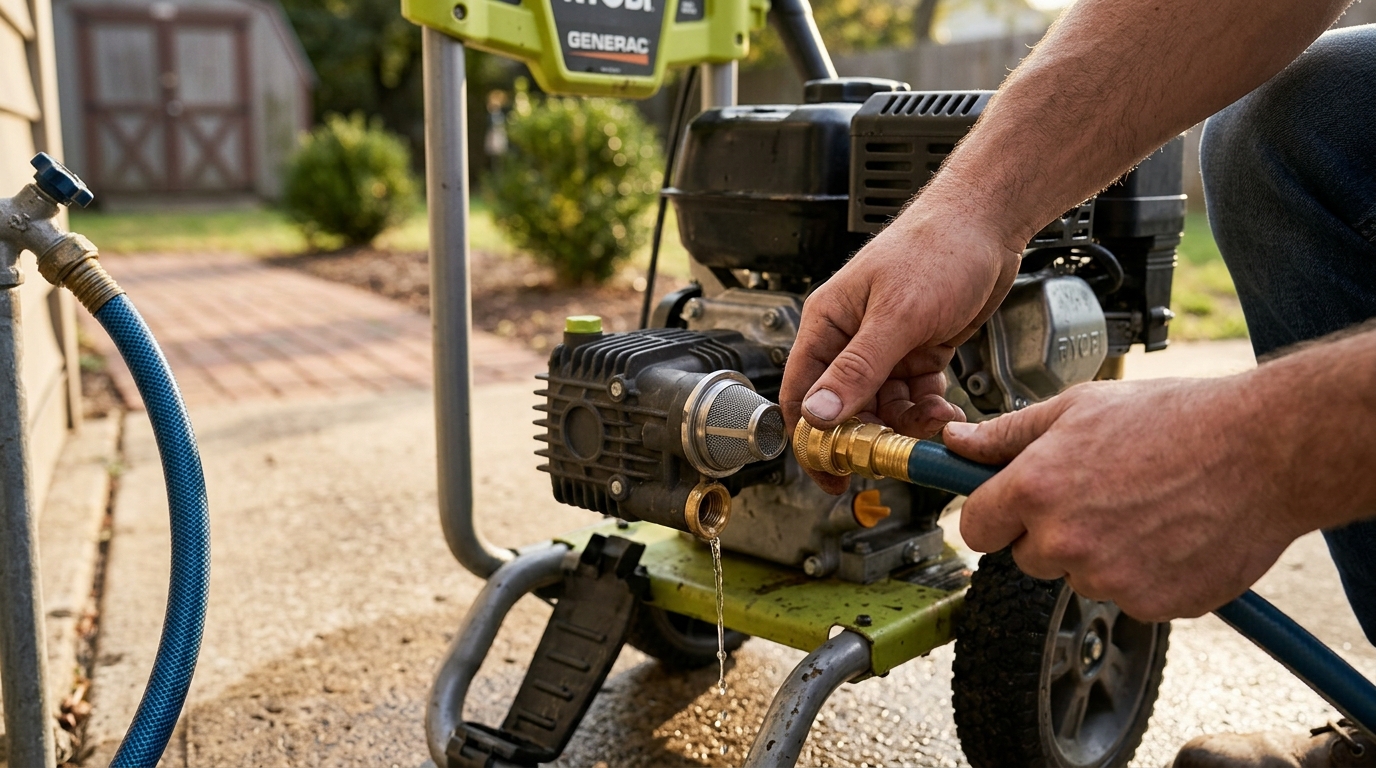
- Check the inlet filter screen on your machine’s water intake by unscrewing the garden hose fitting and inspecting the small mesh screen. Rinse it under tap water if it shows any sediment buildup.
- Connect your garden hose, turn on the water supply fully, and run water through the wand for 20 to 30 seconds before starting the engine or motor. This purges air from the pump and prevents dry-start damage.
- Select your nozzle based on surface type: 40-degree (white) for most general cleaning and rinsing, 25-degree (green) for concrete and brick, and soap nozzle (black) for applying detergent. Never start with the 0-degree red nozzle.
- Plan your cleaning path before pulling the trigger: start at the highest point, work downhill and away from the house, so dirty water always flows toward uncleaned areas rather than back over clean surfaces.
- Sweep the surface thoroughly and use a stiff brush or garden hoe to break up any compacted organic material like matted leaves or dried mud along edges and expansion joints.
- Mix a pressure washer detergent concentrate at the manufacturer’s recommended ratio, typically 1 ounce per gallon for general surfaces or a dedicated concrete degreaser for oil stains. Fill your detergent tank or downstream injector.
- Switch to the black soap nozzle and apply detergent in overlapping passes at low pressure, working from the bottom up so detergent does not streak the surface before it has time to work.
- Let the detergent dwell for 5 to 10 minutes. Do not let it dry completely. For mold and mildew, look for the detergent to visibly lighten the dark staining, which signals it is working.
- For oil stains on concrete, apply a dedicated degreaser directly from the bottle, scrub briefly with a stiff bristle brush to break the surface tension, then let sit for an additional 5 minutes before rinsing.
- Switch to your 25-degree green nozzle for concrete or 40-degree white nozzle for wood, maintain a consistent 6 to 12 inch standoff distance, and rinse in smooth overlapping strokes following your pre-planned top-to-bottom path.
- Purchase a rotary surface cleaner sized for your pressure washer’s PSI and GPM rating. Most homeowner gas units (2,500 to 3,200 PSI) pair well with a 12 to 15 inch diameter surface cleaner.
- Complete the full 10-minute pre-wash checklist from the first approach before attaching the surface cleaner.
- Pre-treat with detergent using the soap nozzle as described in the second approach, then let dwell while you assemble the surface cleaner attachment.
- Connect the surface cleaner to your wand in place of the standard nozzle, turn on the machine, and test on a small section to confirm it spins freely and does not leave circular marks from being held too close.
- Work in slow, overlapping straight passes at walking pace. The surface cleaner covers 3 to 4 times the area per pass compared to a standard nozzle, reducing cleaning time on a standard driveway from 60 to 90 minutes down to 20 to 30 minutes.
- After completing all flat surface cleaning, switch back to a 25 or 40-degree nozzle to edge the perimeter and rinse any areas the surface cleaner could not reach, such as corners and steps.
Why It Works: The Benefits
Proper nozzle selection, pre-soaking with detergent, and a cleared work area eliminate redundant passes. A driveway that takes 3 hours unprepared routinely takes 90 minutes with a solid 10-minute setup.
Detergent dwell time breaks down embedded grime before pressure hits, reducing the need for multiple high-pressure passes that can etch or groove softer surfaces like wood decking and painted concrete.
Checking the inlet filter and hose connections before each use prevents pump cavitation, the leading cause of pressure washer pump failure. Replacement pumps cost $80 to $200, making this a high-return 60-second check.
Efficient technique and proper pressure use 20 to 30% less water per square foot compared to unplanned spraying. On a full driveway and patio job, that can save 50 to 100 gallons while achieving a cleaner result.
Pre-clearing the area, covering nearby plants and outdoor furniture, and testing nozzle distance on a hidden section prevents accidental damage to landscaping, windows, and delicate surfaces that can cost $150 to $500 to repair.
💰 Savings Impact by Action
A complete 10-minute prep routine cuts total cleaning time by up to 50% by eliminating redundant passes and backtracking.
Proper technique and detergent pre-treatment reduce water usage by 20 to 30% per square foot compared to unplanned pressure spraying.
A rotary surface cleaner attachment reduces flat-surface cleaning time by 60 to 70% compared to a standard fan nozzle on driveways and patios.
Inlet filter checks and air purging before each use reduce pump wear, extending equipment life by an estimated 30 to 50% compared to skipping these steps.
Planning a top-to-bottom work path eliminates re-cleaning passes, which account for up to 25% of total job time when the direction is ignored.
🏠 Key Concepts Explained
The Science Behind It
Pressure washing efficiency comes down to a simple physics equation: cleaning power is a product of pressure (PSI) and flow rate (GPM), often expressed as Cleaning Units (CU = PSI x GPM). A machine rated at 2,500 PSI and 2.5 GPM delivers 6,250 CU. Any restriction in the supply line, whether from a kinked hose, partially closed spigot, or clogged inlet screen, reduces the GPM side of that equation significantly, leaving you with a machine that feels weak even though nothing is mechanically wrong.
The nozzle angle affects how those cleaning units are distributed across the surface. A 0-degree nozzle focuses all 6,250 CU into an area the size of a pencil point, delivering enormous force per square inch. Spread across a 40-degree fan pattern, that same energy covers a wider path with each pass, cleaning more surface area per second while reducing the risk of surface damage. For most residential cleaning, wider angles paired with proper dwell time outperform narrow, aggressive nozzles every time.
Detergent chemistry explains why dwell time matters so much. Surfactants in pressure washer soap lower the surface tension of water and chemically bind to oil and biological material like mold and algae. Given 5 to 10 minutes of contact, they break those bonds at the molecular level. High-pressure water can then rinse the loosened material cleanly in a single pass. Without dwell time, the pressure washer is doing all the mechanical work alone, requiring repeated passes that risk surface damage and still deliver inferior results.
Frequently Asked Questions
▼ Why does my pressure washer keep losing pressure mid-job?
The most common cause is an undersized or kinked supply hose restricting water flow to the pump. Make sure your garden hose is at least 5/8 inch diameter and fully unkinked, and that the spigot is turned completely open. If pressure still drops, check the inlet filter screen for sediment buildup and rinse it clean. On gas units, a partially clogged unloader valve or worn pump seals can also cause pressure fluctuation, which typically requires a professional service visit.
▼ I pre-treated with detergent but the stains are still there after rinsing. What did I do wrong?
Oil-based stains and embedded tire marks require a dedicated concrete degreaser, not a general-purpose pressure washer soap. Apply the degreaser, scrub it in with a stiff brush to penetrate the pores, and extend the dwell time to 10 to 15 minutes. For very old stains, a second application after the first rinse often removes what the initial treatment loosened but could not fully lift.
▼ Can I use my pressure washer on my wood deck without damaging it?
Yes, but nozzle selection and standoff distance are critical. Use only the 40-degree white nozzle on wood and maintain at least 12 inches of distance from the surface. Always spray parallel to the wood grain, never across it, to avoid raising the grain fibers. Keep the wand moving constantly and use low-pressure detergent application followed by a gentle rinse rather than relying on mechanical force to strip the wood.
▼ My surface cleaner attachment is leaving circular or ring-shaped marks on the concrete. How do I fix it?
Ring marks mean you are moving too slowly or holding the surface cleaner too close to the surface. Raise it slightly (most need 1 to 2 inches of clearance from the surface) and increase your walking pace to match the rotation speed of the nozzle bar. Overlapping each pass by about 2 inches also eliminates the faint lines that appear when adjacent cleaning paths do not quite meet.
▼ Is it safe to pressure wash near outdoor outlets and light fixtures?
Cover all outdoor electrical outlets, fixtures, and junction boxes with plastic bags secured with painter’s tape before you begin. Never spray directly at any electrical component even if it is rated for outdoor use, as sustained high-pressure water can force past weatherproof covers. If you accidentally soak an outlet, turn off the circuit at the breaker and allow it to dry completely for at least 24 hours before restoring power.
Quick Tips
- Mark your water supply hose length before starting so you never reach the end of slack mid-pass and jerk the wand sideways across a clean surface.
- Work in sections of about 100 square feet at a time when using detergent, so no section dries out before you return to rinse it.
- Keep a 5-gallon bucket of plain water nearby to immediately dilute any detergent that splashes onto plants, vehicles, or painted surfaces.
- After finishing, run clean water through the detergent system for 30 seconds to flush residue from the injector, which prevents clogging between uses.
Variations for Your Situation
- Apartment or HOA Rental: If you do not own a pressure washer, rent one from a home improvement store for $40 to $80 per day. Complete the full pre-check on a rental unit since rental machines often have damaged inlet screens or worn nozzles. Confirm with your HOA or landlord before washing shared surfaces, and always direct runoff away from neighboring units and common drains.
- Tight Budget (Under $20): Skip the detergent and surface cleaner attachment and focus entirely on the free prep steps: debris clearing, inlet screen check, air purging, nozzle selection, and work path planning. These zero-cost steps alone can reduce your cleaning time by 25 to 35% and prevent surface damage. A 25-degree green nozzle, if you do not already have one, costs about $5 to $8 and is the single highest-value nozzle to add.
- Older or Delicate Surfaces (Pre-1980 Homes): Older brick, soft sandstone, mortar joints, and original wood siding are highly vulnerable to high-pressure damage. Use only the 40-degree white nozzle at a 18 to 24 inch standoff, and test in an inconspicuous area first. For painted wood siding on older homes, a downstream-injected low-concentration detergent rinse at soft-wash pressures (under 500 PSI using the black soap nozzle) is far safer than any direct pressure washing and will still remove mold and surface grime effectively.