Every winter, roughly 250,000 American homes suffer burst pipes, and the average insurance claim runs between $5,000 and $15,000 once you factor in water damage, drywall repair, and flooring replacement. The cruel irony is that the fix costs almost nothing. A roll of foam pipe insulation from the hardware store runs about $1 per linear foot, and an afternoon of work can eliminate the single most expensive plumbing disaster a homeowner will ever face.
But pipe insulation isn’t only about freeze protection. Insulated hot water pipes lose less heat between your water heater and your showerhead, which means you get hot water faster and your water heater runs less often. The Department of Energy estimates that insulating your first three to four feet of pipe coming off a water heater can raise delivered water temperature by 2 to 4 degrees Fahrenheit, letting you turn down the heater setpoint and trim standby losses by 3 to 4 percent annually. On a typical gas water heater, that’s $10 to $20 per year for about 15 minutes of work.
This guide covers everything: which pipes to prioritize, which insulation type actually works, and how to go from a quick-fix garage job to a fully protected home system. Whether you’ve never touched a pipe or you’re comfortable with basic DIY, there’s a level here that fits your time and budget.
What You’ll Need
Click on an item below to shop for the recommended items for this recipe on Amazon.
As an Amazon Associate, we earn from qualifying purchases.
How to Do It
- Identify your three highest-risk pipe locations: the garage (especially near exterior walls), the crawlspace or basement rim joist area, and any pipes in unheated cabinets under exterior-wall sinks.
- Measure the diameter of your pipes. Most residential supply lines are 1/2 inch or 3/4 inch. Foam sleeves must match the pipe outside diameter, not the nominal size, so bring a tape measure or a photo to the hardware store.
- Buy pre-slit foam pipe insulation sleeves in 6-foot sections. For garage and rim joist pipes, choose 3/4-inch wall thickness for better cold protection. For under-sink pipes, 3/8-inch wall is adequate.
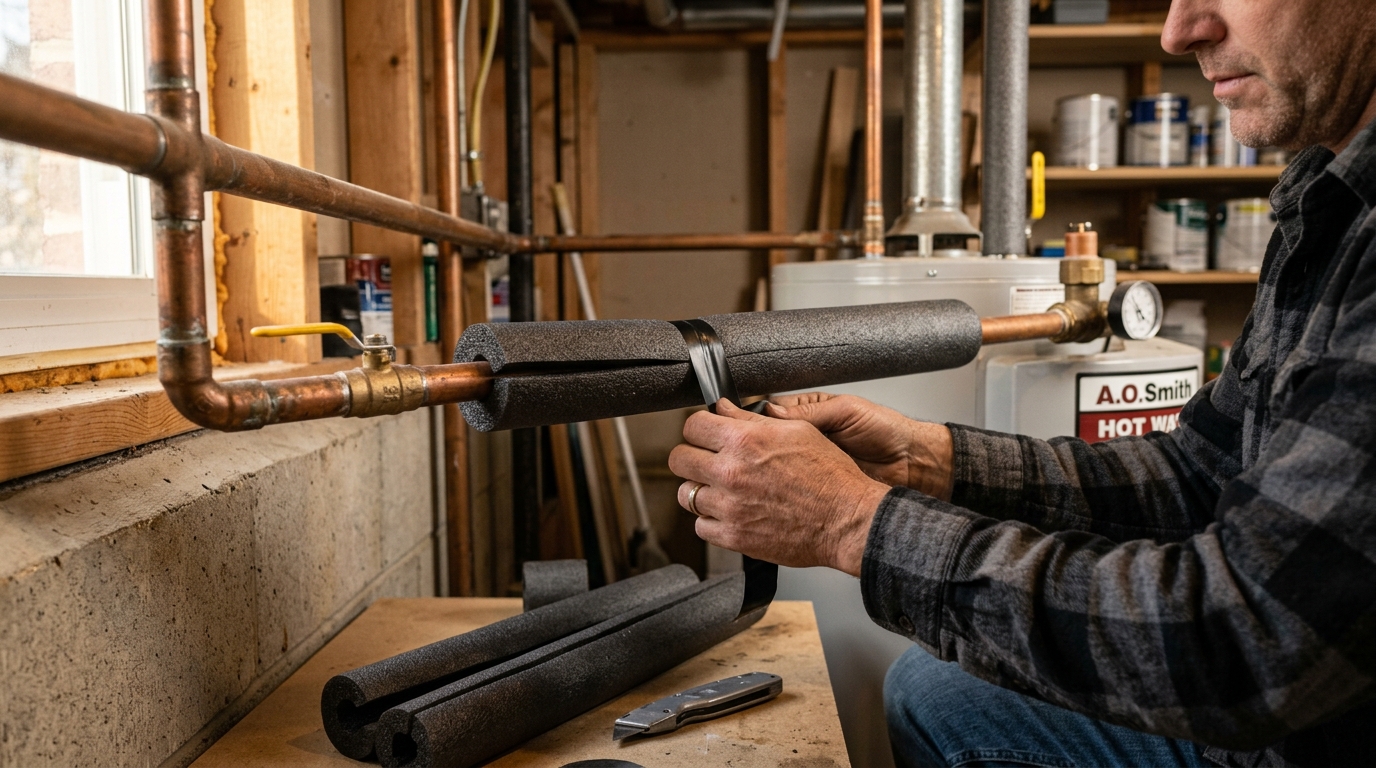
- Snap the slit foam sleeve over the pipe starting at one end. Butt each section tightly against the last with no gaps. At elbows and tees, cut the foam at a 45-degree angle with scissors or a utility knife so the pieces meet cleanly.
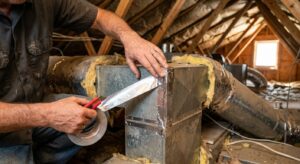
- Seal all seams and seam ends with foil HVAC tape, not duct tape, which fails in cold or damp conditions. Pay extra attention to any gaps at fittings and valves.
- Check under all exterior-wall kitchen and bathroom sinks and stuff the cabinet with an old towel on extreme cold nights if pipes there are not yet insulated – a simple interim step that has saved thousands of pipes.
- Walk your home systematically and sketch a rough map of all accessible pipe runs: basement or crawlspace, utility room, garage, and under-sink areas. Note which pipes are hot supply, cold supply, or recirculation lines. Hot lines get insulated for energy savings everywhere; cold lines get insulated wherever they pass through unheated or humid spaces.
- Calculate your total linear footage and add 15 percent for waste at fittings and cuts. Buy foam sleeves in bulk packs for cost savings. For hot water pipes, use 1/2-inch or 3/4-inch wall foam. For cold pipes in humid areas, use a closed-cell foam rated for condensation control.
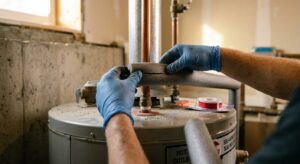
- Start at the water heater. Insulate the first 6 feet of both the hot outlet and the cold inlet pipes. This is the highest-payback run in the house for energy savings. If the water heater flue or draft diverter is nearby, maintain a 6-inch clearance from flue pipes on gas units.
- Work outward from the water heater along all hot water lines through the basement or crawlspace. Snap sleeves onto straight runs, then cut custom-angle pieces for each elbow. At tee fittings, miter two pieces so they meet without leaving a gap larger than 1/8 inch.
- Insulate all cold supply pipes in the rim joist zone, any pipes within 2 feet of exterior foundation walls, and all pipes running through unheated garage walls or ceilings.
- At valves, wrap closed-cell foam tape around the valve body, then butt your foam sleeves tight against each side. Tape all seams with foil HVAC tape, pressing firmly. Label any shutoff valves before covering so you can find them quickly in an emergency.
- Once complete, check your water heater thermostat. If it’s set above 120°F and your pipes are now insulated, you may be able to drop the setpoint 5 degrees and maintain the same delivered temperature at fixtures, compounding your annual savings.
- Hire a plumber or insulation contractor to assess your crawlspace or basement pipe runs. Ask specifically about rim joist sealing combined with pipe insulation, since air sealing the rim joist cavity before insulating pipes dramatically improves freeze protection by removing the cold-air pathway to the pipe.
- Request closed-cell spray foam or rigid foam board for rim joist cavities, with pipe insulation installed after the air seal. This combination reduces cold air intrusion to near zero and is the professional standard for freeze-prone homes.
- If hot water takes more than 60 seconds to arrive at a distant bathroom or kitchen, ask the contractor to evaluate a hot water recirculation pump. A demand-controlled recirculation system with properly insulated pipes cuts wait times to under 15 seconds and can save 10,000 to 20,000 gallons of wasted water per year in a four-person household.
- For recirculation systems, confirm that all return-line pipes are also insulated, including the recirculation loop running back to the water heater. An uninsulated return loop defeats much of the energy benefit of the system.
- After work is complete, ask the contractor for a walkthrough of any shutoff locations and to confirm all pipe insulation is foil-taped at seams. Request documentation of the materials used and their R-values for your home records and insurance purposes.
Why It Works: The Benefits
Proper insulation on vulnerable pipes in garages, crawlspaces, and rim joist cavities can prevent freeze events that cost $5,000 to $15,000 in water damage and repairs. This is the single highest-value return on a $30 to $80 material investment in residential energy and home protection.
Insulating the first 6 feet of pipe on the hot and cold inlets of your water heater reduces standby losses by 3 to 4 percent annually. On a household spending $250 to $400 per year on water heating, that’s $8 to $16 per year with almost no labor cost.
Insulated pipes retain heat longer between uses. In tested homes, insulated pipes delivered hot water 30 to 45 seconds faster at fixtures more than 20 feet from the water heater, cutting the volume of wasted water per use by 0.5 to 1.5 gallons.
Insulating cold water pipes in humid basements eliminates pipe sweating entirely, protecting surrounding framing and insulation from moisture-driven rot and mold. This is a low-visibility benefit that prevents expensive structural repairs over 10 to 20 years.
Foam insulation dampens the knocking and ticking sounds that copper pipes make as they expand and contract with temperature changes, a quality-of-life improvement that older homes with exposed copper runs benefit from noticeably.
💰 Savings Impact by Action
Insulating accessible hot water supply lines reduces standby heat loss by 3 to 4 percent of annual water heating costs.
Properly insulated pipes in at-risk locations prevent freeze events in the vast majority of single overnight cold snaps above minus 10°F.
Faster hot water delivery from insulated pipes reduces cold-flush water waste by 10 to 15 percent of total hot water consumption in homes with long pipe runs.
Closed-cell foam insulation on cold water pipes eliminates pipe sweating almost entirely by keeping the outer surface above the dew point of surrounding air.
🏠 Key Concepts Explained
The Science Behind It
Heat always moves from hot to cold, and it does so through three mechanisms: conduction (direct contact), convection (air movement), and radiation (infrared emission). An uninsulated copper pipe is an excellent conductor with a thermal conductivity roughly 2,000 times greater than the air around it. Every inch of bare copper in contact with cool basement air is actively pulling heat out of your hot water supply. Foam pipe insulation interrupts conduction by surrounding the pipe in a material with very low thermal conductivity, typically around 0.25 to 0.27 BTU per hour per square foot per degree Fahrenheit, compared to copper at 223 BTU per hour per square foot per degree Fahrenheit.
The freeze protection physics are equally straightforward. Water expands about 9 percent when it freezes, and that expansion exerts up to 2,000 pounds per square inch of pressure against the pipe wall, far exceeding the tensile strength of copper or PVC. Foam insulation slows the rate at which pipe temperature drops during a cold event, buying hours of protection during a single overnight freeze. In a typical rim joist location exposed to 15°F outdoor air, a bare 3/4-inch copper pipe may reach freezing in 3 to 6 hours. The same pipe wrapped in 3/4-inch closed-cell foam may take 12 to 18 hours to reach the freeze threshold, often outlasting the cold snap entirely.
The condensation benefit works on dew point physics. When warm, humid air contacts a surface colder than the dew point temperature of that air, moisture condenses out of the air onto the surface. In a basement at 65°F and 60 percent relative humidity, the dew point is about 49°F. A cold water pipe supplied from a 55°F groundwater source will sit at roughly 55 to 58°F, just above the dew point in that example. But during high-humidity summer months, that margin disappears and the pipe sweats. Closed-cell foam insulation keeps the outer surface of the insulation at or above ambient air temperature, eliminating the cold surface needed for condensation to occur.
Frequently Asked Questions
▼ My pipe froze even though I insulated it last year. What went wrong?
The most common cause is a gap at a fitting, valve, or where two foam sections meet. Cold air infiltrates through even a 1-inch gap and can freeze the exposed pipe section. Inspect all seams and joints and re-tape with foil HVAC tape. Also check whether the pipe runs near a drafty rim joist or foundation vent that is funneling outdoor air directly at the pipe, which overwhelms even good insulation.
▼ Can I use pipe insulation on PEX tubing, not just copper?
Yes, foam pipe insulation works on PEX, CPVC, and copper. PEX is actually more freeze-tolerant than copper because it flexes slightly under expansion pressure, but it can still burst under sustained freezing. Match the sleeve inner diameter to the PEX nominal size, which is slightly different from copper, and verify at the hardware store before buying in bulk.
▼ How long before I see the energy savings on my gas bill?
For water heater pipe insulation specifically, savings are small in absolute dollar terms, typically $8 to $20 per year, so you may not notice it on any single monthly bill. The clearest signal is a faster hot water delivery time at far fixtures, which you will likely notice within the first week. Combine pipe insulation with lowering your water heater setpoint to 120°F for savings that are more measurable on your monthly statement.
▼ I’m in an apartment. Can I insulate my hot water pipes?
In most apartments, the main supply lines are in walls or chases you cannot access. However, the pipes under your kitchen and bathroom sinks are often exposed and accessible. Insulating those short runs with peel-and-stick foam tape or snap-on sleeves is a renter-safe improvement that requires no tools and leaves no permanent modification. Ask your landlord about any pipes in unheated spaces, since freeze protection is typically the landlord’s legal responsibility.
▼ What if my pipes are in the wall and I can’t reach them?
In-wall pipes rarely freeze unless the wall cavity is exposed to outdoor air, which can happen at exterior walls with missing insulation or near a dryer vent penetration. If you’ve had an in-wall freeze before, a contractor can assess whether the problem is pipe location or missing wall insulation. For hot water heat loss in walls, a hot water recirculation pump is a more effective solution than trying to insulate pipes you cannot access.
Quick Tips
- Use foil HVAC tape, not standard duct tape. Duct tape adhesive fails in cold and damp conditions within one to two seasons, leaving gaps that eliminate your freeze protection exactly when you need it most.
- Buy foam sleeves with the factory slit pre-glued if available. Self-sealing foam sleeves cost about 20 to 30 percent more but eliminate the need for tape on straight runs and hold up better in humid crawlspaces.
- Photograph your pipe runs before you insulate them. A quick photo log of where shutoff valves, cleanouts, and tee fittings are located saves significant time and frustration if you ever need to access a pipe in an emergency.
- In an extreme cold emergency before you’ve insulated, open the cabinet doors under all exterior-wall sinks to let warm room air circulate around the pipes. A slow drip from the faucet farthest from your water main keeps water moving and dramatically reduces freeze risk at minimal water cost.
- Check manufacturer specs on your foam insulation for minimum temperature ratings. Some standard foam sleeves are only rated to 0°F. For northern climates and crawlspaces in very cold regions, look for insulation rated to minus 20°F or use rigid mineral wool pipe wrap instead.
Variations for Your Situation
- Apartment/Rental: Renters typically cannot access main supply lines, but the under-sink pipes in kitchens and bathrooms are almost always exposed and uninsulated. A package of peel-and-stick foam pipe wrap ($8 to $12) applied to those runs requires no tools and no landlord approval. On extreme cold nights, open cabinet doors under all exterior-wall sinks to let heated air circulate. If your unit has a private water heater, insulating the first few feet of the hot outlet pipe is a no-damage upgrade worth doing immediately.
- Tight Budget (under $50): Start with the three locations that cause 80 percent of all residential pipe bursts: garage supply lines, crawlspace rim joist pipes, and under exterior-wall kitchen sinks. A single 10-pack of 6-foot foam sleeves ($18 to $25) and a roll of foil tape ($7) covers all three zones in most homes. Skip the cold water pipes in conditioned basements for now, those are an energy upgrade, not a safety priority.
- Older Home (pre-1980): Homes built before 1980 often have galvanized steel or older copper pipes that may already show corrosion. Before buying insulation, inspect your pipes visually. Galvanized steel with heavy rust scaling or copper with green patchy staining should be evaluated by a plumber first. Also check whether your older home has fiberglass-wrapped or asbestos-wrapped pipes, which were sometimes used on hot water lines before 1975. Do not disturb any pipe covering you cannot identify. Have a professional test it before removing or adding insulation over it.