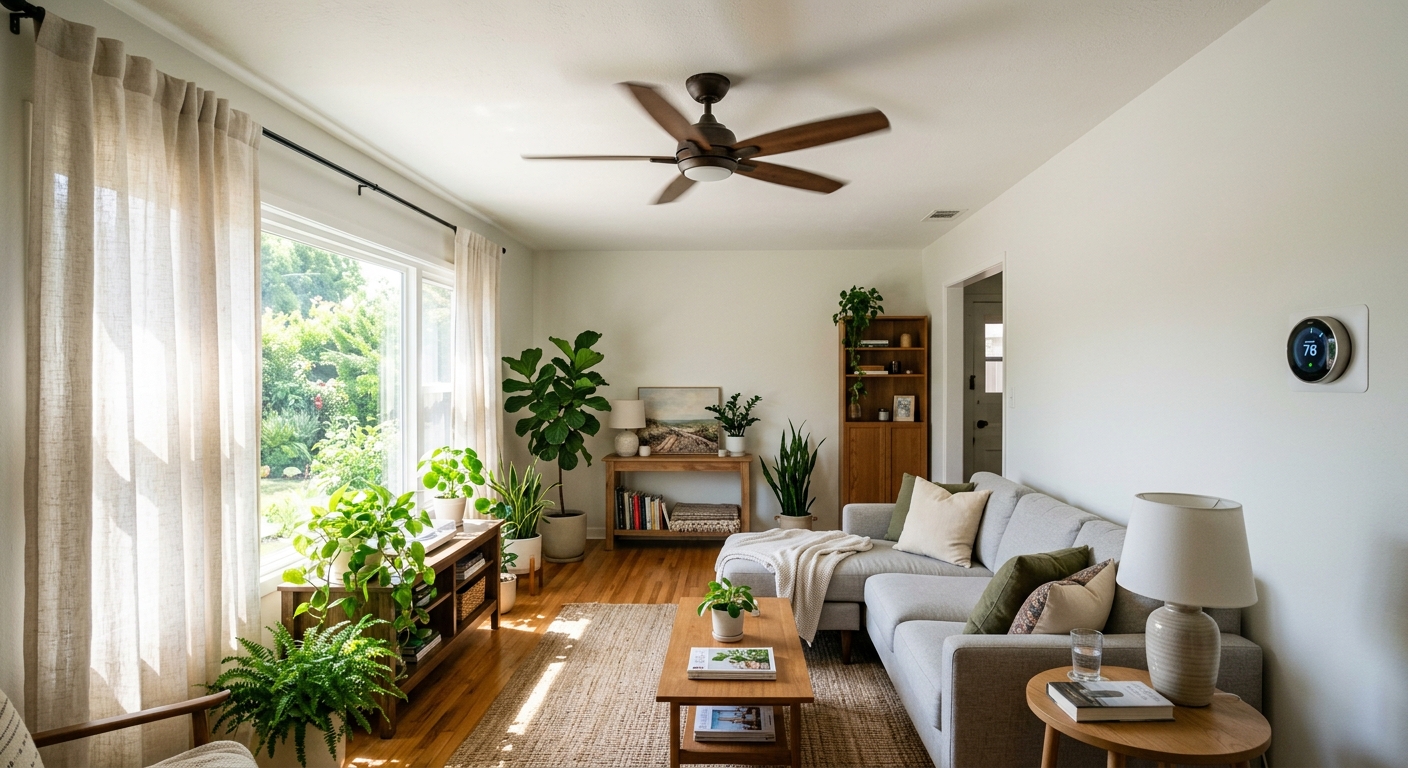
Ceiling fans are one of the most misunderstood appliances in the average home. Millions of homeowners flip them on and walk out of the room, paying for electricity while getting almost no benefit. The hard truth is that ceiling fans do not lower the air temperature at all. They cool you through a process called the wind chill effect, which means if no one is in the room, the fan is doing nothing but running up your electric bill.
Used correctly, ceiling fans make a 78 degree room feel like 74 degrees, letting you raise your thermostat by 4 degrees without sacrificing comfort. That one adjustment can trim your cooling costs by around 8 percent per degree, or roughly 30 percent over a full summer season. For a home with central air spending $200 a month to cool in peak summer, that is real money, potentially $50 to $60 saved every month.
This post covers exactly how to set your fan direction, speed, and thermostat together for maximum savings, how to install a ceiling fan in a room that does not have one, and the common mistakes that cancel out all the benefits. Whether you have one fan or ten, these steps will make sure every one of them is actually working for you.
What You’ll Need
Click on an item below to shop for the recommended items for this recipe on Amazon.
As an Amazon Associate, we earn from qualifying purchases.
How to Do It
- Stand below your ceiling fan and look up. Turn it on and confirm the blades are spinning counterclockwise in summer. Most fans have a small direction switch on the motor housing, usually a slide switch, that reverses rotation.
- Set the fan to medium or high speed. Low speed does not generate enough airflow to create a meaningful wind chill effect during warm weather.
- Go to your thermostat and raise the setpoint by 4 degrees. If you normally keep it at 74 degrees, set it to 78 degrees. The fan will maintain the same level of perceived comfort at a fraction of the energy cost.
- Turn the fan off when you leave the room. Fans cool people, not rooms. Leaving it on in an empty room wastes 15 to 75 watts with zero benefit.
- Check every room in your home and repeat the direction and speed check for each fan. A single fan running in the wrong direction all summer can cost $15 to $30 in wasted electricity.
- Choose the right fan size for the room. Rooms under 144 sq ft need a 36 to 42 inch fan. Rooms 144 to 350 sq ft need a 44 to 52 inch fan. Rooms over 350 sq ft need a 52 to 60 inch fan or two fans. Look for ENERGY STAR certification.
- Turn off the circuit breaker for the room at your electrical panel and confirm power is off with a non-contact voltage tester before touching any wiring.
- Remove the existing light fixture or old fan, noting how the wires are connected. Photograph the existing wiring before disconnecting anything.
- Install the new mounting bracket or fan brace rated for ceiling fan weight, typically 35 pounds or more. Standard light fixture boxes are not rated for fan loads and must be replaced with a fan-rated box.
- Connect the wires according to the manufacturer’s instructions: black to black (hot), white to white (neutral), and green or bare copper to the ground wire. If your switch leg has only two wires and no neutral, follow the included wiring diagram for single-switch operation.
- Attach the fan blades, install the canopy, restore power at the breaker, and confirm counterclockwise rotation on medium speed. Set your thermostat up 4 degrees and verify comfort within 15 minutes.
- Purchase a smart ceiling fan controller compatible with your existing fan. Options include in-wall smart switches (around $40 to $80) and remote receiver kits that install inside the fan canopy (around $30 to $60).
- Turn off the circuit breaker and install the smart controller according to its wiring diagram. Most replace the existing wall switch and require a neutral wire. Confirm neutral availability before purchasing.
- Connect the smart controller to your home Wi-Fi network using the manufacturer’s app and link it to your smart home platform if applicable (Amazon Alexa, Google Home, Apple HomeKit).
- Set an occupancy-based schedule or enable motion sensing if the controller supports it. Program the fan to run at medium speed between the hours your room is typically occupied and turn off automatically otherwise.
- Link the fan schedule to your smart thermostat if you have one, so the thermostat automatically raises its setpoint by 4 degrees during hours when fans are running throughout the house.
Why It Works: The Benefits
Raising your thermostat 4 degrees while maintaining comfort saves approximately 32% on cooling costs over a summer season. For a home spending $180 per month on summer cooling, that is roughly $57 per month or $170 to $230 saved per season.
A correctly set ceiling fan at medium to high speed makes a 78 degree room feel like 74 degrees due to the wind chill effect, letting you stay comfortable at a higher thermostat setpoint without any equipment upgrades.
Running a ceiling fan costs roughly 1 to 2 cents per hour versus 30 to 50 cents per hour for a central air conditioner. Substituting fan use during mild evenings or shoulder seasons can eliminate AC run time entirely for several months of the year.
Ceiling fans reduce hot and cold spots in rooms with poor duct coverage, distributing conditioned air more evenly and reducing the chance that one area overcalls the thermostat while another stays uncomfortable.
Fixing direction and thermostat settings costs nothing and delivers savings on your very next electric bill. A new ceiling fan installation in a room currently using a window AC unit can pay for itself in a single cooling season.
💰 Savings Impact by Action
Raising the thermostat 4 degrees while running fans correctly saves approximately 8% per degree, compounding to 25 to 32% on cooling costs over a summer season.
Switching a fan from clockwise to counterclockwise in summer restores the full wind chill effect and can recover 10% in cooling energy wasted by a fan running in the wrong direction.
Using timers or smart controls to turn fans off in empty rooms eliminates wasted electricity that can account for 10 to 15% of total fan operating cost in a typical household.
Replacing a conventional ceiling fan with a certified ENERGY STAR model reduces fan motor energy use by up to 60% while moving the same volume of air.
🏠 Key Concepts Explained
The Science Behind It
Ceiling fans work entirely through convective heat transfer, specifically by accelerating the rate at which your body loses heat to the surrounding air. When air is still, a thin layer of warm, humid air forms next to your skin, essentially insulating you from the cooler air beyond it. A ceiling fan disrupts that boundary layer continuously, replacing it with cooler, drier air and dramatically speeding up both convective cooling and evaporative cooling from sweat. The result is a perceived temperature drop of 4 to 5 degrees Fahrenheit, even though a thermometer in the room would show no change.
The counterclockwise direction in summer creates a downdraft, pushing a column of air directly down toward the occupants below. This maximizes the velocity of air moving across skin surfaces. Clockwise rotation in winter does the opposite: it creates a gentle updraft that pulls cool air off the floor and forces the warm air that has collected near the ceiling down along the walls, improving heat distribution without creating the chilling effect you want to avoid in cold weather. The difference in blade angle efficiency between these two directions is why the switch matters so much.
From an energy standpoint, the physics are extremely favorable. A ceiling fan motor draws 15 to 75 watts. A central air conditioner compressor uses 3,000 to 5,000 watts. When a fan allows you to raise the thermostat 4 degrees, the AC compressor runs significantly less often. Since cooling costs increase by roughly 8 percent for every degree below 78 degrees on a conventional central system, a 4-degree setback compounds quickly into 25 to 30 percent seasonal savings. The fan’s running cost is so small relative to that savings that its net efficiency contribution is one of the best in the home.
Frequently Asked Questions
▼ I turned my fan on and raised the thermostat but I still feel too hot. What am I doing wrong?
First confirm the fan is spinning counterclockwise when viewed from below and set to medium or high speed. If you are in a room larger than 225 square feet with a fan under 44 inches in diameter, the fan is likely too small to create adequate airflow. A second issue is solar heat gain: if the room has unshaded west or south windows in the afternoon, close the blinds to reduce the heat load before relying on the fan.
▼ Can I use a ceiling fan and window AC together?
Yes, and it is a great combination. Set the window AC to 78 degrees instead of 72 to 74, and let the fan create the wind chill effect that makes 78 feel comfortable. This can reduce window AC run time by 30 to 40 percent and extend the life of the unit. Keep the fan on high and make sure it is blowing downward.
▼ My ceiling fan wobbles when it runs. Is that a problem?
A wobbling fan reduces airflow efficiency, creates noise, and puts stress on the mounting hardware over time. The most common cause is dust-loaded blades, mismatched blade weights, or a loose blade bracket screw. Turn the fan off, clean each blade thoroughly, tighten all blade bracket screws, and check that all blades are at the same angle. Most hardware stores sell a cheap balancing kit (around $5) that fixes remaining wobble with a small clip and counterweight.
▼ Does running a ceiling fan in winter actually save money on heating?
Yes, modestly. Switch the fan to clockwise rotation on its lowest speed setting in winter. This gently recirculates warm air that collects near the ceiling back down to the living area without creating a chilling draft. In rooms with high ceilings, this can reduce heating costs by 5 to 10 percent by making existing warm air more useful before your heating system needs to cycle on again.
▼ How do I know if my ceiling electrical box is rated for a fan?
Turn off the power, remove the existing fixture, and look for text stamped on the metal box itself that reads ‘Acceptable for Fan Support’ or a UL listing for ceiling fan use. If the box is plastic, it is almost certainly not fan-rated. If there is no marking or you are unsure, replace it with a fan-rated brace kit (around $15 at any hardware store) before mounting the fan.
Quick Tips
- Run fans only in occupied rooms. A fan left on in an empty room adds $5 to $15 per month to your electric bill with zero cooling benefit.
- In rooms with high ceilings (over 9 feet), use a ceiling fan with a downrod long enough to position the blades 8 to 9 feet above the floor for optimal airflow.
- Clean fan blades every 1 to 2 months in summer. Dust buildup on the leading edge of each blade reduces airflow efficiency by 10 to 20% and can cause wobble that wears out the motor.
- On particularly humid days, fans are even more effective because they accelerate sweat evaporation. You may be comfortable at 80 degrees with good fan coverage on a 50% humidity day.
- In rooms with ceiling fans, close blinds and curtains on south and west-facing windows during peak sun hours (10 AM to 4 PM). Reducing solar heat gain means the fan has less heat to offset.
Variations for Your Situation
- Apartment/Rental: Renters cannot install ceiling fans without landlord approval, but a freestanding tower fan or pedestal fan placed at floor level aimed toward seating creates a similar wind chill effect. Look for a model with an oscillating head and timer function to cut operating costs. A quality tower fan runs 40 to 75 watts and costs under $50. Always ask your landlord about fan installation since many will approve it given the low installation risk and that the fan stays with the unit.
- Tight Budget (under $50): The entire quick fix approach costs nothing and delivers most of the savings immediately. If you want a hardware upgrade, a $12 to $20 in-canopy remote receiver with a timer feature eliminates the biggest waste (fans left on in empty rooms) without replacing your existing fan. Prioritize the thermostat setback since that single behavior change delivers the largest dollar savings.
- Older Home (pre-1980): Homes of this era frequently have two-wire switch legs with no neutral wire available at the switch box, which rules out some smart fan controllers. Use a remote receiver kit that installs inside the fan canopy instead, since it draws its neutral directly from the fan’s ceiling box where one is usually present. Also inspect the ceiling box carefully since older homes often used pancake boxes screwed directly to joists with no fan rating. Replace with a fan-rated brace before installing any fan.