If you have ever walked into a friend’s home heated by radiant hot water and marveled at how evenly warm it felt, you have experienced firsthand what efficiency experts have measured for decades: not all heating systems deliver comfort the same way. Boilers distribute heat through radiators or in-floor tubing using hot water, while forced air furnaces blow heated air through ducts. Both can keep you warm, but they do it very differently, and those differences show up on your energy bill every single month.
The stakes are real. Heating accounts for roughly 42% of the average U.S. home’s energy bill, according to the U.S. Energy Information Administration. A system that is 10 to 15 percentage points more efficient than your current setup can translate to $200 to $600 in annual savings depending on your climate and home size. The wrong choice, or a poorly maintained version of the right choice, can cost you that money year after year without you ever knowing why your bills feel high.
This post walks you through the core efficiency differences between boilers and forced air systems, what the real numbers look like, and exactly what you should do whether you are tuning up an existing system, deciding on a replacement, or trying to squeeze more performance out of whatever you already have.
What You’ll Need
Click on an item below to shop for the recommended items for this recipe on Amazon.
As an Amazon Associate, we earn from qualifying purchases.
How to Do It
- For forced air: check and replace your air filter if it is gray or clogged. A dirty filter makes the blower work harder and can reduce airflow by 15 to 25%, forcing the furnace to run longer cycles. Replace every 60 to 90 days during heating season.
- For forced air: walk through your home and feel around every supply and return duct register. If you feel air escaping at the seams where ducts meet walls or floors, press the seams shut temporarily with HVAC tape (foil-backed, not standard duct tape) and note locations for a proper sealing session.
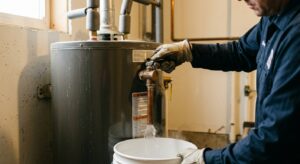
- For boilers: check the pressure gauge on the boiler itself. Normal operating pressure is typically 12 to 15 PSI cold and 15 to 20 PSI hot. Pressure below 10 PSI means the system needs water added via the fill valve. Low pressure causes uneven heating and excess cycling.
- For boilers: bleed any radiators that feel warm at the bottom but cool at the top. Air trapped in the system prevents hot water from circulating fully. Use a radiator bleed key (available for under $5) and open the bleed valve slowly until water, not air, comes out.
- Set your thermostat to the lowest comfortable temperature, ideally 68 degrees Fahrenheit when home and 60 to 62 degrees when asleep or away. Each degree of setback saves roughly 3% on heating bills. On a $1,200 annual bill, dropping from 72 to 68 degrees saves approximately $144 per year.
- Check that all furniture, rugs, and curtains are clear of radiator panels, baseboard convectors, or floor registers. Blocked heat emitters force longer run times and uneven room temperatures.
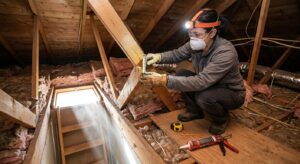
- For forced air: seal all accessible ductwork in unconditioned spaces (attic, basement, crawlspace) using UL 181-rated mastic sealant, not standard duct tape. Focus on joints, elbows, and where ducts connect to the air handler. Studies show this step alone reduces duct losses by 20 to 30%, saving $150 to $400 annually in an average home.
- For forced air: add insulation wrap (R-6 duct wrap, available at home improvement stores for $30 to $60 per roll) around ducts running through unheated spaces. Uninsulated ducts in a 20-degree attic can lose 10 to 20% of their heat content before air reaches the living space.
- For boilers: install thermostatic radiator valves (TRVs) on individual radiators. These $20 to $40 per-valve devices automatically throttle heat to each room based on its actual temperature rather than a single thermostat reading. In a home with 8 to 10 radiators, TRVs typically reduce heating energy use by 10 to 20%.
- For boilers: if your boiler does not have an outdoor reset control, install one. This $150 to $350 device adjusts the boiler’s water temperature based on outdoor temperature, reducing water temperature (and standby losses) on milder days. Properly configured outdoor reset reduces fuel use by 8 to 12% in most climates.
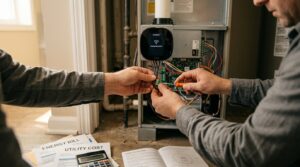
- Replace any standard thermostat with a programmable or smart model. For forced air, a smart thermostat like a Nest or Ecobee ($130 to $250) learns patterns and manages setbacks automatically, saving an average of 10 to 12% on heating costs per ENERGY STAR data. For boilers, confirm thermostat compatibility with your zone controls before purchasing.
- Add a programmable timer to a circulator pump if your boiler still uses a single zone. This keeps the pump from running continuously and reduces pump energy use by up to 50%, saving $30 to $80 per year on electricity alone.
- Have a licensed HVAC technician perform a Manual J load calculation for your home before any replacement. This calculation determines the correct boiler or furnace size based on your actual insulation, windows, and climate. Oversized equipment is one of the most common and costly installation mistakes.
- If replacing a forced air furnace, specify a condensing unit with 95% or higher AFUE (often labeled as a two-stage or variable-speed model). The premium over an 80% AFUE unit is typically $500 to $1,000 but saves $150 to $300 per year, paying back in 3 to 5 years.
- If replacing a boiler, specify a condensing boiler with 90 to 95% AFUE and ensure it is matched with an outdoor reset control from day one. Budget $5,000 to $9,000 installed for a whole-home system. Annual savings over a 70% AFUE unit can reach $400 to $700 for a typical home.
- If converting from forced air to a boiler-based system, recognize that this requires installing radiators, baseboard convectors, or in-floor tubing throughout the home. Full conversion costs $15,000 to $30,000 and rarely pencils out financially unless you are doing a major renovation. A better middle path is a high-efficiency forced air system combined with duct sealing.
- Ask your contractor about available federal tax credits. The Inflation Reduction Act provides a 30% tax credit (up to $600 for furnaces, up to $2,000 for heat pumps, and up to $150 for an energy audit) for qualifying high-efficiency equipment installed through 2032.
- After installation, request a commissioning report showing measured supply and return air temperatures, static pressure, or water flow rates confirming the system is operating within design parameters. A properly commissioned system runs 10 to 15% more efficiently than one that is installed but never adjusted.
Why It Works: The Benefits
Eliminating duct losses alone can reduce effective heating costs by 20 to 30% compared to a leaky forced air system, even if the two furnaces have identical AFUE ratings. In a home spending $1,200 per year on heat, that is $240 to $360 back in your pocket annually.
Homes with radiant boiler heat can typically maintain equivalent comfort at thermostat settings 2 to 4 degrees Fahrenheit lower than forced air homes. At roughly 3% savings per degree of setback, that comfort offset alone saves 6 to 12% on heating costs without any sacrifice in how warm the home feels.
Forced air systems circulate dust, allergens, and mold spores through ductwork. Boiler systems have no ducts and no air movement, eliminating this distribution pathway entirely. Households with allergy or asthma sufferers consistently report measurable air quality improvements after switching to radiant heat.
Quality boilers regularly last 25 to 35 years with proper maintenance, compared to 15 to 20 years for forced air furnaces. Over a 30-year window, you may replace a furnace twice but a boiler only once, saving $3,000 to $6,000 in replacement costs and installation labor.
Adding a heating zone to a hot water boiler system costs $300 to $800 per zone versus $1,500 to $4,000 to retrofit true zoning into a forced air system. Zoning only the rooms you use regularly can cut heating bills by an additional 10 to 20% in homes where large areas are rarely occupied.
💰 Savings Impact by Action
Sealing accessible duct joints with mastic reduces conditioned air loss by 20 to 30%, directly cutting how long the furnace must run to satisfy each thermostat call.
Replacing a 65% AFUE boiler or furnace with a 95% AFUE condensing unit reduces fuel consumption by up to 30% for the same heating output.
Programming setbacks of 8 degrees Fahrenheit for 8 hours per day while sleeping and away saves approximately 10 to 12% on annual heating costs per ENERGY STAR data.
Thermostatic radiator valves allow room-by-room temperature control on boiler systems, reducing whole-home heating energy use by 10 to 20% by avoiding overheating unoccupied spaces.
An outdoor reset controller reduces boiler water temperature on mild days, cutting standby and distribution losses by 8 to 12% annually compared to fixed high-temperature operation.
🏠 Key Concepts Explained
The Science Behind It
The core physics difference between boilers and forced air systems comes down to the medium carrying the heat. Water holds about 3,400 times more heat energy per unit volume than air. That means a small-diameter water pipe can carry the same amount of heat energy as a large duct with a powerful blower fan. Moving heat in water is fundamentally more efficient than moving heat in air, which is why hydronic systems can deliver the same warmth using less pump energy than a blower motor requires to push conditioned air through ductwork.
Radiant heating also exploits a basic principle of human thermal comfort: we lose body heat through four mechanisms, convection, conduction, evaporation, and radiation. Forced air systems work almost entirely by raising air temperature to address convective losses. Radiant systems heat objects and surfaces in the room, which then radiate warmth back to occupants. Research from ASHRAE shows that occupants in radiant-heated environments report equivalent comfort at air temperatures 2 to 4 degrees Fahrenheit lower than in forced air environments. Because the heating load required drops roughly 3% per degree Fahrenheit of setback, this comfort offset creates a built-in efficiency advantage that compounds every hour of the heating season.
Condensing technology is where modern boilers and furnaces close the gap with each other. A standard combustion system exhausts flue gases at 350 to 450 degrees Fahrenheit, sending a significant amount of heat out the chimney. A condensing unit cools flue gases below 140 degrees Fahrenheit, causing water vapor in the exhaust to condense and release its latent heat back into the system. This latent heat recovery is what pushes AFUE ratings from the mid-80s to 95 to 98%. Condensing boilers benefit even more than condensing furnaces from this effect because they can run cooler water temperatures more often, especially with outdoor reset controls that reduce water temperature on mild days, keeping the flue gases in condensing mode for more hours of the season.
Frequently Asked Questions
▼ My forced air furnace runs constantly but the house never feels warm. What is wrong?
The most common causes are a severely clogged air filter restricting airflow, major duct leaks dumping conditioned air into the attic or crawlspace, or an undersized or failing furnace. Start by replacing the filter and checking that all registers are open and unobstructed. If the furnace still cannot keep up on a cold day, call an HVAC technician to measure supply air temperature and static pressure, as those readings quickly identify whether the problem is airflow, duct leakage, or the equipment itself.
▼ Some of my radiators are cold while others are hot. How do I fix this?
Cold radiators on a hot water boiler system usually mean trapped air, a stuck zone valve, or a failed circulator pump for that zone. Start by bleeding each cold radiator using a bleed key until water comes out steadily. If bleeding does not fix it, check that the zone valve for that loop opens fully when the thermostat calls for heat. If both checks pass but the radiator stays cold, the circulator pump for that loop may need replacement, which is a straightforward job for a plumber or HVAC tech costing $150 to $400.
▼ Is it worth switching from forced air to a boiler system for the efficiency savings?
In most cases, a full conversion from forced air to hydronic heat costs $15,000 to $30,000 and has a payback period of 20 to 40 years, which rarely makes financial sense. The better path is upgrading your existing forced air system to a 95% AFUE condensing furnace and sealing your ductwork, which together can capture 80% of the efficiency benefits at 20% of the cost. If you are doing a gut renovation where walls are already open, adding in-floor radiant tubing becomes much more economical and worth serious consideration.
▼ My energy bills went up after I replaced my old furnace with a new high-efficiency model. Why?
High-efficiency condensing furnaces vent through PVC pipe rather than a masonry chimney, which sometimes reveals previously hidden duct leakage because the new system runs at a different static pressure. It is also common for installers to oversize replacement equipment, causing short cycling that reduces real-world efficiency below the rated AFUE. Have a technician verify proper sizing with a Manual J calculation and measure actual duct leakage with a blower door or duct blaster test. Sealing ducts after a furnace replacement is one of the highest-return follow-up steps you can take.
▼ How do I know if my boiler is the right size for my home?
A properly sized boiler should run in long, steady cycles during the coldest days of the year and cycle off before the next call for heat on milder days. If your boiler fires and shuts off every 5 to 10 minutes repeatedly, it is oversized, wasting 10 to 15% of fuel through startup and cooldown losses. Ask a heating technician to perform a heat loss calculation and compare it to your boiler’s rated output. Oversized boilers can sometimes be corrected with an outdoor reset control that lowers firing intensity on mild days, delaying the need for full replacement.
Quick Tips
- Keep interior doors open between rooms to allow heat to distribute more evenly in forced air homes. Closed interior doors create pressure imbalances that push conditioned air out of the building envelope through gaps and cracks.
- Insulate hot water pipes from your boiler to each zone with foam pipe insulation. Bare copper or steel pipes in a cold basement radiate heat into a space you may not be paying to condition, wasting 5 to 8% of the boiler’s output before it reaches living areas.
- If you have baseboard convectors (hot water baseboards, not electric), vacuum the fins inside the covers once per season. Dust accumulation on the fins reduces heat transfer by up to 25% and makes the boiler run longer cycles to reach setpoint.
- Schedule a professional tune-up for any heating system every 2 years for gas equipment and annually for oil-fired equipment. A properly tuned burner can improve combustion efficiency by 5 to 10%, and the technician will catch cracked heat exchangers or failing components before they become safety issues or expensive failures.
Variations for Your Situation
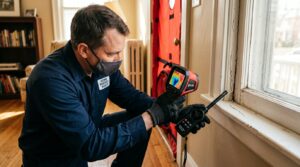
- Apartment/Rental: Most renters have no control over the central heating system type, but you can still improve comfort and reduce your share of heating costs. Use draft snakes or door sweeps on exterior doors ($8 to $20), apply removable window film insulation kits to single-pane windows ($25 to $40 per window), and use a smart plug-in thermostat if you have electric baseboard heat. These steps require no landlord permission and can reduce your personal heating load by 10 to 20%.
- Tight Budget (under $50): Focus on the bleed-and-balance approach for boilers (bleed key costs $5, takes 30 minutes) and filter replacement plus manual thermostat setbacks for forced air systems (filter costs $8 to $15). Together these zero-to-minimal-cost steps can recover 5 to 10% efficiency in a poorly maintained system with no capital investment. Also check that furniture is not blocking radiators or registers, which is a free fix with a measurable impact on run times.
- Older Home (pre-1980): Homes built before 1980 often have original cast iron radiators on gravity-fed or low-pressure steam systems, or oversized ductwork designed for oil furnaces. Cast iron radiators are actually excellent heat emitters and worth keeping if the boiler is upgraded. However, steam systems require a steam-rated boiler, not a hot water model, so confirm your system type before any replacement. For older forced air homes, duct sealing is critical because original sheet metal ducts were rarely sealed at joints and may lose 30 to 40% of conditioned air in unconditioned spaces.