Your air conditioner stopped cooling on the hottest week of the year, and the HVAC technician just handed you a repair quote. Now you are standing at a fork in the road: pay for the repair and hope for the best, or bite the bullet and replace the whole system. It is a decision that can mean the difference between spending $400 today and being done, or spending $400 today only to spend another $1,200 six months from now on a unit that is already on borrowed time.
The repair-versus-replace question is not just about the quote in your hand. It involves your system’s age, its efficiency rating, your local energy costs, available rebates, and a simple but powerful formula called the 5,000 Rule that HVAC professionals actually use. Get this decision wrong in either direction and you either waste money on a dying system or overspend on a replacement you did not yet need.
This post walks you through a clear, step-by-step framework for evaluating your specific situation. You will get real cost ranges, payback period math, efficiency comparisons, and a decision checklist so you can walk into any conversation with a contractor already knowing your answer.
What You’ll Need
Click on an item below to shop for the recommended items for this recipe on Amazon.
As an Amazon Associate, we earn from qualifying purchases.
How to Do It
- Find your system’s age by checking the manufacturer label on the outdoor condenser unit or looking up the serial number on the manufacturer’s website. Most encode the year in the first 4 digits.
- Get the repair quote in writing from your technician. Make sure it itemizes parts and labor separately.
- Apply the 5,000 Rule: multiply your unit’s age by the repair cost. If the result is over 5,000, lean toward replacement. If it is under 3,000, repair is likely fine. Between 3,000 and 5,000 is the gray zone where other factors decide it.
- Check your system’s SEER rating on the yellow EnergyGuide label or the nameplate. If it is below 13 SEER and the unit is over 10 years old, a repair is often just delaying the inevitable.
- Look up whether R-22 refrigerant is involved by checking if ‘R-22’ or ‘HCFC-22’ appears on the unit label. If yes, factor in that any future refrigerant work will cost 4 to 6 times more than on a modern system.
- Make your go or no-go call using the full picture: age, 5,000 Rule result, SEER, refrigerant type, and how many repairs you have done in the past 3 years.
- Check and replace the air filter if it is clogged. A severely dirty filter can cause the evaporator coil to freeze, which mimics compressor failure. A new filter costs $5 to $25 and takes 5 minutes.
- Inspect the circuit breaker panel for a tripped breaker on the AC circuit. Reset it once. If it trips again immediately, stop and call a licensed electrician.
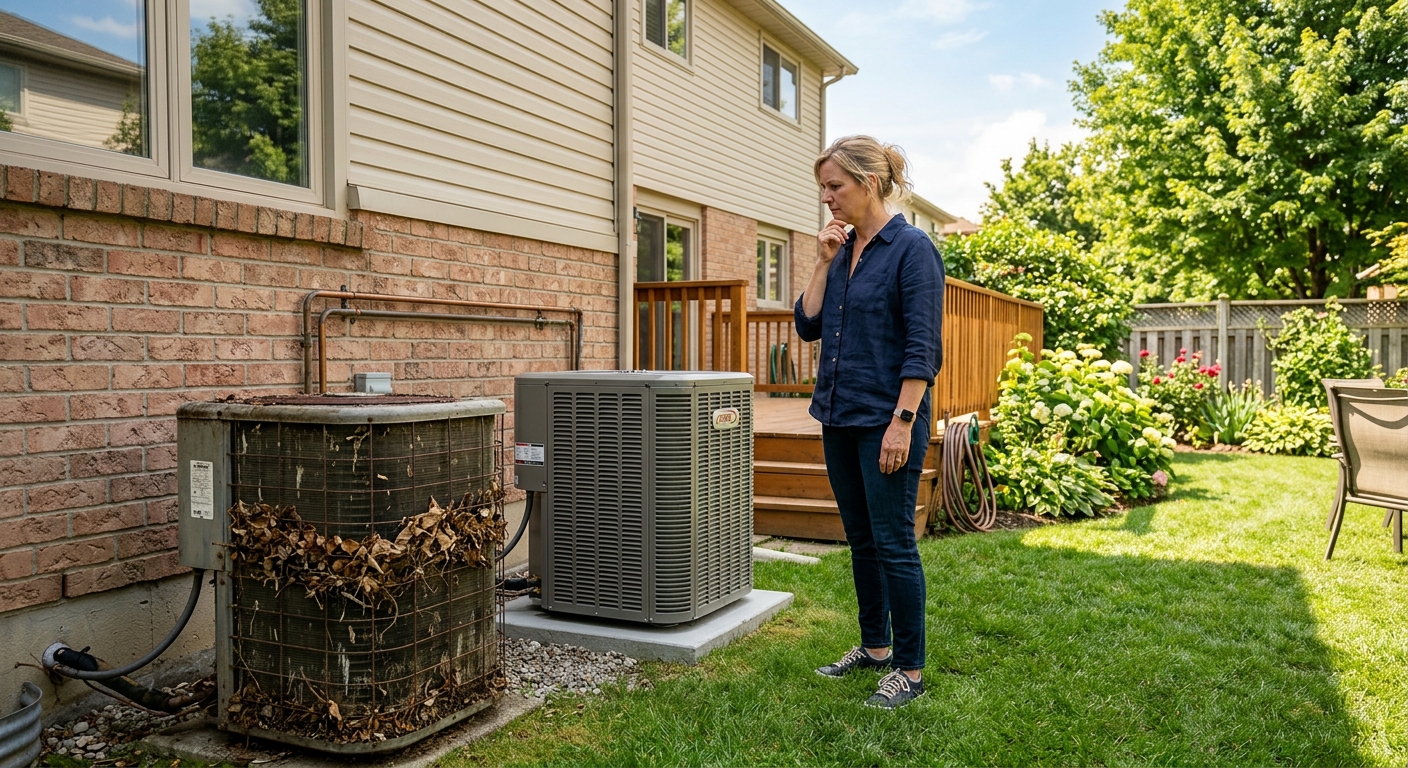
- Go outside and clear debris from around the condenser unit. Grass clippings, leaves, or shrubs within 2 feet restrict airflow and can cause the system to overheat and shut off on a thermal overload.
- Check whether the condensate drain line is clogged by looking for water pooling around the indoor air handler. A clogged drain triggers a float switch that shuts the system off. You can clear a clog with a wet-dry vacuum and a cup of diluted bleach for about $0 cost.
- Use an inexpensive non-contact voltage tester near the outdoor disconnect box to confirm power is reaching the unit before assuming the compressor or capacitor has failed. A failed capacitor costs $15 to $45 in parts and is a common cause of AC not starting.
- Document everything you find and share it with your technician. This helps them diagnose faster and reduces billable labor time, often saving you $50 to $150 on the service call.
- Request that each contractor perform or reference a Manual J load calculation to confirm proper system sizing. Never let a contractor simply match the tonnage of your old unit without verification.
- Compare quotes on the same efficiency tier. Ask for options at 16 SEER2, 18 SEER2, and 20 plus SEER2 so you can evaluate the payback period on the efficiency upgrade using your actual electric rate.
- Ask each contractor about ENERGY STAR certification on the proposed equipment, applicable utility rebates in your area, and the 25C federal tax credit eligibility. A good contractor will know these without being prompted.
- Verify the quote includes proper refrigerant line work, condensate drain inspection, and duct leakage testing if needed. Skipping duct work on a new high-efficiency install wastes 20 to 30% of the system’s efficiency gains.
- Confirm the contractor will pull the required permit. Unpermitted AC replacements can void your homeowner’s insurance and create problems at resale.
- After installation, ask for a commissioning report confirming refrigerant charge, airflow, and static pressure are within manufacturer specifications. An improperly charged system runs up to 20% less efficiently from day one.
Why It Works: The Benefits
Replacing a 15-year-old 10 SEER unit with a new 18 SEER system can cut cooling electricity use by 40 to 45%, saving the average homeowner $200 to $600 per cooling season depending on climate and home size.
AC systems older than 10 years break down an average of twice as often as newer systems. Eliminating repeated repair bills of $200 to $1,500 each can save hundreds to thousands of dollars over a 5-year window.
Modern variable-speed systems maintain more consistent temperatures and remove 30 to 50% more humidity than single-stage units of the same capacity, which directly affects how comfortable 76 degrees feels inside your home.
A qualifying ENERGY STAR-certified system with a SEER2 rating of 16 or higher may qualify for a 30% federal tax credit up to $600 plus utility rebates, effectively reducing your out-of-pocket replacement cost by $700 to $1,100 in many regions.
A new central AC system adds an average of $5,000 to $12,000 to home resale value according to Remodeling magazine’s Cost vs. Value Report, and buyers strongly prefer homes where major systems are recently replaced.
💰 Savings Impact by Action
Replacing a 10 SEER unit with an 18 SEER system reduces cooling electricity consumption by approximately 40% for the same amount of cooling output.
Sealing leaky ductwork recovers 25 to 40% of conditioned air that would otherwise escape into unconditioned attic or crawlspace before reaching living areas.
Professionally cleaning fouled evaporator and condenser coils on an older system can restore 5 to 10% of lost efficiency for a one-time cost of $100 to $200.
Correcting an oversized or undersized system through a proper Manual J load calculation and right-sizing the replacement unit can reduce energy waste by 15 to 20%.
Programming a 7 to 10 degree setback during work hours and overnight saves approximately 10% annually on cooling costs according to DOE estimates.
🏠 Key Concepts Explained
The Science Behind It
Every air conditioner works on the same basic refrigeration cycle: refrigerant absorbs heat from the air inside your home at the evaporator coil, gets compressed into a high-pressure hot gas by the compressor, releases that heat outside at the condenser coil, and then expands back into a cool low-pressure liquid to start the cycle again. The SEER rating measures how efficiently that cycle converts electricity into cooling. A 10 SEER unit uses 1 watt of electricity to move roughly 10 BTUs of heat. A 20 SEER unit moves 20 BTUs per watt, which is why upgrading nearly halves your cooling electricity consumption.
Efficiency degrades over time even without visible failures. Studies from the Florida Solar Energy Center found that AC systems lose an average of 5 to 7% of their rated efficiency per decade due to compressor wear, refrigerant charge drift, and coil fouling. A 14-year-old unit rated at 12 SEER when new may be operating at an effective 9 to 10 SEER today, meaning you are already paying significantly more per cooling BTU than the nameplate suggests. This hidden efficiency loss is why the repair-versus-replace math often favors replacement earlier than homeowners expect.
Refrigerant charge is also critical to understanding why repairs sometimes make sense in the short term. A system that is low on refrigerant due to a small leak will run longer run cycles, ice up the evaporator coil, and stress the compressor with elevated discharge temperatures. Fixing a minor leak and recharging refrigerant on a newer system in good condition is often genuinely cost-effective. On an older system, the same repair buys you months rather than years before the next failure, which is exactly the scenario the 5,000 Rule is designed to flag.
Frequently Asked Questions
▼ My AC is only 7 years old and needs a $1,400 compressor. Should I still replace the whole system?
At 7 years old with a $1,400 repair, the 5,000 Rule gives you 9,800, which normally points toward replacement. However, if your unit is still under the manufacturer’s 10-year compressor warranty (which most units carry if registered), the compressor itself may be covered and you would only pay labor of $300 to $500. Check your warranty before making any decision, as this changes the math significantly.
▼ The contractor says I need a new system but it seems like they are just trying to upsell me. How do I know if the diagnosis is legitimate?
Ask the technician to show you the specific readings that indicate failure, such as capacitor microfarad readings, refrigerant pressure measurements, or compressor amp draw versus rated amp draw on the nameplate. Legitimate diagnoses have measurable data behind them. If they cannot show you the numbers, get a second opinion from an independent contractor, not a company affiliated with the first.
▼ How long before I actually see savings on my bill after replacing my old AC?
You will see lower bills on your first full cooling season billing cycle, typically within 30 to 60 days of installation if you replace during summer. Homeowners replacing a 10 to 12 SEER unit with an 18 SEER system commonly report 30 to 40% reductions in their summer electric bills immediately. Track the savings by comparing the same months year over year, not month to month, since weather variability affects the comparison.
▼ Can I negotiate the price of a new AC system?
Yes, and most homeowners do not try. Contractors mark up equipment by 30 to 50%, and there is real room to negotiate especially at the end of the cooling season in September and October when demand is low. Getting three quotes is the most effective lever, but you can also ask contractors to match a competitor’s price or offer a discount for scheduling during a slower week. Financing promotions with 0% interest are also common and worth asking about.
▼ What if my ductwork is old too? Does that change the replace decision?
Significantly. Leaky ductwork can waste 25 to 40% of conditioned air before it reaches your living space, which means a brand-new high-efficiency system will underperform if the ducts are not sealed. Ask your contractor to test duct leakage with a duct blaster test before finalizing the replacement quote. Duct sealing typically costs $300 to $1,000 and often improves comfort more noticeably than the new system itself.
Quick Tips
- Schedule any AC service call in spring before peak season demand. Diagnostic rates and labor costs can be 10 to 15% lower in April than in July.
- Keep a written log of every AC repair with dates and costs. This record is the single most useful document when applying the 5,000 Rule or negotiating with contractors.
- If you decide to replace, ask your contractor to quote both a standard split system and a heat pump. In mild climates, a heat pump can replace both your AC and gas furnace, with operating costs 30 to 40% lower than separate systems.
- Check your utility company’s website before any replacement. Many utilities offer rebates that are only accessible before installation, not after. Missing this step is one of the most common and expensive oversights homeowners make.
Variations for Your Situation
- Apartment or Condo: If you own a condo or rent an apartment where HVAC decisions go through your landlord or HOA, your role is to document problems in writing and request repairs formally. As a renter, repair costs are typically your landlord’s responsibility under most state habitability laws. If you own a condo, check your HOA documents to confirm whether the AC unit inside your unit is your responsibility or common property, as this varies widely and affects who pays for replacement.
- Tight Budget (under $500): If replacement is not financially possible right now, focus on maximizing the remaining life of your current system. Replace the air filter monthly during summer, have the coils professionally cleaned for $100 to $200 (which can recover 5 to 10% efficiency), and install a programmable thermostat for $25 to $50 to reduce runtime. These steps can extend a marginal system one to two more seasons while you save toward replacement.
- Older Home (pre-1980): Homes built before 1980 often have undersized ductwork, poor insulation, and high air leakage that cause any AC system to work harder than designed. Before replacing your AC in an older home, invest $300 to $500 in a home energy audit to identify whether air sealing and insulation improvements would reduce the required system size. Downsizing from a 4-ton to a 3-ton unit while tightening the envelope can cut both equipment cost and operating cost simultaneously.