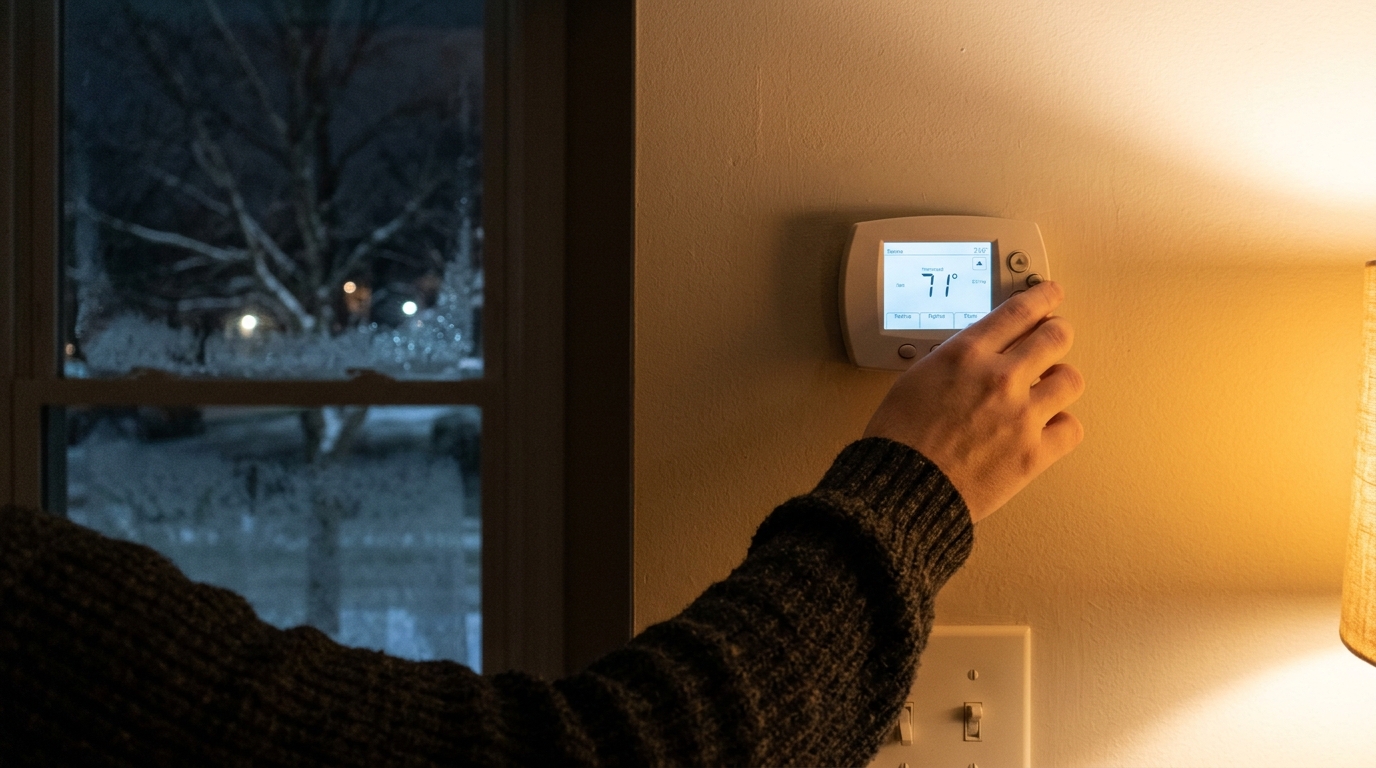
It is 2 a.m., the temperature outside is 8 degrees, and you hear your furnace fire up, run for three minutes, and shut off. Ten minutes later, it does it again. This pattern is called short-cycling, and it tends to get worse right when you need heat the most. A healthy furnace typically runs 10 to 15 minutes per cycle on a cold day, and a short cycle is anything under about 5 minutes.
Short-cycling matters because the startup phase is the least efficient part of a heating cycle. Every time the burner ignites, the heat exchanger has to warm up, the blower ramps in, and a surge of wear hits the igniter, inducer motor, and flame sensor. A furnace that cycles 6 to 8 times an hour instead of 2 to 3 can lose 10 to 20% of its seasonal efficiency and may fail years earlier than it should.
Cold nights make the problem worse for a few specific reasons: higher airflow demand, filters loaded with weeks of dust, thermostat placement quirks, and safety switches that trip when conditions get marginal. This post walks through why it happens, what you can fix yourself this weekend, and when it is time to call a licensed HVAC technician.
What You’ll Need
Click on an item below to shop for the recommended items for this recipe on Amazon.
As an Amazon Associate, we earn from qualifying purchases.
How to Do It
- Turn the furnace off at the thermostat, then slide out the air filter. If you cannot see light through it, replace it. Use the size printed on the old filter’s frame.
- Walk the house and open every supply register and return grille at least 75% of the way. Move furniture, rugs, or drapes that block them.
- Check that nothing is stacked against the furnace’s return air opening, such as storage boxes or laundry.
- Look at your thermostat’s location. If it is within 6 feet of a supply register, in direct sunlight, or on a drafty exterior wall, note it for the DIY approach.
- Go outside and inspect the exhaust and intake vents (white PVC pipes on a high-efficiency furnace). Clear any snow, ice, leaves, or nests from the terminations.
- Restart the furnace and watch two full cycles. A healthy cycle runs at least 8 to 10 minutes on a cold night.
- Turn off the furnace power switch and close the gas shutoff valve. Remove the front access panel.
- Locate the flame sensor, a thin metal rod positioned in front of the burner flame, held by a single 1/4-inch screw. Remove it carefully.
- Gently clean the rod with fine steel wool or a very light grade of sandpaper (320 to 400 grit) until it is shiny. Wipe with a dry cloth. Do not touch it with bare fingers afterward.
- Reinstall the sensor, replace the panel, restore power, and reopen the gas valve. Run a full heating cycle.
- On a high-efficiency furnace, check the condensate drain line and trap for clogs. Pour a cup of warm water through the trap and confirm it drains freely.
- Adjust the thermostat’s cycle rate or heat anticipator if it has that setting. A setting of 3 cycles per hour (CPH) is typical for gas furnaces. Consider moving the thermostat to an interior hallway wall about 5 feet off the floor if the location is poor.
- Close the exterior vent terminations check by looking for frost buildup on very cold mornings. If frost forms, call a pro about extending or re-routing the vent.
- Ask the technician to measure temperature rise across the furnace and compare it to the range on the data plate (typically 35 to 65 degrees F). A rise above the range confirms restricted airflow.
- Have static pressure measured across the system. Readings above about 0.5 inches of water column point to undersized ducts, a dirty coil, or closed dampers.
- Request a combustion and heat exchanger inspection. A cracked heat exchanger is a safety hazard and usually means replacement.
- If the unit is oversized by 30% or more, ask about a two-stage or modulating furnace. These run longer at lower output and can cut short-cycling dramatically.
- Schedule a duct leakage test if your ducts run through the attic or crawlspace. Sealing with mastic (not tape) typically costs $400 to $1,200 and can recover 10 to 20% of lost heat.
Why It Works: The Benefits
Cutting short-cycling can improve real-world efficiency by 10 to 20%. On a $1,200 annual heating bill, that is $120 to $240 per year.
Fewer startups means less wear on the igniter, inducer motor, and blower motor. A furnace that cycles properly often lasts 5 or more years longer than one that short-cycles for a decade.
Longer, steadier run cycles let warm air reach distant rooms. Short bursts heat the rooms nearest the furnace and leave the far bedrooms cold.
Every startup comes with ignition clicks, inducer whine, and blower ramp noise. Reducing cycles from 8 to 3 per hour makes a noticeable difference at night.
Fixing the root cause now prevents a no-heat call on the coldest night of the year, when emergency service rates can run $200 to $400 above normal.
💰 Savings Impact by Action
Restoring full airflow with a clean filter can cut cycling and reduce fuel use by about 5 to 15%.
Eliminating nuisance shutdowns restores full-length cycles and efficiency, saving roughly 5 to 10%.
Sealing leaks with mastic can recover 10 to 20% of heated air lost in unconditioned spaces.
Relocating or upgrading a poorly placed thermostat removes false readings and early cycle terminations.
Replacing an oversized, aging unit with a two-stage or modulating high-efficiency model can cut heating fuel use by 20 to 30%.
🏠 Key Concepts Explained
The Science Behind It
A furnace is designed to move a specific volume of air across a heat exchanger while the burners run. Gas furnaces are typically rated for a temperature rise between 35 and 65 degrees F. When airflow drops, because of a dirty filter, closed registers, or leaky returns, the same heat gets dumped into less air. The heat exchanger temperature climbs, and the high-limit switch, usually set around 200 to 220 degrees F, opens the burner circuit. The blower keeps running until things cool, the switch resets, and the cycle starts again. That is a classic short-cycle.
Cold nights stress the system further. Outdoor air is denser and drier, ducts in unconditioned spaces lose more heat, and the furnace has to run closer to its rated capacity. Filters that were borderline in October are often fully loaded by January. High-efficiency condensing furnaces add another layer: they extract so much heat from exhaust gas that the vent pipe runs only slightly above ambient temperature, so frost and condensation can partially block the vent or freeze the condensate trap, tripping the pressure switch.
Oversizing explains why some homes short-cycle even with spotless filters. A furnace sized for the coldest design day of the year (say, 0 degrees F) will be 2 to 3 times larger than the home needs on a typical 30 degree night. It raises the indoor temperature to the setpoint in just a few minutes, shuts off, the house coasts down 1 to 2 degrees, and the cycle repeats. Two-stage and modulating furnaces solve this by matching output to the actual load, often running 60 to 80% of the time at low fire for far longer, steadier cycles.
Frequently Asked Questions
▼ Why does my furnace short-cycle only on the coldest nights?
Cold weather pushes your furnace closer to its maximum output, so any marginal airflow restriction, such as a half-clogged filter or a partially blocked vent, becomes a shutdown trigger. Frost on a high-efficiency furnace’s exhaust or intake pipe is another common cold-night culprit. Start by replacing the filter and inspecting the outdoor vent terminations for ice or snow.
▼ How many cycles per hour is normal for a furnace?
Most gas furnaces should run about 2 to 3 cycles per hour on a cold day, each lasting 10 to 15 minutes. More than 5 cycles per hour, or runs under 5 minutes, indicate short-cycling. Time it with your phone for a full hour to get a real number before calling a technician.
▼ Is a short-cycling furnace dangerous?
Usually it is a nuisance and an efficiency problem, not an immediate hazard, because safety switches are doing their job by shutting the unit down. It becomes dangerous if you notice soot, yellow flames, gas odor, or a cracked heat exchanger, or if someone bypassed a safety switch. Make sure your CO detectors work, and call a pro if the problem persists after basic fixes.
▼ Can a bad thermostat cause short-cycling?
Yes. A thermostat that is poorly placed, has a failing sensor, or has an incorrect heat anticipator or cycle-rate setting can end cycles early. Try replacing the batteries first, then check its location. If it hangs near a supply register or in direct sun, relocating it or swapping to a modern programmable or smart model ($25 to $150) often solves it.
▼ Should I replace my furnace if it is oversized?
Not necessarily. If the unit is under 15 years old and otherwise healthy, try fixing airflow and ducts first. If it is 15 to 20 years old, has a 80% AFUE rating, and short-cycles badly, replacing it with a properly sized two-stage or modulating 95%+ AFUE unit can cut gas use by 20 to 30% and often pays back in 6 to 10 years, helped by available rebates and tax credits.
Quick Tips
- Replace 1-inch filters every 1 to 3 months during heating season, and every month if you have pets or recent construction dust. Check by holding the filter up to a light.
- Keep a spare filter on hand before the first cold snap so you never run a dirty one through a hard freeze.
- Do not close more than 10 to 20% of your registers to “save heat” in unused rooms. It raises static pressure and can trigger limit-switch cycling.
- Mark your calendar for an annual professional tune-up in early fall. A $90 to $150 visit catches flame sensor, igniter, and blower issues before they fail on the coldest night.
Variations for Your Situation
- Apartment/Rental: You usually cannot touch the furnace, but you can still check the filter (ask the landlord for its size and location), open all registers, keep furniture off returns, and move a portable thermometer to see if the thermostat reads accurately. Document the short-cycling with timestamps and send it to your landlord in writing. Most leases require them to repair heating equipment promptly.
- Tight Budget (under $50): Replace the filter ($5 to $15), clear every register and return, clean the flame sensor with steel wool (under $5), and clear the outdoor vents. Add a $10 to $20 indoor thermometer to compare against your thermostat. These four steps resolve a large share of short-cycling for under $50.
- Older Home (pre-1980): Expect leakier, undersized or poorly balanced ductwork and a furnace that was sized by rule of thumb, often 40 to 60% too large. Prioritize sealing visible duct joints with mastic, adding or enlarging return air paths, and air sealing and insulating the attic. Reducing the house’s heat loss shrinks the load further, so ask about right-sizing when it is time to replace the unit.