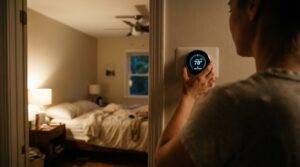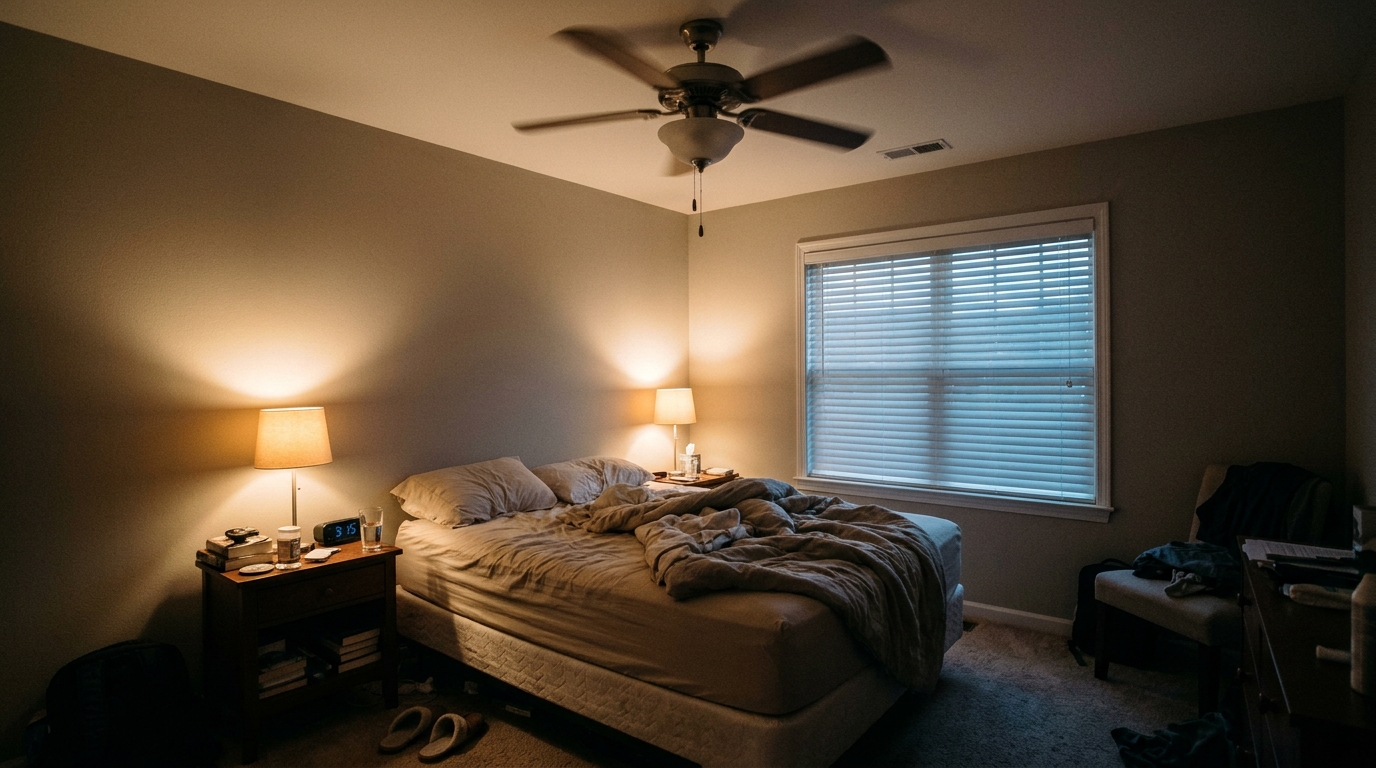
It is one of the most common home cooling beliefs: leave the ceiling fan running all night, even in rooms you are not using, and the house will stay cooler. It feels logical, and the gentle hum of a fan is comforting. The problem is that a ceiling fan does not lower the air temperature at all. It moves air across your skin, which speeds up evaporation and makes you feel roughly 4 degrees Fahrenheit cooler. In an empty room, that effect is wasted.
That does not mean fans are useless at night. Used correctly, a ceiling fan in the room where you actually sleep lets you raise your thermostat setpoint by 3 to 4 degrees while staying just as comfortable. Every degree you raise your cooling setpoint saves about 3 percent on cooling costs, so the fan is the tool that unlocks real savings. A typical ceiling fan uses 15 to 75 watts, compared to 2,000 to 4,000 watts for a central AC system.
This post separates the myth from the math. You will learn where fans actually help, which rooms to leave them off in, how to set your fan direction correctly for summer, and how to pair fans with your thermostat for the biggest drop in your bill without sacrificing sleep quality.
What You’ll Need
Click on an item below to shop for the recommended items for this recipe on Amazon.
As an Amazon Associate, we earn from qualifying purchases.
How to Do It
- Walk through your home and turn off ceiling fans in every room that will be empty overnight (living room, kitchen, home office, guest rooms).
- Confirm the fan in your bedroom spins counterclockwise when viewed from below. Flip the small switch on the fan motor housing if it does not.
- Set the bedroom fan to low or medium speed so it provides a gentle breeze across the bed without being noisy or drafty.
- Raise your thermostat setpoint by 3 to 4 degrees at bedtime (for example, from 74 to 77 degrees Fahrenheit).
- Give it three or four nights to adjust, then fine-tune the setpoint up or down by one degree until you find your sweet spot.
- Measure your bedroom. Rooms up to 144 square feet need a 42 to 44 inch fan; rooms of 144 to 225 square feet need 50 to 54 inches. An undersized fan will not move enough air to matter.
- Choose an ENERGY STAR certified fan with a DC motor, which uses up to 70 percent less energy than older AC motor models and runs quieter at low speeds.
- Turn off the circuit breaker, confirm power is off with a voltage tester, then mount the fan on a fan-rated electrical box (a standard light fixture box is not strong enough).
- Add a remote or smart wall control with a timer or sleep mode so the fan shuts off automatically after 4 to 6 hours, once your body has settled into deeper sleep.
- Program your smart thermostat to raise the setpoint 3 to 4 degrees between 10 p.m. and 6 a.m., then return to your normal temperature before you wake.
- Track your electric bill for two billing cycles to measure the change and adjust fan speed or setpoint as needed.
- Have an electrician assess whether bedrooms have existing fan-rated boxes and wiring, or whether new circuits and braces are required.
- Request downrods sized correctly for your ceiling height so blades sit 8 to 9 feet above the floor for the best airflow.
- Ask for dual-switch wiring or smart controls so fans and lights operate independently and can be scheduled.
- Have the installer balance and test each fan to prevent wobble, noise, and loose mounts, which become safety concerns over time.
Why It Works: The Benefits
Raising your thermostat 4 degrees overnight and using a bedroom fan can cut cooling energy use by roughly 10 to 12 percent, saving $15 to $40 a month in peak summer for many homes.
A 50 watt ceiling fan running 8 hours costs about 6 cents at the national average of 16 cents per kWh. Central AC for the same period can cost $1 to $2 or more.
Gentle airflow helps with heat dissipation and reduces that sticky, stuffy feeling, so many people fall asleep faster even at a higher thermostat setting.
Less runtime means fewer compressor cycles, which can extend the life of your system and reduce the chance of mid-summer breakdowns.
Turning off fans in empty rooms across a 4 fan home can save 100 to 200 kWh per year, which adds up to $15 to $35 annually.
💰 Savings Impact by Action
Raising your nightly setpoint 4 degrees with a fan providing comfort saves about 3 percent per degree on cooling energy.
Turning off fans in empty rooms eliminates wasted motor electricity and a small amount of added heat.
Swapping an older AC motor fan for an ENERGY STAR DC motor model cuts the fan’s own electricity use by up to 70 percent.
Auto shutoff after 4 to 6 hours trims fan runtime by half with no loss in comfort for most sleepers.
🏠 Key Concepts Explained
The Science Behind It
The key to understanding ceiling fans is that they work on people, not on air temperature. Your body sheds heat through a thin layer of warm, humid air hugging your skin. A fan blows this layer away and replaces it with drier, cooler room air, which speeds up evaporation and heat loss. This is the wind chill effect, and studies from the Florida Solar Energy Center show it can make you feel 3 to 5 degrees cooler at typical indoor air speeds.
Because the fan does nothing to the room air temperature, it also does nothing in an empty room. In fact, a fan motor converts nearly all of its electrical input into heat, so a fan running in an unoccupied room very slightly warms it. That is why energy experts consistently say to treat fans like lights: turn them off when you leave.
The savings come from the thermostat. Your air conditioner works harder the bigger the gap between indoor and outdoor temperature. Raising your setpoint from 74 to 78 degrees can shrink that gap enough to reduce cooling energy use by 10 to 12 percent. The fan, costing only a few cents per night, makes that higher setpoint feel comfortable. The result is a large reduction in a big energy load paid for by a very small one.
Frequently Asked Questions
▼ Why is my AC still running all day even after I raised the setpoint and turned on the fan?
Check for the usual culprits first: a dirty air filter, blocked supply vents, and leaky ducts can all force your AC to run longer. Also confirm the fan is only helping people, not cooling rooms, so a setpoint above 78 degrees may still feel warm in unoccupied areas. If the system runs constantly even on mild days, have an HVAC technician check refrigerant levels and airflow.
▼ Can renters do this without landlord permission?
Yes. Renters can use portable pedestal or tower fans aimed at the bed, which give the same wind chill benefit as a ceiling fan with no installation. A quality tower fan costs $40 to $100 and uses 30 to 60 watts. Just avoid replacing a ceiling fixture without written permission from your landlord.
▼ How long before I actually notice savings on my bill?
You will see the effect in your next billing cycle if you consistently raise the setpoint and turn off unused fans. Savings of 5 to 12 percent on cooling costs are typical, though weather swings can hide the change. Compare your kWh usage (not just the dollar amount) against the same month last year for the clearest picture.
▼ What if my home is older than 30 years?
Older homes often have leakier ducts and less attic insulation, so fans help even more because your AC works harder. Have an electrician confirm your wiring can handle a new fan and that the ceiling box is fan-rated. Sealing attic bypasses and adding insulation to R-38 will amplify the savings from the fan and setpoint change.
▼ Is it ever worth leaving a fan on in an empty room?
In a few cases, yes. A fan in a very humid space such as a bathroom or basement can help prevent moisture buildup, and gentle air circulation in a room with a pet may be worthwhile. In general living spaces and bedrooms, turn it off when nobody is there.
Quick Tips
- Use the fan in the room where you actually sleep, and turn it off in every empty room to avoid wasted electricity and extra heat.
- Check the fan direction twice a year: counterclockwise in summer, clockwise on low in winter to gently push warm air down off the ceiling.
- Choose a DC motor ENERGY STAR fan for bedrooms. It runs nearly silent on low and uses around 15 to 30 watts instead of 60 to 75.
- Start with a 2 degree thermostat increase and bump it up gradually until you find the highest setpoint where you still sleep comfortably.
Variations for Your Situation
- Apartment/Rental: Skip the ceiling installation and use a quiet tower or pedestal fan aimed at your bed. Look for models with a sleep timer and low noise ratings, typically $40 to $100. Combine it with blackout curtains and a 3 to 4 degree thermostat bump, and you can capture most of the savings without touching the fixtures.
- Tight Budget (under $50): Turn off ceiling fans in empty rooms, flip your bedroom fan to counterclockwise, and raise your nightly thermostat setpoint by 3 degrees. That costs nothing and can still trim 8 to 10 percent off cooling bills. If you need airflow, a $25 to $40 box fan placed safely near the bed works well.
- Older Home (pre-1980): Confirm the ceiling box is rated for a fan, since many older boxes are not and can fail under the fan’s motion. Pair the fan with attic insulation up to R-38 and sealed duct joints, because older homes lose more cooled air and benefit more from the setpoint offset the fan makes possible.
- High Humidity Climate: In humid regions, fans feel less effective because sweat evaporates more slowly. Keep the fan on, but also run your AC or a dehumidifier to hold indoor humidity near 50 percent, which makes the same airflow feel noticeably cooler.