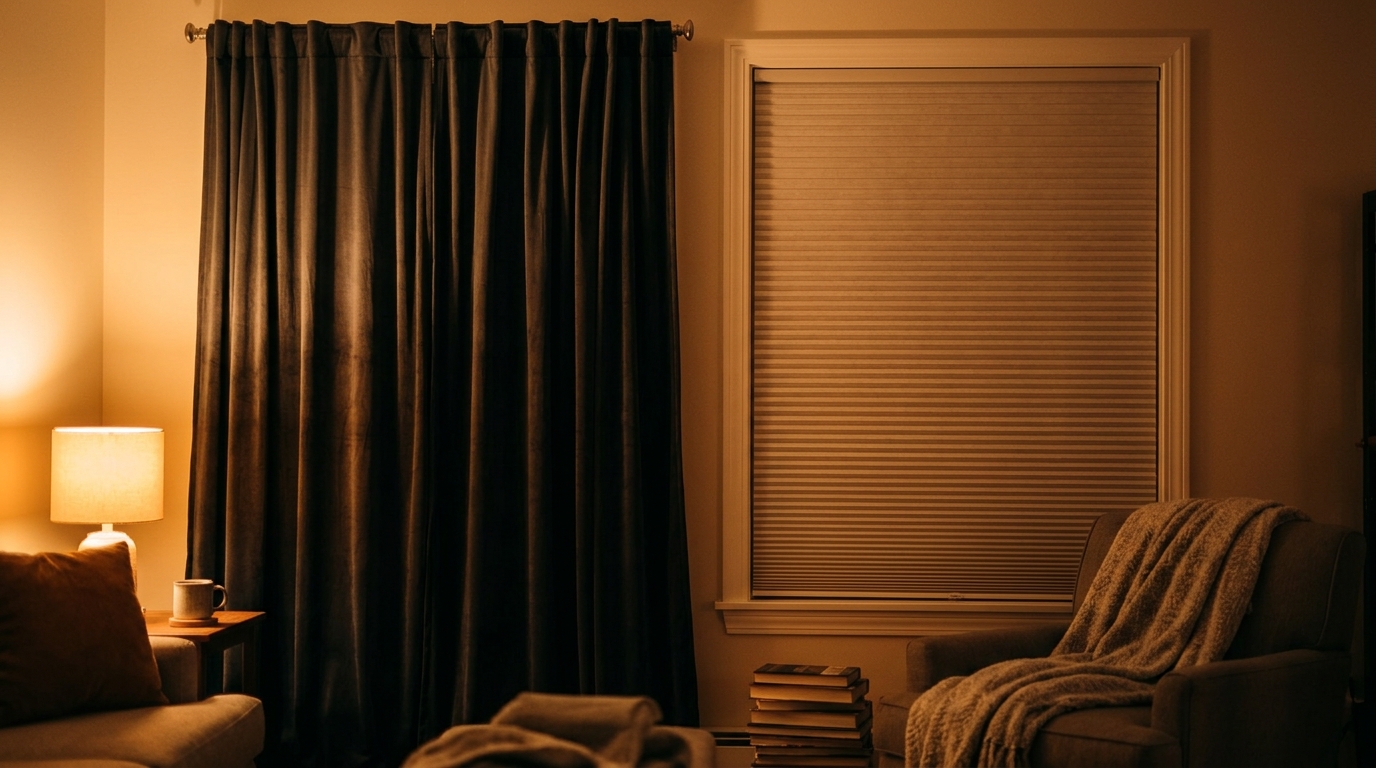
If you have ever sat near a window on a winter evening and felt a cold draft on your face, you have experienced what the Department of Energy has been telling homeowners for years: windows are the weakest thermal link in most houses. A standard double-pane window has an R-value of roughly R-2 to R-3, compared to R-13 to R-20 for a typical insulated wall. After sunset, when solar heat gain stops and outdoor temperatures drop, that thin glass becomes a radiator pointed in the wrong direction.
Window coverings are the cheapest way to fight back, but the internet is full of conflicting advice. Cellular (honeycomb) blinds promise trapped air pockets and tight fits. Thermal curtains promise thick, quilted layers you can install in minutes. Which one actually holds more heat in your living room at 2 a.m.? The honest answer is that it depends on fit, fabric, and how you use them.
In this post we break down how each option really performs, what the DOE and lab testing suggest about savings, what each costs, and how to choose based on your budget, your windows, and whether you rent or own. You will also get two step-by-step approaches, a quick fix you can finish tonight and a more serious DIY upgrade, plus answers to the questions homeowners ask most.
What You’ll Need
Click on an item below to shop for the recommended items for this recipe on Amazon.
As an Amazon Associate, we earn from qualifying purchases.
How to Do It
- Measure the width of the window and the height from the curtain rod location to the floor or sill. Plan for curtains that are at least 1.5 to 2 times the window width so they hang in full folds rather than stretched flat.
- Choose thermal curtains with a tight weave and an insulating backing, such as foam or multilayer lining. Look for products described as thermal or blackout with a dense lining, since thin decorative panels add almost no R-value.
- Mount the rod as close to the wall and ceiling as possible, and extend it 4 to 6 inches beyond each side of the window frame. This lets the curtain overlap the wall and reduces side leakage.
- Let the curtains hang to the floor or at least 1 inch below the sill, and use wraparound or return rods so the sides touch the wall. A gap at the top or sides lets cold air circulate into the room.
- Close the curtains at dusk and open them on sunny days. Tuck the bottom edge against the sill or add a small magnet or hook system to hold the sides closed against the wall.
- Measure each window opening three times, at the top, middle, and bottom, for width and at left, center, and right for height. Use the smallest width and the tallest height for an inside mount, and write measurements to the nearest 1/8 inch.
- Order double-cell cellular shades for the best insulation. Pick a light-filtering or blackout fabric, and consider options with side tracks or channel guides, which block air movement along the edges far better than standard shades.
- Mark bracket locations with a pencil and level, then pre-drill pilot holes and install the mounting brackets with the supplied screws. Use wall anchors if you are not hitting wood framing.
- Snap the headrail into the brackets, install any side tracks flush against the window frame, and test the shade by raising and lowering it fully. Check that the bottom rail sits level and seals against the sill.
- Fill any visible gaps between the shade and frame with removable rope caulk or foam weatherstripping tape. Open shades on south-facing windows during sunny winter days and close all shades at dusk.
- Install cellular blinds as described above so they sit inside the window opening and seal tightly against the frame.
- Add a curtain rod outside the frame, extending 4 to 6 inches beyond each side and positioned 2 to 4 inches above the window.
- Hang thermal curtains that fall to the floor or sill, creating a second sealed air pocket in front of the blinds.
- Close both layers at night. In the morning, open the curtains first and the blinds second so you can capture the best solar gain without losing the privacy benefits of the blinds.
Why It Works: The Benefits
The DOE estimates that well-fitted cellular shades can reduce winter heat loss through windows by roughly 20 to 40 percent. That typically translates to 3 to 8 percent off a whole-home heating bill, or about $30 to $100 per year for an average household.
Reducing radiant heat loss to cold glass raises your mean radiant temperature, so a room can feel 2 to 4 degrees warmer without touching the thermostat. Many homeowners lower the setpoint a degree or two as a result, saving about 1 to 3 percent per degree.
Sealing the perimeter of a window reduces the convective loop that pushes cold air across floors and seating areas. This improves comfort near windows even when the glass itself is unchanged.
Keeping interior air away from cold glass can lessen condensation on the pane. Just be sure to open coverings during the day, since trapping moisture against glass can encourage mold on frames.
The same coverings that hold in heat at night can block solar gain in summer. Closing insulated shades on sun-exposed windows can cut cooling-related heat gain by up to 40 percent, according to DOE guidance.
💰 Savings Impact by Action
Well-fitted double-cell shades can reduce winter window heat loss by 20 to 40 percent by trapping still air against the glass.
Heavy lined curtains sealed at the edges cut window heat loss by roughly 10 to 25 percent depending on fit and fabric.
Blocking convective air loops at the top and sides of a covering can nearly double its effective insulating value.
Pairing cellular blinds with thermal curtains can reduce window heat loss by 40 percent or more by creating two sealed air pockets.
Closing coverings at dusk and opening them on sunny days can add roughly 5 to 10 percent in extra seasonal savings.
🏠 Key Concepts Explained
The Science Behind It
Heat moves three ways: conduction, convection, and radiation. A bare window loses heat through all three at once. Warm indoor air touches the cold glass, cools, and sinks, creating a steady convective current that sweeps across the floor. Meanwhile, your body and warm surfaces radiate infrared energy toward the cold pane, and heat conducts directly through the glass and frame to the outdoors.
A window covering works by interrupting those paths. Cellular blinds are especially effective because their honeycomb cells trap still air, which has a thermal conductivity of about 0.026 W/m-K, far lower than glass at roughly 1.0 W/m-K. Double-cell designs create two stacked air pockets and can reach an added R-value of roughly R-4 to R-5 when sealed. Curtains rely on fabric thickness, lining, and the air gap behind them. A heavy multilayer drape can add R-1 to R-3 on its own, but its performance depends heavily on whether the edges are sealed against the wall.
The reason fit matters so much is convective looping. If a curtain hangs loose at the sides or leaves a gap at the top, warm room air slips behind the fabric, cools against the glass, and drops out the bottom, carrying heat with it. This effect can reduce the nominal R-value of a covering by half or more. Blinds with side tracks, tight inside mounts, and curtains that seal to the wall or floor keep the air pocket still, which is what actually makes the insulation work.
Frequently Asked Questions
▼ Why do my windows still feel cold even after I hung thermal curtains?
The most common cause is air leakage around the sides, top, and bottom of the curtain. Extend the rod past the window frame, let the fabric reach the sill or floor, and tuck the edges against the wall with magnets or hook-and-loop tape. Also check that the window itself is caulked and weatherstripped, because no covering can fix a draft that comes from the frame.
▼ Can renters install insulated blinds or curtains without losing their deposit?
Yes. Tension rods, adhesive hooks, and removable magnetic strips let you hang thermal curtains without drilling. Inside-mount cellular shades often use small brackets that leave only tiny screw holes, and many brands sell no-drill or stick-on options. Take photos before you install and keep the original hardware so you can restore the window when you move out.
▼ How long before I actually notice savings on my heating bill?
You will feel the comfort difference the first night, but bill savings show up within one billing cycle in cold weather. Expect roughly 3 to 8 percent off your winter heating costs if you cover most windows, with the biggest gains on north-facing and single-pane windows. Compare your usage in kilowatt-hours or therms rather than dollars to account for rate changes.
▼ What if my home is older than 30 years with leaky single-pane windows?
Older windows benefit the most from coverings, because their baseline heat loss is much higher. Start with caulking and weatherstripping or a removable interior storm panel kit, then add cellular shades or heavy lined curtains on top. Layering these upgrades can cut window heat loss by 40 to 50 percent, which often costs less than replacing the windows.
▼ Will closed blinds or curtains cause mold on my windows?
They can if you keep them closed around the clock in a humid home. Trapped moisture against cold glass can lead to condensation and mildew on the frame. Open coverings for a few hours each day, run bathroom and kitchen exhaust fans, and keep indoor humidity between 30 and 50 percent in winter.
Quick Tips
- Close coverings at dusk and open them on sunny days, since the free solar heat through south-facing glass often outweighs the nighttime loss.
- Add a cornice or valance above curtains to block the chimney effect where warm air escapes over the top of the rod.
- Choose light-colored backing facing the glass to reflect radiant heat back into the room, and a darker side facing inward if you want to absorb winter sun.
- Check for drafts with the back of your hand or an incense stick before and after installation to confirm the seal is working.
- Seal air leaks around the window frame with caulk or weatherstripping first, since covering a leaky window only masks the problem.
Variations for Your Situation
- Apartment/Rental: Start with a tension-rod or adhesive-hook thermal curtain set, which runs about $30 to $80 per window and removes cleanly. Add a removable foam-board or reflective insulating panel for especially drafty windows, and use peel-and-stick weatherstripping on the sash. Everything comes down without leaving marks.
- Tight Budget (under $50): Hang a heavy blanket or lined drape on a tension rod over your coldest windows for under $20. Add rope caulk to seal the frame gaps for about $5, and focus on just the two or three windows that feel coldest. Close them every night and open them on sunny days to capture free solar heat.
- Older Home (pre-1980): Seal the frame first with caulk and weatherstripping, since older windows often leak more than newer ones. Then add double-cell cellular shades with side tracks, or layer thermal curtains over interior storm windows. Expect the largest percentage savings here, often 15 to 25 percent of the heat lost through windows, because the baseline is so poor.