The average U.S. household spends about $2,200 per year on energy, according to the U.S. Energy Information Administration. A significant portion of that, often 20 to 30 percent, is wasted through air leaks, poor insulation, outdated equipment settings, and habits that quietly drain power around the clock. The frustrating part is that most homeowners never see the waste because it is invisible, hiding in attic hatches, electrical outlets, and ductwork seams.
A DIY energy audit does not require expensive equipment or a certified technician. With a candle, a flashlight, a notepad, and a free afternoon, you can systematically walk through every system in your home and identify the biggest energy drains. Pair that with a second day for fixes, and you have a genuine weekend project with real financial returns. Many homeowners who complete this process find $300 to $600 in annual savings, sometimes more in older or poorly insulated homes.
This guide walks you through the full audit process step by step, from a fast 30-minute scan to a thorough whole-home inspection. You will learn exactly where to look, what the red flags are, and which fixes to prioritize for the fastest payback. No engineering degree required.
What You’ll Need
Click on an item below to shop for the recommended items for this recipe on Amazon.
As an Amazon Associate, we earn from qualifying purchases.
How to Do It
- Check your last 12 months of utility bills and calculate your average monthly cost. Flag any month where usage spiked more than 15 percent compared to the same month the prior year, as this indicates a new problem to investigate.
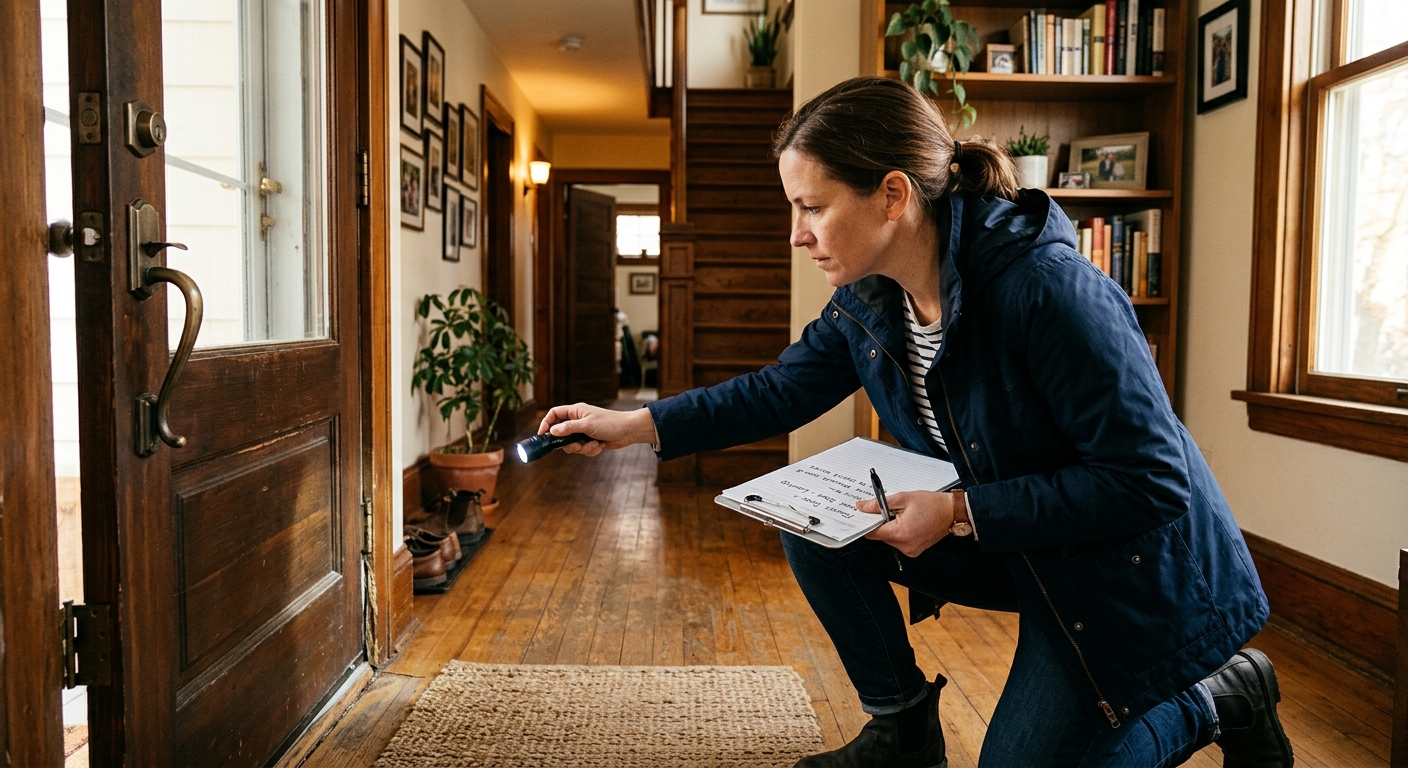
- Walk to every exterior door and hold your hand near the bottom and sides. Any noticeable airflow or temperature difference on a cold or hot day means the weatherstripping is failing and needs replacement.
- Turn off all lights and stand in your attic or basement during daylight hours. Any visible daylight coming through gaps, around pipes, or at the eave line is a direct air leak that needs sealing.
- Locate your water heater and check the thermostat dial. If it is set above 120 degrees Fahrenheit, turn it down. Each 10-degree reduction saves 3 to 5 percent on water heating costs with no equipment purchase.
- Walk through every room and count devices that are plugged in and not actively in use. Identify which ones have a remote control or standby light, as these are constant phantom load sources. Unplug or switch off a power strip for those clusters.
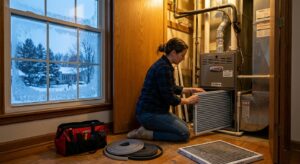
- Check your HVAC air filter by pulling it out and holding it up to a light source. If you cannot see light through it, it is overdue for replacement. A clogged filter reduces system efficiency by 5 to 15 percent.
- On a windy day or while your HVAC runs, walk the entire perimeter of your home holding a lit incense stick or thin tissue near window frames, electrical outlets on exterior walls, baseboards, recessed lights, attic hatches, and plumbing penetrations. Any movement or flickering indicates an air leak. Mark each location with a sticky note or painter’s tape.
- Inspect your attic insulation with a ruler. In most climate zones, you need R-38 to R-60 at the ceiling level, which is roughly 12 to 19 inches of blown fiberglass or cellulose. If you can clearly see the ceiling joists, your insulation is insufficient and heat loss could be 25 percent higher than a properly insulated attic.
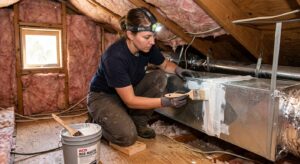
- Examine all accessible ductwork in the attic, basement, or crawlspace. Look for disconnected sections, crushed flex duct, or gaps at fittings. Seal any leaks you find with UL 181-rated foil tape or mastic sealant. Do not use standard grey duct tape, as it fails within a year.
- Test every window by locking it and pressing a piece of paper against the frame while slowly pulling. If the paper slides out without resistance, the seal is broken. Note which windows fail and plan for rope caulk (removable) or replacement weatherstripping.
- Audit your lighting by counting every incandescent or halogen bulb still in use. Replace them with LED equivalents. A 60-watt incandescent replaced by a 9-watt LED saves about $7 per bulb per year, and most homes have 20 to 40 bulbs that qualify.
- Create a one-page priority list ranking your findings by estimated annual savings and implementation cost. Calculate the simple payback for each item (cost divided by annual savings) and start with anything under a 2-year payback. This becomes your action plan for day two.
- Contact your utility company first and ask specifically about free or reduced-cost energy audit programs. Roughly 40 percent of U.S. utilities offer these programs, and a subsidized audit can cost as little as $0 to $100.
- A certified energy auditor will perform a blower door test, which depressurizes your home to precisely measure total air leakage in CFM50 (cubic feet per minute at 50 pascals). This gives you a real number to compare against building code standards for your climate zone.
- The auditor will use an infrared thermal camera to scan walls, ceilings, and floors for hidden insulation gaps, moisture intrusion, and thermal bridges that are impossible to detect visually. Request a copy of all thermal images for your records.
- Duct blaster testing will measure exactly how much conditioned air your duct system is leaking, expressed as a percentage of system airflow. A leakage rate above 10 percent is considered high and warrants sealing or duct replacement.
- Review the written report carefully and ask the auditor to rank findings by return on investment. Use this report to apply for utility rebates, energy efficiency tax credits (check the current federal 25C credit for eligible improvements), and contractor bids.
Why It Works: The Benefits
Homeowners who act on DIY audit findings typically save $300 to $600 per year. Those who also address duct leakage or upgrade insulation can reach $800 or more in combined savings.
Simple fixes like weatherstripping and caulking cost $20 to $50 and pay back within weeks. Even mid-range investments like a smart thermostat ($100 to $150) typically pay back in 6 to 12 months.
Sealing air leaks and improving insulation reduces cold drafts in winter and hot spots in summer. Homes with proper air sealing maintain more even temperatures from room to room.
Uncontrolled air infiltration pulls in outdoor pollutants, humidity, pollen, and sometimes radon. Sealing the building envelope gives you more control over what air enters and how it is filtered.
Energy-efficient homes sell for 2.7 to 9 percent more than comparable inefficient homes, according to studies by the Lawrence Berkeley National Laboratory. An audit creates documentation of improvements that appeals to buyers.
💰 Savings Impact by Action
Sealing cracks, gaps, and penetrations throughout the building envelope reduces conditioned air loss by up to 20 percent of heating and cooling costs.
Sealing leaky ducts in unconditioned spaces can recover 20 to 30 percent of HVAC-delivered energy that was previously lost before reaching living areas.
Setting back temperature 7 to 10 degrees for 8 hours daily reduces annual heating and cooling costs by approximately 10 percent.
Replacing incandescent bulbs with LEDs reduces lighting energy consumption by up to 75 percent per bulb with no reduction in light output.
Eliminating standby power from unused electronics can reduce total household electricity consumption by 5 to 10 percent with no upfront equipment cost.
🏠 Key Concepts Explained
The Science Behind It
Heat moves in three ways: conduction through solid materials, convection through air movement, and radiation through electromagnetic waves. A home energy audit is essentially a search for all the places where these three transfer mechanisms are working against you. Insulation primarily fights conduction, air sealing stops convective losses through bulk air movement, and radiant barriers in attics address the third pathway in hot climates. Most homes have weak spots in all three areas, which is why a systematic audit consistently reveals more opportunity than homeowners expect.
The stack effect is particularly important to understand. Because warm air is less dense than cold air, it rises continuously inside your home during winter and escapes through any opening at the top of the house, including attic hatches, recessed light fixtures, and top-floor electrical boxes. This creates a slight negative pressure at lower levels that pulls cold outdoor air in through foundation cracks, rim joists, and basement windows. Sealing the top and bottom of the thermal envelope simultaneously is far more effective than addressing only one end, because you break the pressure-driven loop driving the air exchange.
Phantom electrical loads operate on a simpler principle: anything with a transformer, a clock, a remote sensor, or a capacitor draws current continuously to stay ready for use. This is sometimes called vampire power. The DOE estimates that standby power accounts for 5 to 10 percent of residential electricity consumption nationwide. Plug-in energy monitors can measure the exact wattage of any device in standby mode, letting you calculate the annual cost with a simple formula: watts divided by 1,000, multiplied by 8,760 hours per year, multiplied by your electricity rate in dollars per kWh.
Frequently Asked Questions
▼ I did the audit but my bills are still high. What am I missing?
If you have addressed air sealing, lighting, and thermostat settings but bills remain high, the most likely culprits are duct leakage, an aging HVAC system operating well below rated efficiency, or a failing refrigerator or water heater. Rent or borrow a plug-in energy monitor to test major appliances individually. An HVAC system more than 15 years old that needs frequent repairs is often costing more to run than a replacement would cost to finance.
▼ Can renters do a meaningful energy audit without landlord permission?
Yes. Renters can address phantom loads, replace bulbs with LEDs (keep the originals to swap back), add removable rope caulk to drafty windows, use draft stoppers at door bottoms, and adjust water heater temperature if the unit is accessible. These steps alone can save $150 to $300 per year. For bigger fixes like insulation or weatherstripping, present your audit findings to your landlord with a simple payback calculation. Many landlords will approve low-cost improvements when framed as protecting their property.
▼ How long before I actually see savings on my utility bill?
Quick fixes like thermostat adjustments, unplugging phantom loads, and replacing filters show up on your very next monthly bill. Air sealing and weatherstripping improvements are most noticeable during the first full heating or cooling season after the work. Compare the same calendar month year over year rather than month to month, since weather variation can mask savings in short-term comparisons.
▼ My home was built in the 1960s. Is a DIY audit still worth it?
Older homes almost always have more to gain from an audit than newer construction because they were built before modern energy codes existed. Expect to find minimal or deteriorated weatherstripping, uninsulated rim joists, and attic insulation well below current recommendations. The savings potential is higher, but so is the likelihood of finding issues like knob-and-tube wiring or vermiculite insulation that require professional evaluation before any insulation work. Proceed with the audit, but be prepared to call in experts for older systems.
▼ What is the single highest-impact fix most homeowners overlook?
Duct sealing. Most homeowners focus on windows and doors, but the DOE estimates that leaky ducts waste more energy annually than all the window and door air leaks in a typical home combined. If your ducts run through an unconditioned attic or crawlspace, even a 15 percent duct leakage rate can add $200 to $400 per year to your HVAC costs. Inspect visible duct connections and seal gaps with mastic or foil tape as a first step.
Quick Tips
- Photograph every leak location you find during the audit so you have a visual record and can track what has been fixed.
- Check the insulation level around your attic hatch specifically. This small, flat surface is often completely uninsulated and acts like a hole in your thermal envelope.
- Seal rim joists in the basement or crawlspace with rigid foam cut to fit plus spray foam around the edges. This single step can reduce heating bills by 5 to 10 percent in cold climates.
- Use rope caulk on windows in rental units or for temporary sealing. It peels off cleanly in spring without damaging paint or frames.
Variations for Your Situation
- Apartment or Rental: Focus on the four areas you can control without permission: phantom loads (unplug or use smart power strips to save up to $150 per year), LED bulb replacements, rope caulk on drafty windows, and door draft stoppers. Ask your building manager for utility data on the whole building to understand if HVAC inefficiency is a shared problem worth raising formally.
- Tight Budget (under $50): Start with zero-cost actions first. Adjust your water heater to 120 degrees, reprogram your thermostat for setbacks, and unplug standby devices. Spend your $50 on a roll of foam weatherstripping ($8), a tube of caulk and gun ($15), LED bulbs for your five most-used fixtures ($20), and a new air filter ($7). These targeted purchases can save $200 to $350 annually for a total outlay under $50.
- Older Home (pre-1980): Prioritize air sealing before adding insulation, because older homes often have significant moisture management issues that insulation can trap and worsen. Begin with rim joists, attic bypasses around plumbing chases, and top-plates of interior walls that open into the attic. Have any gas appliances tested for backdrafting before tightening the envelope. Consider a professional blower door test as your baseline since older homes often have 3 to 5 times the air leakage of a code-built new home, meaning the savings potential from sealing alone can exceed $500 per year.