You punch in two minutes to reheat last night’s leftovers, and within seconds the kitchen goes dark. Your microwave has tripped the breaker again. It’s annoying, it feels alarming, and if you’re like most homeowners, you’re not sure whether to call an electrician, buy a new appliance, or just keep flipping that breaker and hoping for the best.
The good news is that a microwave tripping a breaker usually comes down to one of three scenarios: the microwave is sharing a circuit with too many other appliances, the breaker itself is worn out and tripping too easily, or the microwave’s internal components are drawing more current than they should. Each of these has a clear diagnostic path and a straightforward fix, and most homeowners can resolve the issue without spending a dime on a service call.
In this post, we’ll cover how to safely diagnose the root cause, walk you through two levels of fix, and explain when the problem is actually a sign of something more serious that warrants a licensed electrician. Knowing the difference could save you the cost of an unnecessary appliance replacement or, more importantly, prevent an electrical fire.
What You’ll Need
Click on an item below to shop for the recommended items for this recipe on Amazon.
As an Amazon Associate, we earn from qualifying purchases.
How to Do It
- Reset the breaker fully by pushing it firmly to OFF before flipping it back to ON. A half-tripped breaker sitting in the middle position will not power the circuit until it is fully cycled.
- Unplug every other appliance on the same circuit before running the microwave. In most kitchens, one or two counter outlets share a circuit. Identify which outlets share the tripped breaker by checking which outlets lost power when it tripped.
- Run the microwave alone at full power for 2 minutes. If it runs without tripping, the circuit is overloaded, not the microwave. Your fix is to never run the microwave simultaneously with the toaster, coffee maker, or air fryer on the same circuit.
- If it trips immediately even when running alone, reduce microwave power to 50% and try again. A trip at reduced power points toward an internal appliance fault rather than a circuit overload problem.
- Smell the microwave outlet and the panel after a trip. A burning smell, visible scorching, or a breaker that is warm to the touch signals a wiring problem that requires a licensed electrician before the appliance is used again.
- Purchase a replacement breaker that matches your panel brand and amperage rating exactly. Bring the old breaker to the hardware store or note your panel brand (Square D, Leviton, Eaton, Siemens, etc.) before buying. A standard 20-amp single-pole breaker costs $8 to $20.
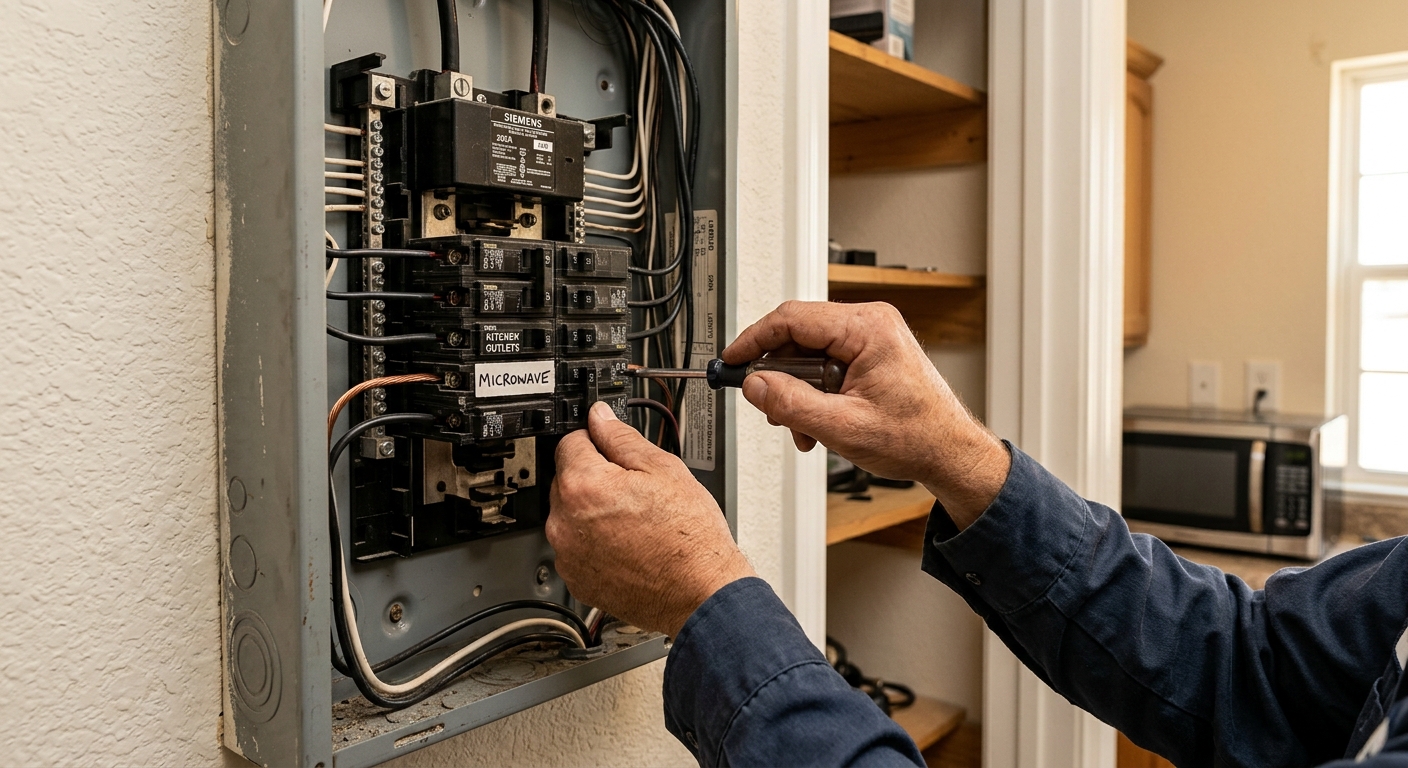
- Turn off the main breaker to the panel to cut power to all branch circuits before opening the panel cover. Use a non-contact voltage tester to confirm the circuit wires are de-energized before touching them.
- Remove the panel cover carefully and locate the tripping breaker. Check for any visible signs of heat damage, melted plastic, or discoloration on the breaker or the surrounding bus bar.
- Pull the old breaker off the bus bar by rocking it outward firmly, then unscrew the circuit wire from its terminal. Connect the same wire to the new breaker’s terminal, torquing to the spec printed on the breaker (typically 20 in-lbs), then snap the new breaker onto the bus bar.
- Replace the panel cover, restore the main breaker, and flip the new breaker to ON. Run the microwave alone at full power for 2 minutes to confirm the fix held.
- If the new breaker also trips immediately with no other load on the circuit, the problem is confirmed to be the microwave or the wiring to that outlet, not the breaker. At this point, test the microwave on a completely different circuit or have an appliance technician inspect the magnetron and door interlock switches.
- Contact a licensed electrician and request a dedicated 20-amp circuit run from the panel to the microwave’s outlet location. Describe the tripping issue and the microwave’s wattage (found on the label inside the door) so they can size the wire correctly.
- Confirm the electrician will pull a permit if required by your municipality. Permitted electrical work is inspected, which protects you during a home sale and ensures insurance coverage.
- Once installed, plug only the microwave into the new dedicated outlet. Even on its own 20-amp circuit, avoid daisy-chaining a power strip or extension cord to the outlet.
- Test the new circuit by running the microwave at full power for several cycles on the same day. Confirm the breaker remains stable and there is no warmth at the outlet or plug.
Why It Works: The Benefits
In the majority of cases, the microwave itself is not defective. Diagnosing the real cause before buying a replacement saves homeowners $150 to $400 on a new unit that would likely trip the same breaker on the same circuit.
A repeatedly reset breaker that is actually protecting against a wiring fault or failing appliance is a genuine fire hazard. Identifying and correcting the root cause eliminates that ongoing risk rather than just masking it.
Tripping a circuit often knocks out multiple outlets and potentially the refrigerator if they share a circuit, not just the microwave. A proper fix restores stable power to the entire kitchen.
Overloaded circuit and fatigued breaker problems are the two most common causes and both are within reach of a careful DIYer. Handling these yourself eliminates the typical $150 to $300 diagnostic and repair fee for straightforward electrical work.
💰 Savings Impact by Action
Correctly diagnosing an overloaded circuit rather than replacing a functioning microwave saves the full $150 to $400 replacement cost.
Replacing a fatigued breaker yourself at $10 to $20 avoids an electrician diagnostic call that typically runs $150 to $300.
A dedicated 20-amp circuit at $200 to $500 eliminates recurring service calls and appliance damage risk, paying back within 1 to 2 electrician visits avoided.
Identifying a true internal appliance fault before it causes an electrical fire prevents losses that average $20,000 to $50,000 in home damage per kitchen fire incident.
🏠 Key Concepts Explained
The Science Behind It
Circuit breakers operate on a simple but critical principle: they are designed to protect the wiring in your walls, not your appliances. The wire gauge running to a standard 15-amp circuit is typically 14 AWG copper, which can safely carry 15 amps continuously without overheating. A 20-amp circuit uses 12 AWG wire, which handles 20 amps safely. When current exceeds those ratings, resistance in the wire generates heat proportional to the square of the current (P = I²R). Sustained overheating can melt wire insulation and ignite framing inside your walls. The breaker trips before that point is reached, which is exactly what it is supposed to do.
Microwaves are among the highest-draw appliances in a typical home. A 1,000-watt microwave at 120 volts draws approximately 8.3 amps at steady state (P = V x I, so I = P / V). But a 1,200-watt model draws 10 amps, and a 1,500-watt unit draws 12.5 amps continuously, leaving almost no margin on a shared 15-amp circuit. The magnetron’s inrush current at startup adds a brief spike on top of that steady-state draw. When a toaster running 1,200 watts is on the same circuit simultaneously, the combined draw of 22 to 25 amps far exceeds a 20-amp breaker’s rating, and the breaker trips within seconds as its internal bimetal strip heats and bends to open the contact.
Breaker fatigue is a real and underappreciated phenomenon. Every time a breaker trips and is reset, the internal mechanism experiences mechanical stress. After 30 to 50 trips over its lifetime, the calibration of the bimetal strip can shift enough that the breaker begins opening at 85 to 90% of its rated current instead of 100%. This is why a 15-year-old breaker on a circuit that has never been a problem can suddenly start tripping under the same loads it handled for years. Replacing the breaker restores the correct trip threshold and costs under $20 at any hardware store.
Frequently Asked Questions
▼ Why does my microwave trip the breaker every single time, even when nothing else is on?
When a microwave trips the breaker immediately and consistently with no other load present, the most likely cause is an internal fault in the appliance itself, most commonly a failed door interlock switch, a shorted magnetron, or a failed capacitor. Try plugging the microwave into a completely different circuit in your home. If it trips that breaker too, the problem is definitively the appliance. At that point, weigh the cost of an appliance repair (typically $100 to $200) against the cost of replacement.
▼ Can I just replace my 15-amp breaker with a 20-amp breaker to get more headroom?
No, and this is a dangerous shortcut. The breaker must match the wire gauge it protects. A 15-amp circuit uses 14 AWG wire, which is only rated to carry 15 amps safely. Installing a 20-amp breaker on 14 AWG wire means the breaker will no longer trip before the wire overheats, which creates a fire hazard inside your walls. If you need a 20-amp circuit, a licensed electrician needs to run new 12 AWG wire along with the new breaker.
▼ My breaker trips only when the microwave runs for more than 30 seconds. What does that mean?
A delay before tripping, rather than an immediate trip, points strongly to thermal overload rather than a hard short. This is the classic signature of a circuit that is slightly overloaded or a breaker that is aging and losing calibration. Start by verifying nothing else is on the circuit while the microwave runs. If the problem persists with the microwave isolated, replacing the breaker is the next logical step before assuming the microwave is at fault.
▼ My microwave is built into the wall above the range. Is it safe to keep resetting the breaker?
Over-the-range microwaves are required by most electrical codes to be on a dedicated 20-amp circuit, and if yours is not, resetting the breaker repeatedly is masking an underlying code deficiency. More importantly, these units are harder to access quickly if an overheating event occurs inside the wall. If your over-the-range microwave is on a shared circuit, get a dedicated circuit installed before continuing to use the appliance regularly.
▼ How do I know if my wiring is the problem rather than the breaker or the microwave?
Wiring problems typically show up as a warm outlet plate, a discolored or charred outlet face, a burning smell near the outlet (not the appliance), or flickering lights on the same circuit when the microwave starts. Any of these symptoms mean the outlet and its wiring need inspection by a licensed electrician before the circuit is used. Do not attempt to diagnose internal wiring issues yourself.
Quick Tips
- Check which outlets share a circuit by tripping the breaker intentionally and noting which outlets lose power. Label the inside of your panel door with this information so every household member knows which appliances cannot run simultaneously.
- If you rent, report repeated breaker trips in writing to your landlord. Persistent tripping is a maintenance issue and in most states the landlord is legally obligated to maintain safe electrical systems.
- Avoid using extension cords with microwaves. Extension cords add resistance to the circuit, increase voltage drop, and can overheat at the connection point. Plug directly into a wall outlet.
- When shopping for a new microwave, check the amperage on the spec sheet, not just the wattage. A 1,100-watt unit can have different inrush characteristics than another 1,100-watt model depending on the inverter technology used.
Variations for Your Situation
- Apartment/Rental: Renters cannot modify circuits or replace breakers, but you can still diagnose the cause. Test the microwave on a different circuit in your apartment using a long-gauge extension cord temporarily (for diagnostic purposes only, not as a permanent setup). If it runs fine on the other circuit, the problem is the kitchen circuit, which is your landlord’s responsibility. Document the issue in writing and request a licensed electrician inspection. In the meantime, run the microwave only when other high-draw appliances on that circuit are off.
- Tight Budget (under $50): Start with the free steps first. Unplug everything sharing the circuit and run the microwave alone. If that stops the tripping, you have solved it at zero cost by simply changing your habits. If the breaker is the culprit, a replacement single-pole breaker costs $8 to $20 at any hardware store and is the only purchase needed. Skip the dedicated circuit installation for now and revisit it if the problem returns after the breaker swap.
- Older Home (pre-1980): Homes built before 1980 often have 15-amp ungrounded circuits in the kitchen and may have aluminum wiring in some cases. Do not assume you can simply swap a breaker or add a higher-amp circuit without an evaluation. Have a licensed electrician assess the kitchen wiring before making any changes. The cost of a wiring inspection ($75 to $150) is well worth it in a home where the electrical system has not been updated, as the fix may need to be more comprehensive than a single breaker replacement.